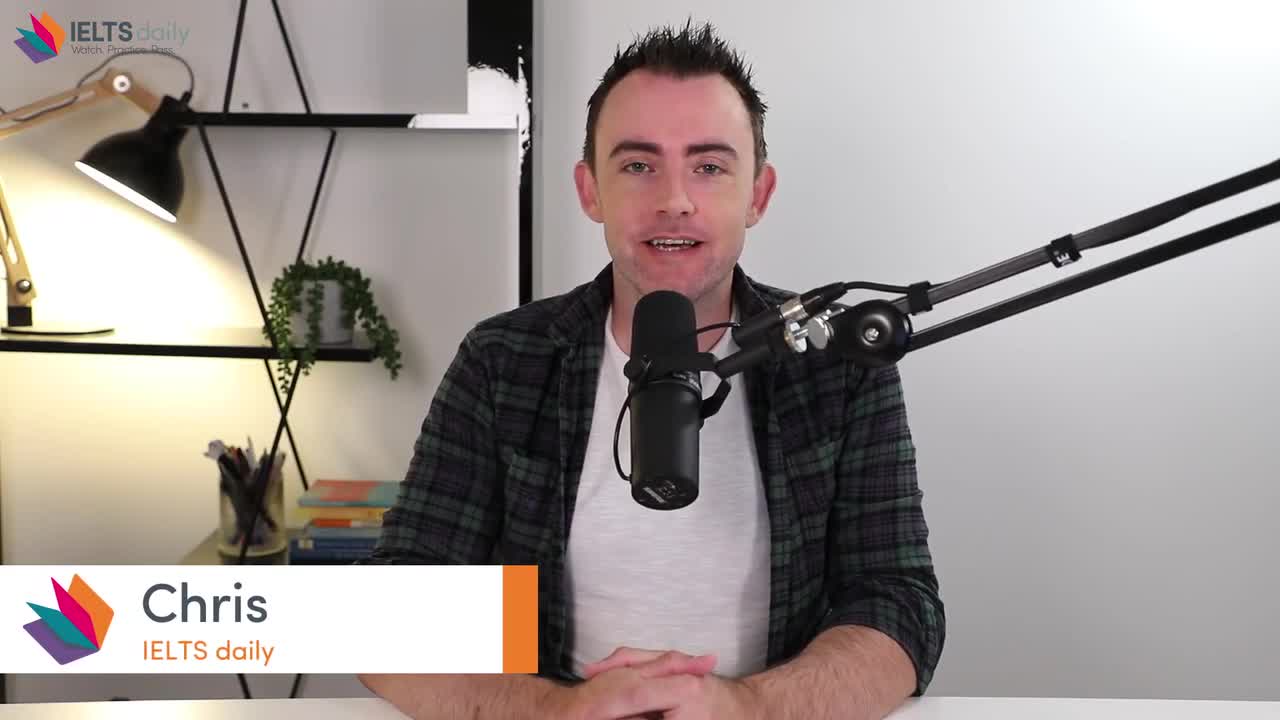
do you find that sitting the IELTS test is a really nerve-wracking and sometimes stressful experience well I know that many people feel the same and we've got another mock exam speaking practice video today and in today's session we've got Stephen who is from Australia our examiner is Maddy and in this video you're probably going to see what it's what it's like to be a little bit nervous in the test Stephen has never taken the test before and doesn't know much about the test, but sitting in front of a camera and having an examiner ask you these questions can be very confronting and you can be nervous as a result.
So are you ready to watch?
I know I'm ready.
Let's go.
Okay, as usual, at the end of this video, you have the opportunity to watch the whole video without my feedback.
So if you're interested in just watching the video first with no feedback, feel free to go to the second part of this video where you can do that.
I'm ready to start watching, so let's click play.
Hello and welcome to this practice exam conducted by IELTS Daily.
My name is Maddie and I am your practice IELTS speaking examiner.
The questions in these tests are designed to simulate the IELTS speaking test.
Let's start.
What's your first name, please?
My first name is Steven.
Thank you, Steven.
And now at the beginning of the IELTS test, you will need to provide some identification.
This is usually a passport, but as this is a practice test, there is no need for that today.
Are you ready to begin?
Sure, I'm ready to begin.
Great.
Let's talk about you.
Do you work or study?
I do work and study.
I study a Bachelor of Commerce at university, majoring in economics and management.
I really enjoy what I study.
I enjoy the quantitative side of economics and the qualitative side of management.
I also do work outside of university life as well.
I work at a high school as an academic advisor, where I provide academic support for students in their final years of high school.
Wow.
Alright, well, the examiner asked a really short question, which was, do you work or study?
And the first thing that you noticed is that Stephen gave this really long answer, probably more than he needs to.
This type of question maybe needs a little bit of elaboration, a little bit of an extension, but I don't think that it needs to talk about what you enjoy, because what happens now is the examiner might have those type of questions later, which are maybe questions what do you study or what do you do as a job?
Do you enjoy what you do?
Those type of questions.
I remember when I sat the test, I actually elaborated more than I should have done and I answered some of the questions before the examiner asked them.
And so you notice that the examiner was a little bit off guard because she didn't know which questions to ask next and she had to jump two or three questions.
And the same thing happens here with Stephen.
He probably expanded a little bit too much.
You also notice as well that maybe because he's in front of the camera, it's a little bit more difficult for him to speak.
You notice he has this kind of, in English we say, a frog in your throat.
Some words are a little bit difficult to come out.
Good start though.
I think he's given some really good answers.
Well done to Stephen.
And you'll notice that he's a native speaker.
And if you're watching this for the first time, go and watch our Rommie video.
Rommie is also an Australian and I explain why Australians or British or Americans, why they sometimes need to take this test.
Well, you've told me what you study.
Do you enjoy studying this?
I really do enjoy study.
It is quite challenging the course.
Since economics is so broad, it is quite challenging to grasp the concepts.
But once I do, I really find it very rewarding and very fulfilling.
Great.
So you'll notice that Maddy did have to repeat this question, which was do you enjoy what you're studying?
And Stephen had already answered that.
A couple of points here.
You'll notice that he does look a little bit nervous, which is normal.
On the test day, you guys are going to be nervous.
So this is kind of a real life situation.
Stephen may have a very minor speech impediment in his everyday life.
And that might affect many people who watch this video.
And lots of you might ask the question, what happens if I have a minor speech impediment?
The examiner will overlook that.
They will probably notice that you have it.
So it's not anything to worry about, nothing that you should be stressing about beforehand.
He did make a very, very minor pronunciation slip here.
He said, two graps.
OK, rather than to grasp, he got the P and the S the wrong way around.
And, believe it or not, this is really common for native speakers to make these tiny slips in their speaking.
I understood what he wanted to say.
The examiner would probably overlook it.
But if he made any more of those mistakes they probably wouldn't be so lenient and they might mark him down a little bit.
Again nerves.
It's a little bit of a struggle to get things out at times, but so far so good.
Really well supported and extended answers.
And what do you want to do in the future?
In the future, I want to become a Thai school teacher.
I want to use the knowledge that I gained from my undergraduate degree to someday pursue a Masters of Teaching degree where I can use that knowledge to support young people and give them the chance to fulfil their potential in finding their careers.
This section is an example that highlights great flexibility with pronunciation features.
Remember that in the test it's not an academic test, so you are allowed to make these contractions of words.
And you might have noticed at the beginning, he said, I want to.
And he pronounced I want to.
And then he moved on and said I wanna.
And he's showing that he has flexibility in using those different forms of pronunciation there.
It's a really nice feature.
And then he used language such as to fulfill one's potential.
I think he said to fulfill their potential.
And that's an example of collocation. words or phrases which naturally fit together.
I really like that.
So to fulfill one's potential.
I'd like to move on to the topic of plans.
Do you like to plan things?
I do like to plan things out.
So I'm just going to jump in here.
This is a perfect example of what nerves do to people.
When you're sitting in front of the examiner, you're going to be very nervous.
And the examiner sees this every single day.
So try not to be nervous if you can.
But if you notice here, Stephen actually begins laughing, which is quite a common result of nerves.
It's what the body does to us.
It's very strange thing, our body.
It makes us do things that we weren't expecting.
And because Stephen's really nervous here and he doesn't know what to say, he just begins laughing in the hope that maybe it will break the barrier between him and the examiner and so that that that might happen to you in the test.
Just don't panic, keep going, and if you need to move on to the next question, that's okay.
I'd say I do like to plan things out.
I say that I am less of a spontaneous person and more of an organised person.
I like keeping things very organised.
I like to have my own planner and a calendar on my phone to assign times for study times, to meet up with people, and meetings and other events outside of work and uni.
Okay, I like this phrase, I'm less of a and more of a. It's a good phrase that you could use there.
So I'm less of a planner and more of a spontaneous person.
I'm less of a chef in the kitchen and more of a guest at dinner parties.
So i'm less of a and more of a.
It shows contrast.
It's a really good feature there of lexical resource.
I like that.
He has really wide range of grammatical structures and complexity, so i'm really happy in all of those sections.
The area that he probably will need to work on just a little bit is his fluency and coherence.
He's starting to struggle to get some ideas out.
And some, some of his answers are verging on a bit repetitive.
And you'll see a little bit later that some of his answers become a little bit repetitive.
And do you like surprises?
Sometimes i do, i really sometimes um, it depends on what kind of surprises it's.
If it's uh, like a surprise test, i wouldn't.
I would feel a little.
It'll be a little bit less pleasant for me, but i do enjoy.
Like a surprise birthday party or a surprise gift or a surprise um outing, though the fun.
I like surprise, surprise surprises that have a joyful connotation to it and less of a negative connotation.
OK, as expected, Stephen is struggling a little bit with paraphrasing and changing his vocabulary.
We heard a lot of repetition of the word surprise or surprises.
And what the examiner is probably listening for is something where you can vary the language in some way rather than just repeating the same thing.
Surprises, surprises, surprises.
What we want to do is show that you have a wider range of vocabulary.
So you could say something like, well, I don't mind surprises.
I suppose it depends on the situation.
I like to plan some things.
But if my friend threw me an impromptu party, impromptu means surprise or not planned.
So you'll see the word on the screen there impromptu.
You could also use kind of an idiomatic expression such as out of the blue.
So if my friend turned up out of the blue, i would really like that.
So out of the blue means unexpectedly or as a surprise.
So there are different ways you could use language to show up, to paraphrase, and i think stephen is just lacking that here and even though he's got a good range of vocabulary and really easy to understand.
There's a couple of points that I think that if he were to sit the test again in the future, he may just want to consider using a little bit more variety in his language.
And has anyone ever surprised you with something?
No, they haven't, because they know how much I dislike surprises, especially gifts.
But I have been to a few surprise birthday parties and contributed to a few surprise gifts for people and it's surprising that I don't like surprises myself but I like giving other people surprises.
Ah Stephen, I'm so disappointed because you are going to use some really great language here to mean to contribute.
So he talked about going to a birthday party or a surprise birthday party where people contributed.
And if you listen back, if you go back and play again, you'll notice that he said and I know what he was going to say he was actually going to say we chipped in and everybody in the party chipped in to contribute to or to to buy a present for the birthday person.
And this idea of the word a phrasal verb to chip in means to put some money all together and everybody collectively buys the present.
So recently I chipped in for my friend's birthday and This chip in language is great because it's a phrasal verb.
It's idiomatic.
It's less common.
And he just went down with.
He went with the standard word, which was to contribute or to put some money in to buy a friend a gift.
So I'm just a bit disappointed that he didn't use the word chip in, because I think that would have been a great learning tool for you.
Now, let's talk about the topic of cycling.
Do you own a bicycle?
I do not own a bicycle, but I do enjoy the leisure of cycling.
I did own a bike when I was quite young.
I rode it in my early childhood days, but I don't cycle anymore.
Do you think you will have a bicycle in the future?
I do hope I will have a bicycle in the future.
Given the topic of climate change, I want to make sure that I contribute more to reducing CO2 emissions and hopefully, choosing a more eco-friendly mode of transport.
And not only is it more eco-friendly, it's also great for exercise and physical activity.
I don't know about you, but I feel like a couple of these answers feel a little bit rehearsed and like he's practiced them a lot.
And I can assure you, I promise you, that Stephen had no idea of the questions before coming to this test.
The examiner asked a question, do you think you will own a bicycle in the future?
And his answers were almost kind of parroting the examiner.
Yes, I do think I will own a bicycle in the future.
I would say maybe if you can paraphrase your answers just a little bit more.
He gave great reasons and explained his answers perfectly.
But I just felt that the answers felt a little bit rehearsed.
That was my only piece of feedback there.
And he also looked a little bit nervous still.
And this frog in his throat again was appearing, but otherwise doing really well.
And did you learn to ride a bicycle when you were a child?
I did learn to ride a bicycle when I was a child.
Obviously, I started out with the training wheels because it was quite hard to balance.
But as time went on, I got used to it, learned to balance myself on the bicycle.
And now it's just part of muscle memory.
Couple of great features of language here.
He used collocations such as training wheels.
Training wheels are the wheels that you have, as a child, on the sides of your bike that prevent you from falling over.
And he used the word muscle memory.
So training wheels and muscle memory are great examples of collocation.
Remember these words, which are less common, but when you fit them together, they make the speech much richer.
Rather than just giving simple language the whole time, you do need to include some of these idiomatic phrases expressions, compound nouns, all those things that are less common in language.
In the next part of the test, I'm going to give you a topic and I'd like you to speak for one to two minutes.
You'll have one minute to think about what you want to say and I will give you a pen and some paper to make some notes.
Yep.
Is that clear?
Yep, very clear.
Here is your paper and here is your pen.
You have one minute to prepare.
Thank you.
Now I'd like you to talk about a person who enjoys spending time outside.
Remember, you have one to two minutes for this, so don't worry if I stop you.
I'll tell you when the time is up.
Can you start speaking now, please?
Yep.
So a person I'd say that likes to enjoy spending their time outside is my best friend.
I met my best friend from high school.
I've known them since grade seven, so about 13, 14 years old, and they're a very outgoing person.
Some of the activities they like to do include exercising outside, going out for shopping, eating out and also, especially during the times of the pandemic, they like to go on a lot of picnics.
And of course, I like to spend time with them as well. when going out so i think i think the reason why they really enjoy spending their times outside is because sometimes staying at home can be quite suffocating and it's great to go outside enjoy the sunshine for a little bit and you know take in a bit of taking a bit of the nature especially during picnics they also when it comes to shopping going out and eating out they really enjoy um the experience of trying something new, trying all sorts of cuisines because sometimes it can be quite limited when they just stay indoors most of the time.
Notice here that Stephen's only been speaking for about one minute and 15.
It's very common for the examiner to encourage you to speak a little bit more.
That's not because they want to be mean to you, but they want to help you.
And to do that, they just want you to speak more so they can grade more of your language.
So it's not a negative thing if the examiner is asking you to speak more.
They are just trying to get as much language from you as possible.
In addition to that, they really they want to make sure that they live a fulfilling life when spending their times out outdoors.
Because We have Again.
Stephen has never taken this test before.
This is a real struggle for many people, even native speakers.
Speaking for two minutes without stopping and having enough things to say, without repeating yourself or extending your answers.
Enough is really, really hard.
And so this is the point at which Stephen is kind of giving up and he recognises that he can't do any more.
This may affect his fluency and coherence mark a little bit, because he's not really extending his answers as much as he could be doing.
So this may come back to haunt him.
Thank you.
I want to stay on the topic of outdoor activities.
And why do you think some people do not enjoy doing outdoor activities?
That's an interesting question.
I like to think that people like to think that extroverts enjoy outdoor activities more than introverts, but it can go both ways.
As an introvert myself, I do enjoy outdoor activities in moderation, like things such as exercising, going out for picnics the sort of activities I genuinely love, I genuinely enjoy doing.
And I'd say that why certain people don't enjoy outdoor activities may be because it takes up a lot of energy for them.
It takes up a lot more effort for them to perhaps step outside the house, step outside their room, to you know, get themselves out there.
Perhaps it could perhaps be a case of a bit of social anxiety.
They might be a bit afraid of seeing a lot of people being in crowds, but even that it doesn't have to be.
But being outdoors doesn't have to be limited to just being in crowds.
It could just be.
It could just be being alone outdoors in a national park or in a park, et cetera, et cetera.
Yeah.
One thing that I would say here is that if you're going to be speaking for this length of time and Stephen's answer was quite long here I do think that in the IELTS test in part three, it's very likely that the examiner will come at you with an interjection or a question or a follow up.
It probably wouldn't be that you were allowed to have that much time or opportunity to expand your answers.
Stephen starts out off topic, actually.
It's a really interesting point.
Why do some people enjoy being outdoors and why do some people not?
And Stephen went down the route of, well, what's the difference between introverts and extroverts?
Well, that wasn't really what the question was about.
However, he does come back onto the topic a little bit later, which is great.
And it's not a problem if you want to go off topic.
It's not something that you should worry too much about.
Try to answer the question though, where possible, because that will affect the coherence mark that you get in your fluency and coherence.
And how does the weather affect outdoor activities?
I'd say the weather greatly affects the way we look at outdoor activities.
For example, on a very sunny day like this, people tend to feel more motivated to step outdoors, since the weather is a lot nicer, the breeze feels nice, and I'd say the other way around rainy, cloudy weather people might not feel as motivated to step outside since the weather is quite gloomy, since they don't feel there isn't much of a positive connotation that's associated with cloudy or rainy weather when doing outdoor activities.
Again, I would expect that the examiner might jump in there and ask a question related to that topic.
It's quite a long section there of Stephen speaking.
He did well.
He again went a little bit off topic, but he did answer the question.
So far, so good.
And why do some people enjoy spending time in the sun and others do not?
I'd say people enjoy spending their time in the sun because, of course, sun exposure is great vitamin D.
But at the same time, I also think there's a bit of a cultural difference between spending time in the sun versus not spending time in the sun.
Some cultures think, some cultures think that it's okay to spend time in the sun, while in other cultures it's spending time in the sun means you're a means, means your skin's gonna get worse, and so forth.
So I think there's a different.
That explains a bit of a difference why some people enjoy spending the time in the sun while others don't, especially in a cultural context.
Great.
I think Stephen's area to improve is maybe just slow down a little bit.
One of the things in the test is that you get your fluency and coherence mark, which asks you to be fluent, but it feels like Stephen's panicking just a little bit and that affects his overall comprehension and ability to fully answer the question in a really rounded way.
Great.
Well, thank you.
That is the end of the practice IELTS speaking test.
Yep, thank you.
Thank you.
So what score, that's the end of the test today, what score would I give Stephen?
Well, I think he did a really great job.
I'm worried though that he wouldn't necessarily get the full band 9 marks.
Just because he's a native speaker doesn't mean that he's guaranteed to get the full band 9.
I think if I were to award him a score here.
Fluency and Coherence section, which you'll see on the screen there, it actually says that for a band 8 speaks fluently, with only occasional repetition or self-correction.
Hesitation is usually content related and only rarely to search for language develops topics coherently and appropriately.
I worry that the first part, which is speaks fluently, with only occasional repetition.
He did repeat some words and phrases throughout and some ideas that he had were just a little bit repetitive.
So I think he would maybe score a band eight here.
Whereas on the other sections, lexical resource would be the next one, would be, I think there's a nine here.
I don't think that he made any mistakes.
He had a wide range of different structures, sorry, in different words.
He had collocations, he had idiomatic expressions.
So I think he deserves about nine here.
For his grammatical range and accuracy.
There were just a couple of very minor slips with grammar, think that he had a really good range of different complex structures and so no major problems there and he probably deserves a band nine for pronunciation.
This one most of the time Stephen was really clear and I understood everything he wanted to say.
But there was a couple of moments when he said something like etc, etc and it wasn't that clearly enunciated and i had to struggle and strain a little bit.
But i'm going to give him the benefit of the doubt and award him i'm going to order him a nine here, so he would score eight nine nine nine, which surprisingly is not a band nine.
When we calculate the individual scores for writing and speaking, If you score 8999, it would actually be a band 85.
The 8.75 is rounded down, which is an interesting one.
And lots of people say, why is 8999 not equivalent to 9?
Unfortunately, that's what happens in the components.
When you look at the overall score, it's actually rounded up.
So in the speaking and writing individual components, it's rounded down.
And in the overall component score when you have speaking writing reading listening, all of those together would give you maybe 85 and that would be rounded up to 9.
Don't forget, you can use in the descriptions below the links to the chapters of this video and you can jump forward and back.
But for now, I'm Chris from IELTS Daily.
Thank you for joining.
If you learned something and if you like this video, don't forget to give it a like.
Take care.
And we have lots more of these videos coming up.
Make sure you leave something in the comments below.
Share your ideas.
If you've got the test very soon, we wish you the very best of luck.
Thanks for joining us.
See you soon.
Hello and welcome to this practice exam conducted by IELTS Daily.
My name is Maddie and I am your practice IELTS speaking examiner.
The questions in these tests are designed to simulate the IELTS speaking test.
Let's start.
What's your first name, please?
My first name is Steven.
Thank you, Steven.
And now at the beginning of the IELTS test, you will need to provide some identification.
This is usually a passport.
But as this is a practice test, there is no need for that today.
Are you ready to begin?
Sure, I'm ready to begin.
Great.
Let's talk about you.
Do you work or study?
I do work and study.
I study a Bachelor of Commerce at university, majoring in economics and management.
I really enjoy what I study.
I enjoy the quantitative side of economics and the qualitative side of management.
I also do work outside of university life as well.
I work at a high school as an academic advisor, where I provide academic support for students in their final years of high school.
Wow.
Well, you've told me what you study.
Do you enjoy studying this?
I really do enjoy study.
It is quite challenging the course.
Since economics is so broad, it is quite challenging to grasp the concepts.
But once I do, I really find it very rewarding and very fulfilling.
Great.
And what do you want to do in the future?
In the future, I want to become a Thai school teacher.
I want to use the knowledge that I gained from my undergraduate degree to someday pursue a Masters of Teaching degree where I can use that knowledge to support young people and give them the chance to fulfil their potential in finding their careers.
I'd like to move on to the topic of plans.
Do you like to plan things?
I do like to plan things out.
I'd say I do like to plan things out.
I say that I am less of a spontaneous person and more of an organised person.
I like keeping things very organised.
I like to have my own planner and a calendar on my phone to assign assigned times for study times, to meet up with people and meetings and other events outside of work and uni.
And do you like surprises?
Sometimes i do, i really sometimes um, it depends on what kind of surprises it's.
If it's uh, like a surprise test, i wouldn't.
I would feel a little.
It'll be a little bit less pleasant for me, but i do enjoy.
Like a surprise birthday party or a surprise gift or a surprise um outing, though the fun.
I like surprise, surprise surprises that have a joyful connotation to it and less of a negative connotation.
And has anyone ever surprised you with something?
No, they haven't because they know how much I dislike surprises, especially gifts.
But I have been to a few surprise birthday parties and contributed to a few surprise gifts for people.
And it's surprising that I don't like surprises myself, but I like giving other people surprises.
Right.
Now, Let's talk about the topic of cycling.
Do you own a bicycle?
I do not own a bicycle, but I do enjoy the leisure of cycling.
I did own a bike when I was quite young.
I rode it in my early childhood days, but I don't cycle anymore.
Do you think you will have a bicycle in the future?
I do hope I will have a bicycle in the future.
Given the topic of climate change, I want to make sure that I contribute more to reducing CO2 emissions and hopefully, choosing a more eco-friendly mode of transport.
And not only is it more eco-friendly, it's also great for exercise and physical activity.
And did you learn to ride a bicycle when you were a child?
I did learn to ride a bicycle when I was a child.
Obviously, I started out with the training wheels because it was quite hard to balance, but as time went on I got used to it, learned to balance myself on the bicycle and now it's just part of muscle memory.
In the next part of the test, I'm going to give you a topic and I'd like you to speak for one to two minutes.
You'll have one minute to think about what you want to say and I will give you a pen and some paper to make some notes.
Yep.
Is that clear?
Yep, very clear.
Here is your paper and here is your pen.
You have one minute to prepare.
Thank you.
Now I'd like you to talk about a person who enjoys spending time outside.
Remember, you have one to two minutes for this, so don't worry if I stop you.
I'll tell you when the time is up.
Can you start speaking now, please?
Yeah, so a person i'd say that likes to in, that likes to enjoy spending their time outside, is my best friend, my best.
I met my best friend from high school.
I've known them since grade seven, so about 13, 14 years old, and they're a very outgoing person.
Some of the some of the activities they like to do include um exercising outside, going out for shopping, eating out and also, especially during the times of the pandemic, they like to go on a lot of picnics and, of course, I like to spend time with them as well when going out.
So i think i think the reason why they really enjoy spending their times outside is because sometimes staying at home can be quite suffocating and it's great to go outside, enjoy the sunshine for a little bit and, you know, take in a bit of taking a bit of the nature, especially during picnics.
They also, when it comes to shopping, going out and eating out, they really enjoy the experience of trying something new, trying all sorts of cuisines, because sometimes it can be quite limited when they just stay indoors most of the time.
Yeah.
Um, in addition to that, they really they want to make sure that they live a fulfilling life when spending their time outdoors, because we have.
Thank you.
I want to stay on the topic of outdoor activities.
And why do you think some people do not enjoy doing outdoor activities?
That's an interesting question.
I like to think that people like to think that extroverts enjoy outdoor activities more than introverts, but it can go both ways.
As an introvert myself, I do enjoy outdoor activities in moderation, like things such as exercising, going out for picnics the sort of activities I genuinely love, I genuinely enjoy doing.
And I'd say that why certain people don't enjoy outdoor activities?
Maybe because it takes up a lot of energy for them.
It takes up a lot more effort for them to perhaps step outside the house, step outside their room, to you know, get themselves out there.
Perhaps it could perhaps be a case of a bit of social anxiety.
They might be a bit afraid of seeing a lot of people being in crowds, but being outdoors doesn't have to be limited to just being in crowds.
It could just be being alone outdoors in a national park or in a park, et cetera, et cetera.
Yeah.
And how does the weather affect outdoor activities?
I'd say the weather greatly affects the way we look at outdoor activities.
For example, on a very sunny day like this, people tend to feel more motivated to step outdoors, since the weather is a lot nicer, the breeze feels nice, and I'd say the other way around rainy, cloudy weather people might not feel as motivated to step outside, since the weather is quite gloomy, since they don't feel there isn't much of a positive connotation that's associated with cloudy or sunny, or cloudy or rainy weather when doing outdoor activities.
And why do some people enjoy spending time in the sun and others do not?
I'd say people enjoy spending their time in the sun because, of course, sun exposure is great vitamin D.
But at the same time, I also think there's a bit of a cultural difference between spending time in the sun versus not spending time in the sun.
Some cultures think, some cultures think that it's okay to spend time in the sun, while in other cultures it's spending time in the sun means you're a means, means your skin's going to get worse, and so forth.
So I think that explains a bit of a difference, why some people enjoy spending the time in the sun while others don't, especially in a cultural context.
Great.
Well, thank you.
That is the end of the practice IELTS speaking test.
Yeah, thank you.
Thank you.