This is The Indicator from Planet Money.
I'm Waylon Wong.
And I'm Darian Woods.
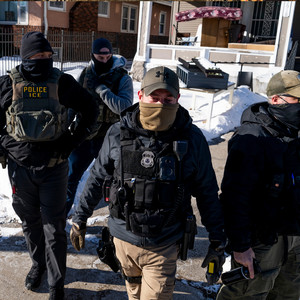
In the last year, the Department of Homeland Security says 12000 new agents and officers have joined US.
Immigration and Customs Enforcement, or ICE.
This was an unprecedented hiring boom that more than doubled ICE's ranks.
The agency was aggressive in its recruitment efforts.
It waived age requirements and offered signing bonuses of up to $50,000.
The Department of Homeland Security says it's deploying agents to remove the quote worst of the worst from the US.
This large ramp up has turned ICE into arguably one of the fastest growing and most scrutinized workplaces in the country right now.
That's because its performance is highly visible and at times questionable.
The majority of immigrants caught up in this crackdown have no criminal convictions.
Many have legal status and even U.S. citizens have been taken into custody.
Recent surveys show an increasing number of Americans saying the immigration crackdown has gone too far.
Some politicians and community leaders are even calling for ICE to be dismantled.
Others say they need better training or a culture shift or both.
Are those changes needed?
And would they even make a difference?
Today on the show, law enforcement experts and former officers assess DHS's performance.
This message comes from Wix.
Nothing beats seeing your ideas turn into cold hard cash.
Well if you use Wix Harmony you better get used to it.
Wix Harmony makes it unbelievably easy to create a fancy new website that's built to sell.
Get the perfect blend of AI and drag-and-drop tools that puts you in control of every detail, plus an AI agent to help you every step of the way.
Try it for free at wix.com slash harmony.
This message comes from Serval AI.
With Serval, you can cut 80% of your help desk tickets.
Serval AI writes automation in seconds.
Your IT team describes what they need in plain English and Serval generates production-ready automations instantly.
Serval powers some of the fastest growing companies in the world.
Get your team out of the help desk and back to the work they enjoy.
Book your free pilot at serval.com slash indicator.
The Trump administration's massive tax and spending law gave 750 million to something called the Federal Law Enforcement Training Centers.
These are the facilities that train recruits for ICE, U.S.
Border Patrol, and U.S.
Customs and Border Protection.
Mark Brown taught at the main campus near Brunswick, Georgia, for five years.
I enjoy training.
I like when the light bulb goes off, so to speak.
The Georgia facility is so big that it has its own zip code.
There are dorms, classrooms, and shooting ranges.
There's even a mini replica of a city spread out over more than 35 acres.
It has storefronts shops, federal buildings, and then you have neighborhoods behind it where you have houses.
You have duplexes trailers, apartment-style buildings.
Because when we would teach crowd control, we would go over there.
We would use that city to show them, okay, this is how you're going to line up on the streets.
So Mark would get the trainees lined up on the street of this fake city.
And he would tell them this is what you do if you're trying to arrest someone and a crowd starts to form.
Or maybe there are protesters.
If they're protesting on the sidewalk, they have the right to protest your presence.
So that's not something for you to engage in.
And then as soon as your person is handcuffed, let's get them up and get them out of there.
Like, we don't need to stick around.
We don't talk to the crowd.
We're not actively going back and forth.
We're not here to debate their points.
They're allowed to protest our presence.
That's fine.
Our biggest thing is keeping everybody safe.
Mark says he's not seeing those protocols in some of the videos of federal agents that are circulating.
And that makes him wonder about the training that the newly recruited ISOR CBP agents are getting or not getting.
So how much instruction do new ICE recruits get?
Well, there's been a lot of contradictory information on this, including from the government.
Different officials within the DHS have said that the training for immigration agents has been shortened.
At the same time, the agency says media outlets are spreading lies about ICE training.
We reached out to DHS for clarification.
Spokesperson Tricia McLaughlin told us that officers are getting the same number of training hours.
Here's what we were able to figure out based on the numbers we got from DHS.
New ICE recruits get 14 weeks of training.
This is fewer weeks than what ICE agents were previously getting.
It's also shorter than the national average for state and local law enforcement officers.
Matthew Ross is an economist at Northeastern University who studies police training.
He says he's concerned that the program for ICE officers has changed significantly in a short amount of time.
I think there's a lot of reasons to be quite worried about what the long term implications of that are going to look like.
And even what we're sort of seeing in places like Minneapolis, it might be a direct result of that.
One major change in the ICE training has to do with learning Spanish.
Previously, new ICE agents got five weeks of Spanish instruction.
DHS spokesperson Tricia McLaughlin told us that the agency replaced those classes with translation services covering multiple languages.
It is not clear what those services are.
Matthew says he's also concerned that ICE recruits aren't getting enough high-quality field training.
That's when new officers are paired with more experienced ones to learn on the job.
Matthew and some other researchers studied field training using data from the Dallas Police Department.
They found that if a recruit was assigned to a more aggressive field training officer, that recruit was significantly more likely to use force.
The furthest we could look out just based on the data we had was three years.
And, as far as we can tell, if you happen to get paired up with a field training officer that used force frequently, you were just more likely to use force for the entirety of that three-year period.
And in fact, it could be true that you just use force more for the rest of your career.
In other words, new law enforcement officers model their behavior after more experienced ones.
And direction from senior officers, whether explicit or implicit, could be a bigger influence on new recruits than their formal training.
That's according to Steph Stoughton.
He's a law professor at the University of South Carolina and a policing expert.
He's also a former police officer himself.
I would be shocked if some of what we see that's problematic in the way that ICE agents and CBP agents are handling these various tasks.
I would be shocked if it's actually a training failure at this point.
Because some of the agents that have been publicly identified are longstanding veterans.
Case in point in Minneapolis, US citizen Alex Preddy appeared to be recording agents on his cell phone as an observer.
The two agents who shot and killed him have been employed since 2014 and 2018, according to ProPublica.
Doesn't matter how you're trained.
If your supervisor says you run up to those cars and if they don't get out immediately you break the windows.
Even if you are trained to not do that, even if you were trained about why that's a really bad tactic, about why that's likely to provoke resistance, about how that's likely to contribute to an otherwise avoidable use of force,
If that's what you're told to do by your supervisor, And if that's what you think the peers around you expect you to do, that's what you're going to do.
Both Seth and economist Matthew Ross say they expect the administration to face multiple lawsuits over how ICE and other federal agencies are conducting their immigration crackdown.
Seth however, doesn't believe that the specter of costly future legal settlements will motivate the administration to change its current tactics.
One of the things that we've seen, from ICE at least, and from CBP, is an approach to accountability that, I think, communicates to agents that it's just performative.
That really removes one of the legs from the stool that we use to get officers and agents to perform as professionals.
The financial incentives alone probably aren't going to do anything, especially not with an agency that just views that as the cost of doing business.
For her part, DHS spokesperson Trisha McLaughlin told us that ICE recruits get the same training they always have.
By the way, DHS confirmed to NPR on Tuesday that McLaughlin will be leaving the agency.
She's been the administration's public face in defending the mass deportation policy over the last year.
Tomorrow on The Indicator, we look at how ICE is planning to spend over 38 billion turning large warehouses into detention centers as part of its immigration crackdown.
This episode was produced by Julia Ritchie with engineering by Jimmy Keeley.
It was fact-checked by Sierra Juarez.
Kicking Cannon is our show's editor, and The Indicator is a production of NPR.
On River to River, we talk to people impacted by change.
Unless they hear our stories, it's not going to have the same effect.
And how to accept change.
A little bit of humility and a little bit of genuine human interaction really matter.
Understand our changing state on River to River an Iowa Public Radio podcast part of the NPR Network.