Discussion keeps the world turning.
This is Roundtable.
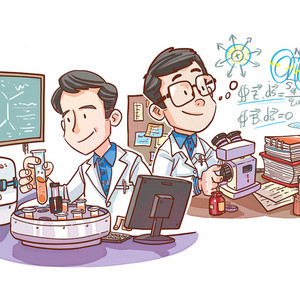
What does it take to go from sketching math equations to developing the world's newest technology?
It all starts with basic science, the kind that takes decades to mature, often under the radar.
And it starts even earlier with education.
As the 2025 International Congress of Basic Science unfolds in Beijing, we're asking, how does China translate basic science into real -world innovation?
And how is it grooming the next generation of STEM pioneers?
Coming to you live from Beijing, this is Roundtable.
I'm He Young. For today's program, I'm joined by Steve Hatherley and Guo Yan in the studio.
First on today's show.
From the mysteries of black holes to next -gen micronuclear batteries, basic science might not always make the headlines, but it silently powers the world we live in.
Right now, nearly 1 ,000 of the world's brightest scientific minds, including Nobel laureates, Fields medalists, and Turing Award winners, are gathering in Beijing for the 2025 International Congress of Basic Science, held from July 13th to 25th, to exchange ideas that could shape humanity's next big leap.
What is this event about, and why is it significant that it's being held in China?
Well, according to a report published by Xinhua News Agency recently, the 2025 International Congress of Basic Science kicked off just a few days ago, and it will conclude on July the 25th.
Nearly 1 ,000 scholars and students, including over 400 world -leading scientists, will engage in deep discussions on cutting -edge progress in mathematics, physics, and information science and engineering.
year. And during this event, four Fuse medalists, three Nobel laureates, and two touring award winners will attend the Congress.
And I think this event shows how important the basic science for China, as well as for the rest of the world.
It's kind of a misnomer, isn't it?
Basic science. It's not basic at all.
There's nothing basic about it.
For field medalists, fields medalists you mentioned, those are mathematicians who have been awarded the Fields Medal.
That's an international award given to recognize outstanding mathematical achievement.
They call it the Nobel Prize of Mathematics.
And the Turing Award, that's the Nobel Prize of Computing, just to give you an idea of how intelligent the people gathering are.
are. It's a really impressive group every time they gather.
Yes, indeed. And it is a global top tier academic event in the field of international basic sciences.
It's sponsored by the People's Government of Beijing, the Ministry of Science and Technology, and the China Association for Science and Technology, and of course, the International Congress of of Chinese mathematicians.
So, well, that room has so much brain power.
Brain power, computing power, brain wise.
Yeah. Those involved, when they talk about basic science, they say it's not only important for technological innovation, and it is, but it's not just that.
It serves as the core kind of engine that drives the continuous ongoing ongoing evolution of our civilization.
They also emphasize when talking about it that enhancing international cooperation in science and also fostering mutual exchange and trust, that's more crucial now than ever before.
And I like that concept, you know, instead of looking at it as a race that needs to be won, looking at it as more of perhaps a relay race, right, Right.
Where you hand the baton and then other scientists and mathematicians and engineers and they take over and they go and then you keep passing that baton on and on.
You're right. And a lot of real life applications such as the mobile phone, the smartphone we use are developed based upon decades of even a century, a century long of basic research. And I think it takes a lot of time.
It takes generations of efforts of the scientists to put that basic theories and information into real application and help to improve the technological innovation.
One hundred percent true.
It's science that's not often appreciated by the public, I think, because as you said, it takes sometimes decades for things to come to fruition, right?
The research itself, basic science, they call it fundamental or bench research as well.
It's the foundation of knowledge for the applied science that will come next.
And this type of research, it encompasses familiar scientific disciplines that we're all familiar with, biochemistry, microbiology, physiology, pharmacology.
When I say familiar with, I mean the terminology, right, not necessarily the science.
I saw a description that I thought put it really quite well in layman's terms. So basic science is kind of the why.
It's research to understand how things work, but not necessarily to solve a specific problem yet.
For example, if you're studying how cells divide, you may not be looking for a cure for cancer, but you want to know why those cells divide.
If you're looking at how or why stars explode, well, you're not building a spaceship to go look at them up close, but you're still doing the research. That's basic science.
applied science is more of the why does this happen how can we use this a fun metaphor is basic science is like mapping a jungle and applied science is building a bridge through that jungle that's a really interesting way to look at it and also i think the problem for a lot of us to finding it difficult to grasp on what basic science entails is because even for the scientists Sometimes it's hard for them to associate it with a particular product or a technology that we use every day.
Because basic science is before that, is still laying the groundwork kind of thing.
Yeah, like Wi -Fi, for example.
That came from basic science discoveries in radio astronomy.
Now, they were doing that research a long time before Wi -Fi came to us as the public.
And that's why I said before, it's hard for the public to kind of get excited about basic science.
because you don't see the immediate application of the research that's being conducted.
You don't see the application just yet.
And how has China developed its capacity in basic sciences over the years, from investing in talent to financing high -risk, long -term research?
Well, since the 18th National Congress back in 2012 from the Party of China, the country has gradually developed a collaborative innovation system.
This has been led by tech -based enterprises, researchers, research institutes, universities, all working together in this collaborative way.
In 2023, that was a big year.
China's total R &D research and experimental development.
The expenditure in 2023 reached over 3 trillion yuan.
That's about $450 -460 billion, maybe even a little more than that.
that was a 233 fold increase when you compare it to 1991 so you can see that the the amount of I mean just looking at the amount of money right it's a lot more than it used to be and there are a lot more people involved in research than there used to be well according to the seventh national population census the share of the population with junior college degree or higher reached 23 .6 percent in 2020 and china's full -time equivalent rnd personnel exceeded 3 million in 2012 surpassed the u .s in 2013 and reached 7 .24 million in 2023 ranking first globally for 11 consecutive years.
I think that showed, both from investment and the talent cultivation, we can see that China has been ramping up efforts to increase its investment into R &D, into basic research. Yeah, and there's been a lot of encouragement for different enterprises to invest as well.
Again, referencing 2023, I said that was a big year.
Companies enjoyed about about $258 billion in additional tax deductions, that's almost 2 trillion yuan for their R &D expenditures.
They did that through prepaid corporate income tax declarations.
So that kind of policy encourages, doesn't it?
It encourages a lot more research and development and a lot more looking to the future.
Well, I think you just said 2023 is a big year for China in terms of R &D.
And I think 2025, this year is also a big year for China.
Probably every year is a big year.
But this year is very special.
We can see the rise of a lot of startups like Unitree, the robotics company based in Hangzhou, and like DeepSeek, as well as the Brinko.
I don't know whether you have heard of that company Brinko.
The company develops prosthetic products based upon the technology of brain computer interface.
And I interviewed that company a few months ago and they told me that, I think that's a perfect example of how real life technology come from basic science.
And this technology, they kind of implant a chip into the brain of people with disability and then these people could control an external device without his hands but his mind right theoretically yeah we've talked about that on round but that right but that application is based upon the development of biology mathematics and chemistry yeah showing why the collaborations are important yes indeed and what are some of the eye -catching achievements we've seen that the basic research and basic science sphere of China has brought to the world?
Well, again, 2023, by the end of that year, China became the first country in the world to surpass four million valid invention patents.
Four million. That's an astonishing number.
Sector by sector, if you look at the information and communication sector, sector China's made a historic leap there as well going from a follower in 2G to becoming the first to commercialize 5G and now we're already starting to hear whispers about 6G right and China's leading in 6G technology research I for one am very curious I mean how much better how much better can it actually get I guess we'll find out right that's what they're working on right now maybe you you can download the movie only one second.
Well, for autonomous driving to happen, you need, I would think, really accurate 6G.
Yeah, fair point. Also, in recent years, I was talking about the information and communications sector, but also in AI -generated content, right, AIGC.
That industry has grown really, really rapidly.
rapidly major internet companies involved achieving key technological breakthroughs in large -scale AI models and just one more example for you from a different field in the pharmaceutical and health care field since the drug registration system reform that happened back in 2020 the pace of innovative drug development and approval has accelerated again by the end of 2023 nearly 150 class 1 innovative drugs had been approved for market launch we're learning everything about the year 2023 today, aren't we?
But again, it's just testament that that was a really impressive year here.
And 2024, a year later, is also a very impressive year.
According to a report published also by Xinhua News Agency, the National Natural Science Foundation of China released the country's top 10 scientific advances of 2024, chosen from over 7 ,000 groundbreaking groundbreaking basic research achievements and the advances were mainly achieved in the fields of mathematics physics astronomy information science chemistry material science energy earth and environmental science and of course these are all basic sciences and the the list includes the chang 'e six missions returned samples which reviewed volcanic activity on the far side of the moon dating back
2 .8 billion years, the realization of intelligent reasoning and training using large -scale photonic computing chips, and the discovery of key evidence that supermassive black holes affect the formation and evolution of their host galaxies.
I think this astronomy And also the space science also have seen a lot of breakthroughs in China over the years.
Yeah, they've made major discoveries in space exploration.
And that's helped to, I think, fill a lot of gaps in international research. There have been a lot of achievements in life sciences that have laid theoretical foundations for disease treatment.
There have been breakthroughs in the field of, have you ever heard of this before?
optoelectronics they've opened they've opened new pathways there too um optoelectronics okay so here's an easy example your tv remote control is an example of how optoelectronics work so you press a button and then electricity flows and then the led from the remote shoots out an invisible an invisible light and then your tv sensor detects the light and then it obeys your command whatever Whatever you told the remote to do, your TV follows.
And that's light plus electricity, which is optoelectronics.
Oh, there you go. Thank you very much for that.
You're welcome. That's definitely something that I've never paid attention before.
But now thanks to basic science and Steve's explanation, I think I get the gist of it.
There's other examples, too, like smartphone screen LEDs and solar powered garden lights.
There's plenty and plenty and plenty of examples of optoelectronics all around us.
All right. All right.
And well, with her and we've heard the stats and saying the breakthroughs, but why does any of this matter to average person?
Yeah, that's something about that.
I've definitely thought about, you know, why is basic science so crucial, even though it feels quite distant in daily life?
But actually, it's something that's not only worth our attention, but there's a huge Congress group meeting that's happening in Beijing devoted to this cause.
Yeah, I mean, you talk about why there's a gap, right?
It's because of the mismatch in time.
I'll bring up the Internet again because I think it's the perfect example.
That foundational research, how data travels online, it happened in the 1960s.
but it took decades didn't it for the worldwide web and everyday internet use to reach us to become our own reality and people in the 19 think about this people in the 1960s if they had talked about you know foundational research for packet switching the average person probably would have went what why why are you doing that well then look what happened you know just a few decades Decades later, everything was transformed around the world.
That's the easiest and maybe biggest example I could think of.
Well, yes, everyday technology has to, well, if you look for the foundation of it, then it's usually basic science.
And also, if you look at the long term, well, basic science is the innovation driver.
And also I can think of it helps to solve big challenges long term.
And yeah, I suppose long term is really the key word here when we think about basic science, because not only does it go under the radar, people don't really understand it very well.
And also, it takes so much R &D and investment, sort of having your eye in the long game before you can bring the economic fruition of the discovery for it to pan out.
Wow. Speaking of long -term benefit, I think the basic science, the investment in basic science will eventually bring economic growth in the longer term.
Investing in basic science builds new industries and, of course, jobs by creating cutting -edge technologies and intellectual property.
So I think there are a lot of long -term benefits that maybe we can't see these days.
But after maybe decades later, or maybe a century later, that would benefit next generations.
Yes. And if basic science is important, then we need to build an education system that prepares young minds to carry it forward. STEM, S -T -E -M, stands for science, technology, engineering, and mathematics.
how does STEM education in China prepare young minds to tackle future scientific challenges?
Well, science helps us understand the world around us, from basic natural phenomena to complex ecological systems. And also technology continues to expand into every facet of our daily routines from smartphones to smart homes.
And engineering tackles everything from basic infrastructure like roads and bridges to complex challenges like climate change and sustainable energy solutions.
And mathematics underlies every occupation and activity from managing household budgets to analyzing big data?
Yeah, those four might seem quite different, but they're really closely interconnected fields.
And that's why we talked about this, too, the importance of interdisciplinary study and interdisciplinary talent development is almost essential.
When you have that kind of integrated framework amongst all of them, then they can work together to solve different problems. For example, math that provides the tools for quantitative analysis, problem solving, logical reasoning to support the other stem subject.
Science, for example, as well, would deepen your understanding of the world by uncovering natural laws, laying the theoretical foundation for solving problems in technology and engineering.
So it's like a spider web.
They seem like they're totally different, but they're not.
And one always helps the other.
It's kind of cyclical.
Yes, indeed. And during this 2025 International Congress of Basic Science, which takes the time span of two weeks, there are plenty of meetings, conferences that take place.
And one of these conferences really caught my attention with the theme that, you know, when you've got so many scientists gathered in the same room, and they're all talking about scientific advances, as a humanities and arts student or graduate, I wonder, oh my, this is just showing that possibly there's no place for arts in all of this.
But during this conference, a scientist actually brought up this idea that we shouldn't just stop our discussion by saying we should be promoting STEM education, but also we should be promoting STEAM education.
And that is S -T -E -A -M and the extra A stands for arts.
And Guoyan, I know you have some thoughts about this sort of relatively new concept in the science sphere.
Well, the A stands for, like you said, arts.
It includes visual arts, humanities, and language arts.
On the foundation of STEM, STEAM education places greater emphasis on nurturing students' artistic and humanistic literacy.
In the context of today's green and digital transformation, the combined cultivation of STEM and art knowledge and skills serves as a crucial educational cornerstone for building an innovative society of the future.
I think that perfectly makes sense.
When the STEM students may learn some art courses, I think that will help them foster their creativity and maybe future innovation in the AI industry, like artificial intelligence.
I know some students who major in STEM courses might pick up some lessons like art design, and that will increase their possibilities to pursue a career maybe in the AI design.
Yeah. And when you study AI and if you are working in STEM and you're working in AI development, how many times has this come up?
Anytime we talk about AI, ethical questions, ethical questions, ethical questions.
When you have the people in charge of the AI, they're developing it, then they have to know what ethical implications there are when they are developing these tools.
So the study of the arts and the humanities can assist in that.
That's one of probably 100 examples that we could give up as to why the arts are important as well.
And the development, I think the goal of developing basic science or STEM courses is to pursue better life for human.
And that's where the development eventually will serve humanity.
And that's why they formulate this idea of STEAM course or STEAM education.
Yeah, and that's definitely looking into the future.
And hopefully we can envisage a better future when you add the arts and ethics and, you know, that other side of consideration into the equation.
And when you look at China's ranking in the world when it comes to STEM education, it's basically America and China and everybody else it feels.
And what are some of the interesting information that's worth our attention when it comes to sort of look at STEM and different countries' role in it and sort of the global picture?
A lot of countries have prioritized the strategic development of their scientific and technological talent.
They've translated this into educational practice.
They've been promoting STEM plus education.
that's an education philosophy that emphasizes linking learning with real -world context and the goal or the aim there is to cultivate high level innovative talent interdisciplinary thinking thinkers and those talents when they are finished with their preparations they're equipped with comprehensive scientific literacy they're also equipped with strong innovation capabilities and And those are vital human resources for talking about all of the global challenges that we face today, such as climate change or such as public health crisis or resource scarcity.
And when you have people who are prepared to tackle those problems, then it makes those problems a lot easier to solve.
And education and a system to measure your capability, a country's capability of STEM education.
Here in China, in Tongji University, STEM education think tank officially released the world's first comprehensive assessment tool for STEM education development of nations and regions, Global STEM Education Development Index 2025.
And this index evaluates 40 countries and regions across the world.
And that covers the area of policy resources, educational process and outcomes and impact.
Yeah, for that particular index, I think the US tops the ranking.
China is second because of its strong educational process dimension.
A lot of STEM graduates coming out of China.
Also excellent student performance in international assessments as well.
and also really competitive teacher capacity.
India is on that list as well.
They lead in STEM graduate numbers.
They have 3 .34 million.
I think that stat was from 2025 or a recent statistic, but due to their lower per student investment, which is only 17 % compared to the United States, for example, its overall ranking remains a little bit lower.
That's why so many engineers come from India.
Yeah. And education doesn't stop at textbooks.
What are Chinese schools and communities doing to bring science closer to everyday life?
Well, according to an article published by China Education News in January this year, a national conference on promoting science education in primary and secondary schools was held in Beijing to discuss and plan the further strengthening of science education in schools in the new era.
Yeah. And since that guideline came out, the country has built 125 national pilot districts for science education.
And that would be in primary and also secondary schools.
Yeah. They've also built 994 science education pilot schools.
And that would make improvements in districts and schools, not the construction of new districts or new schools, just improvements in the existing ones there.
And the schools are innovating themselves in teaching.
Since becoming a national pilot school for science education, Huaxi Middle School, which is located in Chengdu, the capital city of Sichuan province, has promoted the concept of the campus is the laboratory.
And it's developing seven altars, two centers for an innovation center and a reading center, as well as to specialize the labs, an AI lab and a digital lab.
and two corridors, a micro -technology corridor and a science -culture corridor, and eight science -themed landscapes turning the entire school into a living laboratory where every student is a young scientist. That's pretty cool.
That's in Qingdu. But also here in Beijing, where we are, a lot of schools, they've enhanced their curriculums. They offer basic science courses now, specialized science courses, interdisciplinary programs. programs um beijing has established 741 science related students clubs and pioneered stem education and project -based learning so beijing is definitely keeping up yes and we're seeing it's well at least by all the things that you guys have just mentioned it's as if science is the future it's part of it it's a lot of a big part it's a large part of it that is science and Yeah, both.
You need both legs to walk.
That's a direct translation from a Chinese proverb.