JD Vance and Tim Walls are squaring off in their first and only debate on Tuesday.
The NPR Politics Podcast has you covered with all the news and analysis ahead of the Vice Presidential Debate.
Listen to the NPR Politics Podcast wherever you get your podcast.
You're listening to Life Kit from NPR.
Hey everybody, it's Mariel.
Now, plastic is everywhere and for good reason.
It can be cheap, strong, light, bendable, waterproof.
So in recent decades we've been making a lot more of it.
In fact, over half of all plastic that's ever been made has been made since 2002.
Plastic has really advanced what we can do in our culture, but we have to find ways to make it more safe for human consumption and use.
Dr. Sheila Satinorina is a pediatrician and environmental health specialist at the University of Washington and Seattle Children's Research Institute.
And she studies the effects of plastic on people, especially during childhood and pregnancy.
She says plastic is bad for the environment since a lot of it ends up as pollution.
But before it even ends up there, the act of making plastic releases greenhouse gases since it's made from petroleum.
I don't think that people generally know that.
So when we think about the impact of plastic overall for the environment, there are huge greenhouse gas emissions that come from plastic production.
And as it's used, plastic breaks down into microplastics and chemicals leach out of it, which can cause health problems even if we don't feel the immediate effects of them.
Also, if you want to use less plastic, it gets really hard.
Almost all of the burden is on the consumer.
That didn't intimidate NPR producer Claire Marashima, who gave herself a challenge to cut out single -use plastics for one week.
On this episode of LifeKit, I talk to Claire about how it went, what she's learned about the environmental and health impacts of plastic, and what tips she has for you.
Hey there, this is Felix Contreras, one of the co -hosts of Alt Latino, the podcast from NPR Music, where we discuss Latinx culture, music, and heritage with the artists that create it.
Listen now to the Alt Latino podcast from NPR.
As Election Day approaches, NPR's Consider This podcast is zooming in on six states that could determine who wins the White House, Georgia, Nevada, Wisconsin, Michigan, Arizona, and Pennsylvania.
We'll ask voters in these swing states what matters to them, and which way they want the country to go.
Follow along with new episodes this week on the Consider This podcast from NPR.
Once again, we find ourselves in an unprecedented election.
And with all that's happening in the lead -up to the big day, a weekly podcast just won't cut it.
Get a better grasp of where we stand as a nation every weekday on the NPR Politics podcast.
Here are seasoned reporters dig into the issues that are shaping voters' decisions and understand how the latest updates play into the bigger picture.
The NPR Politics podcast, listen on Spotify.
Wilderness is changing.
More wildfires, more people, more cell service.
The How Wild podcast hits the trail to explore the history of wilderness, how it's changing, and what that says about us as humans.
Listen now to the How Wild podcast from K -A -L -W, part of the NPR Network.
All right, Claire, so for you, was this challenge more about helping the environment or protecting your health?
It was probably more about plastic waste in the environment.
I've just been seeing a lot of pictures of trash on beaches recently, and that was a big motivator.
But also, the more I reported, the more I realized that plastic is very not good for health.
So you embarked on a plastic -free week, and specifically you decided to avoid buying any new single -use plastics.
Those are the kind that are meant to be used once and then thrown away, right, like coffee cup lids and shampoo bottles.
How did you go about that?
So I focused on cutting online shopping and food delivery.
I'm a big fan of both of those.
I filled my own containers at the bulk section of the grocery store.
I also carried with me a tote bag with reusable utensils and a reusable container whenever I left the house.
And I decided that if any of my single -use plastic items ran out throughout the course of the week, I would replace them with plastic -free alternatives.
As you did this challenge, I wonder, which changes did you find relatively easy?
Two things kind of seamlessly fit into my routine.
Drier sheets often contain plastic, actually.
So instead of those, I used wool dryer balls.
And the second one was using a menstrual cup instead of single -use period products.
Both of those I saved money on because I didn't have to buy products and use them up.
And I will say, I had both of these things already, but just didn't always use them.
And what is the menstrual cup made out of?
The menstrual cup I used was made from silicone, which is a plastic, but it allowed me to not throw away a bunch of plastic packaging from tampons.
Right. It's reusable.
It is, yes. You just boil it in water once a month.
Got it. What did you find difficult about this week?
There were a few things that were hard.
The biggest one was just like not having time to do a lot of the things that I normally do.
I really didn't have that much downtime between baking bread and making soup and like riding around D .C.
on my bike, looking for ingredients to make things.
For somebody who's busy and has a job, it's not the most convenient thing to do.
Okay, were there any times where you found it was just impossible to give up single -use plastics?
Oh my goodness. There are so many and almost all of them had to do with food.
I love candy. I cannot go a week without candy.
To make my own peach rings, I had to scour the grocery stores for ingredients.
It was difficult for me to find citric acid, which makes them sour in a plastic -free container or in bulk.
I just gave up and bought citric acid in a single -use plastic.
These are so sour. These are incredibly sour.
I did have to buy single -use plastic, but like making my own peach rings and using that citric acid over time, it's definitely less plastic waste than buying a pack from the grocery store in plastic.
Another time that I unintentionally acquired plastic was when I was trying to buy almonds in bulk.
I wrote down the PLU.
I wrote down the weight of the jar before and after filling it with almonds.
However, when the cashier rang it up, they weren't sure how to subtract the weight of the jar and they had to get three cashiers to figure it out.
I held up the line.
It took about five minutes to just figure this out.
There are three people behind me and I'm feeling so self -conscious.
In the end, they poured my almonds into a plastic bag, weighed it, threw the bag away, and then poured them back into my jar, which like defeated the purpose of bringing my own jar in the first place.
Sorry for the delay.
No, it's okay. I'm fine.
That is so frustrating.
Yeah, I mean this does sound like it took a lot of work and I know you were going all in for the sake of this journalism experiment, but I imagine it would feel like a big lift for someone trying to do this for the first time.
Oh, absolutely. It was, since this was all new to me, but it's not exactly a new concept.
I spoke with Isaias Hernandez.
He's an activist and educator who goes by queer, brown, vegan on social media.
And he says that low -income people are already used to living a low -waste lifestyle.
My parents always reused, you know, containers and the butter jars and, you know, upcycling glasses to put their plants in.
And it wasn't until I got older and I got a full -time job and my income increased that's when I realized that I had larger amounts of plastic waste that I was using.
It's almost like how we talk about lifestyle inflation, right?
Where you start making more money and then you start spending more money and buying more expensive things.
And I guess along with that comes more waste.
Alright, folks. So takeaway one here is to look for the easy swaps where you can.
Wool dryer balls instead of dryer sheets, a reusable stainless steel water bottle instead of the throwaway plastic kind.
Bar soap instead of body wash in a plastic bottle.
You can use wax paper and a rubber band instead of Saran Wrap.
Or get washable reusable sponges to throw in the laundry rather than use disposable sponges which often have a little bit of plastic in them.
You can get soap tablets and put them in a reusable glass dispenser rather than use hand soap in a plastic bottle.
If you menstruate, consider a reusable menstrual cup or a disk instead of pads or tampons.
There are lots of ways you can cut down on plastics.
Claire, let's pivot now to talk about the health aspect of all this.
Reusing single -use plastic containers is better for the environment, but not necessarily for your health because we're learning that it's not ideal to eat out of plastics in general, right?
Right. There's a few reasons for that.
One is just the microplastics, which are bits of plastic that come off and you can eat them.
There's also chemicals that can leach out of the plastic.
Usually when it's heated up, but let's just talk about the microplastics.
You know, these small bits of plastic that you can eat or breathe when you use things that are plastic and they can actually become lodged into your organs.
Here's what Dr. Sathy Narayana said.
You can imagine you have a splinter underneath your skin.
It causes irritation.
It can cause an infection.
Similarly, if you have a plastic particle lodged into your lungs or somewhere else in your body, it can cause inflammation and also potentially immune dysfunction.
And then there can be a lot of downstream effects from that.
I wonder if it helps at all, if it can reduce your exposure if you rinse off food that was packed in plastic.
So I asked Alice Brock about that.
She's a researcher at the University of Southampton in the UK.
And she says that, you know, if you have a cucumber that's wrapped in plastic and you rinse it off, it might remove some of the microplastics, but microplastics are present in the food and they're also in tap water.
So it's really hard to be completely free of them.
Yeah. So it's not just these tiny particles of plastic that we're worried about, right?
It's also the chemicals in the plastic that can leech into food.
Yes. I also learned that with plastic containers, they contain chemicals that can actually mess with your hormones.
Here is Dr. Sathya Narayana again.
There can be chemicals that are in the actual structure of the plastics.
They're used to make the plastics either more durable, more flexible, depending on the type of plastic, and those chemicals can leech out of those plastics, especially when they're heated up and then get absorbed into the body.
And they can have negative effects, especially during early childhood and pregnancy.
So whether you're trying to avoid the chemicals or the microplastics, or both, Dr.
Sathya Narayana recommends just swapping your plastic food containers for ones that are glass, metal, or wood, and also avoiding plastic packaging like water bottles.
Okay. Takeaway two is to think about ways to cut down on the plastic you ingest.
Microplastics and the chemicals from plastics can find their way into your body from packaging, cutting boards, cookware, water bottles.
The list goes on. So consider avoiding plastic containers when you can and making swaps like using a wooden cutting board instead of a plastic one.
Avoiding plastics in your food is also so much harder when you're eating out rather than eating at home.
Yes, so much of the food packaging and containers for takeout are made from plastic, or at least contain a little bit of plastic.
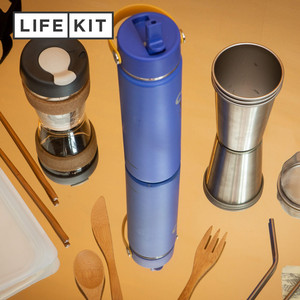
The founder of Plastic Free July, Rebecca Prince Ruiz, recommended putting together a little kit with utensils, containers, a straw, and just keeping it with you because you never know when you're going to eat out at a restaurant.
Yeah, I was thinking about that the other day.
I went to this place.
It was a food hall.
And I got soup, but they just had plastic spoons.
And I went around to so many of the restaurants in that food hall.
And I asked if anybody had a metal spoon and no one did.
This is exhausting, though.
I feel like you, once you start to be aware of it, you look around and plastics are in everything.
Yes, plastic is in things that I did not even know existed.
I actually came away from this week with 102 pieces of either plastic or mixed material, bits of waste, everything from the glue that holds the label to a glass pasta jar, the lining of the cheese powder packet from boxed mac and cheese, a cable tie that was on the court of a bread maker I found on the street,
and cling wrap from the DIY fruit fly traps I made to get some fruit flies out of my house.
So in the US, there's no federally agreed upon definition of what plastic is.
And even if you think you know what it is, it's hard to know what it's in.
There are no nutrition facts for so many of the products we use, like wax paper, butcher paper, dryer sheets, stickers, all of which I learned often contain plastic.
But there's really no way to know whether the ones I consumed did have plastic.
Yeah, it's not like it's gonna say on your cereal box, this serving comes with X grams of microplastics, isn't it great?
Exactly, yeah. I wonder, we've been talking a little bit about plastic alternatives.
I know bamboo can be used as an alternative.
I've got a bamboo electric toothbrush, actually, and I have some bamboo utensils that I bring around with me.
What about glass? Is that a good option?
Well, health -wise, if you're using a glass straw, glass containers, they don't have microplastics because they're not made of plastic.
However, environmentally, the production of glass has a higher carbon footprint than the production of plastic, and the people who work on the front lines of glass production or live near production facilities have more respiratory problems and other illnesses.
I talked to Alice Brock.
She's the researcher at the University of Southampton in the UK.
She studies beverage packaging and climate change.
When it comes to glass, I think people think it's better because they go, oh, well, you can recycle it all the time, right?
The thing about glass is it takes a lot of energy to make, and a lot of gases are released as that happens, so you get carbon dioxide released from that, but also sulfur dioxide, which leads to acid rain and respiratory problems.
But it's a trade -off because while glass can be recycled almost indefinitely, plastic can't.
Here she is again. Every time you recycle plastic, it's made out of long chain molecules.
Every time you recycle it, the chain gets shorter, so it can't necessarily be used as the same material again, or it has to be mixed with new plastic, and it ends up where it's such a low -quality plastic, it can't be recycled anymore.
Takeaway three. If you're looking for a plastic alternative for food storage, consider glass or metal, like stainless steel, especially if you already have it on hand and can reuse it.
Also, keep in mind that the aim here is not to go through your home in one afternoon and toss every last bit of plastic or every less than eco -friendly object.
It's just to do a little bit better for yourself and for the environment.
Okay, so let's get really practical here.
If someone wants to cut down on their use of plastics, and specifically single -use plastics, where can they start?
A good first step is just looking at what kinds of plastic you are going through to begin with.
So Rebecca Prince Ruiz, founder of Plastic Free July, she says look in your trash can, your fridge, your pantry, do an audit of the types of plastic you're consuming already, and then from there you can find alternatives.
And sometimes they're more expensive, sometimes they're cheaper.
Isaiah Hernandez, Queer Brown Vegan Online, says that it doesn't always have to be an expensive thing, and he recommends buying secondhand.
I would tell them to check out their Facebook marketplace.
It is filled with a lot of free items, and a lot of these items sometimes are vintage or either slash new that haven't been used.
But big picture, like there's no way to do this perfectly.
Yeah, it's not like you're gonna be able to cut plastic out of your life entirely.
And really that comes back to this point about climate change and about our health.
A lot of the responsibility has to be on the companies that make these things, right?
Yeah, and the governments that regulate them.
And I talked to Prince Ruiz about that.
She says that the fact that alternatives are often more expensive is reason enough that systemic change is needed, just because it needs to be more seamless, easy, and cheaper for people to buy plastic -free alternatives.
Every single expert I talked to said, like, you will never get to zero plastic, it's not your fault, and just make your peace with that.
But that doesn't mean you shouldn't try it.
Here's Dr. Sathya Narayana.
Even if you have a product, let's take like a stainless steel cup or coffee mug or something like that.
To make it functional, you still need a little bit of plastic somewhere, right, so that it's a little bit more usable if you want to close it or contain it.
And still, that's better than a fully plastic cup, an all -plastic container.
The main things to focus on are do what you can, don't focus on what you can't, and small swaps do add up both for the planet and for your health.
All right, it's time for a recap.
Takeaway one, look for the easy plastic -free swaps where you can.
Bring bamboo utensils with you when you're on the go.
Buy unpackaged produce.
Takeaway two, ingesting plastic could impact your health.
Consider avoiding it when you're preparing and storing food and water.
Takeaway three, if you're looking for a good alternative for food storage, try glass or metal.
And remember, plastic is everywhere.
Getting to 100 % plastic -free is unrealistic, but if you want to make a change, go slowly, see what's in your cabinets, look at your trash can, and get a little more data about yourself so you can make changes going forward.
For more LifeKit, check out our other episodes.
We've got one on how to start composting and another on how to eat more plant -based meals.
You can find those at npr .org slash LifeKit.
And if you love LifeKit and want even more, subscribe to our newsletter at npr .org slash LifeKit newsletter.
Also, we love hearing from you, so if you have episode ideas or feedback you want to share, email us at lifekit at npr .org.
This episode of LifeKit was produced by Margaret Serino.
Our visuals editor is Bec Harlan and our digital editor is Malika Greet.
Meghan Kane is our supervising editor and Beth Donovan is our executive producer.
Our production team also includes Andy Tagle, Claire Marie Schneider and Sylvie Douglas.
Engineering support comes from David Greenberg and Tiffany Veracastro.
I'm Mary Elsigara. Thanks for listening.
Wait, wait, don't tell me.
Fresh air up first.
NPR News now, Planet Money, Ted Radio Hour Through Line, the NPR Politics Podcast, Code Switch, Embedded Books We Love, Wild Card, are just some of the podcasts you can enjoy sponsor free with NPR+.
Get all sorts of perks across more than 20 podcasts with the bundle option.
Learn more at plus .npr .org.
People in Nevada are more racially diverse than a lot of swing states.
About 40 percent of voters in Nevada are not white.
Does that shape their views of issues like inflation and immigration?
Donald Trump and Kamala Harris are both gambling on Las Vegas.
Hear from Nevada voters all this week on NPR's Consider This Podcast.