Sources and Methods, the crown jewels of the intelligence community.
Shorthand for, how do we know what's real?
Who told us?
If you have those answers, you're on the inside, and NPR wants to bring you there.
From the Pentagon to the State Department, to spy agencies.
Listen to understand what's really happening and what it means for you.
Sources and Methods, the new national security podcast from NPR.
You're listening to Shortwave from NPR.
Hey, short wavers.
John Hamilton here in the guest host chair.
And joining me today is Ritu Chatterjee.
She covers mental health for NPR.
Hi, Ritu.
Hey, John.
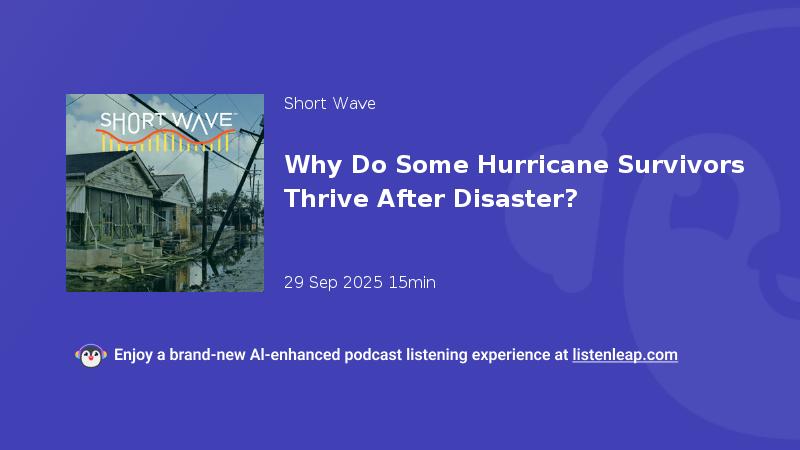
Ritu, I know you've been reporting on mental health of people who lived through Hurricane Katrina.
It has now been 20 years since that storm devastated New Orleans.
What have researchers learned about the survivors?
Well, you know, the one thing that stood out to me was how much the research has revealed about human resilience.
Researchers have really been able to see what this looks like after following more than a couple thousand survivors for nearly a dozen years.
And one of those researchers is David Abramson.
He's a social and behavioral sciences professor at NYU.
Around the 13 14-year mark.
After the hurricanes, People had begun to have a sense that they had come to some sort of stability in their lives.
Okay, 13 to 14 years.
I mean, developing resiliency is apparently not a quick process.
It can take time.
Yeah, and also remember Katrina was one of the most devastating natural disasters in the U.S.
Some people lost pretty much everything except their lives.
So here's what Abramson and his team learned about the mental health of the nearly 1000 survivors they looked at.
This is right after the storm.
We found that somewhere between 40 and 50 percent of the people in our cohort were expressing very high levels of mental health distress, complicated grief, anxiety and depression.
And you know John, other researchers look specifically at symptoms of post-traumatic stress disorder and found over 40 percent of survivors had PTSD in that first year after the storm.
Wow.
So people had all sorts of mental health struggles right after the event.
But it sounds like researchers found that many survivors recovered.
I mean, eventually.
Yeah.
And this was beyond just finding stability.
One of the things that they asked survivors about is called post-traumatic growth.
OK.
New term for me, Ritu.
Yeah.
So post-traumatic growth is something that psychologists have documented in people who've gone through serious illnesses, natural disasters, accidents.
And they have specific questionnaires they use to assess people for post-traumatic growth.
But the bottom line is, people who go through this say that, yes, I suffered a lot.
It was terrible.
But I grew through that experience.
There's this saying by Friedrich Nietzsche, right?
That which does not kill us, make us stronger.
That's Nunak Pham, and she's an adjunct professor at Tulane University.
She studied post-traumatic growth, and she's also a Katrina survivor herself.
So today, on the show what Katrina survivors tell us about post-traumatic stress and post-traumatic growth.
And how one can lead to the other.
You're listening to Shortwave, the science podcast from NPR.
The Michael J. Fox Foundation is on a mission to find a cure.
Now is a critical time for Parkinson's research, and your support will help drive progress toward a cure.
Get involved today.
Visit michaeljfox.org slash getinvolved.
This message comes from Dell Technologies.
Dell AI PCs are newly designed to help you do more faster.
That's the power of Dell AI powered by Intel Core Ultra processors.
Upgrade today by visiting dell.com slash deals.
On NPR's Wildcard podcast, actor Matthew McConaughey says it's important not to overcommit creatively.
What can happen and where ambition has led me astray is you end up with a bunch of freaking campfires and no bonfires.
Listen or watch that Wildcard conversation on YouTube, the NPR app or wherever you get your podcasts.
Ritu, let's go a little deeper into what you've been learning about how an event like Katrina can have a lasting effect on a person's mental health.
I'm sure you've heard a lot of personal stories.
I certainly have.
And as I mentioned earlier, researcher Nunok Pham is a Katrina survivor herself.
And her story, her personal story, ties into some of what her own research and other studies have found about Katrina survivors.
Now, Pham was a teenager when the hurricane hit on August 29, 2005.
I was living in Jefferson Parish, which is the parish adjacent to Orleans, which where most of the floodwater appeared.
Pham and her parents are originally from Vietnam and her parents had just bought their first home back then.
And they'd been living in it for just about a month when they got the news about the approaching hurricanes.
We just thought of it as another storm.
It's going to come.
It's going to pass.
We're going to take a hurricane, as some of us like to call it back then.
And so they packed their bags with clothes for just a couple of days and went to Houston Texas, and checked into a hotel.
That was optimistic on their part, right?
I mean, I'm betting that hotel stay was a lot longer than they expected.
Yeah, two months or so, according to Pham.
And when they finally returned home, they found that they were lucky their house hadn't flooded, but there was still a lot of damage from the winds.
So like the roof and things like that had to be replaced.
The back patio was gone and that needed to be replaced.
Windows.
And Pham remembers that it took a big toll on her parents' mental health.
I think my parents were really stressed out during that time.
I think you know, as an immigrant purchasing their first house, they weren't sure how they would rebuild.
So I saw the physical sign of stress.
They weren't sleeping a lot.
There was a lot of insomnia, just a lot of like worrying, just like constantly talking about what are we going to do next?
Yeah, yeah.
I mean, that takes me back.
You know, I was in New Orleans more than a year after Katrina hit and there were still these mountains of debris piled up on the neutral grounds.
You know those median strips that separate traffic.
Even people who'd spent their whole lives there were having trouble getting their homes repaired or rebuilt.
I imagine it was even harder if you'd come from another country.
Oh, absolutely.
And like many first-generation immigrants in her community, Pham's parents didn't speak much English, which made things even harder.
Like, how do you even find out where to go, how to apply for relief funds?
So Pham says her parents asked her for help with the paperwork.
And it wasn't just her.
This was happening with other kids and other parents all throughout the Vietnamese community down there.
It kind of became this thing where the younger kids in the community who knew how to navigate the computer, who knew how to fill out forms, we did it for our parents and then we just did it for others in the community.
You know, Pham says she had to grow up really fast and become an adult in many ways.
And she says it was really formative.
The Katrina experience changed, made me grow as a person.
Also made me rethink about how to recover from a major trauma.
And years later, as a graduate student at Tulane Pham analyzed data on more than 300 Katrina survivors and learned that the kind of personal psychological growth that she experienced was actually common among many other Katrina survivors.
And this is what psychologists call post-traumatic growth.
Right.
So tell me a little bit more about that term.
Has it been around for a long time?
Yeah, since the mid-1990s, actually.
You know, PTSD as a mental health diagnosis came in 1980 after the Vietnam War.
And then, around 1995-96, two psychologists, Richard Tedeschi and Lawrence Calhoun, introduced the term post-traumatic growth to describe some of the positive psychological changes they and other researchers had been documenting among psychologists many people who'd been through these traumatic or highly stressful life events.
So, in the case of post-traumatic growth in Katrina, I want to introduce you to another researcher who's been looking into this sociologist, Mary Waters at Harvard University.
She actually had been following over a thousand single parents in two community colleges before the hurricane.
And when Katrina hit, she and her colleagues decided to study how this group of people recovered over time.
And what did they find?
You know, nearly two-thirds of the cohort reported post-traumatic growth 12 years after the storm.
What they would say is the storm was terrible.
I would never choose to live through that disaster.
But they said, given that I went through it, it was one of the more positive things that happened in my lifetime because it got me on a new trajectory and I see my children flourishing and I see myself flourishing in these new possibilities.
Flourishing.
That is not the word I expected to hear her say.
Neither did I when I first talked to her, John.
But for what it's worth.
I should emphasize that the trauma of the storm, you know, the displacement, loss of homes and loved ones, did leave a lasting scar on people's psyches.
Here's Waters again.
In the year after the disaster, when we found people, 44 of them reported symptoms of PTSD intrusive thoughts, avoiding areas that would trigger the terrible memories, panic attacks, those kinds of things.
And then four years later, she says, they found 32% reported symptoms of PTSD.
And 12 years later, it was 17%.
Yeah.
You know, it sounds like, on the one hand, this is one of the worst natural disasters to ever hit the US.
Not only did it kill over a thousand people, there were all these lasting mental health impacts, but a lot of survivors say they experienced post-traumatic growth.
Are these like two sides of the same coin?
Yeah, you can put it that way.
And the most surprising thing to me was that among Katrina survivors, even people with PTSD symptoms reported post-traumatic growth.
In other words, post-traumatic stress and post-traumatic, post-traumatic growth can exist in the same individual.
Here's Mary Waters again.
In some ways, the stronger your PTSD, the stronger the traumas that you experience, the more growth you report.
So it's definitely tied to going through something which challenges you in a very strong way.
Kind of reminds me of what Nunak Pham said earlier about what doesn't kill you, you know, makes you stronger.
Yeah.
And you know, researchers like Waters have also learned important things about resources that can make it more or less likely that people will come out stronger after a trauma.
Here's one of Waters' collaborators, psychologist Sarah Lowe at Yale.
Financial instability after the disaster that was associated with consistently low levels of post-traumatic growth.
So I think Financial resources really matter both pre- and post-disaster.
Another factor, she says, is social support.
So feelings of closeness with others, companionship, that someone's there for you if you need it.
A sense of purpose or meaning in life, that one's life has meaning and direction.
And you know, Lowe says that those who had more social support after the storm were more likely to say they grew from their trauma.
Makes sense.
And another thing that Nunok Pham learned from her work is that something called self-efficacy also helps.
Wait, wait, self-efficacy?
Yeah, so that's like your own assessment of your ability to get things done, to overcome challenges.
So if you have that sense of self-efficacy before a disaster, it makes post-traumatic growth more likely afterwards.
So these are things that we, I guess, as a society, can think of providing communities with that are disaster prone, and maybe to buffer them from the impacts of natural disasters.
That's exactly what these researchers think.
And they say it isn't just after a disaster, but also before.
Can we make sure people in disaster prone areas you know have the financial resources to be able to weather and recover from disasters better?
Can we make sure that families and neighbors stay together when people are displaced during disasters?
Because we know how much social support matters in people's recovery.
But the other lesson, it seems to me, is like people might need mental health care for a long time after disaster hits right.
I mean, despite all the post-traumatic growth, rates of PTSD were still high.
Even after a dozen years?
Absolutely, John.
And relief efforts normally don't last that long.
But I want to end on a hopeful note.
Nunok Pham says these findings on post-traumatic growth made her think of disaster recovery, sort of like the Japanese art form kintsugi, which involves mending broken pieces of pottery with lacquer.
It's sort of embracing flaw and imperfection.
And I think that particular philosophy should be applied within the disaster field.
Because what we're trying to do is again, we are acknowledging that there are negative outcomes, but how can we build upon that experience for people to come out better?
In other words, she says survivors of a natural disaster can mend the cracks left behind by the disaster if they have the right resources before and after the event.
Well, Ritu, thank you for sharing this reporting that you've done.
Thank you, John.
It was lovely to talk to you.
This episode was produced by Hannah Chin.
It was edited by Viet Le.
Tyler Jones checked the facts.
Robert Rodriguez was the audio engineer.
Beth Donovan is our senior director.
And Colin Campbell is our senior vice president of podcasting strategy.
I'm John Hamilton in the host chair.
Thanks for listening to Shortwave from NPR.
This message comes from BetterHelp.
It's only human to ask others for advice, like turning to your barista, hairdresser or a taxi driver for life advice.
But when you're looking for help about relationships anxiety, depression or other clinical issues, they may not have all the right answers.
Instead, get guidance from a licensed therapist online with BetterHelp.
Visit BetterHelp.com for 10% off your first month.
The Trump administration has moved fast to change US policy, but much of the country is still trying to catch up.
Business likes a stable environment, so uncertainty does cause a little bit of pain.
On the Sunday Story from Up First a road trip across the country to hear how Trump's policies are impacting everyday Americans.
Listen now to the Sunday Story on the Up First podcast from NPR.