But Why is brought to you by Vermont Public.
As a nonprofit public media organization, listener support makes up the lion's share of how we fund this podcast. or make a donation in any amount.
And we always love it when you share our show with others.
Learn more at butwhykids.org. Thanks for your support.
Now on to the episode. This is But Why, a podcast for curious kids from Vermont Public.
I'm Jane Lindholm, and we're back today with a quick bonus episode in between regular ones.
It's a beautiful day here in Vermont as I'm recording this.
The sun is shining high up in a bright blue sky and fluffy clouds are floating by. and the mountains in the distance are crisp and dark against the horizon.
But I have to say, that's not how it's been for a lot of the summer.
Here in the northeastern United States, where But Why is based, the past few years have brought us an atmospheric phenomenon. that we didn't really have all that much experience with until recently.
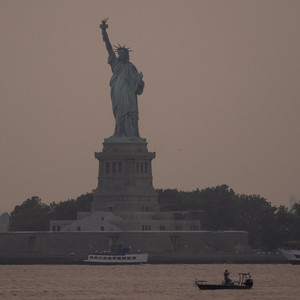
Super hazy days where the sun looks pink and the sky is a blanket of gray and you can't even see the mountains.
The haze is caused by wildfire smoke that has been blown into our region from forest fires hundreds or even thousands of miles away, often in Canada.
Depending on where you live in the world, you might have experienced this phenomenon recently too.
Back in 2020, we made a whole episode about wildfires called What Happens to the Forest After a Fire?
We'll link to that episode in the show notes, but today's episode isn't about the forests or even the fires.
We wanted to pop in to help explain how smoke can travel so far and why so many communities around the country and the world are seeing these extra hazy days lately.
Plus, we'll talk a little bit about how to stay safe and healthy if air quality levels are an issue where you live.
But before we start, we do want to say we know some of you live much closer to forest fires, and some of you have even experienced them.
That can be really hard and sometimes scary.
Our episode from 2020 includes conversations with some kids who've told us a little bit about what that's like.
But for today's special episode to help us understand the way smoke travels.
We called up Joel Thornton, a professor of atmospheric and climate science at the University of Washington. forests are on fire, it's injecting a lot of little tiny particles into the air.
And those then can travel great distances and cover large parts of the landscape.
So when it looks smoky or hazy, it's because there are little tiny particles in the air that are like like grains of sand you might find at the beach, but even smaller, that are basically blocking the sun from getting to our eyes.
Professor Thornton says these particles are made of many, many thousands of different molecules and combinations of different elements.
But mostly, they're made of what scientists call carbonicious materials. little particles of trees and leaves and other material that have been burned by the fire and are light enough to rise up into the atmosphere.
My name is Elliot and I'm seven years old and I live in Camas, Washington.
How far does smoke travel? Yeah, it kind of blows my mind every time I think about it, how fast the air is moving.
If I could hold on to a little bit of packet of air for a minute. and I let it go, that packet could go around the earth in about two weeks.
Fires in Canada, for example, within just a few days can be from the Western part of Canada all the way into the Eastern part of the United States. and fires in Siberia and eastern Russia, or pollution created in Beijing and China,
That can be blown across the Pacific Ocean in a matter of a week or so and end up impacting places in North America.
When Professor Thornton says fires can travel across the continent in just a couple of days, he means the smoke particles, not the fires themselves.
But why do these smoke particles travel so far when smoke from your campfire or your wood stove doesn't travel far at all?
The intense heat from wildfires pushes smoke much higher into the atmosphere than smoke from your campfire could get.
The smoke gets so high, maybe as much as five miles above the Earth, that it floats into the jet stream.
The jet stream is a band of strong air current moving west to east around the world.
So when soot from wildfires gets up into the jet stream, it can get blown across the continent in a matter of days.
Plus, when wildfires are burning, they're often very big and there's a lot of smoke getting into the atmosphere, so it's much more noticeable than smoke from a smaller fire would be.
My name's Theo. I'm from Madison, Wisconsin.
I feel so, why there's so many smoke in the air?
There's more smoke in the air primarily because wildfires are burning more forest than they used to.
But why are fires getting more intense? This is a really important question and many scientists are trying to understand and study right now is what is happening to the frequency of wildfires The intensity, so now there's when a fire starts, how big does it get?
How long does it go on for? How are those properties of fires changing One of the big considerations right now is that the Earth is warming.
The Earth's sort of average weather is changing and it's getting warmer, and warmer air basically causes trees and the ground to dry out faster.
So when it's warmer, the air just sort of sucks out the water from these things so like when we are in dry desert our skin gets really dry and you know we get thirsty because we're losing water to the the atmosphere the atmosphere is very hungry for water in these conditions.
And so it takes up the water and that causes these materials to be more ready to burn.
So then what starts those fires can be natural so a lightning storm can happen and lightning hits the tree the tree catches on fire and if that forest is ready to burn and you know so drier than it normally would be it will burn more intensely and over a bigger area.
There's also natural variations in the weather that just sometimes the place gets drier for a summer than it It typically does.
And that's not necessarily because of climate change.
And then there's also what we might call management practices.
And so we've Humans have really changed our relationship with forests and with land over time, going back to when we started clearing forests to make room for farms and agriculture.
That's been going on for really thousands of years, but also our cities. have been expanding outwards.
So then there's both changes in how we interact with the forest, but also changes with how we've addressed fighting wildfires and or managing the forest to help prevent wildfires?
Hello, my name is Winston. I'm eight years old. and I live in Ka'awa, Hawaii.
Why is smoke a bad smell, but firewood a good smell?
Smell is very complicated science. You'd be surprised at just how one little difference in a molecule might change the smell completely.
Firewood that you're using in your fireplace at home Maybe a specific type of wood, it's probably very dry.
Whereas wildfires, there's lots of things burning. things like the dirt is literally burning in a wildfire the dead leaves on the ground somewhat still living branches and trees are burning.
And that's not what you would normally put in your fireplace.
But I will say, if smoke from firewood in your fireplace or smoke from a wildfire are both not good to breathe, then you should try to avoid breathing either kinds of smoke.
Speaking of breathing, we're going to talk a little bit about how we can stay safe during wildfire smoke season.
Stay with us. This is But Why. I'm Jane Lindholm.
Before the break, we learned about how smoke travels in the air and can reach us even if we live far away from a wildfire.
Now we're going to talk about how we can stay safe and healthy when the air feels hazy and thick.
My name is Greg Fiori. I am a primary care doctor.
I also have a job as the medical director for climate and sustainability at Brigham and Women's Hospital in Boston.
We have some questions from kids about the health effects of wildfire smoke.
My name is Piper. I'm nine years old and I live in Camas, Washington.
Why is it bad to breathe in smoke in the air?
That's a great question. In general, when we talk about smoke, We're talking about something called particulate matter pollution.
That's those teeny tiny particles in the air caused by wildfires and things burning.
That soot, or particulate matter pollution, is what's going up into the atmosphere and making the air we breathe less clean.
When people breathe in particulate matter pollution, It can certainly affect the lungs, but in fact, those really, really, really small particles can get into the body and then can go on to affect essentially any part of the body.
And so that's primarily how people get exposed to kind of the health effects from smoke is through breathing it in.
One of those health effects might be a tickle in your throat.
I'm Ava. I'm seven years old. I live in San Antonio, Texas.
Why does smoke make you cough? the main reason that people will, kind of cough when they're exposed to smoke is because it caught these fine particles in the air cause inflammation in the lungs.
So that is your body appropriately responding to these foreign particles through a process of inflammation, but that can often trigger something like coughing.
It can also trigger symptoms like wheezing, a sense of your chest feeling tight, or shortness of breath.
Generally, hazy days aren't much of a problem, but there are people who are more vulnerable or more affected by polluted air who need to pay extra special attention.
People who have lung diseases like asthma or some adults who have something called chronic obstructive pulmonary disease or COPD. people who have heart conditions or health conditions that affect their blood vessels, people who are very old or very young and pregnant women tend to be the groups that are at the highest risk.
And so If someone is in one of those groups, then they should know that they need to take extra precaution.
One way to know if air quality in your region might be a problem is just to look at the sky.
You can often see smoke in the air because the sun looks different and the sky isn't blue. even on a day when it's not cloudy and the buildings or trees look a little like they're covered in fog or haze.
But another way is to look at something online called the AQI, the Air Quality Index.
The U.S. government monitors air quality and lets you know what it's like in your area by putting a number on it.
The Air Quality Index ranges from 0 to 500.
Zero is very clean air and 500 is very polluted air.
Once the AQI or the Air Quality Index goes above 100... but it's less than 300, people who are in some of the more sensitive groups, those people should be starting to think about how they're going to take some precautions.
Once the air quality index is going to be going over 300, then everybody needs to be considering how they're going to take some precautions.
You probably don't need to worry about the AQI.
Your adults can help you keep an eye on air quality in your region.
They often hear about that on the radio or TV or on a weather app on their computer or phone or watch.
And they can help let you know if you need to slow down on your outdoor activities or maybe wear a mask that can filter out some of that pollution.
Some people get special filters for their homes or the buildings they work or go to school in, too.
And Dr. Fury says it's always good to check in with your doctor if you're in one of those sensitive groups so you can have a plan if the air quality gets bad.
Living with wildfire smoke is a new reality for many of us, and your adults might be navigating it for the first time too.
So maybe you can make checking the air quality index together part of your routine during wildfire season.
Thanks to Professor Joel Thornton and Dr. Greg Fury for helping us understand wildfire smoke, how it travels, and how it affects us.
As always, if you have a question about anything, have an adult record you asking it on a smartphone using an app like Voice Memos or a recorder. then have them email the file to questions at butwhykids.org.
If you like our show, please have your adults help you give us a thumbs up or a review on whatever podcast platform you use to listen to us.
It helps other kids and families find us.
But Why is produced by Melody Beaudet, Sarah Baik, and me, Jane Lindholm at Vermont Public.
Our video producer is Joey Palumbo. Luke Reynolds wrote our theme music and we're distributed by PRX.
We'll be back next week with an all new episode.
Until then. Stay Curious! From PRX.