N .P .R. This is The Indicator from Planet Money.
I'm Waylon Wong. And I'm Erika Beres from Planet Money.
Jordan Skimmerhorn was one of the many federal contractors who was thrown out of work last week.
Her job was with USAID, the U .S.
Agency for International Development, which distributes foreign aid.
As we covered last week, the Trump administration has halted foreign aid, and it's gutting the agency, which had 10 ,000 employees plus contractors like Jordan.
I think it was a real choice to lay off 10 ,000 mission -driven workaholics.
Jordan, fortified with her newfound spare time and a pile of Girl Scout cookies, embarked on a research project.
She decided to look into how USAID money supports American agriculture.
I haven't even applied for unemployment yet.
I've just been spending 24 -7 trying to help build the evidence base for why U .S.
aid matters to the American people and why people throughout the country should care about it.
Jordan compiled data for all 50 states plus a handful of U .S.
territories. She looked into how the government buys huge amounts of crops to send overseas, plus how it funds agricultural research at state universities.
Today on the show, we look at how foreign aid benefits American farmers and what might happen to these programs under a dramatically reduced USAID.
This message comes from Charles Schwab.
When it comes to managing your wealth, Schwab gives you more choices like full -service wealth management and advice when you need it.
You can also invest on your own and trade on Think or Swim.
Visit Schwab .com to learn more.
This message comes from Tourism Australia.
There's something for everyone in Australia all year round.
Hiking Mossman Gorge in the Daintree Rainforest is the perfect spring activity.
Melbourne in the summer means music festivals and front row seats to the best shows.
Meanwhile, the changing leaves of Cradle Mountain give peak fall.
And wine lovers have their pick of cool climate wines in the Barossa Valley.
No matter when you visit, there's something for everyone all year round.
come and say good day.
Explore more at Australia .com.
This message comes from Charles Schwab.
When it comes to managing your wealth, Schwab gives you more choices, like full -service wealth management and advice when you need it.
You can also invest on your own and trade on Think or Swim.
Visit schwab .com to learn more.
The abrupt closure of USAID meant there was no time to wind down programs in an orderly way.
Caught in the chaos was some $500 million worth of wheat, soybeans, and other commodities.
This food was left a molder at ports and warehouses around the world.
At a recent hearing on the Hill, Republican Senator Jerry Moran of Kansas had a question for the agricultural industry officials who'd been called to testify.
While there is certainly a moral component to food aid, I thought it might be valuable for you to remind me if there's a value to farmers.
Here's one way to measure that value.
In 2020, the federal government bought around $2 billion worth of food aid from American farmers.
We're talking rice from Louisiana and wheat from Kansas.
These commodities were then distributed internationally.
That $2 billion represents less than a percent of the income farmers make from their crops.
Still, for some industries, the government purchases are crucial.
One executive at a Kansas agricultural co -op told NPR News that the government is a key customer for sorghum, also known as Milo.
It's a kind of cereal grain.
Well, the last Milo that was sold of any value was Food for Peace.
And that was in the month of December.
Otherwise, there is no market.
Food for Peace. That's the government's longest -running permanent program for food assistance.
It's administered by USAID.
And it goes all the way back to the post -World War II period when American farmers found themselves with a surplus of grain.
President Eisenhower signed a law that would channel this excess to countries in need of food.
In the interest of reinforcing peace and well -being of free peoples throughout the world.
In short, using food for peace.
The new policy wasn't just a way to offload the grain surplus.
The government also believed it would develop new customers for American farm products and win over countries that might otherwise turn to communism.
Food for Peace was eventually moved under USAID, which was started in 1961.
Michelle Erickson -Jones is a fourth -generation farmer in Montana.
She and her family grow wheat, barley, and alfalfa.
She's also the former president of the Montana Grain Growers Association, a job she got by writing in her own name on the ballot.
No one was running.
And so I looked at it and I thought, well, that seems fun.
Literally, that's what I thought.
That seems fun. Michelle says USAID food assistance programs are vital to her state.
It's not like we're just giving this aid for the sake of giving dollars.
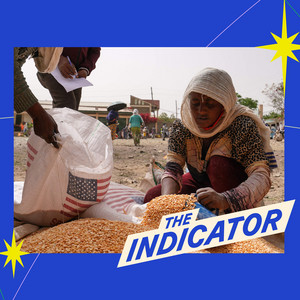
We're also building those relationships because all of those bags say USAID.
All of them say product of the United States.
Last week on the show, we talked about the economic and national security rationales that underpin USAID.
And when it comes to American agriculture, Michelle cites Japan and South Korea as examples of this policy working well.
These countries were some of the earliest recipients of food aid.
They got shipments of U .S.
grown wheat. Then, as their economies grew, they went from being recipients of donated food to being paying customers.
Japan is one of our biggest customers.
South Korea is one of the next biggest.
And they are former USAID customers, one of the originals.
And so the root of the program allows Montana to successfully export as much wheat as we do.
American wheat farmers encouraged the shift by aggressively marketing their crops overseas with the financial support of the government.
This deliberate effort to cultivate new markets was like a large -scale international trade version of when you get a free sample of something at the grocery store and then decide to buy it.
The national security rationale for food aid is that people who get this American -sponsored assistance are less likely to develop anti -U .S.
sentiment. And Michelle says to also think of food aid as a border strategy.
If people don't have to worry about going hungry, they're less likely to leave their home country and migrate to the U .S.
You know, there's this saying, like you have 99 problems until like your one problem is food and then you have one.
Michelle says it can be hard to make the case to farmers to support programs like USAID.
One reason for this is the supply chain that connects growers with the ultimate recipients of food assistance.
Typically, farms don't sell their crops directly to USAID.
Instead, they sell to a grain elevator, a big company like Cargill or Bungie.
So farmers might not even know that they're participating in a program like Food for Peace.
As we said earlier, food aid accounts for less than 1 % of farmers' income from crops.
Michelle says loss of that revenue from the closure of USAID might not be immediately felt.
But lawmakers in agriculture -heavy states are moving with urgency.
Kansas Senator Jerry Moran, along with several other lawmakers, has proposed a bill to move Food for Peace from USAID to the U .S.
Department of Agriculture.
USDA has boots on the ground and the infrastructure already in place to support the logistics for food assistance.
Moran says that under the current system, foreign aid was being mismanaged.
He pointed to an example of a Syrian national who was accused of selling USAID food kits on the black market to leaders of a terrorist organization.
Jordan Skimmerhorn, the former USAID contractor, says she's skeptical whether USDA has the right expertise and staffing in each country to distribute food aid.
Still, she believes some USAID programs will survive.
Every senator wants to protect USAID's investments in their state.
Turns out USAID funds a bunch of different things in a bunch of different states.
We contacted the State Department, which is now running USAID.
We asked about the department's long -range plans for the agency.
We also asked what role Secretary of State Marco Rubio believes American agriculture should play in food security and U .S.
foreign policy. A spokesperson told us via email that the State Department is reviewing foreign aid and that, quote, programs that serve our nation's interests will continue.
However, programs that aren't aligned with our national interests will not, end quote.
Last week, a federal judge ordered the Trump administration to temporarily lift its freeze on USAID funding.
The court asked the Trump administration to file a status report by Tuesday.
As of this recording, there was no update.
This episode was produced by Julia Ritchie with engineering by Jimmy Keeley.
It was fact -checked by Corey Bridges.
Kicking Cannon is our show's editor, and The Indicator is a production of NPR.
This message comes from ShipBob.
Did your holiday shipping let your customers down?
Partner with ShipBob for better order fulfillment.
ShipBob fulfills all your orders for you and achieves two -day shipping from dozens of fulfillment centers.
Go to ShipBob .com for a free quote.
This message comes from Warby Parker.
If you wear glasses, you know how hard it is to find the perfect pair.
But step into a Warby Parker store and you'll see it doesn't have to be.
Find a Warby Parker store near you at warbyparker .com slash retail.
This message comes from Tourism Australia.
No matter what you're into, Australia has something for everyone all year round, like the Dane Tree Rainforest this spring, Melbourne's music scene in the summer, and the wineries of Barossa Valley in the winter.
Come and say good day.
More at Australia .com.