Happy holidays from The Indicator!
For the next week, we are running some of our favorite shows from this year.
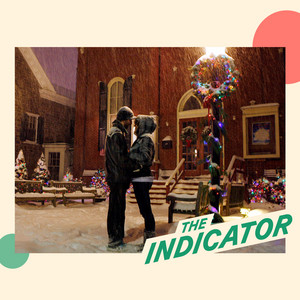
Today's episode is about how the heartwarming holiday rom -com became a staple of TV and streaming platforms.
N .P .R. N .P .R. N .P .R.
N .P .R. N .P .R. Ah, do you feel that, Adrienne?
That nip in the air, the crispness of the fall leaves.
Ah, I can smell the pumpkin spice.
Ugh, for me, fall is the most romantic season.
That's right! This is The Indicator from Planet Money.
I'm Adrienne Ma. And I'm Waylon Wong.
Today on Love Week, we're unwrapping the made -for -TV holiday rom -com and how television executives figured out how to mass -produce seasonal romance.
That's after our theme song.
We have a theme song?
Yes! It's by Grant Lee Phillips, who is the town busker on Gilmore Girls, the TV show!
["Love Week is Love Week"] This message comes from WISE, the app for doing things in other currencies.
Send, spend, or receive money internationally and always get the real -time mid -market exchange rate with no hidden fees.
Download the WISE app today or visit wise .com, tease and see supply.
Support for this podcast and the following message come from Dignity Memorial.
When your celebration of life is prepaid today, your family is protected tomorrow.
Planning ahead is truly one of the best gifts you can give your family.
For additional information, visit dignitymemorial .com.
Hi, I'm Catherine Marr, CEO of NPR, where we're guided by a bold mission to create a more informed public.
Join us today by giving at donate .npr .org.
It's become kind of a national pastime to grumble about how the holiday marketing blitz seems to start earlier and earlier every year.
But believe it or not, there was a time when it seemed like there was not enough Christmas, at least not when it came to made -for -TV movies.
Bill Abbott was CEO of Hallmark Channel's parent company for over a decade, and he remembers those barren days way back in the early 2000s.
For the most part, the TV movie space was really only a few movies leading up to Christmas.
You know, maybe you do five or six Christmas movies a year.
Bill says he and others at Hallmark believed there was a big untapped audience for Christmas content, people who wanted presents, snowflakes, sleigh rides, and most importantly, they wanted PG -rated romance.
So in 2009, Hallmark launched Countdown to Christmas, a collection of movies that would air in the weeks leading up to December 25th.
And Bill says things really got going a couple years later.
That's when the network aired 12 original holiday films with titles like A Princess for Christmas and Mistletoe Over Manhattan.
Did you pick that because it was like the 12 Days of Christmas?
There was a little bit of that there to be candid.
You know, we kind of thought, what's a good number?
And 12 kind of made sense for the business model anyway.
A key part of this business model was frugality.
Bill says they spent around 12 to 15 million dollars on those dozen movies.
To give you an idea of how thin that shoestring is, around that same time, Paramount released a romantic comedy in theaters called No Strings Attached, starring Natalie Portman and Ashton Kutcher.
That single rom -com cost a reported 25 million dollars to make.
Yeah, Bill did not have that kind of Hollywood budget.
So there were some trade -offs made.
If you look back, there are Christmas movies that had no snow that were clearly in warm weather.
Things we would never do now because we didn't have the budget to create that overall setting and location that we've learned is so critical to making the viewer become immersed in Christmas.
And so those were choices that we had to make just due to financial constraints.
Even without Hollywood A -listers and elaborate sets, these movies have found both enthusiastic viewers and advertisers.
Hallmark already kicked off Countdown to Christmas last week and will play holiday movies 24 -7 through the season, and this year's lineup has over 30 new films.
Streaming services like Netflix and Hulu have also aired their own original holiday rom -coms.
As the genres expanded, so have budgets.
But a lot of the cost -saving measures from the early days have stuck around.
For example, the movies tend to have simple small -town settings, and they're shot quickly in just a few weeks.
We have so many years in the business that we don't need more than two takes.
You may recognize that voice as Danica McKellar.
She played girl -next -door Winnie Cooper in the TV series The Wonder Years.
She is also a Christmas movie mainstay.
Maybe you watched Crown for Christmas or Coming Home for Christmas on Hallmark.
You'll see a lot of, you know, 90s child stars like myself in these movies in part because we know how to do this stuff.
Danica is now at a network called Great American Family, which Bill Abbott launched after leaving Hallmark.
Danica followed Bill when he switched jobs, and so did several other actors, along with the holiday movie playbook that Bill helped develop at Hallmark.
One strategy in the playbook is shooting in Canada.
The provincial government in Ontario offers a tax credit of 35 to 40 percent, as long as productions meet certain requirements around hiring local labor and services.
One movie Danica shot in Ontario was Christmas at the Drive -In.
In this film, her character is trying to save the town drive -in movie theater from getting torn down.
Christmas is a beautiful tradition, and so is the drive -in.
If that goes away, how could that possibly be a good thing for Brennington?
Classic. Rescuing a troubled local business is, of course, a recurring theme of these movies.
So, of course, we had to ask Danica about this economic angle.
We don't like to have a lot of bad guys because we don't want to model bad behavior.
So who's the bad guy?
The bank. The rates have gone up, the bank is going to have to foreclose, right?
You're not fighting against a person, you're fighting against the big economic structure that works pretty well most of the time in this country, but then there's some pitfalls, right?
Yeah. Capitalism. Are you allowed to say capitalism in a script?
Are we allowed to say capitalism?
Is there a come up?
We know. You don't want to get political in these scripts, because our goal is to make people feel good.
So if you bring up anything controversial at all, that might interrupt their feeling good.
These stories present a pretty specific view of the world.
One persistent critique of the genre is that it predominantly features straight white couples.
Although, you can now find more of a variety of stories at Hallmark and other streaming services.
Hulu released a rom -com called Happiest Season in 2020, which starred Kristen Stewart.
And Variety said it was the first queer Christmas rom -com.
A lot of the movies, though, still tend to take place in small towns or the occasional fictional European monarchy that's untouched by current events or even pop culture.
Yulien Kwang realized this in 2019 when she was hired to help write a Hallmark rom -com called Love on Iceland.
And spoiler alert. It's part of my lore that I was fired by Hallmark.
Aww. Yulien says she worked on the script with a partner and they kept getting notes that the writing was too hip for Hallmark.
Like, for example, one draft had a reference to George Clooney and his wife Amal.
Yulien said that had to go.
So did a mention of a character working in politics.
After maybe like three or four rounds of that back and forth, I'm sure some beleaguered executive at Hallmark was like, pull the plug.
Yulien and her partner were let go via a polite conference call.
But Yulien says they did get paid.
She remembers her earnings being $30 ,000.
And she and her partner are still credited as writers on the movie.
That means they get residual payments whenever the film airs.
Yulien has since moved on to rom -com projects with major studios.
But she says she's still grateful for the Hallmark gig as a milestone in her early career.
Before going into it, I thought they were very vanilla kind of cookie cutter romances.
What I have learned is that there's a lot of work that goes into the making of a Hallmark movie.
That said, I do hope that they continue to go more diverse and give more opportunities to other plucky young screenwriters and other plucky, not so young screenwriters.
As for Bill Abbott, he says a vanilla cookie cutter production was never his vision.
There's a fine line, he says, between familiarity and repetition.
Between earnestness and something that's too sentimental.
One thing, we have a, it's like the cheese alert.
The minute we sniff it out, it's like, move on.
Is there like a button you press to play a sound in like a screening room?
I like that. That's a great idea.
I watched a movie today that I would have been pushing the button all day long.
This episode was produced by Julia Richie with engineering by Quacy Lee.
It was fact checked by Sierra Juarez.
Kicking Cannon is our editor.
Our lovely theme song is by Stars Hollow's finest, Grant Lee Phillips and the indicators of production of NPR.
We wanted to take a moment as the year comes to a close to say thanks.
Your support is what keeps NPR and the indicator going.
An easy way to support our work is through NPR+.
If you've already joined, we really appreciate it.
If you've never given to public media or you haven't in a while, we would love for you to consider it.
A small recurring donation gets you perks for more than 25 NPR podcasts like sponsor free listening and bonus episodes.
Go to plus dot NPR dot org for details.
Thanks again for being part of the public media community.
All this year, NPR traveled the country hearing from voters, not just about the issues, but about their hopes for the country's future.
We should be able to disagree with each other without bullying each other into submission.
And what it means to be a part of a democracy.
Invest in coverage that moves us forward together by giving today at donate dot NPR dot org.
Support for NPR comes from Amazon Music.
Prime members have access to a catalog of news podcasts ad free breaking news without the breaks available by downloading the Amazon Music app or visiting Amazon dot com slash ad free.
Oh, Santa here coming to you from the North Pole with the elves in our podcast division of just completed work on this season's best gift for public radio lovers.
NPR +, give the gift of sponsored free listening and even bonus episodes from your favorite NPR podcasts all while supporting public media.
Learn more at plus dot NPR dot org.