Hi, Science Quickly listeners.
I'm Bri, Associate Books Editor at Scientific American.
If you love the stories we share here on the podcast over at scientificamericancom, there's a whole world of stories waiting for you.
You'll find my book recommendations and curated reading lists, along with deeply reported articles and science news that helps you stay informed, curious and connected.
I love finding books that push me to think about the world in new ways, and hope our stories do this for you too.
And if you're in New York, join me on November 20th at 730pm at Greenlight Bookstore for a panel discussion with some of the incredible authors we recommended this year.
Now, if you believe in the power of great science storytelling, like me, please consider subscribing to Scientific American at scientificamericancom.
Slash getsiam, slash sciencequickly, to help support everything we do.
Happy Halloween listeners.
For Scientific American Science Quickly, I'm Rachel Feltman.
Halloween is pretty much my favorite holiday.
That's mostly because of the crisp autumn weather and the spooky vibes, but I certainly don't mind an excuse to eat way, way more candy than usual.
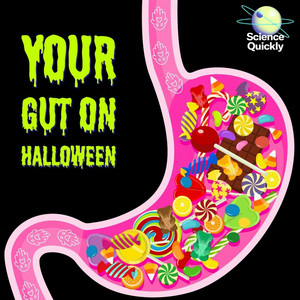
But what does this annual sugar splurge mean for the microbes that live in our guts?
The answer isn't as scary as you might think.
The trick is choosing your treats wisely.
Today's guest is Chris Damon, a clinical associate professor of gastroenterology and medicine at the University of Washington.
He's here to tell us how our candy consumption can help treat or trick the critters that haunt our guts.
Thanks so much for coming on to chat with us today.
Yeah, no, it's great to be on and thanks for the invitation.
So, as a gastroenterologist, when you think about Halloween, what are the big concerns that come up for you?
Well, that's a good question.
When I think about Halloween, first of all, it's one of my favorite holidays.
Same here.
It has been, you know, tracing all the way back to high school and Halloween window paintings.
And you know, of course, candy comes to mind when you think about Halloween, in addition to fun costumes and kids and pumpkins.
In terms of concerns, I'm a pragmatist realist when it comes to nutrition, and my kids remind me of this as well that it's okay to cheat every now and then.
I think holidays are one of those times when it's probably okay to relax a little bit around nutrition and Candy is a treat and should be treated as such.
Halloween is a holiday of tricks and treats.
So there you go.
But you know, moderation ultimately is a guiding light and moderation can happen any given day, but also can happen over the course of weeks and months.
Well, and you wrote a piece for the conversation last Halloween about the gut microbiome specifically.
That I thought was really interesting.
Like you said, holidays are great cheat days, and somebody who's mindful about their sugar intake all year is certainly not going to get in trouble enjoying some candy on Halloween.
But how much does that hold true for our gut microbes?
What do we know about what getting a sugar overload does to them?
So our microbes, when they see sugar...
There are certain bacteria that are present in our microbiome that thrive on sugar.
And they just happen, unfortunately, to be the ones that tend to be a little bit more inflammatory.
And so they can cause gut inflammation.
They can cause inflammation throughout the body.
And so when we treat ourselves to Halloween candy, we're also treating those less savory microbes to a happy meal, which ends up often with not feeling so happy, and we pay the consequences.
But not everyone responds equally to any nutrition and some are going to have more of those microbes.
Some might spike their blood sugars more because of underlying health conditions.
So ultimately, a lot of nutrition is really about listening to your body and how you feel.
Well, and you talked about in your piece how some candies might be friendlier to your good gut microbes than others.
Could you tell us a little bit about that?
This is something I'm really passionate about.
I don't think...
You know, all processed foods are equally bad.
Certainly, you're going to be best off having a whole food always.
But I think there are some processed foods which are better than others.
And that's true for Halloween candy as well.
Now, if you're going for lollipops and Starbursts and Skittles, you know, which are really just pure sugar.
There's, you know, colorings as well, present in these foods.
That's going to be less healthy than if you reach for something that has whole nuts in it, like a Snickers or a Payday or heaven forbid have a candy apple with a full apple in the center.
A candy that has elements of whole foods is going to be better for you than a candy that's almost purely processed sugar.
And then intermediate to something like a payday and something like a Starburst would be a peanut butter cup.
There's still good wholesome peanut butter mixed in with lots of sugar, but that peanut butter still retains a lot of the original elements of the peanuts that were used to make it.
And could you tell us a little bit about what's going on in our guts when we digest those whole foods that makes it better for our gut microbes.
I feel like our nutrition conversation at large has been very much around the things that are bad for us.
And we focused on the sugar, the salt, and the fat.
And that's certainly a piece of the puzzle.
And I wouldn't characterize them as bad.
These elements of food are incredibly important.
And it's really a matter of missing the balance.
And with balance...
While there are things that we get too much of, there are also things that we get too little of.
And we're starting to hear more about this.
Things like fiber and phytonutrients, polyphenols.
These are the types of things that are often processed right out of foods and that are missing in ultra-processed foods.
So when we talk about rebalancing our diet, it's really about bringing some of these things back in.
And what's fascinating is these elements are often as good for our microbiomes as they are for us.
And our microbiomes transform them into elements like modified polyphenols and things called short chain fatty acids that are incredibly important for our body's health and regulating our immune system and our metabolism, and even our brain.
So obviously there are a lot of things about a big sugar spike that might make you feel not so good.
But if we're talking about the gut microbiome specifically, what are things that people can do in the days after a day full of treats like Halloween to really support their gut flora?
Absolutely.
So, you know, after a day of indulgence, it's best to get back on the health bandwagon, so to speak.
And there are certainly, you know, things that are healthier to eat than others.
Naturally whole foods and that would be all the things that you normally hear about as being healthy and fruits and vegetables, but also whole grains and legumes like beans, nuts and seeds.
These are things that are often forgotten, but actually incredibly important.
Refocusing your diet back on those types of foods can help your body recoil from the indulgence of Halloween candy.
Well, thank you so much for coming on to chat.
I hope you're having a happy Halloween and enjoying some treats.
Yeah, wonderful.
And likewise, a similar well wishes to you and your listeners.
Happy Halloween.
That's all for today's episode.
We'll be back on Monday with our weekly science news roundup.
Science Quickly is produced by me, Rachel Feltman, along with Fonda Mwangi and Jeff Delvisio.
This episode was edited by Alex Seguiera.
Shana Posis and Aaron Shattuck fact-check our show.
Our theme music was composed by Dominic Smith.
Subscribe to Scientific American for more up-to-date and in-depth science news.
For Scientific American, this is Rachel Feltman.
Have a great weekend!
Thank you.