With NPR Plus, you get bonus content from behind the scenes of your favorite shows,
like the NPR Politics Podcast.
Friend of mine who worked at the Associated Press came in to the courtroom and said,
step to it, Michael Cohen is flipped on Trump.
And with NPR Plus, you'll be supporting Public Media.
Learn more at plus.npr.org.
You're listening to Life Kit.
From NPR.
Hey everybody, it's Mary L.
Well, today we're going to talk about tobacco products, vaping, and teenagers.
The University of Michigan has been doing this ongoing study of Americans and what drugs they use for decades.
And the researchers, they ask adolescents in 8th, 10th, and 12th grades, what drugs you use and how often.
So when it comes to tobacco products, there's good news and bad news.
The good kids these days are smoking cigarettes a lot less.
In fact, cigarette use is at or near the lowest ever recorded since the start of the survey in 1975.
The bad news, instead, the kids are vaping.
Overall, the highest rates are among those that are 17 to 18 years of age,
where the prevalence is 23% report having a vaping the past year.
So it's one out of five.
It pick around 2019 and then it has slowly go down, but it's still extremely high among teenagers.
One in five high school seniors, that's astoundingly high.
And it's worth pointing out here, getting addicted to and quitting cigarettes is not the same as getting addicted to and quitting nicotine vapes.
We'll get into why in a moment, but parents should know it's a whole new world out there and the old rules don't necessarily apply.
So on this episode of LifeKit, how to talk to teens about using e-cigarettes and how to help them quit?
Lee Gaines is an investigative education reporter at NPR Member Station W FYI, and she's been covering this in depth.
She's going to talk about why e-cigarettes are so addictive, what we know about the health impacts,
and what to do when you find out that your child is vaping.
Support for this podcast and the following message come from Wise, the app that makes managing your money in different currencies easy.
With Wise, you can send and spend money internationally at the Mid Market Exchange rate.
No guesswork and no hidden fees.
Learn more about how Wise could work for you at Wise.com.
It's a high stakes election year, so it's not enough to just follow along.
You need to understand what's happening so you are fully informed on November.
Every weekday on the NPR Politics Podcast, our political reporters break down important stories and back stories from the campaign trail.
So you understand why it matters to you.
Listen to the NPR Politics Podcast wherever you get your podcasts.
This message comes from the Pop Culture Mom's Podcast.
Best friends, Andy and Sabrina take their obsession with TV and movies to the next level,
talking to celebrities about the comedy and tragedy of parenthood,
and the fictional moms they love most.
Listen to Pop Culture Mom's wherever you get podcasts.
NPR Plus is a new way to support public media and get more from your favorite NPR podcasts like Fresh Air.
Sometimes I'll actually preface the question with if it makes you uncomfortable to talk about if it's too personal, just tell me.
Here's the question.
For behind-the-scenes content, bonus episodes, and more, sign up at plus.npr.org.
Serena Clark started vaping right before she turned 18 years old.
I was with my best friend. She was vaping and I'd be with her a lot,
and I was curious about it, but I would never just go for it, but then it came around to my birthday,
and then I was like, you know what, I'ma try it.
Serena lives in Tulsa, Oklahoma now, but she grew up in Shreve Port, Louisiana.
She describes herself as a people person, outgoing, a lover of the outdoors, and a musician.
At first, vaping was something she did with friends.
And so you weren't immediately addicted, but how quickly did that addiction set in?
Honestly, it took like a couple of weeks.
And even though she was under 21, the legal age to purchase e-cigarettes,
Serena says vapes were really easy to come by.
She had older friends who would buy them for her, and then sometimes there were stores nearby
that didn't even ID. They just wanted the money, basically.
So sometimes I could go in there myself and buy one if I wanted to.
Initially, Serena was buying disposable vapes.
She says they cost about 10 to $15 each.
At first, the vapes I was getting, they would last me to a good two weeks, almost three,
but then the more addicted I got to nicotine, they would run out by the end of the week.
And that brings us to take away one.
Vapes often contain way more nicotine than a regular cigarette,
and that makes them highly addictive.
Dr. Deepa Kamenge is a pediatrician and associate professor at Yale School of Medicine.
She works with teens and young adults who are struggling with substance use disorders,
including nicotine addictions.
The interesting thing about vapes that is different than cigarettes is that they have very,
very high nicotine concentrations.
Deepa says that high concentration of nicotine in e-cigarettes makes teens more likely to get addicted.
And we know that teen brains are kind of wired to really get a lot of reward
from these high nicotine concentrations.
And that's what makes them pretty susceptible to addiction.
And Deepa says these products are also marketed in a way that's super appealing to teens.
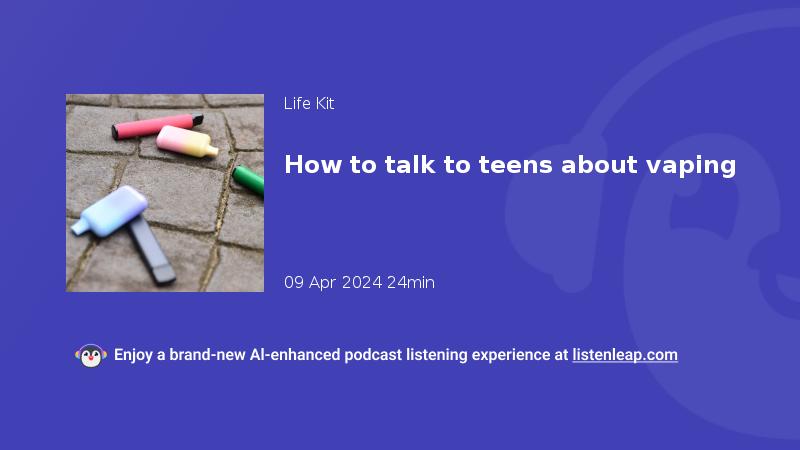
The packaging is aesthetically pleasing.
They come in nice colors, shapes, and designs, and some of them are flavored.
They're generally fruity, sweet, mentee flavors.
These are all appealing flavors to young people.
Like gummy bear and other candy flavored e-cigarettes.
The combination of the flavors with a nicotine is going to make nicotine even more appealing.
Dr. Nora Volkov is the director of the National Institute on Drug Abuse.
Because you have two reinforces.
One of them is the flavor itself, which actually can, by itself, be rewarding.
And then behind it is nicotine.
And your brain is going to learn rapidly that nicotine is rewarding and reinforcing.
At the peak of her addiction, Serena says she was using vapes that contained 5% or 40
milligrams of nicotine.
Whereas with a single cigarette, you're inhaling only about 1 to 2 milligrams of nicotine.
Compared to smoking cigarettes or weed, vaping was an easy habit for Serena to hide.
Because e-cigarettes don't produce smoke.
They produce an aerosol.
And the smell can be mistaken for perfume.
Serena could discreetly use her vape whenever she wanted.
But there were consequences.
It was causing a whole bunch of issues with me from my health.
Like it got to the point like I was just wheezing.
Like my breathing was not good.
And that leads us to our next takeaway.
Takeaway 2.
Understand the risks that vaping poses to teen health.
Deepa says there's really good evidence to show that vaping negatively affects lung health.
It's linked to wheezing, symptoms, it's linked to lung injuries.
Serena experienced this first hand.
She was wheezing and having a hard time breathing.
Serena also plays the flute. And once she got addicted to vaping,
her performance in her high school band suffered.
It got to the point where I was having a hard time blowing my instrument,
just playing my instrument in general.
And then there were times when I would just get up real fast.
Or I'm just walking and I'm just losing shortness of breath.
Deepa hears about symptoms like this all the time.
They feel differences when playing sports.
They can't keep up. They can't participate in training to the same degree as their peers.
Whereas they used to be able to do all the cardio.
They explain that they all feel pains when trying to go upstairs.
Nicotine can also harm the developing adolescent brain,
according to the Centers for Disease Control and Prevention.
And some substances found in e-cigarette vapor have been linked to an increased risk for cancer.
There's also evidence that shows teens who vape are more likely to smoke regular cigarettes in the future.
And medical experts say vaping nicotine increases the risk
teens will become addicted to other drugs.
We don't know the long-term effects of vaping on adolescent health and development.
But Deepa says it's something we should be concerned about.
We are still learning about the longer-term effects of vaping,
especially vaping that starts during the teen years.
What that means, you know, 20, 30 years down the line.
So remember, vaping nicotine is highly addictive.
It's bad for lung health and may harm brain development.
All of those are very good reasons to take action to prevent teens from vaping in the first place.
That brings us to Takeaway 3. Talk to your kids about vaping and do it early.
Deepa says it's best to start these conversations before children reach their teen years.
Because the reality is that very young kids are exposed to vaping.
Whether that's through the media, observing it in public, or seeing their friends do it.
So I do see 10-year-olds, I do see fifth graders who have started vaping
or smoking or using other substances as well.
It happens more often than we think.
Deepa says this is a problem across communities and districts.
Regardless of whether your kids attend public or private schools.
And really you want to be the first person to have that conversation with your child.
And it's ideally before middle school because they're going to see it.
And they're going to hear about it.
And it's really, you know, in their benefit to hear it from you first.
What your expectations are.
Deepa says you can use that exposure to vaping to start the conversation.
Maybe you're watching a TV show and someone on screen is vaping.
Or perhaps you're waiting in line somewhere with your kid and someone pulls out an e-cigarette.
So asking them what do you think that is,
then explaining to them what it is, it's a vape, and that, you know, it's dangerous.
And, you know, it's not healthy.
So really just living your everyday life.
There are a lot of opportunities to sneak in these brief conversations.
When kids are young, Deepa says keep the language simple and age-appropriate.
Vaping isn't safe or good for you.
As kids get older, you can share more details with them about the health impacts,
your expectations that they won't vape.
You can also help them figure out strategies to avoid it.
To be clear, this is an ongoing conversation.
And Deepa says starting the conversation early can have benefits in the long term.
Checking in with your kid, how they're doing,
asking them what they're experiencing with their friends.
And really showing that you care from a young age increases the likelihood
that they'll continue feeling safe and comfortable coming to you
in the teen years when they're, you know, perhaps encountering challenges.
Nora also has this message for parents.
Well, to start with, this number one, don't vape.
I've seen parents that hide themselves from their children,
so they don't see them vaping.
If they figure it out, that could be very detrimental.
Because the message that is being sent, of course,
is vaping cannot be so bad.
And at the same time, it's not so bad to actually
sky that you're doing something that shouldn't be supposed to do.
Instead, Nora says, have an open dialogue that's in no way confrontational
or critical of your child.
Explain to them matter of factly why vaping nicotine isn't healthy,
especially for teens.
And she says it's important to be attentive to what your kids are doing.
During the COVID-19 pandemic, when kids were home and schools were closed,
she says drug use among teens, including vaping, dropped significantly.
Nora says teens told researchers that the reason they were doing fewer drugs during this period
was because their parents were monitoring them.
But she cautions that you still need to respect your child's privacy.
If you don't, that could make them defensive or secretive.
Serena says kids respond best to a conversation, not a lecture.
Really, really, really, really don't hound them.
That's a heavy one because going up, I was hounded.
I was hounded about vaping or just smoking in general.
And I really wouldn't listen.
That brings us to take away four.
If you discover your child is vaping, don't ignore it.
Keep the dialogue going and stay calm.
It's scary as a parent, your mind goes in a lot of directions.
But Deepa says getting really upset and yelling can be perceived by some teens that you don't
care about them or their well-being.
It decreases their ability to hear you.
So the degree that you can really try to approach it
is calmly as you can and it's very difficult because
you're very worried often about your child in these situations.
I think really increases the likelihood that your kid,
first of all, will talk to you and second will be open to
suggestions or support that you can give.
Deepa also cautions against the assumption that this is a one-time thing.
Because the rates of vaping are so high among teens and these products are incredibly addictive,
one-time use isn't something you can count on.
And she says if your child is vaping, limiting the amount of money you give them or
restricting their access to certain privileges isn't a bad idea.
What you're doing really is setting up healthy boundaries for your child and showing them that
as you make good choices, these privileges will return.
Nora also strongly recommends teens who are vaping get screened for any underlying
condition that could be driving their desire to use.
If you have ADHD and you are not being treated when you're intoxicated with nicotine,
will make you concentrate better and pay attention better.
Just like it will make you a less depressed when you are on the effects of nicotine.
Serena experienced something similar.
Vaping for her was a way to relieve stress.
It gave me honestly some type of peace because I was the type of person who would
get stressed out and get angry and I'd just be shaken and nervous and bothered.
But once I took a hit of the vape, it was just, I was just relaxed.
But again, these are transients and ones that drug leaves your brain,
which it leaves it very rapidly, then you are worse off than you were before because the brain
readaps.
So remember, stay calm and try to get to the root of what's driving their desire to vape,
which might include treatment from a medical professional.
And Serena adds, make sure they know you care and let them know how you feel and let them know
the health risk. You may feel like you're wasting your time, but
Chesney, us teenagers, we hear you and we always have that in the back of our heads.
After high school, Serena's breathing problems and chest pains became a real concern.
And she says she remembered how her parents told her they were worried about her health.
By this time, she was living in Tulsa and she had a new girlfriend.
My girlfriend, she was concerned about my health as well. And so then I was like, yeah,
I need to stop this.
But quitting wasn't easy. Serena first tried to quit two years ago when she was 19.
I stopped vaping for about three, four months and then I ended up going back to it.
That brings us to take away five. While more research is needed, there are some promising
strategies to help the young people in our lives stop vaping.
To be clear, lots of teens and young adults want to quit vaping.
Deepa says she has patients as young as 14 who are trying to quit and they're struggling with cravings,
difficulty concentrating and irritability.
Because they are experiencing withdrawal and they literally cannot get through a class without
vaping as a result of that. Deepa says research shows that it can take adult cigarette smokers
multiple attempts to quit. So it's to be expected that a teen might quit and then start vaping again.
It doesn't mean that that quit attempt was useless and won't have benefits.
It also doesn't mean that you shouldn't encourage quitting again, right?
Because it takes several times for some people to quit.
Because vaping nicotine is a relatively new problem, Nora says we're still trying to figure
out how to help teens quit. The problem with nicotine vaping overall is that the evidence that
exists in terms of the efficacy of the interventions is not as robust as we would want it to be.
She says there's an urgent need for research on how to help teens quit vaping.
In part because the medications typically give into adults to help them quit smoking,
known as smoking secession aids and nicotine replacement therapies,
haven't been shown to work as effectively in teens.
They were saved but they did not work in adult lessons.
But Nora says medication isn't the only option. Therapy can help teenagers understand
their addiction and how to manage their cravings.
Teaching a teenager what are the factors that are leading them to continue taking
and vaping when they no longer want to do it? Deepa says a therapist or other healthcare provider
can help kids come up with strategies to avoid vaping and parents can reinforce those strategies
at home. So some of the things we talk about are like having a schedule distracting yourself when
you feel urges, avoiding things that might trigger urges for you, really trying to encourage,
make it easy for your kid to avoid those triggers if you can.
And Nora says there are other tools teens can use.
There are as most trials that have been published with positive effects,
with social media that actually engage peers.
Take Serena's story for example. The first time she tried to quit she joined a texting program.
It didn't work for her because she says the responses she got were automated.
She wasn't talking to real people. But then she joined an Instagram-based program called Quit the Hit.
It's a free five week facilitated program that gets groups of 10 to 15 young people who are trying
to quit vaping together in a private group chat. We were able to share different techniques and
tips that help us to stop vaping, to slow down, to help us get to where we want to be with that.
And actually having like a actual person coach in that group chat, just sending videos and
tips and different things to help us. It was just really nice. And I think just having that
connection with people that helped me a lot.
Serena says she was able to quit by weaning herself off nicotine. By reducing the concentration
in the vapes she purchased. I ended up going down to like a 1% vape. And when I had got to that 1%
vape, I didn't even hit that one at all because just hitting that one maybe just want to vomit,
honestly. Because there was no that type of nicotine. It was just like,
flavored air. It's been about a year since Serena stopped vaping. She says her life has
improved dramatically as a result. She's not wheezing anymore. She doesn't have any chest pain.
And she's developed healthier ways to cope with challenges.
Instead of me wanting to vape now, the ways I deal with stress or just anything in general,
I go outside now. I just sit out on the porch, look at the sun, listen to the pretty birds.
Like I just do things that are better for me. But my life has just been better. All that better.
So let's recap what we've learned. Take away one. Vaping nicotine is highly addictive. And the
marketing and flavors make it especially appealing to kids. Take away two. Vaping can harm teens'
health. More research needs to be done on the long-term effects, but we do know it causes lung damage.
Take away three. Talk to your kids about vaping and why you don't want them to start. And do it
before their teenagers. Take away four. If you discover your child is vaping, stay calm. Keep
the conversation going and try to understand what's driving that behavior. Take away five.
While more research is needed, there are some promising strategies to help the young people in
our lives stop vaping. That was reporter Lee Games. For more life kit, check out our other episodes.
We have one on how to talk to teens about drugs in general and another on the benefits of a walk
in the forest. You can find those at npr.org slash life kit. And if you love life kit and want even
more subscribe to our newsletter at npr.org slash life kit newsletter. Also, we love hearing from
you. So if you have episode ideas or feedback you want to share, email us at lifekit.atnpr.org.
This episode of life kit was produced by Claire Marie Schneider. Our visuals editor is back
Harlan and our digital editor is Malika Garee. Megan Cain is our supervising editor and Beth Donovan
is our executive producer. Our production team also includes Andy Tagle, Margaret Serino and Sylvie
Douglas. Engineering support comes from David Greenberg. Special thanks to Susan Wally,
Suitschitra, Krishnan Serran, and Marsha Zaria. I'm Mary Elcigara. Thanks for listening.
This message comes from NPR sponsor Ted Health from the Ted Audio Collective. Every week on Ted Health,
Dr. Shoshana Ungerliter and leading health experts break down the newest medical breakthroughs
and most relevant health questions. Listen where you get your podcasts.
Ever feel like you missed the big point of the last movie you watched?
At Pop Culture Happy Hour, a podcast by and four pop culture addicts, we'll talk about the latest
and greatest culture in depth. For talking points for your next happy hour, check out Pop Culture
Happy Hour, four days a week only from NPR. This message comes from the Kresge Foundation.
Established 100 years ago, the Kresge Foundation works to expand equity and opportunity
in cities across America, a century of impact, a future of opportunity, more at Kresge.org.