Hi, I'm Vanessa from SpeakEnglishWithVanessa.com.
How fast can you speak English?
Let's talk about it.
Have you ever thought, oh my goodness, English speakers speak so fast.
How will I ever be able to speak like that?
Well, today I have some good news for you.
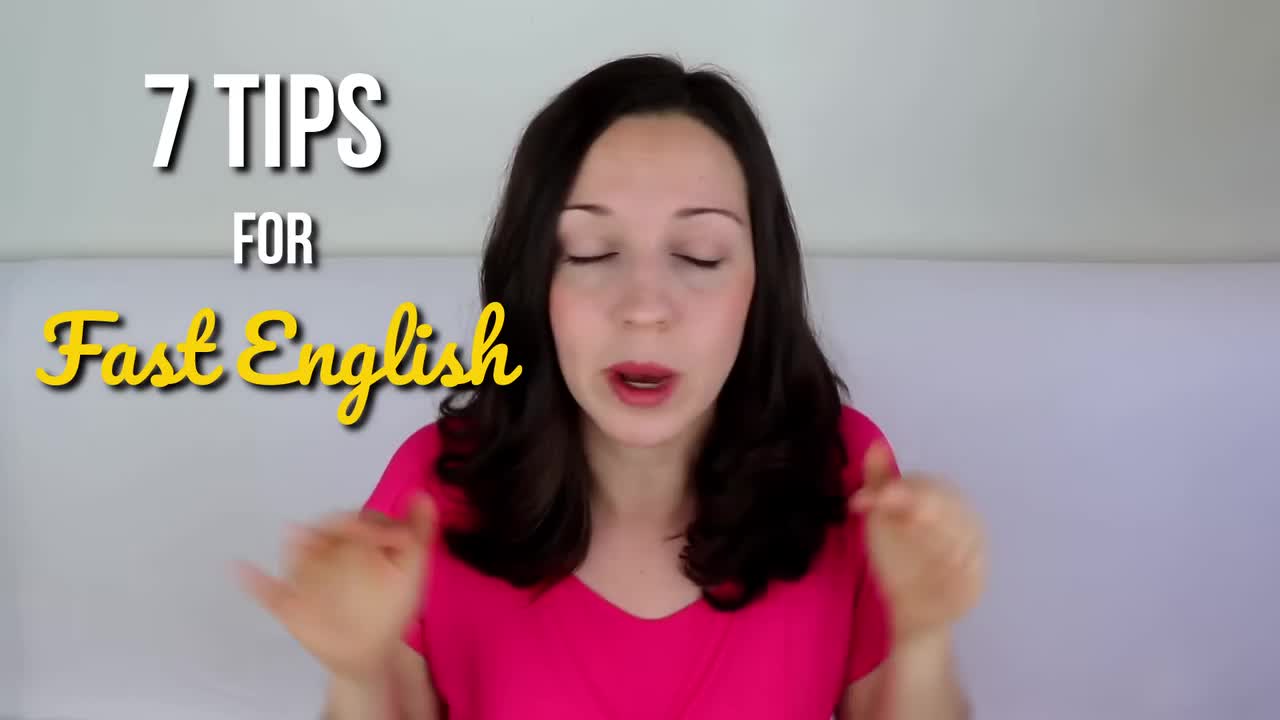
I'm going to share with you seven important tips that native speakers use when they speak quickly.
We're going to talk about reducing sounds, cutting off sounds, and connecting sounds.
And then, at the end of this lesson, I have a challenge sentence for you that I want you to be able to say as fast as you possibly can.
So let's get started with the first tip.
My first tip for speaking fast English is to use contractions.
What are contractions?
They're when you put two words together.
I'd like to go. is, I would like to go.
He's busy.
He is busy.
What are you doing?
What are you doing?
If you'd like some tips about how to pronounce 81 contractions, I made a video about that up here to help your pronunciation.
But this first tip is the most simple.
We'll talk about some more difficult tips later, and it's an easy way to speak quickly.
I'd like to go.
I would like to go.
Do you see how we can speak quicker, because we're cutting off all the sounds in the word would, except for that final D.
I'd like to go.
Great.
Let's go on to the second tip.
My second tip for speaking fast English is to reduce these four common verbs gonna wanna gotta have to.
I'm gonna study English means I'm going to study English.
That word to simply becomes a. I'm gonna study English.
Or you might say, I wanna study English.
Here, we're changing want to to wanna.
Again, the word to changes to a. I wanna study English.
Or maybe you would say, I gotta study English.
Here, we have a longer verb.
I have got to study English becomes I gotta.
I gotta study English.
And then you might say, I have to study English.
Have to?
Here again, to changes to a. I have to study English.
Can you say these with me?
I'm going to study English.
I want to study English.
I got to study English.
I have to study English.
Beautiful sentences and it's so fast.
My third tip for speaking fast English is to reduce the word you when you're asking a question.
We're going to talk about three common question words and unfortunately, the word you reduces in a different way for each question.
So listen carefully and let's check it out.
The first question word is what.
How can we reduce the question, what are you doing?
What are you doing?
We could reduce this to say, whatcha doing?
Whatcha.
Whatcha.
It sounds like a CH sound here.
And actually, we've cut out completely the word are, and the word you just becomes cha.
Whatcha doing?
You might notice too, extra tip, that the end of the word doing, that G, also gets cut out.
Whatcha doing?
Whatcha doing?
So I end that word with an N.
Whatcha doing?
Whatcha doing?
Oh, I'm teaching an English lesson.
Oh, I'm studying English.
I'm going to sleep.
Whatcha doing?
Whatcha doing?
Whatcha, whatcha doing?
Let's talk about the second WH question.
Where you going?
Where you going?
Do you notice the same thing happening here with that ing at the end?
Where ya going?
It ends with an N. What is happening with the word you?
Where ya?
We just changed it to ya, ya.
Not you, but YA.
Where ya going?
And again, we cut out R. Where are you going?
Where you going?
Where you going?
Where you going?
What about if you wanted to ask a polite question?
Would you help me?
Maybe you need some help in the office.
You might ask this lovely question.
Would you help me?
But if you want to say it fast, you could say, would you help me?
Would you help me?
Would you help me?
Would you?
Instead of a ch sound, like we talked about before, whatcha doing?
Here instead, we are going to say j. Wouldja help me?
Can you say that with me?
Wouldja.
Wouldja help me?
Would you help me becomes wouldja.
Wouldja help me?
Wouldja help me please?
Tips number four, five, and six include cutting off sounds.
These are a little bit more tricky, so let's pay attention carefully.
Tip number four for speaking fast English is to cut off the T at the end of words.
Ooh, what about this sentence?
I go out. every night.
I go out every night.
Do you hear I go out every night?
Nope.
Instead, your tongue is at the top of your mouth.
You're about to make the T sound, but no air goes through, so it's just stopped at the top of your mouth.
I go out every night.
I go out every night.
If you would like to know some more common sentences in English that use this.
We use this all the time, but you can check out this video I made up here about how to pronounce the most common sentences in English.
I go out every night.
Can you say that with me?
Every night.
Tip number five for fast English is to cut off the letter D at the end of words.
Let's check out this sample sentence.
I found a blue and white card.
I found a blue and white card.
I found a blue and white card.
Maybe you found a blue and white card on the street and it was a birthday card that someone just threw out their window.
I found a blue and white card.
I found.
The word ends in the letter N. I found a blue and white Here the word and is being reduced.
Just cut off that final D sound.
I found a blue and white card.
Card.
This is a little bit different than the word car.
I drive a car because your mouth is making the shape of that D sound, but it's not making the vibrations happening.
You're not actually making a D sound, but your mouth is making that shape.
Card, card.
My tongue is flat against the roof of my mouth to make the D, but it's not coming out.
Card, card.
Can you say that sentence with me?
I found a blue and white card.
I found a blue and white card.
I found a blue and white card.
My sixth tip for speaking fast English is quite advanced.
It is to cut off the first sounds with a few pronouns.
His, her, and them.
Let's look at a couple sample sentences.
I think he's right.
I think he's right.
I think he's right.
There's no H happening here.
I think he, think he.
Kind of sounds like you're saying think he.
I think he's right.
Do you notice too, at the end of the word right, there's no T sound.
I think he's right.
I think he's right.
I think he's right.
We do this all the time.
Let's go on to another pronoun.
It's his turn.
It's her turn.
It's his turn.
It's her turn.
This one's a little bit weird, isn't it?
The H at the beginning of his and her is cut off.
We don't do this all the time, but it does happen often enough that you want to make sure you can understand when native English speakers are using it, and also so that you can use it yourself.
It's our turn.
It's her turn.
It's his turn.
His turn.
It's his turn.
It's his turn.
We're not saying it's his turn.
It's his turn.
It's his turn.
It's our turn.
It's our turn.
It's our turn.
Great.
What about the word them?
I listen to them.
I listen to them.
Um.
The word them has the th cut out and instead you're saying um.
Um.
I listen to them.
Maybe if someone asks about some music that you like, you might say, oh yeah, I listen to them.
I listen to um, um.
I listen to um.
This is quite casual and we use it a lot in daily conversation.
I listen to um.
Can you say that with me?
I listen to um, um.
So we need to reduce some pronouns as we're speaking.
Him, his, her, them.
My seventh tip for speaking fast English is specific to American English.
It is to change a T sound to a D sound.
You might have noticed that we've done a lot with T's and D's, cutting them off at the end of words, and here we're changing them for each other.
So when we say a word like the word better.
Water.
Do you hear better, water?
No.
In American English a T, that's between two vowel sounds.
It doesn't always have to be a vowel, but between two vowel sounds is going to change to a D, Better water.
Let's look at a sample sentence.
The sweater is better.
I like water.
Sweater.
Notice that T?
It's between two vowels.
Is better.
It's between two vowel sounds.
I like water.
It's also between two vowels.
What if we take it up a notch?
These T's in the next sample sentence are also between vowel sounds, but it's not so clear.
Put it in the desk.
Put it in the desk.
We have a lot of D sounds.
Put it in.
Put it in.
What's happening with that T at the end of the word put?
Well, it's a T between two vowels, even though there's two separate words.
Put it in.
And the word it is between two vowels, even though it's two separate words.
So I know this can be a little bit tricky, but you're going to hear native speakers use this all the time, so make sure you can do it too.
Can you say it with me?
Put it in.
Put it in.
Put it in the desk.
Put it in the desk.
Put it in the desk.
Put it in the desk.
Do you see how that makes it much faster?
Because, instead of spending the time to let the air come out of your mouth, Your tongue is just tapping the top of your mouth to make a D Put it in.
Put it in instead of put it in.
It makes it a lot faster.
Are you ready for a final challenge sentence?
It's going to combine so many of these seven tips and it's going to challenge your mind and your pronunciation muscles.
Our sentence is, I'm going to eat his food and it'll taste great.
Pretty fast.
Let's break it down.
I'm gonna.
I'm gonna.
Remember those reductions we talked about at the beginning of this lesson?
We have a contraction, I am, and then we're reducing going to, to become gonna.
I'm gonna.
I'm going to eat is, eat is.
Here the final T is changing to a D.
But why is it changing to a D if the next word doesn't start with a vowel?
Well, do you remember that we need to cut off the H for the word his?
So instead it sounds like a vowel, is.
Eat is.
So let's change that T to a D and make sure that you cut off the H. Eat is.
Can you say that with me?
Eat is.
Eat is food.
Food.
What happens to that final D?
We just cut it off.
Food and we're cutting off the next D. It'll taste great.
It'll.
What is happening with this contraction?
Well, when we say the contraction it will, we kind of add a little u sound.
Before the L, it kind of sounds like U-L-L.
It'll.
So here we have two vowel sounds, even though we don't see them, similar to before.
It is.
So here we have it'll.
It'll taste.
Here we're cutting off the T, great, and we're cutting off the T again.
It'll taste great.
Can we go back and say this full challenge sentence together?
Let's give it a try.
I'm going to eat his food and it'll taste great.
So much going on here.
Let's try to say it fast.
I'm going to eat his food and it'll taste great.
I'm going to eat his food and it'll taste great.
I'm going to eat his food and it'll taste great.
Great.
I hope that you can say this sentence by yourself.
Use those pronunciation muscles and challenge yourself.
Thanks so much for learning English with me.
I want to know in the comments which one of these fast English tips was new for you.
Can you make a sentence with one of these fast tips?
Try to speak it quickly and if you see other comments, you can try to say them fast as well.
Thanks so much for learning with me, and I'll see you again next Friday for a new lesson here on my YouTube channel.
Bye.
The next step is to download my free ebook, Five Steps to Becoming a Confident English Speaker.
You'll learn what you need to do to speak confidently and fluently.
Don't forget to subscribe to my YouTube channel for more free lessons.
Thanks so much.
Bye.