NPR. It's a well -known fact that Americans love to shop.
We're just not always very good at it.
Panic buying is spreading across America.
Panic buying in full swing Thursday.
Panic buying now. Panic buying.
Lots of panicking. So, and that was caused by a dockworker strike last month that shut down ports along the east coast and south.
And some shoppers responded by raiding stores.
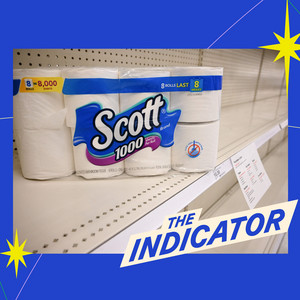
They were afraid the closed ports would mean a shortage of essentials, including the king of essentials.
Look, we get it. Port strikes, pandemics, hurricanes, these are all scary things that can lead to panic.
And it can be hard to know what will and won't be on store shelves when they happen.
And that's why the indicator has your back.
This is the indicator from Planet Money.
I'm Adrian Ma. And I'm Stephen Bissaha from the Gulf States Newsroom.
Today, we're going to talk to a supply chain superhero about how to shop no matter what's the latest crisis knotting up the supply chain.
So keep calm and keep listening.
This message comes from Wwise.
It's the app for doing things in other currencies.
Send, spend or receive money internationally and always get the real -time mid -market exchange rate with no hidden fees.
Download the Wwise app today or visit Wwise .com.
Tease and C's apply.
Support for NPR comes from NPR member stations and Eric and Wendy Schmidt through the Schmidt Family Foundation, working toward a healthy, resilient, secure world for all on the web at the schmidt .org.
This is our glass of This American Life each week on our show.
We choose the theme, tell different stories on that theme.
All right, I'm just going to stop right there.
You're listening to an NPR podcast.
Chances are you know our show.
So instead I'm going to tell you we've just been on a run of really good shows lately.
Some big epic emotional stories and some weird funny stuff too.
Download us, This American Life.
This message comes from Pushkin in the Against the Rules podcast.
Bestselling author Michael Lewis is looking at what the rise of sports betting is doing to America's teams and fans.
Listen, wherever you get your podcasts.
To be the guide in our shopper's guide, we got Terry Esper.
He's a professor researching logistics and supply chain management at Ohio State University.
And he actually gave us a one -on -one a few years back on what logisticians do.
And Terry made it sound like he almost moved you from Logistics 101 to a new major.
I was trying to recruit him back into studying logistics.
He was like, wow, yeah, this is really interesting.
And I'm like, well, hey, man, come on back.
We'd love to have you at Ohio State, but I couldn't appeal to him.
Never stop recruiting.
Always be closing, as I say.
So you haven't been moonlighting as a logistician on the side here?
Not yet, but honestly, Terry makes a very persuasive case.
Yeah. And you can think of logisticians as the WD -40 for our economy.
They make sure the supply chain from raw goods to factories to store shelves moves as smoothly as possible.
And while it might be easy to imagine a logistics professor getting judgy about panic buyers, Terry actually saw the latest shopping spree as a good thing.
So you are pro panic buying to an extent.
Let me not say I'm pro panic buying.
But I am pro consumers making the link between there's something happening in logistics.
Oh, that could affect my daily life.
Like, I am very much pro that.
So to be clear, panic buying is not a good thing.
It can create shortages or worsen the ones that got people panicking in the first place.
So to avoid that, we got our crisis buyer's guide, which honestly is less a catalog of products to buy or skip and more of a mindset, a series of questions to ask before running to the store or filling your online shopping cart.
For example, in the case of a global trade disruption like the dock worker strike that we just saw, the first question to ask is, is what I want to buy made domestically?
Because if it's not being imported from some other country, in most cases, there's nothing to worry about.
And this lets us kick a big panic buying purchase out of our shopping carts.
I'm talking toilet paper.
The companies that typically manufacture most of the brands of toilet paper that we buy in this country, they all pretty much manufacture that product here in the U .S.
Terry says when it comes to global trade disruptions, you should still save most of your worries for the products that we do import.
And that includes a lot of perishable goods.
We're talking things like fresh fruit, fresh fish.
So instead of running the paper aisle, you should run to the seafood aisle.
That's definitely something to take into consideration.
Another item to keep an eye on when we're talking global shipping issues is medicine.
Pharmaceuticals is one of those product areas that I actually advise people to maybe watch a bit because a lot of pharmaceutical product and even the active ingredients in pharmaceuticals, a lot of that product is imported.
But at the same time, Terry says, hold off on the panicking.
Here's the thing. Most pharma companies have roughly around 180 days of inventory on hand.
Six months of inventory, which, when you think about it, is kind of a contradictory approach to the way a lot of companies operated before the pandemic.
Right. You might have heard of this thing in logistics called the just -in -time economy.
This idea that companies should have goods and materials show up at stores and factories just when they're needed.
Right. No more, no less.
And they shouldn't have a lot of extra supply just laying around.
But Terry says companies still remember this sting of how just -in -time bit them when the pandemic threw off that timing and led to shortages.
He says that meant we've seen a swing from just -in -time to just -in -case.
Most companies have, you know, really taken a different approach to be much more proactive about making sure that they keep inventory within and across their supply chains.
This also gets us to the next question you should ask before panicking.
Is it something that was sudden or something that was foreseeable?
Case in point, it is actually possible that the dock workers could go on strike again.
They only have a temporary agreement that lasts until mid -January.
And if negotiations fall apart, another strike could ensue.
But companies have time to prepare.
Every company that I engage with, they're watching what's happening with that port situation and they are buffering their inventories and they're preparing for it in many, many ways.
So have faith in the logisticians for this one.
Have faith in the logisticians.
Yes, of course, not every supply chain disruption comes with a warning months or weeks in advance.
Right. We've been hearing about these lately in the form of natural disasters like a hurricane.
Yeah. And this is a scenario where Terry says toilet paper actually makes a bit more sense to add to your shopping list.
If you have a big family and you don't know how long it's going to be before you'll be able to get your hands on a replenishment, that makes sense.
And so for that reason, I think that, you know, it's a fine line between when it becomes maybe a bit more of a panic buy and when we're just making good decisions.
To prepare our families for a contained and prayerfully short lived interruption and getting access to products.
And this brings us to the final question to ask yourself.
How much do you actually need?
Because chances are it is probably not a month's supply of toilet paper.
Terry says that's because logisticians still have your back with a little help from meteorologists.
A lot of people that study meteorology go to work for corporations and really work at modeling and predicting where there might be potential weather issues.
So if you're talking about a company like a Wal -Mart, they're moving inventory closer to those areas to be prepared to replenish after the weather event.
You know, for all the praising we're giving to logisticians right now, they do have their limits.
If a natural disaster hits somewhere that's a major supplier of a vital product, that's a problem.
Like when Hurricane Helene destroyed a major IV fluid facility in North Carolina.
We're still dealing with an IV shortage because of that.
Still, Terry says disruptions like that are at the exception that average shoppers shouldn't worry too much about.
To summarize our guide, if we're dealing with a global shipping disruption like a port strike, you can leave anything domestically made off your prepper list.
Right. And if it's something exported, check to see how long people have known about the upcoming crisis, because there's a good chance companies have been building up their rainy day inventory.
And while it might be a good idea to stock up a little before a bad storm, do not buy every roll of toilet paper, because logisticians are already at work making sure the next TP shipment is on the way.
That's where the logisticians with our cape will swoop in and save the day.
Right. Give us the opportunity to save the day.
Terry Esper, logistics superhero.
Steven, this actually reminds me.
Last time we interviewed Terry, we actually made a movie trailer for a logistician action movie.
Oh, yeah, I already got the popcorn popping.
In a world where shipping is slow to a crawl, we're in stock levels don't equal on shelf availability.
Who can create order from chaos?
Is anyone here a supply chain manager?
I am in theaters this fall.
It's the logistician.
As Hollywood called it, awesome stat trailer.
Oh, yeah, I'm ready, man.
You know, you're staying ready.
This episode is produced and fact checked by Cory Bridges with engineering by Neil Rauch.
Kagan Cannon is our editor and the indicator is a production of NPR.
On NPR's Wild Card Podcast, comedian Seth Meyers talks, frankly, about his early career.
I was a far more temperamental when I was younger and things ran very hot at SNL and there were definitely times where my instincts were to say something that would have been relationship ending to people.
I'm Rachel Martin. Seth Meyers is on Wild Card, the show where cards control the conversation.
Hey, everyone, I'm B .A.
Parker, a host of the podcast Code Switch.
And on my show, I get to dig into all of the facets of being a black woman from honoring my ancestors to exploring representation in reality TV.
Code Switch is a place where I think out loud about how race and identity are connected.
Join me on the Code Switch podcast from NPR.
Joe Biden's on his way out and Donald Trump's on his way back.
Want to know what's happening as the presidential transition is underway?
The NPR Politics podcast has you covered with the latest news and analysis.
Listen to the NPR Politics podcast.