Okay, so tell me if this sounds like you.
You love NPR's podcasts, you wish they weren't interrupted by sponsor breaks like this one, and you want to support NPR's mission of creating a more informed public.
If this does sound like you, then it's time to sign up for perks across more than 20 podcasts with the NPR Plus bundle.
Learn more at plus .npr .org.
This is Planet Money from NPR.
Of all the power tools in a woodshop, I am most scared of table saws.
My father, a nine and a half fingered carpenter, never let me get near them.
When I started working at a cabinet factory, the instructions were clear.
Of all these extremely dangerous spinning pieces of metal, the table saw is the one I should be the most careful around.
And yet, the other day, I was getting ready to get dangerously close to one.
I'm in a woodshop just outside of Portland, Oregon, and not just any workshop.
It is the cleanest, most well -organized shop I have ever seen, not a speck of sawdust.
And in the middle of it, there is a table saw.
A table saw is what you use when you want to cut something the long way, generally.
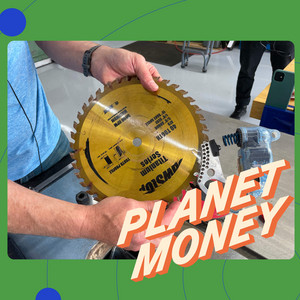
So picture a table, and sticking out of that table is a very sharp blade, about the size of a dinner plate, spinning very fast.
And the person operating this table saw right now is someone who has tried to make table saws much safer.
I'm Steve Gass. I am the inventor of SawStop.
What does SawStop do?
SawStop is a technology for table saws that if you run your hand into the blade, it stops it so quick you just get a little nick instead of cutting your fingers off.
Really? Really, every time.
Uh, you think we can test that out?
Oh, yeah. I am not ready just yet to sacrifice a digit for podcasting, but at Steve's suggestion, I have brought a pack of hot dogs.
Actually, beef brats.
They were cheaper. The way this test is gonna work is that Steve is going to push a board with the beef brat on top of it, simulating a finger, into the blade.
And when the brat hits the blade, he is pretty confident that the saw is gonna stop.
He's done this a bit.
The blade is gone, disappeared into the table part of the table saw.
The hot dog unscathed.
I don't even think we can see the mark where it hit the hot dog.
How many fingers do you think this is saved?
Well over 10 ,000 fingers now.
10 ,000 fingers. Yeah.
Yeah. Fingers get saved on SawStops every day now.
I asked Steve to see this dark magic again.
He takes the saw blade off, replaces the part, and we're ready to go.
Can I do it? All right.
Let's fire it up. Is it good to go?
Why don't I just try my finger?
I think that's a bad idea.
It just seems like, based on experience, it's unpleasant to touch a spinning saw blade, even with SawStop.
I'm gonna do it. Oh!
Just kidding. It was a hot dog.
Oh, that's delicious.
I think the saw works have been sent out.
Hello, and welcome to Planet Money.
I'm Nick Fountain. Table saws send an estimated 30 ,000 Americans to the emergency room every year, according to the government.
3 ,000 of those people lose a finger or worse, sometimes even their hand.
3 ,000 people. The cost of all of that is huge.
Billions of dollars in medical treatment and lost wages every year.
And yet Steve figured out the technology to prevent these injuries 25 years ago.
He's been trying for 25 years to make it the standard.
He thought he'd be a hero, but so far, he has not been successful.
And along the way, he's made enemies of pretty much everyone in the power tool industry.
For a while there, you were the most hated man in woodworking.
Yeah, yeah, you would want to check my head for horns if you read some of the woodworking forums.
Today on the show, Steve against the machine or the makers of the machines.
Need a binge listen?
Check out the latest series from NPR's embedded podcast.
It's called tested.
Since long before the Paris Olympics, women in sports have been asked to prove their gender.
There was chit chat about is that really a woman?
Listen to tested a new series from embedded and CBC about the history and future of sex testing in sports.
All episodes are out now.
Hey, it's Mike and Ian.
We're the hosts of how to do everything from the team at wait, wait, don't tell me every week.
We take your questions and find someone much smarter than us to answer them.
Questions like, how do I safely jump out of a moving vehicle?
How do I dangerously jump out of a moving vehicle?
We can't help you, but we will find someone who can listen to the how to do everything podcast from NPR.
Our co -pilot for the show is none other than Chris Arnold from NPR's investigations desk.
Chris, you've been covering the story for a couple of decades.
And the way you found out about it, it was kind of an accident, right?
Yeah, I had just bought my first house and it needed a lot of work.
So I was fixing it up.
And one day I was reading this woodworking magazine and I saw this little blurb about saw stop, which I'd never heard of.
And I was like, whoa, a table saw that won't cut off my fingers.
Like that is definitely the saw that I want to buy.
And I called the 800 number and Steve himself picked up and he just had this really incredible story to tell.
Steve is a tinkerer, a woodworker, an inventor.
He says that when he was a kid, he got injured in a wood shop pretty badly, not by a table saw, but by another tool.
And after that, he's thought a lot about tool safety.
Inventing saw stop, Steve says, was actually pretty quick.
He realized essentially that a human body conducts electricity, but wood does not.
So he designed a saw that can tell the difference.
And it will immediately stop when the blade hits a finger.
Coming up with this basic idea that took like an afternoon, it was what came next, the next 25 years that really came to test him.
Steve patented his invention.
His hope at the beginning was that one of the big tool makers would use his technology and pay him.
In other words, they would license it, but he didn't have much luck convincing the tool companies.
And so he worked up a crude prototype and took it on the road.
And there was no trade show or conference that was too small or too weird for Steve.
Like pretty early on, he got invited to a conference for defense attorneys who work on product liability lawsuits, which kind of raised his eyebrows, but he's like, all right, well, they're inviting me.
Sure. Walking into that conference.
How did that feel? Well, it was a little bit like going into the lion's den.
But on the other hand, I thought they would be advocates for it because otherwise the manufacturers would be getting sued and, and have big payouts and, and that wouldn't work well for them.
Um, it didn't turn out that way.
Steve had been optimistic.
He thought this room full of lawyers who worked for power tool companies would like his invention.
Fewer injuries would mean fewer lawsuits.
And so maybe these lawyers would be able to convince the table saw manufacturers to adopt SawStop.
And also Steve thought this was a win for society at large.
Really. I mean, you know what, when somebody gets hurt, there are a ton of costs.
If the person is hospitalized, the tool company doesn't pay for that.
It's the person's insurance company, or maybe the state.
If they have to go on disability, we all pay for that in one way or another.
Yeah. In economics terms, these costs are known as externalities.
The tool manufacturers are not bearing all these costs.
We are. And one way our society has decided to try and place those costs back onto the manufacturers, at least part of those costs is through lawsuits.
We allow people to sue manufacturers when they get hurt.
And if product liability lawsuits get expensive enough, companies might decide it's just cheaper to make their products safer.
And here's Steve is with this invention that would immediately make one of the most dangerous power tools out there much, much safer.
So he shows these lawyers, his hot dog presentation, and he is just buzzing.
He thinks, man, I nailed it.
You know, I'm excited.
I've just had the opportunity to present, uh, this technology to a group of people who have the potential to be very influential in its adoption.
Also, make you rich and make it so that you can live on the, on the beach sipping.
So I don't drink, so won't be a my tie, but sipping a soda, uh, you know, living the easy life.
Um, and yeah, so I'm, I'm really excited.
I, you know, I have, you know, sort of, uh, delusions of grandeur.
But the lawyers of the room seem to view this all very differently.
Right after the hot dog presentation, this one lawyer gets up and his presentation was how we're going to defend against product liability claims relating to SawStop.
See what Steve hadn't realized was how much of a threat SawStop was to these companies for a long time, table saws were just considered inherently dangerous.
But as soon as Steve invented SawStop, that wasn't necessarily true anymore.
And that could open up a big legal can of worms.
Because if some saws had saw stopped, the ones that didn't might not be considered reasonably safe anymore, which meant the tool makers could be opening themselves up to way more lawsuits.
And that is what this lawyer started talking about.
And his argument, uh, was sort of insidious.
It was basically, well, if none of us adopt this technology, we will be able to argue that it was not technically viable.
And the evidence for that will be the fact that no one adopted it.
In other words, because Steve's product is just a prototype, it was an unproven technology.
And if nobody adopted it, if no manufacturer put it on their saws, it would stay unproven.
And I heard that and I thought, you know, that sounds a little bit like a group suggestion to Steve.
It kind of sounded like, look, nobody put this on their saws and then all this is just going to stay nice and quiet and go away.
And the way it played out actually followed nearly exactly that script.
I called up the lawyer who gave this presentation.
He said he did talk about how if manufacturers didn't adopt this technology, they might not be opening themselves up to this new legal risk.
But he also talked about a lot of different things that day.
It was kind of a wide ranging academic presentation.
And Steve just latched onto that one kind of thought experiment.
Still around this time, back when I first started covering the story, I did talk to people inside the industry and they told me that this legal risk was a really big concern for them.
Now, up to this point, Steve had hoped that SawStop would make the world a little bit safer and yeah, him a little bit richer.
But he realized right then and there in that conference room that if his invention was ever going to see the light of day, it would be up to him.
He actually told the lawyer, if none of you adopt this technology, my company is going to do it.
We will become a saw manufacturer to prove that SawStop works.
And I think he and everyone else who heard us say that thought, yeah, right, they're not going to be able to build a saw.
So they were making a bet that there's no way we'd be able to.
And if I was in their shoes, I think they probably were making a good bet.
It was probably a decent chance that we were not going to be able to successfully build a new saw, start a company, introduce this new technology on our own.
Yeah, that was probably a reasonable bet.
And yet, and yet they were wrong.
Yeah, Steve actually did start making these safer table size and people actually started buying them.
This is another way, the free market way that products get safer.
Instead of lawsuits forcing manufacturers to make things safer.
We let consumers decide.
People can choose to pay for a safe saw and some of them did.
They bought saws from SawStop.
Not everyone, but a lot of folks did like for school woodchops or companies that decide that the added cost is better than a worker's comp claim.
Even you did Chris.
I totally did. I mean, after I interviewed enough woodworkers who really badly injured their hands, you know, honestly, I just can't bring myself to use any other kind of table saw now.
But there is another way of looking at this story when we're Steve is not the hero.
That's after the break.
It's easy to get caught up in life on earth.
It's being human, but we're just one species on one planet in a whole universe.
Come get out of your head and explore that universe with us with fun, fascinating stories of science and discovery.
Listen now to the show we've podcast from NPR.
It's fall. So maybe you're figuring out your Halloween costume or where to get a pumpkin spice latte.
And if you want to know what buzzy movies, TV shows and music to check out this fall, we've got you covered.
If you skip it, you're going to be skipping.
I think one of the best shows of the year.
Listen to the pop culture happy hour podcast from NPR.
On this week's episode of Wild Card, musician Casey Musgraves explains how she's tried to slow down time.
I'm kind of drinking each day, each moment, and I'm trying to not like wish myself to the next whatever's on the horizon.
I'm Rachel Martin. Join us for NPR's wild card podcast, the show where cards control the conversation.
We all hear things differently and that can be tough when there's so much noise.
This election year, we're a space to speak up and to listen.
Listen to 1A for the latest on election 2024 only from NPR.
Up until now, Steve has been on what might be called a hero's journey.
Steve against the machine.
But there is another telling of this story where Steve is not the hero.
He's the opposite. Yeah, we reached out to the people behind the machines, some of the biggest table saw manufacturers.
They didn't respond or they declined an interview, but we did get to sit down with Susan Arenga.
I'm the executive manager for the Power Tool Institute.
We are a trade association that supports the power tool industry.
Do you get good discounts?
No, you know, for all my members listening, I am still waiting for products.
No, I do not get discounts.
No, nope. Now, the story we've been telling so far has left out one very important detail, at least according to the power tool companies, and that is that when Steve invented SawStop, he was a practicing patent attorney.
The three guys he started the company with, all named Dave, weirdly, also were patent attorneys.
Yeah. And so they patented the crap out of this new invention, as you might imagine.
And now it's not like the power tool companies are fundamentally against doing that.
We're not against patents, so I will say that.
But Susan says Steve didn't just patent his invention.
He also went to the regulators, to the government.
Yeah, specifically the Consumer Product Safety Commission.
He lobbied the CPSC to make a rule that would require table saw manufacturers to use SawStop or a similar technology.
And the government actually took him seriously and had started working on a rule to do that to make table saws safer.
To be clear, Steve's proposed rule didn't specifically mandate SawStop, but according to Susan from the Power Tool Institute, it effectively did.
Because Steve surrounded SawStop with patents, Power Tool companies would essentially be forced to license his technology.
And to her, there's just something self -serving about that.
I don't think any manufacturer should petition a government agency to mandate a technology that is self -interest that would then create a monopoly.
Now, if you think about it, a patent is basically a government approved monopoly on a specific invention for a limited time.
And the rationale behind that is that it encourages innovation, because if an inventor invents something, they can get paid for it.
Susan says Steve built a really strong patent fortress.
Like for instance, when a rival saw maker came out with a table saw that prevented injuries, she says they tried not to infringe on his patents, but Steve had dozens of patents protecting SawStop.
So he sued the rival and one, they had to pull the product.
And those two things, Steve's willingness to sue rivals and lobby the government for what the industry calls self -serving reasons, those have really riled up the industry.
And some people who just like to use power tools, it's become kind of a cultural issue with some people getting angry that like, you know, the government might get between them and their power tools.
For years now, Susan has been adamantly fighting this CPSC rule.
She's testified in front of the commission.
She's working with a Congresswoman who introduced a bill that would essentially block the rule from going into effect.
And her organization of power tool manufacturers has been voluntarily upping these safety standards of their saws.
It's not like manufacturers just sat back and did nothing for 20 years.
They came up with an alternate technology.
She's talking here about these plastic guards that come standard on table saws.
Now they mostly cover up the blade and they make it harder to accidentally touch the blade.
It's a different type of technology to address a hazard.
It's not meant to replace a saw step technology.
It's sort of not idiot proof, right?
Like, sorry, that's not a disparagement of carpenters.
My dad is a carpenter, but you can move the blade guard out of the way.
If a user decides to do that, yes, they can, but they shouldn't.
I mean, the other challenge is a consumer could try to use a different type of saw to make a cut.
Lord knows we've all used circular saws before the table.
So I can't hear you.
I can't hear you. Oh, I said Lord knows.
No, no, I don't want to hear that.
Oh, there's a bad connection.
The argument that Susan and her group make that has gave the most traction though.
It's about cost requiring a saw stop like safety feature on all size.
That would make them more expensive.
Like consider the basic table saw.
It's called a benchtop saw.
It's light. It's portable.
Today, you could pick one up from a store for very, very cheap.
If a mandate comes down, Susan says the price could more than double.
It could potentially, it could potentially triple it.
Triple the cost, you're saying.
There's a potential for those low costs.
You know, some saws start at 150.
So there are very economical table saws for the data.
And then if you add on the amount for redevelopment, the redesign, the research, all of that that goes into it, it's a significant cost.
This cost issue is a really big deal.
Like is it okay for the government to double or triple the cost of a product just to make it safer?
It is a thorny question.
So we brought it to someone who has spent the better part of their career thinking about it.
My name is Bob Adler and I'm a former commissioner at the US Consumer Product Safety Commission.
Bob spent years at the CPSC working on such hits as much safer lawnmowers and trampolines and cribs for babies.
I'm very comfortable around cribs because so many of them are constructed so well and they're safe.
Do you sleep at a crib at night?
No, but my grandson does.
If you think about it, government regulation is the other big way, other than lawsuits and competition, that products get safer in America.
We have this whole bunch of agencies that are set up to regulate this stuff.
Bob says before the commission makes a new rule though, they have to check for three things.
Does it unduly increase the price of a product?
Does it unduly affect the availability of the product?
Does it unduly impact the utility of a product?
In other words, does our rule unreasonably increase the cost of a product or people's ability to get it or use it?
Bob says when he was at the commission he spent years on table saws painstakingly dissecting each of these issues.
The one we were the most interested in was cost.
Remember those cheaper saws that are sold at stores like Harbor Freight or Lowe's, those might double even triple in price.
If one of the tests is supposed to be that it doesn't unduly raise the cost of the product, how do you justify doubling the cost of those cheaper saws?
That's a very, very important point.
It's one I spend a lot of time thinking about and worrying about.
I think the best answer is that whatever increase in costs initially over time economies of scale will kick in.
It has every time we've written a safety standard, so it does seem to me that there there would be a very significant impact on the low cost saws.
I just think it's worth it.
Yeah, he says they crunch the numbers over and over and for him it is worth it because the cost of the injuries are so much bigger than the cost of adding the safety features to the saws.
Like the commission says the benefits outweigh the added costs by up to 2 .3 billion dollars every year.
Yeah, the cost benefit ratio is just spectacular.
After looking at this for two decades, the commission may be on the verge of passing a final rule requiring a saw stop type safety feature on all saws, though they might not vote on it until next year.
Bob says yes, it would raise the cost of table saws, but it would also prevent thousands of serious and costly injuries a year.
One of the great things about a safety standard like this is it takes those costs that have been externalized to innocent victims and it internalizes them to the people who are benefiting, namely consumers and manufacturers.
Oh, now you're talking our language, the language of economics.
There you go. I'm not an economist and I don't really play one, but yeah, the economics were really important.
When somebody gets hurt, it is not just the injured person who has to pick up the tab.
It is all of us. And so essentially, we are all subsidizing table saws right now.
If a rule goes into effect, those costs will shift to the people who are buying the saws and the manufacturers.
It has been 25 years since Steve Gass invented saw stop.
Most of his original patents have expired.
And actually, in 2017, he sold the company and all of its patents to this tool company in Germany.
Recently, saw stop and that parent cut, but he said that they would donate the one big remaining patent behind saw stop to the public if the government goes ahead and mandates new safety standards, which means that they're saying at this point, just like, please take this for free, just use it on your
saws. So all in all, if there is a rule, Steve says, he doesn't really stand to benefit.
Some people, though, still think he is the anti here of this story.
He says he doesn't really mind that.
So it's easy for the power tool companies or it was useful for the power tool companies to position me as a greedy patent attorney.
I may be, I may not be, but it doesn't really matter to the merits.
Because if I am or I am not, it doesn't change whether or not society benefits from a rule preventing these injuries.
That really should be decided on the economics.
Is society better off if we make a rule that all saws include this kind of technology?
And the answer is clearly yes.
You know, Chris, I very recently bought my first house.
Congratulations, we've been talking about this and you finally did it.
Yeah, it's really exciting.
Except the house needs some work.
And the first thing I'm going to do is put in new floors.
And so I've been looking at my options for table saws.
So the obvious question is, are you going to buy a saw stop?
I don't know. I'm just going to use it for like a week, right?
I'm not sure the added extra cost is worth it to me.
I mean, I've owned this size for 20 years, you're probably going to get a few fingers.
The 300 bucks is worth it to me.
Yeah, I don't know.
It's probably going to be the gametime decision.
Today's episode was produced by Sam Yellow Horse Kessler and James Sneed and edited by Jess Jang.
It was fact checked by Sierra Juarez and engineered by Valentina Rodriguez Sanchez.
Alex Goldmark is our executive producer.
Special thanks to Scott Newman, Bob Little, and the Beef Brat who bravely gave its life for this episode.
Not because of the saw, but because Nick ate it.
Also, thank you to Dave Kenyon for giving me a job at his cabinet shop, Kenyon Woodworking.
Sorry for crashing your truck.
And to my dad who, full disclosure, lost his stuff working on an oil rig, not in the wood shop.
But that did not stop him from us.
I'm Nick Fountain and I'm Chris Arnold.
This is NPR. Thanks for listening.
Nervous about the new school year?
Whether you're a student or a parent, life kick gets it.
You're so worried about where you fit in.
Your body is changing.
You know, it's braces, it's bras, it's all of the above.
And I think nobody is comfortable for quite a while.
Whether those changes with Life Kits Guide on transitioning back to school, listen to the Life Kit podcast from NPR.
Once again, we find ourselves in an unprecedented election.
And with all that's happening in the lead up to the big day, a weekly podcast just won't cut it.
Get a better grasp of where we stand as a nation every weekday on the NPR Politics podcast.
Here are seasoned reporters dig into the issues that are shaping voters' decisions and understand how the latest updates play into the bigger picture.
The NPR Politics podcast, listen on Spotify.