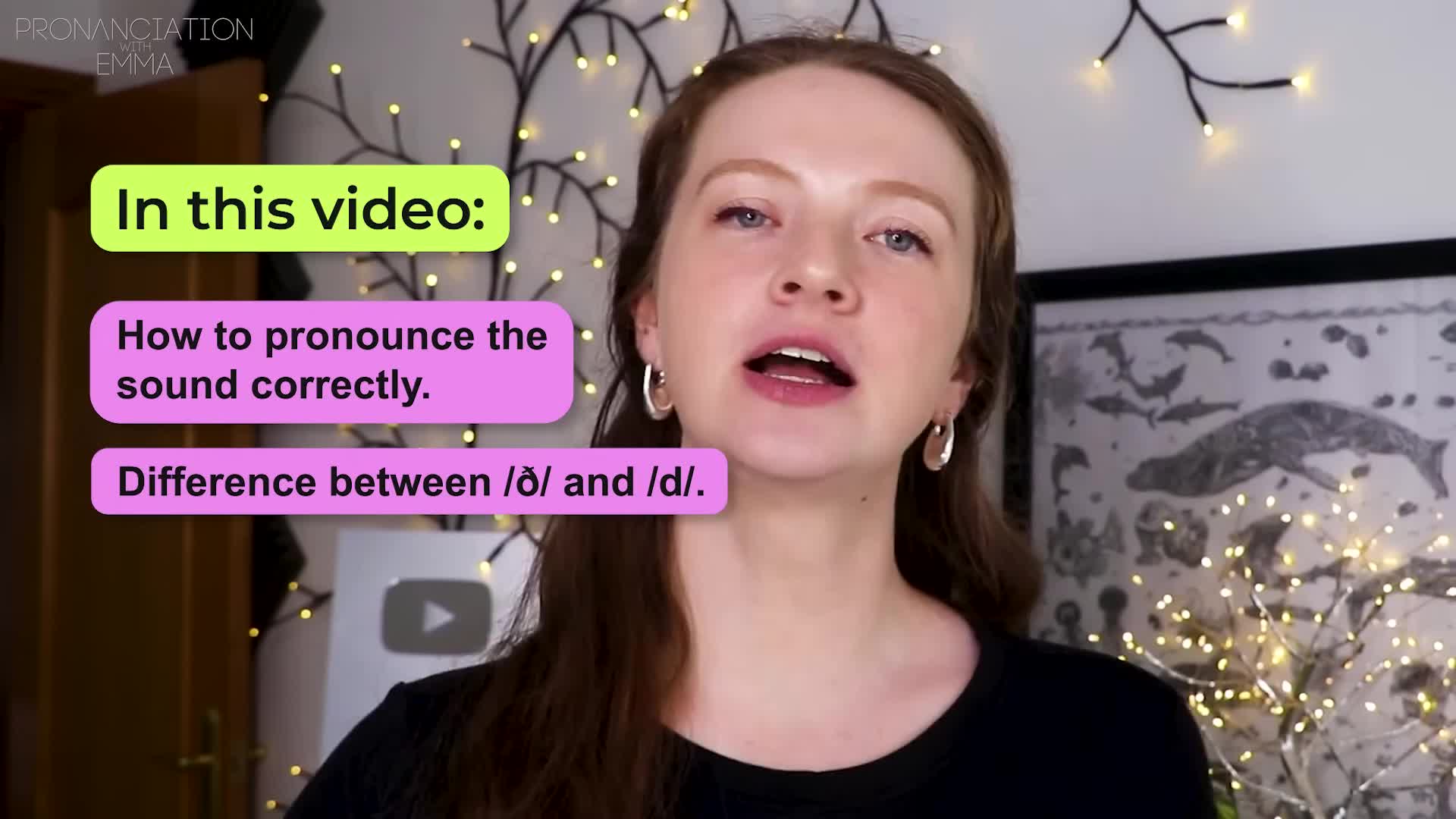
Today you're going to finally learn how to pronounce the voiced TH sound.
That's the sound in words like this, that, they, them, and those.
It's one of the trickiest sounds in English and even advanced speakers often replace it with a d sound and end up saying dis instead of this.
So in this video I'll show you exactly how to make the sound correctly, how to feel the difference between the and duh, and then we'll practise together, using word pairs, sentences and some fun tongue twisters at the end, to really lock in this sound.
I'm Emma, a qualified British English pronunciation coach with a degree in English language and linguistics, a Cambridge CELTA teaching qualification and a master's in teaching English to speakers of other languages.
I've been teaching since I was 16 years old and I've helped thousands of learners from around the world sound clearer, more confident and more natural in English.
And just a quick heads up, my course.
Emma's Pronunciation Hub is reopening for enrolment in January 2026, is getting a huge upgrade with 300 new activities, downloadable audios to practice on the go and personalized weekly feedback.
So if you're serious about improving your English pronunciation, you could join the VIP waitlist using the link below.
You'll get free workshops and exclusive bonuses when the doors open.
Alright, let's get started with today's lesson!
So there are two sounds that often get mixed up by English learners.
This is the voiced th sound in words like this, that and those to make this sound.
Your tongue goes between your teeth and your tongue lightly touches your top teeth.
Your voice vibrates here in your throat.
If you put those together, you get, So you'll feel a soft buzzing here.
Now with the d sound this is the word in words like day, dog and den.
To make this sound, the tip of your tongue here comes up to touch the alveolar ridge inside your mouth.
That is the part that just starts to go up here.
Make sure that you are not touching your teeth.
The sound in English is not a dental sound.
So you don't say , you say .
Your tongue is further back in the mouth.
Careful that you're also not retroflexing the sound.
That means when your tongue curls back and instead you're using the bottom side of your tongue to touch the top.
This gives you a sound like .
So make sure you're touching here with the alveolar ridge. make sure that the air stops and then you release it quickly with the th sound you can keep the sound going there's no stopping and releasing so you have and Notice that with this one, my tongue is between my teeth.
So let's compare them.
Repeat after me slowly.
This.
This.
They.
They. then den those does breathe breed Now let's practice those a little bit faster.
This, dis.
They, day.
Then, den.
Those, does.
Breathe, breed.
Do you feel the difference?
For your tongue sticks out slightly and the air flows continuously.
With the sound is shorter and you shouldn't see your tongue when you pronounce it.
Now let's train your ear and your mouth together.
Repeat after me slowly first and then faster.
This This.
This.
This.
Now faster.
This.
This.
This.
This.
This.
This.
Venden.
Venden.
Venden.
Venden.
Venden. day they day they day they day they day those does those does those does those does those does this is a bit trickier is that one breathe breed breathe breed breathe breed breathe breed breathe breed though doe though doe though doe though doe though doe now let's practice in some short phrases some of these phrases won't make much sense but it doesn't matter we're here to practice pronunciation and compare words with the and they know they know they know they know let's say it faster they know they know they know they know they know they know then we went then we went faster Then we went, then we went, then we went, then we went, then we went, then we went.
So what I'm showing you here is how to train your fluency.
So even if it's a bit difficult, that's okay.
You can slow it down, but do start to get used to speeding it up a little bit, even if it's just 1 faster.
Let's try with two more examples.
Now for the final example.
I've chosen quite a difficult one here.
It's there.
It's there.
So you're transitioning from the it's to the th.
Move your tongue forward slowly.
It's there, It's there.
The same with the second one.
It's there.
It's there.
Now let's say them quickly three times.
It's there.
It's there.
It's there.
It's there.
It's there.
It's there.
If you were able to say that one quickly, then congratulations, because that's probably one of the most difficult phrases there.
Now let's practice these in some real sentences.
Repeat slowly and exaggerate that tongue movement for the sound.
Then we're gonna say it at a natural speed.
This is my book.
This is my book.
They are my friends.
They are my friends.
So careful you're not saying they are my friends.
It's not day.
They are my friends.
I saw them yesterday.
I saw them yesterday, so not i saw them, i saw them.
Make sure your tongue is sticking out.
Those are the documents i mentioned.
Those are the documents i mentioned.
So be careful.
Those are the.
Those are the documents i mentioned.
Then we had dinner together.
Then we had dinner together.
So careful, together.
That also has the voice th together.
My brother lives in london.
My brother lives in london.
My mother loves this weather.
My mother loves this weather.
They told me that this one is better careful, not this one, that this one.
They told me that this one is better.
They told me that this one is better.
I think this is a voiceless one.
So same position, but with no vibration.
I think they're there already.
I think they're there already.
So they're there.
They're there.
Make sure your tongue's sticking out.
That's their other car.
That's their other car.
If you're watching this video and practicing alone then try video recording yourself.
If you can't see your tongue coming out even just a little bit for those th words then try again.
You must be able to see the the the the.
You must be able to see your tongue coming out when you're doing this sound.
Now it's time to make this more fun and really test your English pronunciation.
I have two tongue twisters here to help you practice the voiced TH sound a little more.
I'll say it slowly first and then I'll say it at a normal speed.
If you can try and match that normal speed as closely as you can then...
Well done.
Let's see how you get on.
This, that and those things there, they're theirs, not theirs.
This, that and those things there, they're theirs, not theirs.
Your tongue should be hurting a little bit at this point.
And the second one.
The other brother thought this thing through thoroughly.
How was that one?
That one was quite a tricky one because you have the voiceless th and the voice th in there.
So if you got this one, well done.
A final point I want to make is to really pay attention to the smaller words.
What tends to happen with my students is they'll be focusing so much on the bigger words, the more important words like other and brother, but they kind of forget the little words like the and this.
So they'll say .
So their TH sounds will be perfect in some of the words, but they slip back into this old habit of and .
So be really careful with that.
Make sure you're paying attention to your tongue placement. the other, this thing.
Don't worry if you messed up these tongue twisters.
It's absolutely fine and it's part of the learning process.
And everyone finds these difficult when they first start.
Try not to get frustrated, as this can tense up the muscles in your face and actually make it more difficult for you to pronounce these sounds correctly.
So here's your homework for today's lesson.
For the next seven days, I'd like you to spend two minutes a day just repeating the drills from this video.
So that's the minimal pairs, the sentences and the tongue twisters.
Record yourself once a week and notice how much smoother and more natural you start to sound.
If you're sitting there thinking, oh no, the th sound, it's still difficult.
For me it feels strange.
It's because your mouth muscles are just not used to doing it yet.
You need to train them, and training them takes time.
So be patient with yourself and remember that consistency is key here.
You're retraining muscles in your face and your mouth that are not used to moving in this way.
So focus on practicing every day and you'll train your muscles and it will start to feel more comfortable for you.
So that's the end of today's english pronunciation lesson.
I hope you enjoyed it and you learned something new.
If this video has helped you even just a little bit, then give it a like, share it with a friend who's also learning english and hit subscribe for more practical british english pronunciation training videos every single week.
And don't forget Emma's Pronunciation Hub reopens in January 2026.
Join the VIP waitlist below for early access, free workshops and exclusive bonuses when the doors open.
I'll see you in the next lesson.
Bye-bye.
Thank you.