Ted Audio Collective You're listening to Ted Talk's Daily where we bring you new ideas to spark your curiosity every day.
I'm your host, Elise Hugh.
It is impossible to ignore that we are in a time of crises going on all over the world.
So it's all the more important to try and understand what else we can do to prevent conflict.
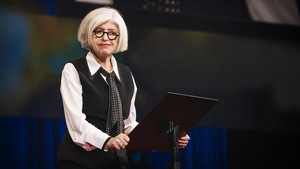
It's the work of conflict resolution expert Gabrielle Riftkind, who addresses what to do to make peace real.
This essential talk coming up after the break.
Support for this show comes from Capital One.
Banking with Capital One helps you keep more money in your wallet with no fees or minimums on checking accounts and no overdraft fees.
Just ask the Capital One bank guy.
It's pretty much all he talks about in a good way.
He'd also tell you that this podcast is his favorite podcast too.
Aw, really? Thanks Capital One bank guy.
What's in your wallet? Terms apply.
C capital1.com slash bank.
Capital One NA member FDIC.
Support for this podcast comes from the Defender 110.
For those who embrace the impossible, the new Defender 110 is up for the adventure.
This iconic vehicle has been redefined with thoroughly modern design, with an exterior that's reimagined, with really compelling proportions, and really precise detailing.
The interior is built with robust materials, built with integrity.
The Defender capability is legendary, whether you're off-roading or dealing with harsh weather conditions.
And the Defender family features the 2-door Defender 90, the Defender 110, and the Defender 130, which seats up to 8 people.
Really great for trips and big families.
A vehicle made to go further is the Defender 110 Learn More at Land Rover USA.com-forwardslash-defender.
Support for this show comes from Mint Mobile.
You know when you discover a new show that's worth binging or a song that you play on repeat, and you have to share it with your friends so they can experience how awesome it is just as you have?
That's kind of what it feels like when you discover that Mint Mobile offers premium wireless for $15 a month when you purchase a three-month plan.
It's such an awesome deal.
There's no way that you can keep it to yourself, and that's why I'm telling you all about it.
Say bye-bye to your overpriced wireless plan and switch to Mint Mobile.
All plans come with high-speed data and unlimited talk and text delivered on the nation's largest 5G network.
Go to MintMobile.com-slashtalks.
That's MintMobile.com-slashtalks.
Cut your wireless bill to $15 a month at MintMobile.com-slashtalks.
$45 upfront payment required equivalent to $15 a month.
New customers on first three-month plan only speed slower above 40 gigabytes on unlimited plan additional taxes fees and restrictions apply, see MintMobile for details.
These days we're surrounded by photo editing programs.
Have you ever wondered what something or someone actually looks like under all the manipulation?
It's me, Elise, and this October I'm giving a TED Talk in Atlanta about finding true beauty in a sea of artificial images.
I'm so excited to share the stage with all the amazing speakers of the TED Next Conference, and I hope you'll come and experience it with me.
Visit go.ted.com-slash-tednext to get your path today.
And now our TED Talk of the Day.
I have worked in international conflict resolution for the past two decades.
I'm not a pacifist, but in the end, war is the greatest human rights abuse and does not make the world safer.
We think we go to war for good moral reasons.
We're fighting for good to triumph over evil.
Instead we unleash a cascade of chaos and misery.
In the 21st century, the United States, along with its allies and my country, the United Kingdom, have been involved in four major wars, Afghanistan, Iraq, Libya, Islamic State, and we have provided funding and supplied military equipment to Ukraine and Israel.
So let's consider the outcome of some of these wars.
The Afghan War was a 20-year war, and we left the Taliban in power.
The war in Iraq, we had an immediate military victory which for short lived civil war and contributed to the war in Syria.
The war in Libya unleashed chaos and violence in the Sahel region.
The war against Islamic State weakened it militarily, but none of the root causes would doubt this.
All of you know war is horrendous.
But maybe many of you believe that it is inevitable.
I would like to persuade you today that there are many things that we can do.
Even if we commit to arming countries militarily like porcupines, we can commit ourselves to war prevention, early mediation, and getting into the mind of the enemy.
I direct the Oxford process.
It's a conflict resolution organization.
And what we try and do is create back channels to the political leadership at the highest levels of those who are in positions in power and can decide the future of the outcome of the war.
I come from a group psychoanalytic background, but I'm passionately committed to putting together the human mind and geopolitics, its power relationships, and what doesn't lead to war.
We know marginalization, humiliation, and exclusion are some of the key drivers of war.
We also know that war dehumanizes people.
Some of the conflicts I've worked on are the Palestine, Israel, the Iranian nuclear issue, and now the Russia Ukraine war.
So what can we do to prevent war?
We need to address the security concerns of all sides, not just our own security.
Russia invaded Crimea in 2014, and then all of Ukraine in 2022.
It was morally justified for us to support a country whose sovereignty had been breached.
But now hundreds of thousands of people are dead and wounded.
And we do have to ask what else could we have done?
President Putin warned that if NATO edged up on the Russian border, war would be the result.
In 2008 President Bush stated Ukraine would join NATO.
Germany and France pushed back, as they knew it would create a new crisis between Russia and the West.
The U.S. have tolerated a hostile military presence on its border in Mexico and Canada.
We might have avoided this war if we address the security concerns both of Russia and Europe.
And established a common European security architecture before the war and it will need to happen afterwards.
Western governments could have played more of a mediating role, supporting Ukraine to be a bridge between East and West, not just encouraging Ukraine into our zone of interest.
Ukraine has difficult geography.
It will always need to find a way to coexist with its Russian neighbour.
What else could we do? We need to come off our moral pedestal and stop deciding what is good and evil.
We need to talk to the bad guys, the men of violence, if we are to end war.
We understood we had to talk to the IRA in Northern Ireland, Fargh in Colombia and Etter in the Basque Country.
But usually we want to speak to the good guys, the people like us, the people in grey suits.
Back in 2001 after the Afghan war and as part of the Bond Peace process, if we had brought the Taliban in when they were weaker, things may have looked different.
Western governments, including the US and the UK, refused to talk to President Assad.
They said it was talking to evil.
By not talking to him, we created a greater evil as thousands and thousands more people died.
And now back to the episode.
Today many of you will have Ukraine, Russia, and Hamas, Israel on your minds and what can be done.
This is the work Oxford process does, quietly behind the scenes, to explore whether opportunities to end war.
But it requires the blessings of Western governments and they often don't have an exit plan.
To end the war in Ukraine, we will need to talk to President Putin.
We will need to understand his red lines, what his end game is, what opportunities are offered ceasefire.
After the heinous massacre of 711, engaging with Hamas is unthinkable.
To many Israelis, following the terrible carnage in Gaza, Hamas has even more support and will need to be included in some kind of future process.
Now both sides have to humanize each other.
One way through is the release of Mawan Baguati, a Palestinian leader who has spent the last two decades in Israeli prison.
He supports a future Palestinian states sitting side by side with Israel and he has the leadership qualities to unite the Palestinian people, which will be essential.
For some he is the new Mandela, for others he has blood on his hands.
In more everybody has blood on their hands.
The Americans are now talking about two states' solution, which would involve normalization between Saudi Arabia and Israel.
And yet again, we cannot just speak to our friends and exclude our enemies.
In Iran and its allies will only sabotage the process.
Each one of you here today wants to make a difference, but we can feel small and impotent in the face of war.
But how we behave individually is a microcosm of how we behave in war.
None of us like to engage with people who think differently to us.
We all divide the world into good and evil.
All we want to talk to and people we don't.
But we need to engage with everybody and understand the radical differences that exist between us.
And we need to start today.
What else can we do? We need to act early and put in place early mediating processes.
In some words, there's an opportunity for mediation when the parties are on the precipice and they're more open to compromise.
Then there's a second opportunity when they've tested their battlefield strength and realized they have not achieved their original objectives.
When these opportunities are missed, the parties become hardened by the horrors and trauma of war.
They believe they have sacrificed too much to compromise and make peace.
So what can we do to make these ideas real?
Today the UN is a weakened institution and many have lost faith in it.
But if we're to be serious about peacemaking, we will need to strengthen it again.
One way through is to empower the UN to have statutory early mediation when countries are on the edge of tipping to war and then three months later when they've tested their battlefield strengths.
The UN would also appoint permanent war prevention teams, embedded in the countries at risk of going to war.
High level mediators and permanent peace tables, we would establish them in such areas as Sudan, Pakistan, India, Taiwan, China, Palestine, Israel, the US, China.
We would be committed to prevention and early intervention.
So in conclusion, liberal democracies should see themselves first and foremost as mediators and bridge builders and help countries manage their radical differences.
Not the world's self appointed policeman or supplier of weapons.
Instead of providing drones and missiles, we could contribute more resources and expertise to mediation and peacemaking.
We would put all our passions and pragmatism into avoiding war.
War is like a cancer. It spreads quickly.
Once it's progressed far enough, nobody knows how to stop it.
Treat it quickly, even prevent it, millions of lives can be saved.
We behave as if war is inevitable.
It is not. Thank you, my friends.
Support for Ted Talks Daily is from Progressive Home of the Name Your Price Tool.
You can say how much you want to pay for car insurance and they'll show you coverage options that fit your budget.
It's easy to start a quote.
Visit progressive.com to get started.
Progressive Casually Insurance Company and Affiliates, Price and Coverage Match, Limited by State Law.
Support for the show comes from LinkedIn.
LinkedIn ads allow you to build the right relationships, drive results, and reach your customers in a respectful environment they are not getting barraged.
This is very targeted. You will have direct access to and build relationships with a billion members, 180 million senior level executives, everyone's on a LinkedIn, it seems like, and 10 million C level executives.
You'll be able to drive results with targeting and measurement tools built specifically for B2B in technology, LinkedIn generated two to five times higher return on ads spent than other social media platforms.
You'll work with a partner who respects the B2B world you operate in, 79% of B2B content makers said LinkedIn produces the best results for paid media.
Start converting your B2B audience into high quality leads today will even give you a $100 credit on your next campaign, go to LinkedIn.com slash Ted Audio to claim your credit that's LinkedIn.com slash Ted Audio, Terms and Conditions Apply, LinkedIn, the place to be to be.
That was Gabrielle Rifkin speaking at Ted 2024.
If you're curious about Ted's curation, find out more at Ted.com slash curation guidelines.
And that's it for today.
Ted Talks Daily is part of the Ted Audio Collective.
This episode was produced and edited by our team Martha Estefanos Oliver Friedman, Brian Green, Autumn Thompson and Alejandro Salazar.
It was mixed by Christopher Faisy-Bogan, additional support from Emma Taubner, Daniela Balorezo and Will Hennessy.
I'm Elise Hugh. I'll be back tomorrow with a fresh idea for your feed.
Thanks for listening.