N .P .R. This is The Indicator from Planet Money.
I'm Waylon Wong. And I'm here today with occasional NPR reporter and producer Nick Neves, who has a story about a squirrel and a meme coin.
Hi, Waylon. Hi. Okay.
So, you may remember Peanut the Squirrel.
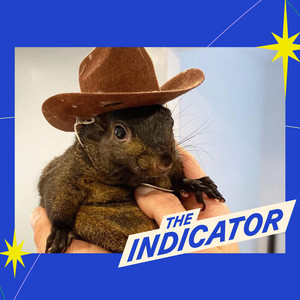
He was an Instagram famous squirrel owned by this guy, Mark Longo.
And Mark would dress him up in little cowboy hats and they would eat waffles together.
It was very cute. Were the waffles also small?
Actually, the waffles were normal size.
But the cowboy hats were small.
The cowboy hat was small.
Or just peanuts. Yes.
But Mark didn't have a license to take care of wild animals.
And late last year, New York state agents raided his house and confiscated Peanut.
And in the process, it bit one of the officers.
And to test it for rabies, the officers killed Peanut the Squirrel.
I do remember this now.
A lot of people were talking about this, including J .D.
Vance. So I know Don's fired up about Peanut the Squirrel.
And Elon Musk talked about it on Joe Rogan's show.
I hope you guys go out there and vote for Peanut, man, if nothing else.
Yeah. And at the same time, someone made a cryptocurrency named after Peanut the Squirrel, and it exploded in value in just a few weeks.
I couldn't track down who made the coin.
Mark says he had nothing to do with it.
And I was so confused about meme coins, and I still am.
How could a dead squirrel make millions of dollars?
Whether or not we understand them, these quote -unquote meme coins are having a moment.
You may have heard of Hak tua coin, Trump coin.
A lot has changed since the early days of crypto.
Today on the show, what are the rules of the meme coin game, and who's winning?
is your choice not theirs that's why when it comes to managing your wealth schwab gives you more choices you can invest and trade on your own plus get advice and more comprehensive wealth solutions to help meet your unique needs with award -winning service low costs and transparent advice you can manage
your wealth your way at schwab visit schwab .com to learn more support The support for NPR and the following message come from the Lemelson Foundation, dedicated to improving lives through invention, innovation, and climate action.
This message comes from Charles Schwab.
When it comes to managing your wealth, Schwab gives you more choices, like full service wealth management and advice when you need it.
You can also invest on your own and trade on Think or Swim.
Visit schwab .com to learn more.
First things first.
First, to understand Peanuts' afterlife as a meme coin, we first need to understand, and please don't roll your eyes, the blockchain.
Think of a blockchain.
Investigative reporter at Bloomberg who writes about crypto.
And you might remember him from our previous episode on zombie NFTs.
But back to blockchain.
It's got two columns.
In column A, you've got people's names.
So let's say it's got Waylon, Nick, and Zeke.
In column B, we got a number like, you know, 1, 5, and 10.
And so that's if this is a Bitcoin blockchain, that's how many Bitcoins we have.
So that's sort of all there is to it.
Do you feel like a master of the universe, Nick?
Right. Yeah. No. The big question with crypto, though, is why does it have any value?
Like, why is a number in the spreadsheet in the sky worth any money?
The first viral meme coin, Dogecoin, was made as a joke, in part to say, look, one new cryptocurrency shouldn't have any more value than another one.
But Dogecoin blew up anyways.
Zeke said a friend of his who bought Dogecoin low sold it for a few thousand bucks and helped fund a trip to Disney.
He taunted me and said, I am frickin' Nostradamus.
I guess the lesson here is things when to pay for them.
Right, yeah. But anyways, that was early days.
The thing that's changed since then is that it used to be kind of hard to make a new coin.
The latest, like, meme coin craze was really enabled by this new trading platform called Pump .Fun that made creating a meme coin, like, a point -and -click experience.
Thousands of new coins are minted every day.
You can make a coin right now named after a cute deceased animal.
And people could buy it.
I aped $10 ,000 into Peanut the squirrel.
Yes, Peanut. As Peanut's death made the rounds in the media, the coin got more and more buying.
Which already made many crypto millionaires.
In just a few weeks, the coin went from around five cents to over $2.
Yeah, but Peanut coin, like most meme coins, has dropped in price since that early spike.
A typical pattern for these coins is that once the price goes up, developers will sell their coins and crash the price for everybody.
This is called rugging.
Like pulling the rug from under someone.
This is Omid Malakhan at Columbia Business School, and he really believes in the spreadsheet in the sky.
He holds Bitcoin and thinks crypto represents the future of finance.
He's certainly, though, got a take on meme coins.
The Dogecoin, I tell people, that's just gambling.
You don't say I'm going to invest in playing roulette or the lottery.
And just like regular gambling, the house can be stacked against you.
In order to pull out the rug and make money, other people need to think the meme coin is going to keep going up.
Right. This is just greater fool's theory on the blockchain.
You can make money as long as there's someone who thinks they'll be able to sell it for more than you.
One way to make something appear to be going up is to do what's known as wash trading.
Zeke says in this case, someone might control multiple crypto wallets.
And you trade it back and forth at increasing prices.
And other people see, oh, wow, it's going up.
And you start attracting some real buyers because the coin appears hot.
Of course, in a traditional regulated market, this is super illegal.
But Omid says part of what makes crypto good is that anyone can do anything on it.
Good is that anyone can do anything on it.
he doesn't mind that people trade meme coins.
Meme coins became popular in the last couple of years because they were fair, supposedly.
And they were for the people and of the people and owned by the people.
Nobody controls them.
And certainly nobody holds a substantial percentage of the supply.
Then comes Trump coin, of which over 80 % of the supply is controlled by Trump and his partners who issued this thing.
Two LLCs associated with the Trump organization control the coin.
It totally blew up.
OK, but here's the important thing to note.
Those companies only released a small fraction of the coins for the public to purchase.
When a coin is released like this, it's usually held for a number of years.
But Trump token can start selling in three months.
Omid says insiders are going to want to sell their share as fast as they can.
Because if you get something for free and you can make billions of dollars selling it, you're probably not going to hold it for the long term.
So it will be bad for the price, which means it'll be bad for everyone who's holding it.
Except for Trump and his associates who get effectively free money.
This is not how the good meme coins operate.
The way the game is played is, well, if you happen to buy it on the open market before the meme went viral, than you deserve to make money off of its success.
Like early purchases of the peanut coin, for example.
They got lucky. Omid says people should be allowed to gamble.
But a coin made by someone who's already got clout, who made a meme in order to make money?
It's funny to hear myself say this, but that to me fails the integrity test of a good meme coin.
Right now, as of this recording, Trump coin's market cap is around $3 .5 billion.
But this raises a lot of questions.
Like, if a lot of these coins are rigged or extremely risky, why are people still making and buying them?
On one hand, you can think of them kind of as souvenirs or collectibles.
And as charitable donations, right?
Right, yeah, they can be.
In fact, Mark Longo, Peanut and Squirrel's owner, actually launched his own meme coin, JFP, Justice for Peanut.
He says it's to raise money for his animal sanctuary.
Omid, though, has another explanation for what's behind meme coins.
I think meme coins are sort of a symptom, which is the term of art we use in academia and in other places is financial nihilism.
And the basic idea is that a lot of people, particularly young people, increasingly feel like the whole shebang is rigged against them.
Healthcare is expensive.
Housing is expensive.
Eggs are expensive.
Yeah. You know, we're all living in the same world.
And they increasingly feel like they have to take risks, that they have to do crazy things with their money.
But if you're doing things like meme coins or meme stocks or sports betting, there's a significant chance you'll just lose everything.
Nick, thank you for bringing us this story.
Thanks for having me.
I'll see you at Waffle Wednesday.
See you there. This episode was produced by Julia Ritchie with engineering by Neil Tebalt.
It was fact -checked by Sierra Juarez.
Kiki Cannon is our editor and the Indicator is a production of NPR.
Support for NPR and the following message come from IXL Learning.
IXL Learning uses advanced algorithms to give the right help to each kid, no matter the age or personality.
Get an exclusive 20 % off IXL membership when you sign up today at IXL .com slash NPR.
This message comes from Tourism Australia.
No matter what you're into, Australia has something for everyone all year round, like the Daintree Rainforest this spring, Melbourne's music scene in the summer, and the wineries of Barossa Valley in the winter.
Come and say g'day.
More at Australia .com.
Support for this program comes from Texas Mutual Insurance Company, a workers' comp provider dedicated to handling claims efficiently and compassionately.
Their specialized adjusters are trained to take policyholders through each step of the process, providing clarity and direction after an on -the -job accident.
By proactively working to support businesses from the time of -