The AI boom has had a lot of people comparing this moment to the dot-com crash.
That's when the US stock market boomed on the promise of the internet, but then dropped about 50 from its peak.
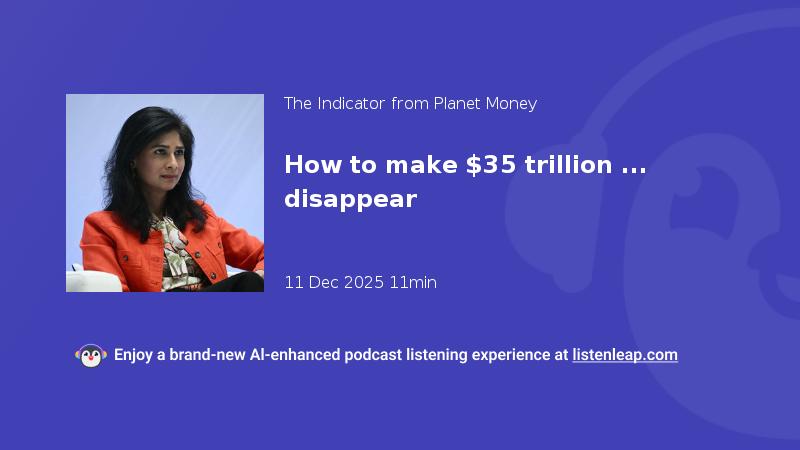
Geeta Gobbinath is the IMF's former chief economist and second in charge.
She's now at Harvard.
And Gita has gamed out what a dot-com style bust would actually mean for the economy today.
We're talking about growth basically coming to a standstill in the U.S.
This is The Indicator from Planet Money.
I'm Darian Woods.
Today on the show a conversation with Gita Gopinath about the possible erasure of 35 trillion from the global economy.
This message comes from Capital One with the Capital One Saver Card.
Earn unlimited 3% cash back on dining and entertainment.
Capital One.
What's in your wallet?
Terms apply.
Details at CapitalOne.com.
This message comes from NPR sponsor Capella University.
Learning doesn't have to get in the way of life.
With Capella's game changing FlexPath learning format, you can set your own deadlines and learn on your own schedule.
That means you don't have to put your life on hold to earn your degree.
Instead, enjoy learning your way and pursue your educational and career goals without missing a beat.
A different future is closer than you think with Capella University.
Learn more at capella.edu.
This message comes from Dell Technologies.
Your new Dell PC with Intel Core Ultra helps you handle a lot when your holiday to-dos get to be a lot.
That's the power of a Dell PC with Intel inside.
Get yours at dell.com slash holiday.
Economist Geeta Gopinath joined me from her Harvard recording studio late November.
So I think we have all the gadgets we need.
Looks like a very serious microphone there.
So today I want to explore how the U.S. stock market could mean trouble for the rest of the world.
And to set the scene, can you describe what's been behind the US stock market's pretty big increase over 2025?
If you want to understand what's happening in the US stock market, I think it also helps to go back about 10 to 15 years, which is that if you compare the performance of the US stock market relative to other stock markets around the world, the US has been exceptional.
So it was a one-way bet in terms of putting money in US equities.
And so that's what happened was not just US households and firms put their money in the stock market, but the rest of the world also basically put a lot of their money in the US stock market.
So that's how 2025 started.
Now, since then, it's grown by another 14% in terms of the value of the S&P 500.
So it's a strong stock market.
What's underlying that is the dynamism of U.S. tech.
So if you take the Magnificent Seven, which is the seven big tech stocks, that drives about 40 of this increase in valuation that we've been seeing over the last many years.
The Magnificent Seven companies are Microsoft, Meta, Amazon, Apple, Google, Nvidia, and Tesla.
They're investing heavily in AI.
A lot of people's savings are invested one in the US stock market and therefore ineffectively 7 companies.
So what's keeping you awake at night?
If we look at some numbers.
So I'll give you one number which is looking at the ratio of the price of stocks to the earnings of companies.
It's the price to earnings ratio.
This is now at the second highest level in the last 100 years.
So the first highest level was just before 2000.
So it was just before the so-called dot-com bust when we had a crash.
The valuations are really high, and that gives you some pause.
Yeah, this is the CAPE ratio.
We've actually talked a bit about this on the show before.
Indeed.
Now that doesn't mean that there's going to be a crash tomorrow or in six months, but it does tell you that the valuations are high.
And so if the American stock market is in some kind of bubble and it pops, what's a scenario that might happen?
One useful way to think about this is to compare this to what happened after the dot-com bust right.
When you had in 2000, a large stock market crash.
So over two years, the stock market fell by like 50, 60% cumulatively over a two-year period.
So if something similar were to happen this time around, given the scale of wealth that's now invested in the US stock market, we're looking at US households losing about 20 trillion in wealth and the rest of the world losing about 15 trillion in wealth.
Now, these numbers are much larger than what it was before.
25 years ago.
So if you take that number and then you translate that into what typically happens to consumption, you could see consumption growth dropping by 35, which then means US economy as a whole that growth dropping by 2.
And just to keep some numbers in mind, the U.S. economy tends to grow around 2%.
So just through this channel, we're talking about growth basically coming to a standstill in the US.
So you're saying if the stock market were to do what happened in the dot-com bust, the stock market would crash quite a bit and cause households to spend less?
And then that would translate into going from a growing economy to a stagnant economy.
That is correct.
Pretty close to recession, if not in recession.
And this is, I'm actually giving you some pretty, you know, conservative numbers.
I think the effects could be bigger.
And so it's interesting that this is a U.S. problem with huge U.S. effects.
What could that look like for other countries?
Those who would be hit most are Europeans, because they are the ones who are actually exposed to US equities much more than say, developing economies or emerging economies or so on and so forth.
So there will be spillovers to them too.
But we know this, that Europe, When the US goes into a recession, that pushes down growth prospects everywhere, because it remains the case that US consumers are a big source of demand for things that people produce elsewhere, everywhere in the world.
So that's going to slow down economies globally.
Even for the US, I would say that it's getting increasingly harder to ride out crises because when the dot-com crash happened, The US government increased its spending by a lot and that helped right the economy right.
It helped stabilize the economy and prevent things from getting worse.
But right now, because US debt is about 120 of GDP and the rates at which they're borrowing are high, it's not easy to simply go and increase spending.
So you've succeeded in scaring me quite a lot.
But on the flip side of this argument, could it be premature to raise an alarm over a potential bubble?
Is it possible that investors will miss out on huge gains if, for example, AI is as transformative as promised?
I think we should all be humble about the fact that it's hard to to precisely pinpoint when you may have a correction in the market right.
Ideally, what we would like is there to be some adjustment that happens gradually over time.
If it happens slowly, it's okay.
The bigger problem is if there's a big crash.
And so I think it's not a bad idea for everybody to pay a little more attention to valuations of companies, to see how much of their portfolio is dependent on these seven stocks, and maybe diversify some.
And are we seeing other countries starting to reduce their exposure to the U.S. as well?
We are certainly seeing that there is more capital now going to other parts of the world.
Part of that reason is because there is a sense in which US stock markets are so high in terms of their price they become very expensive.
So in fact, this has been a very good year for emerging and developing countries.
You've seen capital go into those markets much more than they did in 2024.
So when you're at dinner parties, how do people react to your scenarios of potential doom?
So firstly, I'm not trying to be a doomsayer.
I think everybody I talk to agrees with the math.
The math adds up.
If you have a dot-com crash, it's about $35 trillion.
That is indeed... correct.
There are some people who are more optimistic about how things may play out, and they could well be right.
You know, I think the big question everybody has to ask is this very large amounts of investments that are happening in AI is not coming along with a clear sense of where the revenues will come from to make up for all these very large amounts of investment.
Well, Gita Gopinath, you have left me more worried than when I started.
But thank you so much for joining The Indicator.
Thank you, Darian.
The idea is to worry about something so that you can act on it, and then you don't have to worry about it.
This episode was produced by Cooper Katz-McKim with engineering by Robert Rodriguez.
It was fact-checked by Sierra Juarez.
Caken Cannon edits the show and The Indicator is a production of NPR.
Hey, it's Darian Woods here.
I just want to take a moment to talk about the vital role of public media.
It was founded to provide news and information to everybody for free, regardless of anybody's ability to pay.
We still believe in the mission of public media at NPR.
But, as of this fall, federal funding for public media, including NPR and local NPR stations, has been eliminated.
Despite that, we remain committed to this work to go beyond the headlines, to show you how the economy affects your life.
Just this year we've done a bunch of big series on how batteries are changing the electric grid, on the business of crime and the changing economics of Hollywood.
In 2026, with your help, we can do even more.
Thank you if you already go the extra mile as an NPR Plus supporter.
If not, you can join the Plus community, get a bunch of perks like bonus episodes from across NPR's podcasts and support public media by signing up for NPR Plus today.
This message comes from BetterHelp.
The holidays bring traditions and joy, but they can be tough too.
Therapy helps you care for yourself so you can truly show up for what matters most.
Visit betterhelp.com slash NPR for 10% off.