It's a high stakes election year, so it's not enough to just follow along.
You need to understand what's happening so you are fully informed on November.
Every weekday on the NPR Politics Podcast, our political reporters break down important
stories and back stories from the campaign trail.
Do you understand why it matters to you?
Listen to the NPR Politics Podcast wherever you get your podcasts.
On the next all songs considered from NPR Music, we play and guide you through the best
songs to slow the blood and calm your nerves, including the one track, scientists say can
reduce anxiety by up to 65%.
Look for all songs considered every Tuesday wherever you get podcasts.
Planet Money helps you understand the economy.
We introduce you to fascinating people.
We did not have a tragedy.
No man, didn't need one.
We show you how money influences everything.
Tell me what you like by telling me how you spend your money.
And we dig until we get answers.
I had a bad feeling you were going to bring that up.
Planet Money finds out.
All you have to do is listen.
The Planet Money Podcast from NPR.
You're listening to LifeKit from NPR.
Hey there.
Andy Tegel here in Fr. Mary, El Segera.
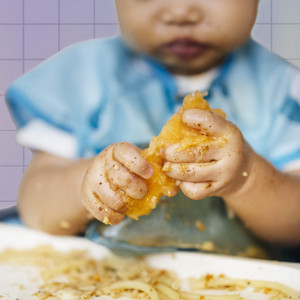
I'm a reporter for LifeKit and I'm also a new parent a few months deep into the process
of starting solid foods with my baby boy.
You want to know something that's on the menu for just about every parent on this road
with me?
No, it's not avocado.
It's not bananas.
It's not oatmeal.
It's worry.
Fear.
Guilt.
And let's not forget everyone's favorite side dish served both hot and cold.
Expectation.
When my daughter was probably six months old, I was like, okay, I'm going to do this.
It's six months.
That's by the book.
And I would offer some foods.
And she just was not interested.
She would not open her mouth.
She would just kind of look away.
She wasn't even grabbing the food.
That's Marina Chapado.
I'm a Latina pediatric registered dietitian and face behind Nutri Chicos.
That's Marina's bilingual nutrition practice for children and families based out of Miami.
She's working consulted in this field for over a decade.
Still, it wasn't until she became a mom herself that she fully realized.
Wow, feeding kids is hard.
It is challenging.
I have questions.
I had doubts.
And I just imagine what any other mom, any other parent who didn't have the knowledge
that I had was going through.
It seems every parent has their own flavor of concerns or hardship when it comes to starting
solids.
Like, in our house, my kid has no fear and a mouthful of teeth.
Like ten of them at just nine months old.
So his favorite activity is literally biting off more than he can chew.
It's so exciting that he's so excited by food, but all the gacking has not been good
for my blood pressure.
And you have anxiety about allergens or portions or picky eating or the qualities of foods
you're introducing.
Maybe like Marina, you're worried because little one just isn't interested in solids yet.
In her case, just three weeks after that first attempt, starting solids.
Just a light bulb went on.
She started opening her mouth.
She started grabbing the banana when I was eating the banana.
And so sometimes, you know, it's hard to trust our kids because we might not know what
to expect.
It's really allowing them to show us when they're ready.
In this episode of Life Kit, a primer on starting solid foods for nervous parents just
like me.
Whether you're spoon feeding, baby-led weaning, or figuring out your own combination
of the two, we're here to help you start solids with confidence.
We'll help you think about many more.
Earn more about how wise could work for you at wise.com.
This message comes from the Pop Culture Mom's podcast.
Most friends, Andy and Sabrina take their obsession with TV and movies to the next level,
talking to celebrities about the comedy and tragedy of parenthood and the fictional moms
they love most.
Listen to Pop Culture moms wherever you get podcasts.
Numbers that explain the economy.
We love them at the indicator for planet money, and on Fridays, we discuss indicators in
the news.
Like job numbers, spending, the cost of food, sometimes all three.
So my indicator is about why you might need to bring home more bacon to afford your eggs.
I'll be here all week.
Wrap up your week and listen to the indicator podcast from NPR.
In a stressful election year, we know that a good show, movie, or book can feel like a
sacred thing.
At Pop Culture Happy Hour, we believe Pop Culture can be good for you.
So we're here four days a week to bring you a book, movie, or show recommendation to
put you in high spirits.
For a dose of old fashioned Pop Culture therapy, listen to the Pop Culture Happy Hour podcast
only from NPR.
Okay, we're going to get into the meat and potatoes of starting solids, but first, a little
table setting.
This episode is a guide for parents whose babies are ready to start solid foods and who
have already chosen a method of feeding their baby.
We're not going to spend any time here defining or debating the merits of different feeding
methods.
So, just a heads up.
Now, without further ado, building babies menu.
Recent research suggests that babies' first year of life is a small window of opportunity
in which babies are extra receptive to all types of flavors and textures.
And when they try new things, it pays off down the line.
That's why takeaway one is variety, variety, variety.
I wish I could tell you there was a perfect food pyramid to feed your baby, but that's
not really how it works for baby food.
Where'd say the key is to keep mixing it up.
And we're not just talking about building a balanced plate of fruits, veggies, proteins,
and grains.
It's also about how you eat and where your food comes from.
And whether that come through baby-led weaning, puree feeding, a mix of store-bought food,
a mix of take-out, that is fine.
Dr. Amna Hussein is a board certified pediatrician in private practice in North Carolina.
Please note, Amna is a pediatrician, but not your pediatrician.
So please don't take her general tips as personal medical advice.
It comes back to how do you avoid picky eating, variety, variety, variety.
This advice might be easier for some than others.
Personally, I just do not like to cook.
So when I started to feed my kids solids and I saw all of these super parents on social
media lovingly and easily cooking, sauteing, spicing, curing, and popsicleing their
babies every meal, it was hard not to feel inferior and go into full-on panic mode.
Here's Marina again.
This is going to be also important for many parents because not everything could be made
three hours in advance and organic at the fresh market.
If you can, I think that's wonderful, but I never want for parents to feel that they
need to do this in order to provide the best nutrition.
Absolutely not.
Marina says, look out for any added salt, coloring, sugar, or artificial sugar.
You don't need any of that in your baby food.
You might notice some items come with extra vitamins that work as preservatives.
For example, you'll see like a vitamin C added to preserve freshness, totally fine with
that.
One more great tip when you're shopping for baby food.
You know what?
I'm going to give the total like normal parent answer.
If the combination sounds gross to me, I probably wouldn't feed it to my child.
All right, moving from the store to the kitchen, let's talk groceries.
Cooking fresh meat and produce is great and always a doctor's first choice for health,
of course.
But Omnis says, frozen works too.
You know that frozen broccoli that you steam right in the bag?
That's a staple in my family, for example.
So we're frozen strawberries for smoothies.
But Marina says, remember, it's not just about fruits and veggies.
Don't get me wrong.
I'm a pediatric registered graduate.
Of course, I love fruits and veggies, right?
But there's going to be a lot of other foods that I'm going to like.
For example, foods that support neurodevelopment.
So we really want to focus on high fat, right?
So whether it's the avocados, the salmon, the eggs, all of those higher fat foods, even
the iron from the lentils, from the beef, from the pork, are going to be really, really
important in fostering those important connections early on.
Marina says a lot of people can get hung up on what they think baby should be eating.
Because a lot of times the foods recommended by healthcare providers don't necessarily mesh
with diverse cultural backgrounds.
Take kale.
Not exactly a staple in her culture.
Does that mean that I need to learn how to eat kale?
No, right?
So forget about the kale.
I really want families to feel proud and to feel that they can give their babies some
of those cultural foods, it's just going to be a matter of maybe adapting it, right?
Adapting the plate.
For Marina, that meant serving her daughter beans and tortillas along with veggies and avocados
and salmon and not being afraid of incorporating cultural flavors with baby food.
So don't be scared to experiment with spices.
Marina says you want to be mindful when it comes to salt, but baby food does not need
to be bland.
Then once you've nailed down what your kid likes, you might be tempted to just stick to
that.
But Anna says you should keep it moving.
Don't get too comfortable.
I actually think that even if your child loves sweet potatoes, you still have to offer
them green beans.
I think you should still offer them apples.
I think you should still offer them whatever protein.
If you're vegetarian, you can still offer them tofu.
If you are vegan, you can still offer them different types of proteins and beans.
Remember, this is your window of opportunity.
Take advantage.
And that also should include allergens.
And that's takeaway two.
Introduce allergens early and often.
This might come as a surprise to some, but research shows strong evidence that introducing
common allergens like eggs, peanuts, trinets, and shellfish early is now considered a good
way to reduce the risk of allergies.
No figure.
In fact, one landmark 2015 study showed that introducing even at-risk babies to peanuts
early on reduced the risk of allergy by 81%.
But you have to be smart about it.
That means knowing what factors put your kid at higher risk for allergy.
And the first one is eczema.
The reason behind this is partially to do with an overactive immune system and partially
specific to each baby.
But just know.
If your little one is eczema, that means they have about a 30% chance of also experiencing
food allergies.
The second risk factor is any other existing food allergies.
So for example, if there's a egg allergy or a milk allergy, then we want to just maybe
make sure we talk to your pediatrician and say, okay, what's going to be the best route
of introducing these top allergens in a safe way, but definitely not avoiding them.
Introduce allergens one at a time in small amounts.
And we're talking small.
For example, the website Solid Start suggests an eighth of a teaspoon.
Whether it's a peanut butter powder and some apple sauce.
And plan to offer that food early in the day.
So you'll have time to spot and treat any reactions.
Don't worry about missing any allergic reaction.
It's pretty easy to spot the signs.
So a lot of the times they might develop some type of skin reaction.
They might become really red or inflamed.
Or maybe it's a little bit more red or a little bit more red.
But if you're not sure, you're going to be able to see the signs.
And if you're not sure, you're going to be able to see the signs.
And if you're not sure, you're going to be able to see the signs.
And if you're not sure, you're going to be able to see the signs.
And if you're not sure, you're going to be able to see the signs.
And if you're not sure, you're going to be able to see the signs.
And if you're not sure, you're going to be able to see the signs.
And if you're not sure, you're going to be able to see the signs.
And if you're not sure, you're going to be able to see the signs.
And if you're not sure, you're going to be able to see the signs.
And if you're not sure, you're going to be able to see the signs.
And if you're not sure, you're going to be able to see the signs.
And if you're not sure, you're going to be able to see the signs.
And if you're not sure, you're going to be able to see the signs.
And if you're not sure, you're going to be able to see the signs.
And if you're not sure, you're going to be able to see the signs.
And if you're not sure, you're going to be able to see the signs.
And if you're not sure, you're going to be able to see the signs.
And if you're not sure, you're going to be able to see the signs.
And if you're not sure, you're going to be able to see the signs.
And if you're not sure, you're going to be able to see the signs.
And if you're not sure, you're going to be able to see the signs.
And if you're not sure, you're going to be able to see the signs.
And if you're not sure, you're going to be able to see the signs.
And if you're not sure, you're going to be able to see the signs.
And if you're not sure, you're going to be able to see the signs.
And if you're not sure, you're going to be able to see the signs.
And if you're not sure, you're going to be able to see the signs.
And if you're not sure, you're going to be able to see the signs.
And if you're not sure, you're going to be able to see the signs.
And if you're not sure, you're going to be able to see the signs.
And if you're not sure, you're going to be able to see the signs.
And if you're not sure, you're going to be able to see the signs.
And if you're not sure, you're going to be able to see the signs.
And if you're not sure, you're going to be able to see the signs.
And if you're not sure, you're going to be able to see the signs.
And if you're not sure, you're going to be able to see the signs.
And if you're not sure, you're going to be able to see the signs.
And if you're not sure, you're going to be able to see the signs.
And if you're not sure, you're going to be able to see the signs.
And if you're not sure, you're going to be able to see the signs.
And if you're not sure, you're going to be able to see the signs.
Of course, are a beloved, smushable food for a parent and little one alike.
oatmeal is another common first.
I think black beans or pinto are red, really.
Any kind of being, if they're cooked well enough, shredded chicken or whitefish.
Some scrambled eggs.
Rice.
Smush.
Smush.
Now, things you want to avoid are the opposite of all that.
Firm, round, and or slippery foods.
So grapes, nuts, popcorn, hard candies.
So some of it has size, but some of it has texture.
So a hard candy is going to be kind of like the same hard texture as a peanut or an almond.
Popcorn is a little bit different in shape.
Or a grape is a little bit different in textures.
But the shape is still large and it's the size of an airway.
Do you know how small a young child's airway is, by the way?
I'm going to talk me this and it really threw me for a loop.
It's about the size of like a drinking straw in diameter.
So to accommodate that, you're going to want to make firm things soft, round things no longer round,
and slippery things less slippery.
Take chickpeas, for example.
On their own, hard, round, big choking risk.
Out of a can, soaked, a little softer, but not all of them are going to be completely smushable.
Out of a can, from your fingers.
Stoo them a little bit, cook them down.
They are going to be much softer.
And that might be safer to offer.
Now, when it comes to the size of pieces of food, it's a little counterintuitive.
When babies are younger at around six months, you're going to want to serve them bigger hunks of food,
because they don't yet have that pincer grasp down.
A lot of the times we want to use the width of two fingers, what's called the palm or grasp.
So a lot of the times when you know when babies usually grab your hands, they grab them,
and they grab two fingers, right?
And so this is kind of mimicking their developmental milestones.
Think spears of bananas or strips of toast.
Then, once they do develop those motor skills, closer to nine months,
you can start serving finger foods.
Bite-sized pieces about the size of a knuckle.
So puffs, elbow macaroni, and the like.
And at this point, you have to let them feed themselves.
I know, painful to watch, super messy, but also hilarious.
So much fun, get ready.
Now, what do you do when you serve food safely and your baby starts buttering?
First, understand the difference between a gag and a choke.
First, gags.
They're often noisy, accompanied by a cough, and look equally unpleasant.
Gagging can be very frightening, but when the child is coughing or gagging,
it kind of relieves me in some way to understand that,
okay, there is a protective mechanism there.
Something did try to impact or tickle their airway in such a way
that their airway and their larynx spasined, led to the gagging,
but their airway is intact.
They are moving air in and out because they are coughing.
My internal gut reaction every time my son gags is to jump up,
yell, and immediately employ the hook finger.
Maybe you can relate, but that is zero for three, the right answer.
It might make it worse, and it might make the kid or the baby just swallow that food.
Instead, do your best to stay calm and react minimally so your little one doesn't panic.
Let them work through it on their own.
But watch them. Guide them through it.
You know, whether that be comforting them, offering small sips,
don't offer necessarily another bite of food, let them take a minute,
calm, get their bearings, so gagging, noisy. Got it.
Now, if it's choking, choking on the other hand is silent.
Choking is silent because there is something obstructing or impacting your child's airway.
In some cases, that's true, or you might also hear a very high pitch noise.
And you might very possibly see very panicked looks on their face.
If a baby is choking, the evidence backed and proven method is back blows followed by chest blows.
And then if they're unresponsive, proceed with calling 911 and CPR.
About now, you might be wondering about some of those decoking devices you might have seen on commercials or social media.
I asked Amna about this, and she says not to rely on them.
They may create a false sense of security for parents.
Number one advice here. Take infant CPR or brush up on that class you took already.
If you have a pamphlet on it, keep that next to baby's eating area. Go and move it there right now.
It's not just about the food though. A lot of baby's environment contributes to their safety while starting solids.
And that's takeaway four. Create safe eating environments.
For example, Amna asks every parent, do you have a high chair at home?
If you do have a high chair, sturdiness is the name of the game.
So if it's free standing, making sure all those legs are safely on the ground.
If you have one that attaches to something, making sure it attaches correctly to what it should be attached to.
So the back or bottom of a chair, if needed, or safely clamped to a table heavy enough to hold it.
If you bought one second hand, or you're using a friend or relative's hand me down.
You just want to make sure that those shoulder straps, those buckles, they're all intact.
A big danger with high chairs comes from tipping or toppling.
Sometimes it's because little one isn't strapped in quite right or quite tight enough.
So make sure you hear that click every time.
Other times, baby finds a way to wriggle away or out.
You just want to make sure that your child is protected.
And that's why I typically say a five point harness because as many times as we want to say,
eyes on the child all the time, eyes will not always be on a child, right?
If you don't have a high chair, that's okay.
You just want to make sure a baby is still eating upright at a 90 degree angle.
So on the floor or supported on the table, not on that slap or on the couch.
Couches lead way for slouching.
And slouching can lead to choking.
So, confeting the baby when they're moving or you're moving or offering them food in a stroller,
a car seat, or any other reclined position.
Remember, eating solids should be its own dedicated activity.
It's a special moment in time in your life and babies.
So treat it that way.
That might mean revamping the family schedule.
In our household, I saw that my child ate a lot better at dinner time when we ate with her.
And that means that in the Hussein family household, dinner is at five.
And avoiding distraction to the best of your ability.
Try to put the phone away, you know, or maybe have another parent film,
but don't film and be trying to feed the baby.
You want to try, especially initially, when your child's developing a relationship
with food going in the mouth to keep it a peaceful distraction-free setting.
All right, you figured out our meal plan and our eating space.
But that all assumes sweet little one is on board.
As parents, we know it's rarely that easy.
So if you have a picky ear at home, this one's for you.
Take away five.
Baby's appetite is a moving target.
Keep your routine and don't give up.
First, let's get clear about what a solid food schedule should actually look like.
I know you've been wondering.
According to the World Health Organization, you should aim for two to three solid food meals per day
for infants six to eight months old,
starting with just one to two tablespoons of solid food and working your way up.
For babies nine months and older, aim for three to four meals a day
with one to two snacks as needed depending on their appetite.
And just like grownups, that appetite can change from day to day.
As an adult, I sometimes get very hungry so lunch,
and I will want a salad plus something else, or a sandwich plus something else.
But then sometimes maybe I kind of just want to stack on an apple and peanut butter,
and I may not get hungry till later.
Such a simple idea.
Sometimes you're hungry, sometimes you're not.
And yet, I still find myself obsessing over every mostly full baby plate,
like sweetie pie.
Just try the apple sauce.
Are you sure you don't want just one more bite of cheese?
All this to say, starting solids, releasing that sense of control can be really tough on parents.
But both omna and marina say, the most important thing to remember in these scenarios is not to force it.
Because you want this to be a fun, enjoyable experience for them.
Not stressful.
Instead of trying to control your child,
our experts say refocus that energy on simply paying close attention.
The baby is the one who is ultimately in control of how much they eat.
Our job is to continue presenting food in a positive, in a safe,
an appropriate environment kind of learning their cues.
So what do you see when they're hungry?
They're opening their mouth. They're interested.
They're kind of looking at every time you put things around their face.
They're going to be opening their mouth, anticipating its food.
So they're very engaged in this little dance.
And on the other hand, what are their fullness cues?
They've lost interest. They're probably moving their head to one side and another.
They might be pushing the food away.
And I think that's our cue to say, okay, I am trusting you.
I am trusting you that you're telling me this is done.
Having a consistent feeding schedule and a dedicated eating area with a family,
it goes a long way.
Even if they don't eat a ton or they're not interested in food every time.
So be patient, celebrate the small wins.
And if they're not into something at first, keep at it.
Research has shown that parents we give up way too easily.
In particular, one study showed that on average,
parents usually gave up introducing a new food to their kid
between the third and fifth attempt.
But...
Constant introduction.
Eight to fifteen times of that same food will get them to like it eventually.
Eight to fifteen times.
I know. That sounds like a wild number.
But get this.
Those kids whose parents stuck at it and kept offering them those veggies again and again and again and again.
They didn't just learn to like veggies in the short term.
At six years old, more than half of the kids in the study continued eating and enjoying them.
So for me, the takeaway is, invest early and don't give up.
Don't give up.
And don't let off the gas.
You might have heard the expression food before one is just for fun.
But as a pediatrician, omna is not a huge fan of this.
I think this sometimes happens with parents because they think solace before one is fun.
But now after one, it's serious, okay?
Now you really gotta eat.
And it's like, whoa, whoa.
Like the baby doesn't know that they just turned one.
The child doesn't know that they were supposed to change a milestone.
Like this is something that should gradually happen.
So even if it takes eight to fifteen times more than you might like,
keep at it. Keep building that foundation.
It's a process and an ongoing family project,
but hopefully one with lots of sweet moments to be savored along the way.
Because food is never just iron, never just calcium.
Food is about family.
Food is about memories and it's about culture and it's about love.
Okay, that was one full plate of information.
Let's recap.
Takeaway 1. Variety, variety, variety.
Study show the best way to avoid a picky eater in the future
is to give your baby lots and lots of different foods now.
Takeaway 2. Introduce allergies early and often.
Takeaway 3. Safety first.
Avoid choking by following safe eating practices.
Takeaway 4. Create safe eating environments.
Takeaway 5. Babies appetite is a moving target.
Keep practicing good eating habits and try not to get discouraged
if they don't take to something right away.
For more life kit, check out our other episodes.
We've got one on kids and veggies and other on kids and screen time.
And lots more on everything from friendship to personal finance.
You can find those at nperer.org slash life kit.
And if you love life kit and want more, subscribe to our newsletter.
At nperer.org slash life kit newsletter.
Also, we'd love to hear from you.
If you have episode ideas or feedback you want to share,
email us at lifekit.npr.org.
This episode of Life Kit was produced by me, Andy Tagle.
Our host is Maryl Saguera.
Our visual editor is Beck Harlan.
Our digital editor is Malika Kareeb.
Megan Keane is the supervising editor,
but Donovan is the executive producer.
Our production team also includes Audrey Wynn,
Clamera Schneider and Sylvie Douglas.
Engineering support comes from Gillie Moon and Stacey Abbott.
I'm Andy Tagle.
Thanks for listening.
From the campaigns to the conventions,
from now through election day and beyond,
the NPR Politics podcast has you covered.
As Joe Biden and Donald Trump square off again,
we bring you the latest news from the trail
and dive deep into each candidate's goals for a second term.
Listen to the NPR Politics podcast every weekday.
On the next All Songs Considered from NPR Music,
we play and guide you through songs
to slow the blood and calm your nerves.
My stress level on a scale of one to ten has been at an 11.
Look for All Songs Considered every Tuesday,
wherever you get podcasts.
Here at Shortwave,
we look beyond the usual famous scientists we learn about the school.
Einstein, Newton, and Schrodinger.
They're all men.
To the rule-breakers and boundary pushers,
expanding our horizons.
Women scientists like particle physicists,
B. Potchotary,
hear her story and other brilliant women on Shortwave,
the science podcast from NPR.