Hello everybody.
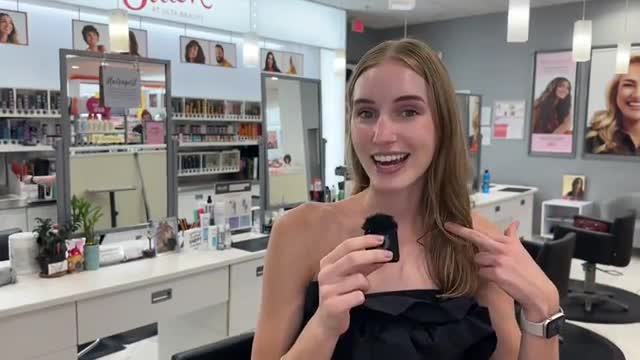
In today's video, I will get a haircut at the hair salon and if you're a woman, you'll get a haircut at the salon, but if you're a man, you'll get a haircut at the barber shop.
In this video, I will first visit this hair salon behind me to get a haircut and then I will go to a barber shop to show you how men normally cut their hair.
So if you go to a hair salon to get a haircut, you will get your hair cut with a hair stylist or a hairdresser.
And if you're a man and you go to the barber shop, you'll get your hair cut with a barber.
To get a haircut, you need to make an appointment.
Yesterday I walked into the store and I went over here to the counter and I made an appointment for today at 12 pm.
You can't just walk into the store and just get a haircut at that same moment.
You have to make an appointment and schedule a time with the hair stylist to cut your hair.
Right now it's 12 p.m. and it's time to get a haircut.
So I will walk over there and sit down in one of the chairs.
Right now I'm sitting down in the chair and in a few seconds the hairdresser, or hairstylist, will come over here and ask me a question.
He or she will ask me, how would you like your haircut?
And then some responses you can say are, I would like a trim.
And you can also say, I'd like to get rid of my split ends.
And then your hairstylist will ask you, how much you would like trimmed off.
So you can say about this much or you can say about two inches.
Now let's learn some basic vocabulary about our hair.
What do we call the part of our hair that grows out of our heads?
That's called the root.
These are my roots.
Now what do we call the ends of our hair?
These are my tips.
Now how do we describe hair?
For example, is my hair straight, wavy, or curly?
My hair is straight.
Straight.
And what is my hair color?
I have blonde hair.
There are so many different ways to describe hair and it's important to be specific when speaking English.
And in today's video, I want to introduce you to today's sponsor, Preply.
Preply is a language learning platform with thousands of native tutors who can help you improve your English.
You can find a lesson that fits your budget and busy schedule.
You can even choose a specific topic for your class, like for example, getting a haircut in English.
That way you can describe your hair, whether it's straight, wavy, or curly.
Use my code ARIANITA50 for a 50 discount on your first trial and start describing your hair with confidence.
Thanks to Preply for sponsoring this portion of this video.
Let's get back to the video.
Right now I'm next to the hairdresser Mackenzie.
Hello.
And then I will get a haircut with her today.
First I'll put the cape on you.
Thank you.
So are you getting a haircut today?
Yeah, I'm just thinking about a trim, not too much.
Just maybe cutting the split ends.
How much are you thinking you want to take off of your length?
Maybe one inch.
Okay.
Yeah.
Would you like any layering your hair?
Shorter pieces throughout?
Can you just keep my hair straight?
I don't want any layers today.
Okay, would you like your hair washed today?
Yes please, we can go ahead and wash your hair then.
Perfect, thank you.
Now I'm going to go to a different room and get my hair washed before I get a haircut.
So the hairdresser Mackenzie will wash my hair.
She will shampoo it and condition it.
Would you like the water to be warm or cool?
Warm please, thank you.
First I'm going to shampoo.
I'm going to put the conditioner just on your ends.
Thank you.
Then I'm just going to towel dry your hair.
And then we can go back to that chair where you were before.
Mackenzie just washed my hair, and now I will go back to the chair and get a haircut.
So when people get a haircut, what do they normally ask for?
Sometimes someone will ask for layering all around their hair.
Sometimes people will get just one length straight across, or they will get shorter pieces in the front of their hair, like bangs or um face framing, like what you have right now your bangs on your forehead.
Yeah, they look really good too, thank you, thank you.
My question for you is where do you part your hair?
Every day, i part my hair down the middle, down the middle, yeah.
So we're not doing any layering today.
No.
One length and then you said one inch off of the length on the bottom.
Yes, one inch.
And then what are some of the tools you normally use to cut people's hair?
Like what are you doing right now?
So right now I'm using a comb to detangle and make all of the hair even and straight.
For me to use my shears or scissors to cut the hair with.
And then I will use clips such as these to section the hair into different parts, so that I can focus on one section at a time.
So what I'll have you do now is sit straight and then do not cross your legs, and then I'll have you look down to your feet.
Then I will cut an inch off the bottom, so the front of the hair.
Here is where I would do the shorter pieces for face framing.
But since we're doing it all one length today, we're not going to be cutting anything any shorter, we're just going to keep it straight across.
Yes, Now that I'm done cutting the hair, I'm going to put it into two sections so I can blow dry the hair with a round brush like this.
This helps me blow dry the hair quicker in different sections.
I do that at home too.
Yeah.
So we'll take this and blow dry with my blow dryer.
This will help keep the hair detangled while I'm drying it.
If the blow dryer gets too hot on your scalp, just let me know.
OK, I'll let you know.
Thank you.
So now we've finished with the blow dry.
What I'm going to do next is check and make sure that my haircut is even.
So I'll have you look down for me one more time and I will make sure the length is straight across.
This is to make sure that there are no random long hairs like this.
Just get rid of those.
How would you like your hairstyle today?
We can straighten your hair or we can curl your hair.
Can you curl my hair please?
Sure, absolutely.
I will turn on my curling iron.
I'm gonna put your hair in sections again so that I can curl all the pieces individually.
So now I'm gonna use my curling wand to curl your hair for you.
This style will usually last about a day or two.
Now that we have finished curling your hair, I can put some hairspray in it if you would like.
Would you like some hairspray today to make the hair hold?
Yes, I would like some hairspray.
Do you recommend any other products to put in my hair?
You could try going home today with a heat protectant spray to help protect your hair from the heat of the iron.
I'll have you close your eyes so that I can keep them from getting hairspray in them.
All right, is there anything else I can do for you today?
I think that's it.
Thank you so much.
Awesome.
It looks great.
It was lovely meeting you.
And then we are going to go up to the front where you can pay for your ticket.
Perfect, thank you.
Right now, I'm next to another client who's getting her hair done.
And what are you doing to your hair today?
I'm getting my hair dyed blue, like teal.
Oh, like this?
That's so cool.
That'll look really nice.
Thank you.
Are you also getting your hair cut?
I am not.
You're not?
Okay, so just keeping the same length.
And what's the process of dyeing someone's hair blue?
First, we have to bleach the hair, which is what we're doing right now, so it is lighter.
And then after the bleach is done processing, we rinse it out, and then we put on the blue.
And then how long will that take?
Um, depending on how like thick the hair is, it could be anywhere between like an hour and a half to like three hours.
Okay yeah, i just got a haircut at the salon at ulta beauty it's inside ulta and i got a little trim about one inch off of my hair.
And now, since we're inside the store and they have even more hair products, i will play a little game with you guys.
If you paid attention during the video, you might know some of the answers to this game.
What was this device that the hairstylist used to dry my hair?
This is called a blow dryer or a hair dryer.
What is this hairstyling tool that Mackenzie used to curl my hair?
This is called a curling iron.
Curling iron.
What is this called that she used to brush my hair and style it?
This is called a hairbrush but specifically it's a round brush.
I'm outside Ulta Beauty and I got a haircut, but now we're going to the barber shop, where I will show you how men get their hair cut with a barber and how men trim their beard and their mustache.
Let's go!
Right now I'm inside the barber shop.
This is the barber shop, and it does look a bit different compared to a hair salon, because here in the barber shop, you'll get your hair cut with a barber.
That is the barber and in the hair salon, you'll get a haircut with a hairdresser or a hairstylist.
In the barber shop, you'll get a haircut, you'll get your hair styled and shaved.
So some of these tools you won't find in a hair salon.
Hi Austin, you're the barber and what type of tools do you use to cut people's hair?
So here we have a clipper.
This would be your trimmer to do the outline of the haircut.
And then this would be your foil shaver to make it bald if you wanted a very short fade.
And then here we have a straight razor to do the outline of your haircut.
And then I got anything from combs to brushes to styling comb.
And then I got spray water, bottle duster to get the hair off you hair gel hairspray, anything you need.
And then what is the most popular hairstyle people normally get?
I'd say the most popular style right now would be any kind of fade.
Fade?
OK.
Thank you so much.
Anytime.
Hi, Thomas.
What is the process of cutting someone's hair in the barber shop?
The process is the client will come in.
He'll sit in the chair.
We'll turn him around to the mirror so he can see his own hair.
Call that a client consultation.
Ask him how he'd like it cut, how he'd like it styled, any personal preference, and then try to match his ideal to real life.
His head
Try to make what he envisions in his head a reality for him and what he thinks he should look like.
What kind of haircut did you do on this client?
This gentleman just gets a normal business cut.
It's like a seven on the side and just trim and texturize the top.
Basically, once you go inside the barber shop, you will sit down in one of the chairs and talk to the barber and tell him what kind of haircut you want.
There are many different hairstyles for men.
For example, you can get a buzz cut, which is an extremely short haircut for men, which is where your hair is basically the same length.
Or if you are bald, you probably won't visit a barber shop.
But if you do have a beard, then you will come to the barber shop and trim your beard or have it shaved.
Now there are many different styles of beards.
For example, you can have a goatee. you can have a circle beard which is hair just around your mouth and you can also have a stubble beard which is in between a clean shaven look and a full beard let me know down below in the comments if you have a beard or do you like the clean shaven look Another hairstyle is a fade on the sides.
So on the sides of your head you will have a fade, or basically your hair will start blending into your skin because of the cut.
If you have a low fade, it'll start lower on the sides of your head, but if you have a high fade, the fade will start over here, a little bit higher than the low fade, and you'll have more hair on the top of your head but less hair on the sides.
Another popular hairstyle for men is a crew cut, and this is where your hair will be longer, on the top of your head and on your sides.
You might have a fade or it might be tapered.
And another popular hairstyle is dreadlocks.
If you have dreadlocks, your hair might be braided together or twisted together, And dreadlocks have many different styles, so you can have them short or very long.
And outside the barber shop you might find this big sign and this is called a barber's pole and this just lets people know out and about on the street if they're walking by this store, that it's a barber shop.
Okay everybody, that's all for today's video.
Let me know down below what type of haircut do you get at the barber shop or, if you're a woman, at the hair salon.
Don't forget to like and subscribe and I'll see you guys next week.
Bye!