All right, it's happening today.
Let's talk about how to film yourself.
Whether you are an aspiring filmmaker, content creator or just generally want to document your life better, knowing how to film yourself can be one of the best skills that you can acquire.
Over the course of my creator journey, there are two reasons why I wanted to learn how to film by myself.
I didn't want to bother anybody and I didn't want to rely on anybody.
We can unpack that later.
Truthfully, it can be such a pain when all you wanna do is create something, but you constantly have to wait for help.
It was a huge point of friction for me that I knew that I had to figure out if I not only wanted to keep sharing my work on a consistent basis, but also for the sake of just not putting a stopper whenever I would get a spark of creativity.
The last few years, I've had my fair share of trials and tribulations, trying to figure out how to achieve the vision in my head while shooting solo and create a process around it.
Most of the videos that I shoot on this channel are by myself, so today I want to share a few tricks that I've learned over the past couple of years creating content, filming solo for my own videos and keep it simple enough that you can implement them today in your videos, if you want to.
We are going to cover gear, lighting, and even how to use your visuals for better storytelling.
Let's get into it.
Alright, so we're going to film most of this in my house today because, chances are, if you're watching this, you don't want to go outside.
But anything can be applied to wherever you decide to film.
Things you will need.
A camera.
This is the question I actually get most on this channel.
Recently, about a month ago, I got the Sony FX3.
It is literally my dream camera and I've wanted it for so long.
But up until getting the FX3, I was actually filming on the Sony a7S II.
This is literally seven or eight years old at this point.
It's so beat up.
On the brink, it is hanging on for dear life.
Things are coming off.
No flip screen.
Scuffs and scratches.
This thing has been with me through the trenches.
And I was filming with this up until around a month ago.
So if I could film on this, you can film on anything.
As for lenses, I like using the 24-70mm when I have to go get B-roll.
It's just a very versatile lens.
I didn't need a tripod of some sort.
I like this one because you could also do a top-down shot with it.
So right now, all you need is the camera and a tripod and a lens if you have a DSLR.
So now I'm gonna show you some things that I personally use.
You don't need them, but when I'm filming alone, I use them all the time.
Since we're filming by ourself, a good thing to get would be some sort of external monitor.
This one is just a cheap one off of Amazon.
There's also other options.
If you are capturing audio, if you're talking to the camera or you want to get some sounds, you're gonna need a mic of some kind.
I use this teeny one from Sony.
This is the E-CM-D10.
You can also use a lav mic like so.
This pack comes with two.
Let me show you how it works.
So you can stand as far from the camera as you want.
I'm literally in the freaking corner right now and you can hear me pretty good.
Usually you just like thread this through your shirt all right next up.
If you're a baller, then you can get one of these.
This is a motorized slider and this one is from gbm.
I have had this for the past maybe three years.
It has served me well.
I use this all the time.
It's hard when you film by yourself and you want some movement, so i invested in a motorized slider.
They come in different lengths as well if you don't have a much like storage room.
So basically you get one of these.
There's a cable that connects to this and then you just set your speed and whatever else.
And you can also use it manually as well.
It's my assistant when I need help on videos and no one's around.
I'll link all my gear in the description below.
Feel free, of course, if you want to support the channel.
There are so many aspects to filmmaking.
Story, art direction, composition, tone, And of course, lighting.
So once I know where I want to film, the first thing I look at is lighting.
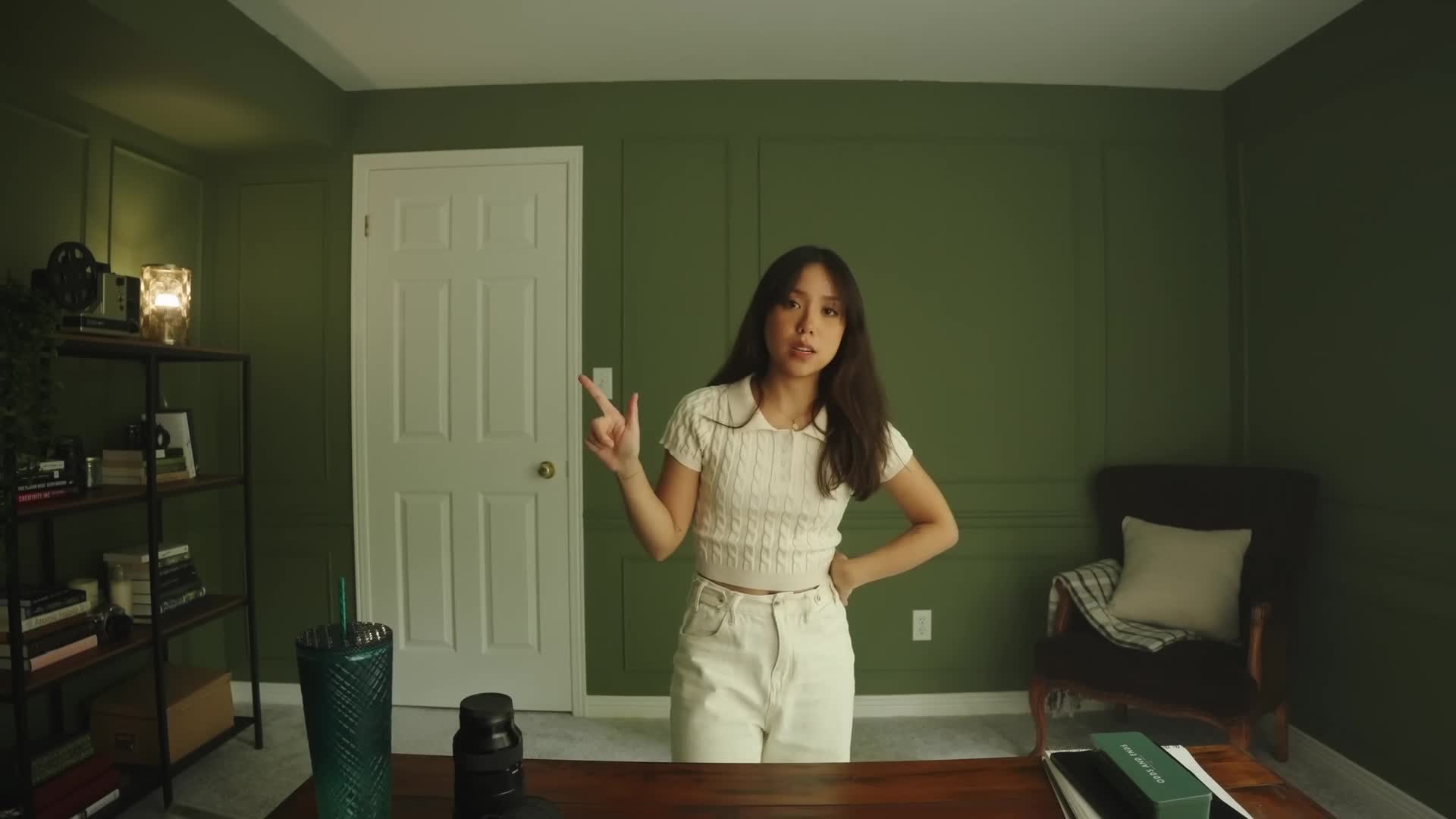
This is my office.
I literally cleaned it out for this example.
Not very bright in here at the moment, but there is a very strong light ray.
Focusing on lighting is the one thing that is going to transform your footage and give it that cinematic quality.
Maybe this means waking up early for a soft morning light or catching golden hour in the late afternoon.
If you invested in some lights, then that's great, but sometimes it can be as simple as placing your camera in the right spot.
Today we are going to use a window, which everybody has access to.
So for our example today, I'm sitting in front of a window.
I'm on my 24 to 70 lens, 50 millimeter focal length right now.
And as you can see, the window is blown out.
Not a great image.
However, just by changing the placement of our tripod, we can go from this to this, and it is already a world of a difference.
It's obviously not perfect.
There's a lot more things that we can do.
You can add some diffusion to soften the light even more, but this is a good place to start and a good rule of thumb when you are say, on location or in a place where you don't have a lot of gear with you or no gear at all.
So this is an easy way to get a more cinematic feel.
Just by moving our camera placement, we can create more shadows.
All you really have to pay attention to is the angle in which the lighting is hitting you.
So this is more of like a 45 and this would be better for like a talking head if you were to film something like that.
But yeah, if I'm filming like b-roll or something, this is really good.
Learning how to light can be intimidating and a whole beast of its own.
It's a little harder to rely on natural light, but it's great once you know how to shape it and frame for it.
Now let's talk about coverage.
This means getting a variety of shots for the scene you are filming.
I'm not gonna lie, this takes a long time.
I'm preparing you.
However, it is always worth it because this is what is going to immerse your viewer into the scene.
Get that long shot, that medium long shot, that medium shot, that medium close-up, that close-up, different perspectives, things in your environment.
Do not overlook that stuff.
When you are visually telling a story, whoever is watching needs context.
Where in the world are you?
And an easy way to do this, like many movies before us, you can start with an establishing shot.
This can be a wide shot.
It can also be an aerial shot.
And if you're like me and you can't fly a drone to save your life, then you can also find aerial shots using storyblocks.
Storyblocks is a stock footage and media library that creators can access with a monthly or annual subscription, and they are also the first ever sponsors of this channel.
So thank you, Storyblocks.
I can't tell you how many times using their subscription has saved me both time and resources when creating videos.
With one subscription, you have unlimited access to all the files that you need, including stock footage, sound effects, motion graphic templates and more.
Even film textures to overlay on your videos, which is a personal favorite of mine.
Whether you are a creator or freelancer or business, they have a plan for everyone.
All royalty-free and safe to use no matter where you distribute your projects.
Getting a variety of shots while filming on your own is the one thing that is going to take ages.
So if you're looking to save a bit of time while still adding that production quality to your videos, then you can check out the link in the description and head over to storyblockscom slash lifeofrisa to sign up.
At the end of the day filmmaking is a tool to help better convey the story you're trying to tell.
Every shot should be purposeful.
If you're talking about something, then show it.
If you decide to move the camera, then what's the motivation behind it?
Make creative decisions that aid what's already going on in the scene.
These are visual cues to let whoever's watching know how to feel or what to watch out for.
I know it sounds cliche, but learn how to enjoy the process.
Often you hear people say it's worth it when you see the final product, but genuinely i have learned to love the filming process of it because it takes up so much of my time, especially if i'm filming by myself, if i'm trying to figure out things for the first time.
There's always going to be limitations when filming yourself, but there are ways that you can make it more enjoyable.
Find what works for you and the way you like to work, and i promise it will be such a better experience when you take the time to figure out how you like to create.
You're not always going to get the perfect conditions or the perfect lighting.
You're going to miss some shots and have to go back.
You'll wear the same clothes for four days in a row and run back for your camera countless times, but eventually you'll be more adept to thinking these things on the fly.
The more you shoot and the more you edit.
Being a filmmaker is also being a problem solver.
And trust me, there will be a lot of problems you're gonna have to solve.
But now I have found a system where I actually find it quite relaxing to film by myself.
There's something almost meditative about it.
I put on some music and then I set up my lights, I set up my frame and I get to it.
Enjoying it just makes it easy to get into flow and sometimes you'll even capture some magic.