summer's here and nordstrom has everything you need for your best dress season ever from beach days and weddings to weekend getaways and your everyday wardrobe discover stylish options under a hundred dollars from tons of your favorite brands like mango skims princess polly and madewell it's easy too with free shipping and free returns in -store order pickup and more shop today in stores online at nordstrom .com or download the nordstrom app For Scientific American Science Quickly, I'm Rachel Feltman.
This is the final episode of our three -part series on bird flu.
On Wednesday, we met scientists who are getting their hands dirty with dairy cows and poultry to better understand how H5N1 bird flu is spreading.
Today, we'll take a look at efforts to create vaccines for H5N1 and learn why eggs are so critical to the vaccine -making process.
Our host today is Naeem Amrsi, a multimedia journalist based in New York City.
Here's Naeem now. It's barely 10 a .m. in San Antonio, Texas, And it's nearly 90 degrees in the middle of May.
While the rest of the city steps out in sandals and shorts, I'm watching a team of scientists at Texas Biomedical Research Institute.
They're rummaging through metallic shelves to find the extra layers of protective gear they need to start their day.
Scrubs, gowns, gloves, shoe covers, hairnets, and long white coveralls.
so we need to change all our clothes and that's what we have these cabinets there that's virologist luis martinez sobrido he observes with a keen eye as two members of his lab dress up for the next shift you take everything out only the scraps and the bunny suit they also use this headnet to cover the head i don't have that problem i don't need that Luis's team is preparing to enter a BSL -3, which is short for Biosafety Level 3 Facility.
In these highly secure labs, scientists handle some of the world's potentially deadliest viruses.
So mainly here, we are working with TB tuberculosis.
We are working with SARS -CoV -2 and H5N1.
H5N1 is the reason I am here.
As we learned in the first two episodes of this series, the virus is moving between species, from wild birds, to their domesticated counterparts, to cows and other mammals.
And now, it's reached humans.
The currently circulating strains have already infected dozens of people, mostly poultry and cattle farm workers.
Luckily, most of these infections have been mild.
But historically, H5N1 viruses have killed nearly 50 percent of the people they've infected, according to the World Health Organisation.
And that's a major concern.
The more these H5N1 viruses circulate the greater the chance they change into forms that cause severe disease and that easily spread between people.
We do not have any pre -existing immunity against this H5N1 virus.
And if it's able to transmit, it will be able to potentially cause a pandemic.
I wanted to understand what biologists like Luis are discovering about bird flu, and how they might try to protect us if it does start jumping between humans.
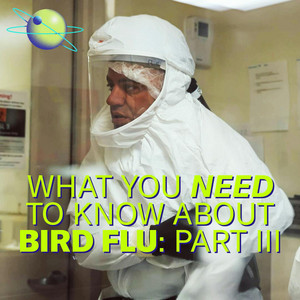
Inside the ante room, a sealed space between the outside world and a BSL -3 lab, each of Luis's colleagues puts on their final piece of equipment, a battery -powered respirator that is connected to a large white hood with a transparent front.
They call it the bubble.
So we start with checking our bubble and connecting the battery.
And then start the bubble.
Then we connect the shroud to protect our face.
That's Ahmed El -Sayed, a staff scientist working in Luis's lab.
In his immaculate white coveralls, he reminds me of a beekeeper.
At the back of his head, a thick cable connects his bubble to the air filter around his belt.
It's a lifeline from any contagion inside the lab.
We are waiting to have everyone ready before opening the second door because we cannot open it twice.
So once everything is fine, then we enter the BIN number.
and to enter the lab as they disappear into the lab I am left wondering what Ahmed and his colleague will do over the next 6 hours of their shift working with those potentially deadly viruses so I asked Luis so the main specialty of our lab is reverse genetic approaches.
Reverse genetics mainly refer to the ability to generate recombinant viruses in the laboratory.
It's not a virus that has been isolated from an animal or from a human.
Recombinant viruses are one of the most powerful tools in virology.
They let scientists like Luis use genetic sequences to recreate and modify viruses found in the world.
all that without having to rely on samples from the outside world.
This helps researchers test a bunch of things about viruses such as H5N1, from how they respond to antiviral treatments, to how they mutate and how sick they make us.
More importantly, like in the case of the influenza vaccines, allow you to generate attenuated forms of the virus than you can use as vaccines for the treatment of viral infections.
Every year, tens of millions of Americans get a flu shot.
This prevents tens of thousands of hospitalizations.
And making the annual seasonal flu vaccines is a coordinated global effort.
The World Health Organization offers recommendations on the vaccines make -up twice a year.
In February, for the Northern Hemisphere, and September, for the Southern Hemisphere.
They make these recommendations based on which strains experts think are most likely to spread.
In the United States, the Food and Drug Administration considers that data and then makes its own recommendations which pharmaceutical manufacturers use to produce millions of doses that are distributed across the country.
Along the way, labs like Luis's get involved.
Well, we generate some of the stocks or the seeds of the vaccine.
We cannot produce vaccines for a large population.
We just do it on a smaller scale here.
What Luis calls the seed of the vaccine is a specifically designed virus that pharma companies use to develop flu vaccines.
It doesn't make us sick, but instead helps our body create antibodies.
It's also known as a candidate vaccine virus.
So if I get a flu shot at the end of the year, it could be coming from here, yeah.
in addition to its contribution to your annual flu shot louise's lab makes candidates for potential vaccines to protect against h5n1 these so -called pandemic vaccine viruses are an essential line of defense against the threat of an avian flu pandemic they can be used to create vaccines to help reduce severe illness and whether we're talking about flu shots for For seasonal strains, or avian strains, making them usually involves a surprising tool.
We infect eggs with the virus.
These aren't your everyday supermarket eggs.
They are fertilized eggs, produced in secret biosecure farms across the country.
It's believed that we go through millions of these eggs every year.
And they are used because flu viruses grow very well in the elantoid cavity, cavity which is full of liquid that contains waste from the embryo as well as various proteins.
Luis and his team showed me how they make these H5N1 vaccine seeds.
They said it all starts in their super -secure BSL -3 lab that only authorized researchers can enter.
I can't go in. So we usually start with a vaccine virus that we generate in the laboratories.
It does not infect or replicate humans, but it grows very well in eggs.
Once the scientists create the virus, they conduct a bunch of tests to make sure it actually isn't dangerous to humans.
Only when they know the virus is safe do they move it to another lab with less stringent safety rules.
No need for respirators.
And this time, I could join.
We have egg incubators like this where we have, keep the eggs inside.
And they actually rotate like every 50 minutes, 20 minutes.
Ahmed removes a dozen white eggs from the incubator and turns off the ceiling lights.
So we get the egg on day one, so then we keep it until day 10 to be ready, the embryo will be ready, and the egg will be ready for infection, to propagate the viruses.
So now we will start to candle the egg.
He holds an egg in one hand.
He moves the egg below a small light attached to his workstation, causing it to glow orange, except for a small circular patch at the top which remains white.
That's the air sac, he explains.
He wants to avoid injecting the virus there because it won't grow.
Then we find out a certain point and in which we can use to enaculate safely the embryonated egg without affecting the embryo.
After labeling a dozen eggs, he passes the crate to Ramya Smetavani Barre, a PhD student who also works in Wyss' lab.
We will actually be making a hole here at the point, and we will be injecting the virus into the allantoic fluid.
Under a loud bio -safety hood, she pokes small holes into the eggs eggs and injects them with the specially designed vaccine virus.
So these are 18 gauge needles.
These are very thick, so it just helps in making the hole, like drill a hole quickly.
So I will just make a hole here.
So you see this point here where the X mark is made, so from here we will be injecting using a syringe.
Now that the eggs have been infected, the team needs to wait for the virus to propagate in large enough quantities.
In two days, they will extract the allantoic fluid, which now contains the virus.
virus. Then they will conduct a number of tests and put the samples with the highest virus concentration into vials.
Each has enough virus to make thousands of flu vaccine doses.
And after leaving Luis's lab, the vials go through a series of quality control evaluations and testing.
And then they will be sent to manufacturing labs which, in the case of a pandemic, can use them to replicate the process in millions of eggs.
Since this is a virus that is still alive, the next thing they do after growing the virus is to kill the virus, inactivate the virus.
So once they inactivate the virus, they process and then they put it in the tube, and then they send it to the pharmacy, and that's where you get.
For the 2024 -2025 flu season, the CDC said it expected about 80 % of flu vaccines in in the United States, to be made using the egg -based method.
And without the science that has, even if most people don't know it, gone into every flu shot you've ever had, we might not be able to prepare for what scientists say is the growing threat of a potential bird flu pandemic.
We recently are aware of how important the vaccines are because of the COVID -19 pandemic, right?
That these vaccines have clearly saved millions of lives.
But clearly, it's the best mechanism that we have to protect us against any type of infectious disease, including influenza.
And if H5N1 does become easily transmissible between humans, the seeds that Luis's lab makes and the H5N1 vaccines that follow could become central to our pandemic response.
So there are stockpiled vaccines against H5N1.
This is a process that began during George W.
Bush's administration.
administration. These are not well matched to what's circulating now, but there have been efforts to update that stockpile.
There's not enough in the stockpile currently to vaccinate the entire U .S. population.
There are efforts underway to increase that stockpile if needed, and contracts in place.
In the event of a threat change, you would anticipate manufacturers coming online and some of the seasonal flu capacity being shifted to pandemic flu requirements.
That's Amesh Adalja.
He's a pandemic preparedness specialist at Johns Hopkins University and an infectious disease physician.
Amesh emphasizes the importance of vaccines as one of our first lines of defense against a potential avian influenza pandemic.
But he sees some challenges in our current system.
The issue will always be, does the vaccine work very well?
Is it well -matched to the strain that's circulating or that's causing the issue?
And how much of it do we have and how fast can we have it in the arms of those people who are at most risk?
Part of what complicates addressing these concerns is the use of chicken eggs he says if you're in an avian influenza outbreak it might affect chicken farms and chicken egg production however people recognize that and there have been specific flocks that have been segregated away and kept under high biosafety to not allow them to be infected they're not kept in open where you know a passing you know goose can't put its droppings in the chicken cage the individuals or the humans that have to interact with them have have to wear aggressive personal protective equipment.
So to experts like Amesh, threats to egg availability aren't the main problem.
The larger concern is that creating vaccines by using chicken eggs takes so long that scientists have to pick the strains about six months before a vaccine gets into our arms. And that creates a problem because when they're making that strain selection, things might change later in the season and they're pretty much stuck with what they picked.
So that's why we sometimes have vaccine mismatches because of that long lead time required by the egg -based vaccine manufacturers.
This means that if the H5N1 viruses currently circulating were to mutate into a new strain that doesn't respond to the vaccine seeds made in labs like Luis's, it would be at least half a year before we even have egg -based shots available.
By that time, many people could already be infected.
Additionally, Image says there is another problem with growing bird flu vaccines in eggs.
When you propagate the virus in chicken eggs, the virus mutates and you might end up at the end with something different than what you started with that might not work as well.
So I think it also decreases the efficacy.
So, you know, long lead time, which allows mismatches to occur more frequently, and you get egg -based mutations that decrease the efficacy of the vaccine.
As I mentioned before, we still use eggs to make most flu shots, and most of the time, it works well.
It's the cheapest option and we have a widespread manufacturing infrastructure built around this process.
But there are also quicker alternatives, like cell -based vaccines which are grown in mammalian cells, and though these approaches cost more right now, experts like Amish have advocated for them to be adopted more widely.
Some labs are trying to develop even newer solutions based on messenger RNA, like many of the covid vaccines this process could allow countries to deploy a vaccine that matches the new strain much quicker the trump administration however recently cancelled 766 million dollars in funding for the pharmaceutical company moderna to develop an mrna based bird flu shot this has added to concerns about the us department of health and human services approach to vaccination But for H5N1 to trigger the next pandemic, it would first need to acquire the ability to easily transmit between humans.
And that, we think, hasn't happened yet.
We have these little entities, microscopic entities, viruses.
Flu has only eight genes.
Eight genes and they get inside a cell of an organism.
We have 30 ,000 genes.
and how the virus is able, these eight genes, code information that take over the whole 30 ,000 genes and then change completely the cell to make copies of themselves.
How can you achieve that with so little information, right?
That's fascinating.
That's Adolfo Garcia Sastre.
He's one of the world's leading flu virologists and he trained Luis back in the 2000s.
He now runs a lab at the Mount Sinai Icahn School of Medicine in New York City.
His lab looks at pretty much everything that has to do with flu.
Vaccination, treatments, viral evolution, transmission mutations.
But even he was surprised by what H5N1 has done.
I could never imagine in my life that there would be cows infected with flu.
Before that they say, you think that flu can replicate and establish a cycle in dairy cows by replicating in the mammary glands of the dairy cows?
and say, what are you crazy or what?
As we heard my colleague Megan Bartels explain in episode two, scientists were astonished when they learned that H5N1 had jumped from birds to cows.
And now the big fear is that the virus manages to adapt well enough to our bodies to transmit efficiently between people.
One way that could happen is through reassortment, the genetic mixing of multiple influenza viruses that we learned about in episode one.
So if we get, for example, the 2009 H1N1 pandemic of flu, it has acquired gene chromosomes of the genes coming from four different viruses.
One was a virus circulating in humans, the other was a virus circulating in birds, the other a virus circulating in pigs, and the other a virus circulating in pigs by a different geographical area.
So somehow these viruses got together into a peak and then created this particular virus.
Another way H5N1 could develop the ability to move from human to human is by simply mutating.
Mutations happen when viruses make copies of themselves and mistakes slip in.
Most of the time, the mutations that don't benefit the virus are less likely to pass down.
But it can happen that if a new mutation gives you a new characteristic that makes you more likely to replicate faster than your previous brothers and sister, then this mutation dominates.
Now, let's say H5N1, if it requires 20 different mutations to replicate and transmit in humans, And if each mutation by itself doesn't make it better, then it's very rare, because these 20 mutations it's very difficult that they happen at the same time.
But if it requires only four mutations, that's a different story.
Maybe you can get four mutations being generated at one moment, and it just happened to be that there is a human that gets infected with this mutant virus.
virus, then you start to propagate in humans." There's an ongoing debate among virologists about how many mutations it would take for the H5N1 viruses we are currently dealing with to better adapt to humans.
One study found that for the strain that has been circulating in dairy cows since last year, one single mutation could potentially do the job.
Here's what Adolfo had to say.
It's very unlikely because I think the number of encounters of this virus with humans There have been so many that if it would be only one mutation required for transmissible in humans, it would have happened already.
Flu pandemics caused by mutations are historically very rare.
But there's one notable exception.
Experts believe that in 1918 an H1N1 virus thought to have avian origins mutated in a way that made it better adapted to humans.
Eventually, that virus caused one of the deadliest pandemics in recorded history, with estimates made suggesting it killed anywhere from 50 to 100 million people worldwide.
In 2005, Adolfo was part of a team that recreated this virus in the lab.
And here's what they found.
So 1918 was always a mystery and speculation about flu research. We realized the virus was a very nasty virus to start with, and that many of the deaths happened because that was an extreme case of a very virulent virus for humans of influenza and that means that this can happen again but will it happen again?
When we started to try to understand what are the determinants of virulence of this virus, we found that it needed to have like a perfect storm, a combination of multiple mutations happening, multiple genes of the virus and only this combination makes the virus as lethal as it Just in the last roughly 140 years, there have been five flu pandemics, ranging from the disastrous 1918 pandemic to the relatively mild 2009 outbreak.
Virologists tend to agree that another flu pandemic is inevitable, but there's a disagreement about how likely H5N1 is to be the trigger.
So I asked Adolfo's longtime colleagues what they thought.
Some people think that it's just a question of time when any of these H5, they are bound to jump into humans.
turn it around and say they have been with us so long already in all kinds of animals, avian, mammalian, why hasn't it happened?
And so I'm not so sure it will happen, and I'm not so sure that this is the next pandemic strain which will cause us all the grief which we have seen with other pandemic strains.
That's Peter Pellese, Adolfo's mentor at Mount Sinai.
And a leading figure behind a lot of innovations that influence their research. I think it's really hard to predict.
People were saying this would become a pandemic in 1997, in 2003.
And since then, very often, I think there is a high chance right now or higher than before just because there is so much virus out there and because it seems to adapt to mammals better.
And that's Florian Kramer, who also works with Adolfo and Peter at Mount Sinai.
What is really clear is that it's going to be another flu pandemic.
It doesn't need to be H5, but there have been, all the time, pandemics.
It's not a foregone conclusion that H5N1 will trigger the next pandemic.
But if it does cause the next pandemic, are we ready to respond effectively?
I talked to epidemiologists Jennifer Nozzo and Shira Doron.
Here's what they told me.
So, historically, H5N1 has been observed to be one of the most deadly viruses we've seen, meaning that of all the cases we've been able to find, about half of them have died.
And that is truly extraordinary when you sort of rank pathogens in terms of their potential to kill the people that we know are infected.
That's Jennifer. She directs the Pandemic Center at Brown University.
That has not been the case with the current strain.
What we've seen with this particular strain is very mild illness.
And so often what we're seeing with the individuals who have developed H5N1 influenza from cows and poultry is just conjunctivitis or just conjunctivitis with some mild upper respiratory symptoms like a sore throat.
out. And that's Shira.
She's the chief infection control officer at Tufts Medicine.
From the beginning of the current outbreak to early June 2025, there have been 70 known human cases of H5N1 in the United States.
And though most cases have been mild, we may be undercounting them.
By a lot. We know that our known cases are a relatively small proportion of total actual cases, especially because the disease has been so mild in most of the farm workers who have become infected.
Most people with very mild infection don't go to the doctor and don't request testing.
Add to that the fact that many of these workers are undocumented migrants who are trying to stay under the radar.
If many cases go undetected, it means that H5N1 could be spreading silently.
And every time it affects a new person, it gets a chance to mutate, possibly into a form that adapts better to our bodies.
I think it's quite concerning that we continue to see new outbreaks on farms being reported and yet no new human cases have been identified in months.
So the number of animals who are getting infected continues to climb and somehow the number of people who are being infected has just remained unchanged.
changed. We are also seeing that the amount of tests that states are doing has decreased.
So we have a lot of reason to be concerned that we haven't found new cases because there's been a contraction in surveillance efforts directed at H5N1.
There may be lower H5N1 activity, I'm not ruling that out, but we also know that H5N1 is not going away.
So in order to stay ahead of the curve, Jennifer says we need to ramp up our monitoring efforts, from testing for possible infections to conducting wastewater surveillance.
We'd also need to do much more to protect those who are most exposed to the virus.
We know just telling people to wear personal protective equipment to protect themselves against the virus every time they're around animals is not working because people have continued to get sick despite making those recommendations.
So I do think there is a case to be made to offer the vaccines that we do have to the agricultural sector, not mandate, but offer as another tool to protect them.
Otherwise, we could be caught off guard. H5N1 could be a lot less severe and still cause a tremendous amount of chaos and damage.
You know, COVID -19 has observed to be far less lethal than what we've observed H5N1 to be.
And if H5N1 became able to infect people easily and able to transmit easily between people, thus triggering a pandemic, and anything close to the case fatality that we've seen it have, it would be far and away so much worse than anything we've ever observed with COVID -19.
And of course, that's a scenario nobody wants.
But if it happened, it's not like we'd be taking shots in the dark.
As we learned from Luis, we can make vaccines that are thought to be effective, at least against the current circulating strains of H5N1.
Additionally, we have antiviral treatments, some of which researchers such as Adolfo and Peter have tested against the nastiest flu viruses, including viruses with genes from the 1918 strain.
And they tend to work pretty well against many different flu viruses.
So what seems to concern epidemiologists such as Jennifer and Shira the most is not whether we have the right treatments and prevention mechanisms available to fight bird flu.
Instead, the question is whether we have enough resources right now to handle another pandemic.
We have tested a number of strategies and figured out how to do some really hard things.
And those are triggers we could pull again, if need be.
So, for example, in my hospital, we now know how to set up very quickly a mass testing site, a mass vaccination site.
We know how to expand intensive care to areas and expand patient care.
So in some ways, we're more prepared today because of COVID -19.
But in other ways, we are less prepared, the experts say.
The thing that I'm most worried about is the loss of experienced personnel.
personnel. During the start of COVID -19, one of the things that states tried to do was contact tracing, but it was really hard because states didn't have the kind of personnel.
So there was a massive, quick effort to try to build that personnel.
You know, now not only do we not have that workforce anymore, but we've also lost a lot of public health leaders.
You know, it's like we had an enormous fire rip through the United States and we decided to systematically dismantle all of the fire departments.
So I am deeply worried about how the United States would fare in another pandemic.
Jennifer says that sooner or later, there will be another flu pandemic.
Whether it will be caused by H5N1 or another bird flu virus, we just don't know.
But the way we prepared today, from the vaccine seeds built in labs like Luis's, to the critical research conducted by Adolfo, to the care administered in Shiras Hospital, hospital will determine how strong our response is, and whether the next outbreak will upend our world.
That's all for today's episode.
We hope you've enjoyed this week's special series on bird flu.
We'll be back with something new on Monday.
Science Quickly is produced by me, Rachel Thaltman, along with Fondam Wongi, Kelso Harper, Naima Mercy, and Jeff Dalvisio.
This episode was reported and hosted by Naima Marcy and edited by Alex Liguiara.
Shaina Posis and Aaron Shaddock fact check our show.
Our theme music was composed by Dominic Smith.
Special thanks to Laura Peterson and Katie Corcoran at the Texas Biomedical Institute, Jane Dang and Elizabeth Dowling at the Mount Sinai Icon School of Medicine, and to Kimberly Lau, Dean Visser, and Gina Briner at Scientific American.
Subscribe to Scientific American for more up -to -date and in -depth science news.
news. For Science Quickly, this is Rachel Feltman.
Have a great weekend.