Ted Audio Collective You're listening to Ted Talk's Daily where we bring you new ideas to spark your curiosity every day.
I'm your host, Elise Hugh.
A story today of how a sack of seeds can change entire villages.
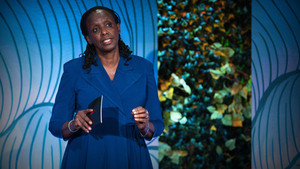
In her 2024 talk, Green Revolutionary Agnes Calibata reminds us that farms are small businesses.
And she says, thinking about the support system these farm businesses need is crucial in the face of climate change.
That's coming up after the break.
These days we're surrounded by photo editing programs.
Have you ever wondered what something or someone actually looks like under all the manipulation?
It's me, Elise, and this October I'm giving a Ted Talk in Atlanta about finding true beauty in a sea of artificial images.
I'm so excited to share the stage with all the amazing speakers of the Ted Next Conference and I hope you'll come and experience it with me.
Visit go. Ted.com slash Tednext to get your pass today.
And now our Ted Talk of the Day.
I have told this story a million times.
I'm going to tell it today again so that it can help you connect with the 500 million farmers, small older farmers that are out there.
I grew up on a small family Uganda where my parents were refugees from Dwanda.
My parents found their group of server, maize, and potatoes.
My mom dug the land and fed us.
My dad never touched the who even was.
And my mom never complained because she felt it was her responsibility to feed the family.
That's why I got out of there at the age of around 14.
Thanks to the fact that my dad had been a teacher in Dwanda.
But I was the exception, not the rule.
And I'm here today to tell you that important small older farmers can change their lives, can nourish people, improve economies, and actually help them deal with the current challenge of climate change.
When I finished school, I worked in a research in Uganda.
And a friend of mine gave me two kilograms of seed to take to my parents.
This was an improved variety.
When my mom platted it, she got ten bugs in a place where I should have usually got three bugs.
She sold some to her to fellow farmers and bought herself a traditional dress.
She did not have to ask my dad for money.
That was the first time.
And I still remember the excitement and the joy in her face, like it was yesterday.
But of course, she did more seed and shredded more of the same seed.
In my mind, I was like, if I can't inform my mom, my mother, like I did, with one, with one circle of seed, I can definitely pour whole villages.
I can't help sending more girls to school.
I still remember the pain I felt when I was told that my best friend had been married at 15 because her parents could not keep her in school.
I still think of all the girls that did not make out of my village because they didn't have the opportunities I had.
And it gives me a certain yawning that actually keeps me grounded in the realities of my world.
The opportunity came 15 years later when I joined the leadership of the Ministry of Agriculture and Water, ultimately as the minister.
This is not a country where you want to wake up as a minister.
Farmers land holdings are the smallest in the world, not least in Africa.
The country's mountainous, farmers' roots land every season.
And the country was just coming out of a genocide and everybody was struggling.
But this did not water down my excitement.
In my mind, I was sublims and I needed to make lemonade.
I took advantage of the fact that one of the farmers owned their land and we designed a program to consolidate land and synchronize how farmers formed without worrying of land boundaries.
My government put in place policies to ensure that farmers had access to seeds and to fertilizers.
We put in place extension for every 500 hectares.
The first season of farming was a lot of preaching and campaigning and why would farmers want to use seeds and fertilizers they had never seen.
But by the third season, farmers were demanding that seeds and fertilizers be delivered in a good time for planting.
Three years in, we had a bumper harvest and it was my worst nightmare because we had not prepared for markets.
I had not thought about storage and maize was everywhere.
I went back to government and my government helped me working with the World Food Programme and government procurement agencies.
We were able to buy farmers produce and we worked with the private sector and set up more long-term solutions through processing, installing processing capacity.
Once farmers had a market, the transformation was possible.
I remember feeling as I walked around the country, feeling that the air around me was vibrating with energy and excitement.
My people were happy. My country was proud.
In the period of six years, Gwanda was recording poverty reduction levels that were not being seen in the region and the World Bank attributed it, attributed 65% of that poverty reduction to what was happening in the Gwarka-Chust sector and related value addition.
There is the thing, 2.5 million farmers, some of the smallest in the world, were feeding 12 million people and were creating work for themselves.
To me, this is what important smallholder farmers look like.
By a new challenge, they are ahead.
Climate change. By 2013, crop failure was becoming clear because rains were coming too late for stopping to early.
I vividly remember when I went to the food visit with my president and clouds started gathering like to rain.
Fat lasers were on their way from Ukraine and seeds were on their way from Zambia because we hadn't yet figured out how to produce seeds ourselves.
It was two months before the rains and my heart started beating in my chest.
I was like, what am I going to do?
Here I am, I'm going to let these farmers down again.
Because then every drop of rain martyred, climate change has taken out the ability of farmers to understand seasons.
Farmers don't know when rains are going to come or when to plant.
Farmers don't even know what crop to plant anymore.
I see this in every count of the 15 counts where I now work as a grass president.
About an hour to speak, so the Africa is going through one of the worst droughts ever.
Zimbabwe has just lost 70% of their maize crop yield because of a scorching heat wave, the first ever in 40 years.
Kenya has just experienced a flood that has left the land buried after farmers had planted.
But our hands are not tied.
There must be something we can do about it.
We have tools that we can deploy.
And now back to the episode.
There are so many things in our capacity, that we can do to empower farmers to take back their lives and be part of feeding the world.
In the end, we need to stop climate change in stocks.
Top-emitting countries need to stop emitting or be prepared to pay farmers every time they lose a crop, livestock or property.
Two years ago, farmers in the East Africa lost everything after six consecutive seasons of drought.
Today, we should be able to pay those farmers using now the loss and damage fund that was launched last year at COP28.
Reversing climate change is going to take some time.
In the meantime, we need to ensure that farmers have access to improved varieties of seed that need less water, good fertilizers, excitation services, soil health information, climate information and crop insurance that can help them know when to plant.
Plant early or not to plant at all and save that seed if friends are not going to happen.
Most important, we need to ensure that farmers know that disasters are coming so that they can get out of the way.
Todd, we need to invest in post-hivest losses so that we save everything that comes from every season.
Pixburg's designed out of Purdue University and now commercialized in most of East Africa are actually showing full security because they are allowing farmers to store grains for longer periods.
Lastly, we need to rethink markets and how farmers access trade, especially how African farmers engage in African food markets.
You recently saw European farmers demonstrate because they were worried that they were losing their market share.
African farmers lost their market share in the 80s and have never gained it.
As a result, Africa produces what does not consume and consumes what does not produce.
The African-freak continental trade area that has just been launched is an opportunity for us to start advancing into continental trade in Africa in ways that can work for African-smohoda farmers.
Everywhere you look in the world today, farmers are often poor and I get it.
We want food to be cheap and affordable, but we can't do this at the expense of small hodofomas.
They are businesses too and want them to be successful.
We want them to be successful because in Africa and parts of Asia, 70% of the food we eat is grown by small hodofomas.
So I would like to flip this.
I would like us here consumers, businesses, politicians to recogonize the place and lot of small hodofomas and how when we empower them, they can feed themselves, improve their livelihoods, be part of feeding 10 billion people while nourishing the planet.
We do not recogonize the best custodians we have of this planet.
They too understand it.
They know it's what they are going to pass on to their children.
They treasure it. Improving small hodofomas and ensuring that they are able to advance the lives of their children, give them a short education like my daddy did is what I walked towards and it's what keeps me awake every night.
Thank you. That was Agnes Calabata speaking at Ted's Countdown Delema Series on the Future of Food in 2024.
If you're curious about Ted's curation, find out more at Ted.com slash curation guidelines.
And that's it for today.
Ted Talks Daily is part of the Ted Audio Collective.
This episode was produced and edited by our team, Martha Estefanos, Oliver Friedman, Brian Green, Autumn Thompson and Alejandra Salazar.
It was mixed by Christopher Faisy-Bogan, additional support from Emma Taubner, Daniela Balorezo, and Will Hennessey.
I'm Elise Hugh. I'll be back tomorrow with a fresh idea for your feed.
Thanks for listening.