This message comes from ADP.
Whether it's a last -minute policy change, or adding a new company holiday, anything can change the world of work.
From HR to payroll, ADP helps businesses take on the next anything.
ADP, always designing for people.
You're listening to Life Kit, from NPR.
Hey everybody, it's Marielle.
Today we're serving up something special.
Direct from the Life Kit Kitchen.
How to cook when you're not into cooking.
Or maybe when you just don't feel up to cooking.
And don't worry, we are not here to evangelize about the joy of perfectly julian vegetables, or a gorgeous slow roasted leg of lamb.
While both sound lovely, cooking doesn't have to be fancy.
You don't have to learn a lot of complicated techniques or make magazine -worthy dishes for every meal.
Even the most accomplished and celebrated chefs get that feeling of not wanting to step foot in the kitchen.
Oh, I mean, I have it all the time.
I think any professional cook would agree with that.
I think there's a trope in professional kitchens of this thing that you do all day and then you go home and you make yourself a peanut butter sandwich.
Samin Nosrat is a chef and the author of Salt, Fat, Acid, Heat, a best -selling cookbook that won the James Beard Award in 2018.
It's kind of like the Oscars of food.
She hosted a Netflix show of the same name.
What was on her dinner table last night?
Annie's mac and cheese with some broccoli in it.
Was it the most healthy thing to eat, or was it the most, I don't know, creative thing?
No, but it was the thing I needed in that time, which was just something super quick and comforting and warm.
If this answer surprises you, Margaret Ebay says, it's time to reconsider.
Frozen vegetables exist for a reason.
Ready -made meals are there for a reason.
All of those are completely valid ways of feeding yourself.
Margaret is a food writer, recipe developer, and author of the new book, You Gotta Eat, Real Life Strategies for Feeding Yourself When Cooking Feels Impossible.
She says, while eating is necessary, cooking can plunge us into emotional hot water.
Like that lasagna recipe makes your stomach grumble.
But then you start worrying about the carb content or whether you should try and find gluten -free lasagna noodles.
Or you feel judged every time you use box spread crumbs or jarred garlic because your mother would never.
Or you really care about cooking with organic produce, but your budget is tight.
And it's just exhausting.
All of those are unbelievably valid concerns.
But at the same time, I have maybe seven minutes to make lunch.
I just can't solve the world's problems.
I need to make some cheese and crackers.
So let me be clear, you don't have to cook.
But if and when you want to, we have tools to get you started.
On this episode of LifeKit, reporter Andi Tagle will help you grow your confidence in the kitchen.
With the help of Samin and Margaret, she'll talk about reading between the lines of a recipe, learning to trust your taste buds, and the magic of the microwave.
But hermit is here to help customers build wealth their way.
And we provide powerful technology and complete human support where technology can deliver ease of use and affordability.
And the people behind that technology can provide advice and guidance.
Learn more at betterment .com.
Investing involves risk.
Performance not guaranteed.
This message comes from ADP.
ADP knows any new technology, any old competitor, any trendy thing, even a trendy thing that everyone knows isn't a great idea, but management just wants us to give it a try for a bit can change the world of work.
So whether it's a last minute policy change or adding a new company holiday, ADP designs forward thinking solutions to help businesses take on the next anything.
ADP, always designing for people.
This message comes from NPR sponsor Atlassian.
Atlassian makes the team collaboration software that powers enterprise businesses around the world, including over 80 % of the fortune 500.
With Atlassian's AI powered software like Jira, Confluence, and Loom, you'll have more time to do the work that matters.
In fact, Atlassian customers experience a 25 % reduction in project duration per year.
Unleash the potential of your team at Atlassian .com.
This message comes from Capital One with the Venture X -Card.
Earn unlimited double miles on everything you buy.
Plus, get premium benefits at a collection of hotels when booking through Capital One Travel.
What's in your wallet?
Terms apply. Details at CapitalOne .com.
Support for NPR and the following message come from the Pew Charitable Trusts, sharing about the state of housing in America on the After the Fact podcast.
Available at pewtrusts .org slash after the fact.
If you can't carry a tune, you're tone deaf.
Can't keep a plan alive?
You've got a brown thumb.
There's no cooking equivalent term, but if there was one, I'd be it.
That's where I started with this story.
I've just never much enjoyed being in the kitchen.
I'm clumsy, impatient.
I hate being hot. And now, with a toddler at home, I have precious spare downtime to devote to the task.
So there have been many an overcooked meat, undercooked vegetable, and sadly, sadly seasoned side dish, sacrificed on the altar of my cooking efforts.
Maybe you can relate.
I offered all of this to Samine.
Like, maybe some people just don't have what it takes?
I don't know if I buy that anybody is fundamentally never going to get better in the kitchen, because cooking is a skill and skills are something that get better with practice.
So that's takeaway one.
Much to my dismay, cooking is a skill, not an innate talent.
Anyone can learn, but you're going to have to get motivated.
If you're coming to this episode hot with a great big attitude towards your oven and not very much time on your hands, there's no secret sauce that's going to change that for you.
You have to decide this skill is important enough to make time for.
So, Margaret's big advice to get your cooking engines fired up, find the fun.
If there's any part of the cooking process that you enjoy even a little bit, if it sparks any kind of creativity or pleasure when you're doing it, my big advice is to notice that.
It's to notice if there's a part that feels good to you.
Maybe you want to challenge yourself to eat the rainbow every week.
Maybe, like me, you love how much your kid loves to help out in the kitchen, so you seek out recipes that are tiny helper friendly.
Or maybe, like Margaret, your motivation is part craving and part saving.
For example, she found a simple spicy noodle recipe online that can quickly satisfy a craving for her local Thai spot.
And for me, it always feels like a tiny victory.
You know, I'm saving $10 or whatever.
That's such a huge part of it.
It's just like if there's any part of it at all that activates any part of pleasure in your brain, hang on to it.
And listen, friends.
All we're trying to do here is feed ourselves.
At least, if you're listening to this, I'm assuming you're not setting out to be a professional chef or food stylist.
So if at any point you start to feel discouraged or frustrated by your lack of skills at the stove, remember, there's not just one way of doing things.
Your habits and the way that you feed yourself aren't less valid because they aren't professional kitchen habits.
And in fact, you are part of a long and proud tradition of every other human on Earth.
Who has been doing this since the dawn of humans trying to make themselves some sort of food.
An imperfectly diced onion is still a diced onion.
Eggs can be made in the microwave.
And according to Margaret's book, anything's a sandwich if you're not a coward.
My point is take away too.
Expand your idea of cooking.
You're probably already doing more than you think you are.
What images do you conjure when you think about cooking?
Is it Julia Child or Martha Stewart in perfectly pressed aprons, merrily marinating a chicken?
Or the chops and twacks of the high pressure kitchen and the TV show The Bear?
Yes, chef, that is what cooking can't be.
But you know what else can count as cooking?
The Super Bowl. So Margaret and her husband do this thing at their house where every so often they'll turn to each other and ask, is today the Super Bowl?
And what it means is that we are having dip for dinner.
That is one of the sacred joys of the Super Bowl, no matter who's playing in it, is you get to have dip for dinner.
I think anything that kind of liberates you to treat your dinner the same that you would as the light snacks that you would eat at a party and then call dinner, that's a good day.
You can also be really liberal with what counts as a chip and what counts as a dip.
Chips can be actual chips of all form or flavor.
It could also be tater tots or carrot sticks or pita bread or lettuce cups.
Dip can be guac or nacho cheese or leftover chicken salad.
Hummus, baba ganoush or good old sour cream and onion.
And yes, assembly counts as cooking.
So if you can pop open your favorite jar of spinach and artichoke or you can throw together a mean charcuterie board, go on, give yourself a pat on the back.
You're cooking! Can you also perhaps use a can opener?
Great. Another nutrient dense, energy easy cooking option to add to your repertoire.
Bean salad. Maybe this is something a lot of people already know about, but as someone who is far too dependent on flimsy grocery store bag salads, this recommendation was a revelation to me.
The beauty of bean salad is that because beans are so hardy and robust, and they come in cans, you never have to worry about the ingredients all going bad before you have a chance to assemble them.
Here are just a few options for Margaret's book.
Add chickpeas, cucumbers, cherry or grape tomatoes, and tzatziki.
You've got yourself a Greekish bean salad.
Throw together cannellini beans, pesto and parmesan.
Boom. You've got a sort of Italian bean salad.
Have some leftover leafy greens that haven't yet given up in your fridge.
Add some northern beans, some balsamic vinegar and olive oil, and you've got yourself a classic house salad.
It really automatically turns something that could just be like, a can of beans.
This is like what someone down on their luck in a cartoon eats for dinner, to something that's really joyful and lost in the fridge a long time.
You get the point. Cooking doesn't have to be super taxing to be satisfying or creative.
And that brings us to the microwave.
You know, people look at it as a way to reheat leftovers, and it is really, really good at that.
But also, if you are someone who can't deal with turning on the stove for whatever reason, maybe you don't even have access to a stove, it's truly amazing how much cooking you can do in a microwave.
Microwaves are just really small, really efficient steam ovens.
That means they're not going to be very good at getting food crispy, but they're great at anything with moisture content, like soups or oatmeal.
You can make baked potatoes in the microwave.
You can make enough rice just for you in a mug in the microwave, and it doesn't take very much time and you don't have to worry about dirtying a pot or a colander.
One of my very favorite tricks is making eggs in the microwave.
Eggs of all kinds, people.
Scrambled. Over -easy.
Extra cheesy. Just make sure you're using a microwave safe container, so nothing metal or plastic in there.
Other than that, don't be scared to elevate or experiment with your comfort foods.
For example, ramen, like packet ramen, gets a bad rap as the food of, you know, desperate college students.
But it can be the base for such a satisfying, excellent meal.
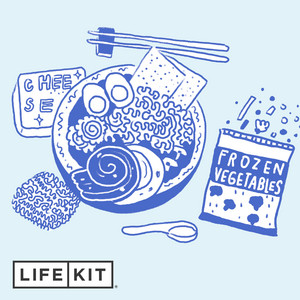
You could throw in an egg or some frozen vegetables, or you could add some peanut butter and hot sauce if you want to give your noodles a quick tie spin.
Also, the little flavor packet is so good, and you don't have to use it in ramen.
Yogurt and ramen flavoring.
Stir it up. It's beautiful.
It's delicious. All right, so now we've got a healthy list of pantry meals in our pocket, some fun new combinations to try.
Hopefully you're feeling pumped up and ready to step it up a notch.
Takeaway three, recipes aren't the boss of you.
Unless you're baking.
Okay, to set ourselves up for success working with recipes, we first have to pick the right one.
Just one thing that can build up your confidence and that you'll be excited about eating.
It doesn't have to be the most, most beginner recipe necessarily, but I would avoid doing something that is notoriously persnickety and like takes, I don't know, 12 hours?
Like I wouldn't pick cassoulet and I wouldn't pick a croquembouche.
Maybe that means starting with something that's already been pre -verified for you as both simple and delicious.
Beck Harlan, a fellow life -kitter and anti -cooking home cook in arms, sent me her go -to dump recipe.
Meaning you just dump all the things in a pot and you're more or less done.
It's a salsa verde chicken recipe from the New York Times that, now that she has it memorized, she makes for her family every week.
Here in my kitchen, I decided to spring for Filipino chicken adobo.
It's a classic family dish and one of my absolute favorites, so I know how it should taste.
It's something I've always wanted to be able to make with ease and I know it's not terribly complicated.
I opted for the New York Times version of the recipe for a few reasons.
The end result looked a lot like what I grew up eating.
The steps were simple and straightforward and the possible substitutions were clear and upfront.
Which brings me to another basic tip.
Before you get started, read the whole recipe.
To A, know do I have all the ingredients.
B, is this something that I can do in 15 minutes or is it saying start this and then refrigerate it overnight?
A couple other quick starters before you really jump in.
You want to make sure you have the right size and number of vessels for things.
Those aren't included in a recipe.
And you want to be mindful of your timing.
So my recipe, for example, calls for marinating two and a half pounds of chicken one to eight hours before cooking and cooking in batches to avoid overcrowding the pan.
That means I'm going to need one container for marinating, another for cooking and another place to hold the cook pieces separate from serving dishes.
And if I really want that chicken to pack a punch, I want to marinate it for as long as possible.
Now, if any of this feels overwhelming already, a really important thing to understand about recipes is they're always up for interpretation.
Recipes aren't written on high and inscribed in a stone tablet, right?
There's something that a person is making.
And they are kind of a mixture of three things which are a technical manual, a translation project from my kitchen to your kitchen, and a form of poetry.
Like, I'm trying to describe what food should look or taste like to you who has never seen it or smelled it or tasted it.
Margaret says recipes can often be way more forgiving than people think.
Sometimes, and I'm totally guilty of this, people will decide to give up before they even start because they don't have the exact amount of ingredients or the exact right thing that a recipe calls for.
And I'm saying you should still try it.
Like, if you have two onions and it calls for three onions, it's just gonna taste a little less like onion than you might anticipate from the original recipe.
Of course, use your best judgment here.
If you like the sound of that hot mustard grilled chicken recipe but you don't have mustard and you don't have chicken, you're probably out of luck.
But if you don't have, like, a cherry pitter or the exact right size baking dish or olives imported from Greece, you can probably find a workaround.
And a lot of times, in the comment sections of recipes, other people have already done that legwork for you.
Now, an important caveat here, this logic doesn't always apply for baking.
Baking often requires a certain degree of precision because chemistry is involved.
But for a lot of other things, like soups, sauces, casseroles, most foods you'll make for casual dinner, you are the ultimate authority in your kitchen.
So, returning to that adobo, my recipe calls for one teaspoon of black peppercorns and two teaspoons of granulated sugar.
It's okay to eyeball those kinds of measurements.
In fact, that might even be part of the fun.
Particularly when you're looking at something like spices.
Okay, like, the intensity of the spice that you have, there's no way of knowing if it is more or less than the recipe developer's intensity.
And so, you can kind of look and say, okay, they're saying a quarter of a teaspoon.
That's not very much.
So, I'm going to put in not very much.
They're saying a tablespoon.
That's more. I'm going to put in more.
I'm going to like, maybe shake it out in the palm of my hand and make sure that that's like about a tablespoon and throw it in.
You add your spices at will.
You brown or boil or braise the best you can.
And before you know it, you've cooked a whole recipe.
And maybe you even liked how it turned out.
Maybe you like it enough to try it again next week.
Suddenly, you have a go -to dish and you can start to build your skills from there.
If you can get like one or two or three wins under your belt, then you can start to eventually over time learn, oh wait, the same method I use for this chicken adobo, it's basically a braise or a stew.
I can change the flavors and it can become Hawaiian shoyu chicken.
Or I can change the flavors and the spices and it can quickly become a delicious Tex -Mex taco filling.
This brings us to takeaway four.
Trust your taste buds to keep building your cooking confidence.
So maybe at this point you're asking, but how do I just grow those cooking instincts?
Like Margaret's ramen packet and yogurt dip, or flipping an adobo into a Tex -Mex taco.
I love both of those ideas for the record, but I would never think to do them on my own.
When I look into a fridge of mismatched ingredients, I am instantly forlorn.
But Samin says, it's really not all that complicated.
Your palate develops only with time and only with paying attention.
And it doesn't have to be only that you're developing your palate.
When you cook, you can always just sort of decide to tune in when you're eating.
If you know what you like to eat, you can figure out what you like to cook.
She broke it down really simply and with extremely Californian sensibilities.
She was like, okay, Andy, you're from LA.
You know when you order a burrito and you watch someone put it together in front of you?
But the chicken looks a little dry.
So I'm going to have them put sour cream and guacamole in there because I want to add something to be moist and creamy to balance out that dry chicken.
Or I like black beans instead of refried beans because the refried beans are too runny and they make the burrito too soft.
Those instinctive preferences you have for your perfect bite are the same ones you can use to guide you when you cook.
And they can be broken down into four basics you've certainly heard of before.
Salt, fat, acid, heat.
And it's just that maybe you have not connected the dots of, oh, sour cream is a fat, but it's tangy, it's also an acid.
When I get some refried beans, those are salty and fatty.
And then on top of that, the only other sort of thing that's not part of salt and fat and acid is texture.
So that's the crunch or the creamy or the fresh thing.
Once you have that basic salt, fat, acid, heat framework, try using it with your own cooking.
Like, does this bean salad need more acid for tang?
Should I grab some chili oil?
This ramen could use some extra heat, right?
And beyond that, when I'm saying, oh, you learn you're adobo and you can turn that to a taco, all it is is just learning what flavor combinations are traditional to what parts of the world.
And that you can do by googling a recipe.
You can also follow chefs you like and trust online to see how they do things.
Symeen mentioned Sola L.
Whaley and Melissa Clark, two chefs we've had on the show, has great resources for cooks just starting out.
And then eventually it's tasting your way.
Your palate develops only with time and only with paying attention.
And it doesn't have to be only that you're developing your palate when you cook.
You can always just sort of decide to tune in when you're eating.
So next meal time or snack time, eat extra slowly, mindfully.
We've got an excellent episode on just how to do that if you need inspiration.
Maybe close your eyes on that first bite.
What taste hits you first?
What lingers? Could it use a crunch, a kick?
But you don't have to stick with professionals or like make a reservation at a Michelin star restaurant to train your taste buds.
There is something to learn even from Doritos.
Then bring that data with you the next time it's your turn to make dinner.
And don't be scared to get weird with it.
Stoners get a bad rap in the kitchen but like the very classic stoner thing where you're like, I'm gonna throw all these things into a sandwich.
That's also kind of the same instinct as a lot of chefs, right?
Like you're just kind of experimenting and poking around the edges and seeing what tastes good.
And okay, maybe it doesn't taste that good.
So what? You're out like a sandwich?
I think if there's something that catches your fancy and you wanna try it, try it.
And usually it's edible.
And if it's really not edible, then I do usually have bagel bites on hand.
Which brings us to our final takeaway, Takeaway 5.
Sometimes you're gonna need the bagel bites and that's okay.
By bagel bites, I just mean anything that's incredibly easy for you in a pinch like avocado toast or a microwave baked potato.
Messing up every now and then is just a part of the process for everybody.
Even professional chefs with award -winning cookbooks.
Like for Thanksgiving this past year, Cimine decided to make prime rib.
And I had done the math to figure out the timing and I thought I was doing such a good job and I was tending to it and then I fell asleep.
And I had cooked it so far past what would be well done.
Like it was, I was like, oh my God, I turned our dinner into charcoal.
Eventually, Cimine was able to find a way to save her prime rib.
But she says that's not always how it goes.
So when you make a mistake, you have to determine.
Is this something that can be saved or something that can't?
Things like if it's a little bit over -salted, you can sort of make up for that by balancing the other elements, adding basically more of everything else, right?
More fat, like if it's, I don't know, more croutons, more rice, more whatever, to sort of increase the total volume of the dish without increasing the salt until it's back to being balanced.
But if you accidentally dumped in a whole salt shaker for a recipe that calls for half a teaspoon, that's probably a bagel bite deal.
Or, you know, those eggs in the microwave.
Between under and overcooking, Cimine says she'd definitely prefer overcooking.
Undercooking can be a straight up health hazard, while a dry chicken can be an opportunity for creativity.
I would probably let that meat cool, shred it, and turn it into a chicken salad that I can make up for that dryness with either Greek yogurt or mayonnaise or anything creamy.
If you realize you accidentally skipped a whole page of a recipe, or if you grabbed garlic powder instead of cinnamon, bagel bites.
But if your chard is just awful chard, if those fried fish filets spend a little too long sizzling, everyone scrapes.
But I also encourage everyone to taste, because sometimes things look charred or burnt, and they don't actually taste burnt, so they just taste like deliciously, delightfully caramelized.
This is again about developing that relationship to your palate and knowing where you are and what is savable.
And listen, with all of these things, with every misstep, Margaret says be generous with yourself.
Don't let perfect be the enemy of good.
If you want to cook, when you want to cook, remember that mistakes are part of the process and remember that it's okay if you really can't deal with it for a week or two and then you come back to it.
You can make something beautiful and persnickety and time consuming and the next day just absolutely call it and eat cheese and crackers.
Okay friends, I'm officially hungry.
Let's do a quick recap and then get to cooking, shall we?
Takeaway one, cooking is a skill, not a talent.
That means anyone, even you and me, can learn and improve as long as you're willing to find the motivation and put in the work.
Takeaway two, expand your idea of cooking.
Microwaving is cooking, so is charcuterie board making and nacho arranging and adding an egg to your woman.
So don't forget to give yourself some credit for the creativity you already have in the kitchen.
Takeaway three, remember recipes are up to your interpretation.
You are the ultimate authority in your kitchen and it's always okay to play, unless you're baking.
Takeaway four, to start improving in the kitchen, trust your taste buds.
If you know what you like to eat, use that to help inform your cooking and help you find balance when you're putting a dish together.
Takeaway five, failure is a part of the learning process.
That's okay, know what's worth saving, and when it might be time to order a pizza and grab a bag of your favorite cheesy chips.
Honestly Doritos are truly, I think, one of the greatest achievements of mankind.
The way they coat, you get the cheesiness, you get the salt.
Do you feel the same about Cool Ranch because I'm a Cool Ranch girl?
Yeah, Cool Ranch, I think, has a little more tang.
I like them both. I do like classic.
I'm cheesy, what can I say?
I'm a cheesy person.
That episode was reported by LifeKit's Andy Tagle.
For more LifeKit, check out our other episodes.
We have one on how to save money when you're grocery shopping, and another one all about how to make soup.
You can find those at npr .org slash LifeKit.
And if you love LifeKit and want even more, subscribe to our newsletter at npr .org slash LifeKit newsletter.
Also, we love hearing from you, so if you have episode ideas or feedback you want to share, email us at LifeKit at npr .org.
This episode of LifeKit was produced by Sylvie Douglas.
Our visuals editor is Bec Harlan, and our digital editor is Malika Garib.
Meghan Kane is our supervising editor, and Beth Donovan is our executive producer.
Our production team also includes Claire Marie Schneider and Margaret Serino.
Engineering support comes from Robert Rodriguez.
I'm Mary El Segara.
Thanks for listening.
This message comes from homes .com.
When you're home shopping as a parent, you have lots of questions about local schools.
That's why each listing on homes .com includes extensive reports on local schools, including photos, parent reviews, student -teacher ratio, school rankings, and more.
The information is from multiple trusted sources and curated by a dedicated in -house research team.
It's also you can make the right decision for your family.
Homes .com, we've done your homework.
This message comes from Warby Parker.
Prescription eyewear that's expertly crafted and unexpectedly affordable.
Glass is designed in -house from premium material starting at just $95, including prescription lenses.
Stop by a Warby Parker store near you.
Support for the following message comes from LinkedIn ads.
As a B2B marketer, you know how noisy the digital ad space can be.
If your message isn't targeted to the right audience, it just disappears into the noise.
By using LinkedIn ads, you can reach professionals who are more likely to find your ad relevant.
Target them by job title, industry, company, and more.
Get a $100 credit on your next campaign at LinkedIn .com slash results.
Terms and conditions apply.