Hey everybody, welcome back to my YouTube channel.
My name's Arienita La Gringa.
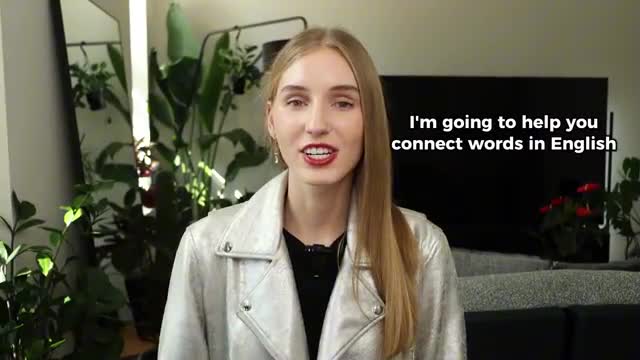
In today's video, I'm going to help you connect words in English Hmm, that didn't sound natural.
Let's see if I can say that a little bit smoother.
I'm going to help you connect words in English, just like a native speaker would.
Did you notice how I just connected those words in the intro?
So what are connecting words?
Connecting words, sometimes called linking, is basically joining the sounds of words together, not necessarily speaking faster.
It's about creating a smooth flow of speech.
For example, listen to this.
My car is red.
Now listen to this.
My car is red.
My car is red.
Hear the difference?
Native speakers do this all the time without even realizing it.
It's a natural part of spoken English.
Let's look at another example.
Hold on now.
Hold on.
Much smoother, right?
And every word either begins or ends with a vowel or consonant.
Vowel sounds are open and flowing, like A E I O U, And a consonant is a sound that stops, like K CH R TH Y, W.
All right.
So now that we know what connecting words are and that we know the difference between vowels and consonants, let's see how all this stuff actually works.
Let's start with rule number one, consonant plus vowel.
This is the most common type of linking.
It's when a word ends in a consonant sound and the next word starts with a vowel sound.
You simply join the sounds together and treat them like one word.
For example, look at.
Look at.
Look at the bird.
Look at.
Hold on becomes hold on.
Can you hold on a second?
Hold on.
Pick it up sounds like pick it up.
Pick it up.
A cup of tea sounds like a cup of tea.
A cup of tea.
So this sounds more like of or even a. A cup of tea.
A cup of tea.
Turn on sounds like turn on.
Turn on the light.
Hand it over.
Sounds like hand it over.
Hand it over, now hand it over.
And the last example ran out.
Sounds like ran out.
I ran out of gas, ran out.
Now let's go to the next rule.
The next rule is consonant plus consonant.
When a word ends in a consonant sound and the next word begins with a consonant sound, you often blend or slightly change the sounds.
So let's check out the first example.
This shop, this shop.
So the s in this can sometimes change into a sh sound, so it almost sounds like this shop and it's something that happens naturally and most people don't even realize they're doing it.
And another example is is she, is she, is she that can easily become is she, where the s and is turns into a sh sound to match the sh and she.
So you want to keep the airflow going from the ending consonant sounds into the beginning of the next one.
And Why do we do this?
Well, sometimes our mouths are lazy.
It's easier to say two similar sounds together than to switch sounds quickly.
So instead of saying feel like, we say feel like.
Feel like.
I am connecting both consonants and it sounds like one long consonant.
For example, gas station sounds like gas station, gas station.
It's almost like these two words are together and the S connects both words. gas station.
Another thing that happens when we link consonants together is that sometimes a sound just disappears altogether.
For example, next door might sound like next door, next door.
The T is dropped.
And old man might sound like old man.
Oh man, the D is dropped.
Best friend might sound like best friend, best friend.
The T is dropped here.
And lastly, just saying might sound like just saying.
Just saying.
The T is dropped here.
Now let's move on to the third rule, vowel plus consonant.
So what happens when a word ends with a vowel sound and the next word starts with a consonant sound?
Well, the word ending with a vowel just connects right to the word starting with a consonant.
It's really simple.
Me too. sounds like me too, me too.
As you can see, there's not a big difference.
Pay rent sounds like pay rent, pay rent.
Really nice sounds like really nice.
Really nice.
This is one of the easiest connecting rules because the key is to not pause between the words.
There's not a huge difference between the sounds.
Just let the sounds flow smoothly from one word to the next.
Now, the next rule is vowel to vowel linking.
If a word ends with a rounded vowel sound like the oo in do or the oh in go and the next word starts with a vowel, you'll often hear a little W sound slip in to make it flow better.
For example, go out can sound like go wout. go out.
You're just adding a W in there.
Go on becomes go on, go on.
Do it becomes do it, do it.
Who is it becomes who is it.
Who is it?
Then if a word ends with a vowel, sound like I say or see, and the next word also starts with a vowel, we usually add a little Y sound in between.
For example, I am sounds like I am, I am.
See it becomes see it. see it, say it becomes say it, say it.
And finally, we are here becomes we are here.
We are here.
I just taught you the four ways to link words in English, but I wanna make something really clear.
Linking words does not mean speaking faster.
Many learners think they have to speed up their speech to connect words, and that's simply not true.
Linking is about smoothness, not speed.
It's about avoiding choppy, abrupt speech.
All right, time for a bonus round.
This one's still about connecting consonants, but it's a little trickier.
Sometimes when you connect certain consonants, they actually turn into a completely new sound.
The first common one is when a word ends with a T and the next word starts with a Y.
These two blend together to create a ch sound.
For example, can't you often sounds like can't you.
Can't you see I'm busy?
Can't you see I'm busy?
Get your sounds more like get your.
Get your coat.
It's cold outside.
Get your coat.
It's cold outside.
Won't you sounds like won't you.
Won't you please come in?
Won't you please come in?
Don't you sounds like don't you.
Don't you remember me?
Don't you remember me?
Got you sounds like gotcha.
Gotcha, I win.
Gotcha, I win.
Or you can also say, I gotcha a present.
I gotcha a present.
You can say each word separately like can't, you, but blending them together is very common.
Now something similar happens when a word ends in D and the next word starts with Y.
In that case, the D and Y combine to make a ju sound.
For example, did you becomes ju.
Did you?
Now it's totally fine to say, did you?
But you can say, did you?
Did you see that movie?
Or you can also say, did you know about the surprise party?
Did you know about the surprise party?
Another example is could you.
This becomes could you.
Could you.
Could you help me with this?
Could you help me with this?
Or you can say, could you please turn down the music?
Could you please turn down the music?
Hide your becomes hide your.
Hide your.
Hide your wallet.
There are pickpockets around.
Hide your wallet.
There are pickpockets around.
Okay, everybody.
I hope you found this lesson on connecting words super helpful.
The more you listen to and try to connect words yourself, the more natural it will become.
Let me know down below in the comments what your favorite part of the video was.
If you enjoyed this video, give me a like and subscribe and I'll see you guys next week.
Bye.