You're listening to Brains On, we're very serious about being curious.
Brains On is supported on part by a grant from the National Science Foundation.
Thank you so much for auditioning for our new musical.
We'll be in touch. Next!
Next on the list to audition is...
let me see... But... Um?
It just says Moon? Just says Moon?
I think you mean THE Moon.
AKA the world famous glowing orb who's also a triple threat.
I sing... La... I dance...
And I make the tides ebb and flow.
I'd love to see Lin-Manuel Miranda do that.
The Moon? Hi. Um... You realize we're casting for the musical Little Orphan Annie, right?
I know. And you're so lucky I'm here.
Tomorrow... It says here that you've been in movies?
Oh yeah, lots of them. Usually just in the background, but I did have a starring role in this really, really important film made by a little government agency called NASA.
Maybe you've heard of them?
They shot on location on me.
Um... Well, thanks for coming all this way to audition.
This is great stuff. Really.
We'll be in touch. You mean it?
Really? Finally, this is my big break.
I can just feel it. Moon, baby, you're gonna be a star.
Sure. Exits right there.
Next. You're listening to Brains on from APM Studios.
I'm Molly Bloom and joining me today is Ira from San Jose, California.
Hi, Ira. I'm Molly. Today we're answering a truly out of this world question from Caleb.
Hi, my name is Caleb from Guadalatoma, Massachusetts, and my question is, how do you build a house on the moon?
What materials do you use?
Ira, would you want to live on the moon if you could?
Yeah, if I could breathe and I had the things I need, yeah, I would like to.
The views would be really cool.
The views would be cool.
So what would you want to make sure to take with you?
My favorite book series, Keeper of the Lost Cities.
My favorite stuffed animal, my family.
I would hope some of my friends are enjoying a bunch of stuff so I don't get bored, food, water, and maybe some hair bands and clips and maybe a hairbrush.
These are really good ideas.
So humans have been to the moon before.
In the late 1960s and early 1970s, the United States landed several crewed spaceship on the lunar surface.
The first person to ever set foot there was Neil Armstrong in 1969.
These missions stopped in 1972 and no one has been back since.
That was over 50 years ago.
It's been so, so long, but right now, the US Space Agency, NASA, along with more than 30 other countries are working to get humans back to the moon sometime in the next few years.
These would just be short visits anywhere from 10 to 30 days.
But the goal is to eventually build a base there.
Make homes even so people can stay for longer.
Maybe one day we'll even have moon hotels.
What would that be like?
Welcome to the lunar inn.
It's morning on the moon.
Or what we call morning, we have daylight on the moon for around two weeks straight in Earth time.
Then it's totally dark for the next two weeks.
Oh, I have to pee. Where's the party?
Right away you'll notice the gravity of the situation.
And by that we mean there's much less of it.
You only weigh about a sixth of what you weigh on Earth, which means walking.
Aha, there's the toilet.
Whoa. Walking is a challenge.
A normal step has enough power to send you flying.
It's best to use a slow and gentle side, Shuffle.
Okay. Shuffle, shuffle.
Okay. Ah, finally. Ah, wait.
What was that noise? That's the sound of our moon toilet flushing.
Since there's so little gravity here, Earth toilets won't work on the moon.
Lunar toilets have to suck the waste away.
Germs still work on the moon though, so don't forget to sanitize your hands.
As you head to breakfast, make your way through our super thick concrete halls.
Wow. That's solid. It better be.
There's no air on the moon, so you need strong walls to keep all this breathable oxygen inside.
Without them, you'd be toast.
Yikes. Speaking of toast, welcome to the cafeteria.
Did you know the first ever meal eaten on the moon was bacon squares, peaches, sugar cookie cubes, juice, and coffee?
Sounds tasty, right? Well, we've got even better, fair now.
Some of the salad was even grown here in our lunar greenhouses.
Yum, moon salad. And be sure to turn around, because right there is our extra large picture window.
Huh? Huh. It's so beautiful.
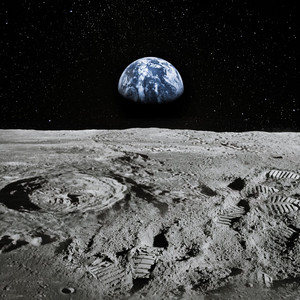
And up in the sky, is that Earth?
Yes, it is. You'll notice that it's a crescent shape.
Just like how people on Earth see the moon covered half in shadow at times.
Here on the moon, we see Earth in shadow too.
What a view, huh? Well, I have got to get a picture.
Let me just walk a little closer and just remember the difference in...
Whoa! Gravity. Can we get a mop in the dining room, please?
Ugh, still not used to that.
Buh, buh, buh, buh, buh, buh, buh, buh, buh, buh, buh, buh, buh, buh, buh, buh, brains on.
Wow, sign me up. I can't wait to visit the moon.
Before you book your room, Molly, let's talk about getting there.
First, the moon is really far away, around 238,000 miles from Earth.
It would take a spacecraft about three days to get there.
Okay, no problem. I'll just bring a good book.
Second, it's super expensive.
It can cost over a million dollars to send just one kilogram of stuff to the moon.
Wait, that's how much my hardcover book weighs.
Wait, second thought, skip the novel.
Maybe I'll just look out the window.
Well, don't forget the space you're traveling through is for deadly radiation.
Alright, space has something called cosmic radiation.
It's made up of super tiny, super fast particles.
They come from our sun and from deeper in space.
A space radiation can make you very sick if you're not protected from it.
On Earth, we have an atmosphere that protects us, but in space, astronauts need special ships and spacesuits to help shield them from the radiation.
And it's not just radiation.
There are also tiny pebbles in space.
They're flying at super speeds and they can damage your ship.
So you need really sturdy vehicles.
Blind through a big dark void of mega dangers?
Okay, actually, looking at a window with that seems terrifying, so I'll just catch up on sleep, I guess.
Once you land on the moon, there are more problems.
The moon has no air, so you have to bring it with you.
And there are spaces that with oxygen tanks to breathe if you want to go outside.
Not my preferred vacation, but okay, no need to pack Hawaiian shirts, I guess.
Also, the moon is covered in toxic dust.
It's really bad if you breathe it in.
So you have to be careful.
Don't let it get in your ship or building.
Oh dear, toxic moon does sound really bad for my allergies.
Is it too late to pack extra tissues?
Plus, it gets super hot and super cold on the moon.
Sometimes it's 200 degrees Fahrenheit.
Other times it's 200 below zero.
Oh, that is too many degrees below zero.
I didn't know degrees could go that low.
And the moon even has moon quakes.
Some last for hours. Deadly dust, 400 degree temperature swings, moon quakes.
You know, I think I'm going to just do a staycation here on Earth.
But here it's nice this time of year.
Even though I might not want to visit the moon, lots of people do.
Yeah, thrill seekers, astronomers, atmospheres, one reason NASA wants to build a base there is because it could help us explore other parts of space too.
It would be much easier to send ships to Mars if they could stop at the moon first and pick up more supplies and fuel.
We still have lots to figure out before that dream is a reality.
But here's something we can figure out right now.
It's the... Shhh! Mystery Sound!
Are you ready to hear the mystery sound, Ira?
Yeah. Alright, here it is.
Hmm, what do you think, Ira?
It sounds like someone's eating something like cracker.
My first thought was a cracker.
But it sounds too soft to be a cracker.
Hmm. So what else do you think it could be?
I don't know. Maybe like a very, very hard chip.
Or a hard cracker. Or maybe someone like biting a lollipop and chewing a lollipop?
Ooh, yeah, that's not good for your teeth.
But maybe they were doing it.
Alright, well we're going to hear it again.
Get another chance to guess and hear the answer after the credits.
So keep listening. We are working on an episode about stringed instruments and how they all make unique sounds.
From ukulele's and satars to violins and guitars.
For this episode we want you to send us your own version of the brain song theme song.
You know, ba, ba, ba, ba, ba, ba, ba, ba, ba, ba, ba, ba, ba, ba, ba, ba, ba, ba, ba, play it on the piano, bang it on a drum, strum it, beatbox it, sing it, write your own lyrics.
You don't have to play the whole thing and you can add your own flair.
Ira, if you could come up with your own version of the brain song theme song, how would you do it?
Um, maybe, brains, brains, brains, on, brains, brains, brains, on, but less often.
I like that. That was delightful.
Listeners, please send us your theme song recordings at brainson.org.
And while you're there you can send us mystery sounds, drawings and questions.
Like this one, my question is what makes the good paper airplane?
You can find an answer to that question on the moment of um podcast.
The short dose of facts and fun every weekday.
Again, that's brainson.org.
So keep listening. Brainson Universe is a family of podcasts for kids and their adults.
And since you're a fan of brainson, we know you'll love the other shows in our universe.
Come on, let's explore.
The brain, brains on universe so many podcasts brains on smash boom best forever ago.
The king up signal smash boom best debate show.
What are they arguing about this time?
Tomatoes versus potatoes.
I was just remembering in 1949 the Mr.
Potato Head went into production, a pivotal toy and a lot of people's childhood.
And I was googling right now Mr.
Tomato Head. And the first thing that comes up is, did you mean Mr.
Potato Head? Oh. It's a little bit loud.
Search for smash boom best wherever you get your podcasts.
I wore winter boots every day for two years.
I hate climbing trees. I'm Deborah Goldstein, host of the podcast The Big Fib and half of those statements were indeed Fibs.
On every episode of The Big Fib, we bring on two grownups.
One is an expert and the other is a liar.
And it's the job of our human child contestant to help us figure out who is who, because no one can spot a liar better than a kid.
We've had episodes on everything from Minecraft to mythology and from Lego to libraries.
Join me and my robot co-host Lisa on The Big Fib on Apple Podcasts or on GZMshows.com.
You're listening to Brainson.
I'm Molly. And I'm Ira. Today, we're talking all about whether you could build a house on the moon.
Turns out there are some pretty big challenges like moon dust that irritates your lungs and super extreme temperatures.
Not to mention that it's really expensive.
But scientists at NASA are already hard at work trying to figure out the best way to build moonhouses.
And they hope to have their first houses built on the moon by 2040.
That's less than 20 years away.
What a relief. Did you hear something?
I think it came from that open window.
It's me. Hello! Out here!
What the what? What's the moon?
Why is everyone always so surprised when they realize I can talk?
I happen to have been voted most pleasing speaking voice at Moon High School.
And also most likely to end up on human Broadway.
There is no business like show business.
Makes sense to me. Definitely nothing weird here.
Anywho. I just so happen to overhear you two talking about whether it would be possible for humans to build houses on me, the moon.
And I couldn't help myself.
I have lots of thoughts on this.
What kind of thoughts? So glad you asked, Ira.
Earth has been hogging all the humans for thousands of years.
It's time they share a little.
You know what I mean? I'm not playing second fiddle to Earth anymore.
I'm ready to be the star.
The moon that I was always meant to be.
Sure. But we just talked about all the reasons why it's going to be hard to build houses on the moon.
The sharp dust. The radiation.
No air. The moon quakes.
Or maybe all the junk left behind on me by astronauts.
Where's that music coming from?
Shhh. This is my big moment.
It can be so lonely, candid, when you're orbiting a planet.
And there's only you and Earth and outer space.
Sure I love human company, but all the things you dump on me are cluttering the craters on my face like.
Bits of spacecraft chunks of probes.
Where'd you think this stuff would go?
And a tiny sculpture of an astronaut.
Belkin feather, that's a boot.
And a dozen pairs of boots.
And that's just a fraction of the stuff I've got.
I'll have to beg your pardon, but I've no intent to garden with the rakes and drills and brushes lying here.
These cameras and batteries, a photo shoot won't flatter me.
I'm not a lunar trashcan for your gear.
When you look at me the moon on a balmy night in June, they say it's romantic to do.
But you might be alarmed.
The opposite of charm, to see bags and bags and bags of human poop.
Sure this orbit can be lonely, but I'm currently the only one you've got.
I'm begging on my knees.
I could use a little grooming while I'm out here, moaning.
Keep your garbage off my face, so pretty please.
Wow, that was so lovely.
I agree. First thing we need to do when we return to the moon is clean up a bit.
It's a polite thing to do.
Thank you. All that junk left behind, not with standing, I'm totally open to responsible construction on my surface.
But there's some stuff you Earthlings should know first.
You should take notes. Are you taking notes?
Yep, got my notebook right here.
Molly, that's a brick of tether cheese.
Oops, if this is my cheese then what in the world did I put on my nachos earlier?
I don't know. I'm not sure if I can do that.
I'm not sure if I can do that.
I'm not sure if I can do that.
I'm not sure if I can do that.
I'm not sure if I can do that.
I'm not sure if I can do that.
No screen windows for getting a nice spring breeze blowing through.
You can't do that. So it has to be air tight.
Got it. Since there's no atmosphere or air on the moon, you have to be sure that all the air is sealed up tight inside your house.
Right. You'll need a special air-lack chamber, like what you'd see on TV or in the movies.
It keeps the air from escaping when you go in and out of your house.
And it keeps all that sharp moon dust from getting inside and making you sick.
Oh, yeah. You definitely don't want to be breathing my dust.
It's like they always say on human Broadway.
No dust, no fuss, and that's the plus.
Do they always say that?
Well, if they don't, they should.
The second thing your moon house needs, really, really, really good insulation.
Oh, yeah, insulation is the fluffy stuff in rolls that helps you stay warm in the winter and cool in the summer.
And that's probably pretty important for protecting people from those big swings in temperature on the moon's surface that we talked about earlier.
But how do you do it? Easy.
The rock and dust that covers my surface is great for insulating things.
Just pile up, say, six to ten feet of that stuff on top of your house, and you're good.
A house under six to ten feet of rock and dust isn't that kind of like living underground?
It's exactly like living underground, Ira.
And in fact, underground is a great place to be if you're on me, the moon.
You're more protected from that dangerous space radiation you mentioned earlier.
Makes sense. Plus, living underground protects you from all the comments and asteroids and tiny space rocks that slam into my mooney's surface.
Remember, I don't have an atmosphere.
So without that protective bubble of air, all that stuff just crashes right into me.
On Earth, that atmosphere is like a special shield.
When meteors and asteroids fly into it, they burn up.
Yeah, that's because this stuff is falling really fast toward Earth.
The air in front of it gets all squished together and it gets super hot, which burns things up.
If you see a shooting star on Earth, it's actually a tiny piece of a meteor burning up as it flies through the atmosphere.
Here's my human astronomer friend, Phil again.
The thing about meteors when you're outside and you're looking up in the night sky and you see a shooting star, right?
That's a meteor and that's caused by something that is typically smaller than a grain of sand.
But it's moving really, really quickly.
And so it burns up, it generates so much heat when it goes through our atmosphere, it burns up.
Well something like that hitting the moon, it's just going to go right down to the surface and cablam.
So you really have to think about that.
It's not big, but it has a lot of energy.
So you really, it can really punch through stuff so you have to protect yourself.
Whoa, shooting stars smaller than a grain of sand?
Awesome. But without a nice cushy atmosphere, all of these tiny little pebbles could totally bust up our moon house.
Could you just dig a big hole and put your house in it?
You could. Or you could just use one of my beautiful craters and caves.
Did you know that I, the moon, have hundreds of deep underground caves?
Scientists think that some of them were created when lava flowed from ancient volcanoes.
And some of these caves even stay a pleasant 63 degrees all the time.
Positively cozy. But what if we don't want to live underground?
Asking for a friend. Oh, Molly.
Molly, Molly, Molly, Bume.
It's blue. Who said you had to live underground?
Scientists are studying all different kinds of super tough building materials that could be used to make above ground houses on the moon, like mixing moon dust with water to make something that looks like concrete.
Or 3D printing houses. The sky's the limit.
Yeah, just imagine what a moon colony could look like one day.
It have to have huge solar panels to capture energy from the sun and store it in batteries to power our houses.
And greenhouses so you can grow your own fresh food.
One day, people might even be able to harvest water from deep icy craters at the moon's poles.
And then you could use that water to make rocket fuel.
That means you could use the moon colony as a place to fill up for longer space travel, like trips to Mars.
Oh, oh, maybe someday people will have custom moonhouses with giant thick windows so you could see Earth.
And trampoline gyms. I bet you could jump so high thanks to the moon's super duper low gravity.
Now you're talking. Next up, moon trampoline parks.
Moon Olympics. Moon Broadway.
But could you guys hurry up and get here already?
Because it's a hard not life for me.
It's a hard not life for me.
Scientists are working hard to figure out how to build houses on the moon.
There are some big challenges like toxic moon dust and space radiation.
Plus, super extreme temperatures and even moon quakes.
That means our moonhouses will have to have great insulation and ways to hold all the air inside since the moon doesn't have an atmosphere.
But someday moon colonies could be a launch pad that lets us explore other parts of space like Mars.
That's it for this episode of Brainson.
This episode was written by Sandin Toddin and Shaila Farza.
It was produced by Realzy DuPont.
Our editor was Molly Bloom.
Fact checking by Ruby got three and filled plate.
We had engineering help from Deegan Adams and Derek Ramirez with sound design by Rachel Breeze, original theme music by Mark St.
Chas. We had production help from the rest of the Brainson universe team, Anna Goldfield, Nico Gonzalez Whistler, Lauren Humpert, Joshua Ray, Charlotte Traver, Anna Weggel, and Otto Waldo Salassi.
Beth Kroeman is our executive producer and the executive's in charge of APM studios are Chandra Kavati and Joanne Griffith.
Special thanks to Aparna Barrowdlodge, Ion Tundin, Erija Singi, Emma Asavedo, and Michelle Raff.
Brainson is a nonprofit public radio program.
There are lots of ways to support the show.
Subscribe to Brainson Universe on YouTube where you can watch animated versions of some of your favorite episodes or head to Brainson.org.
While you're there, you can send us mystery sounds, drawings, and questions.
Okay, Ira, are you ready to hear the mystery sound again?
Yeah. Wonderful. Okay.
What do you think? It's definitely someone eating something.
There's this Indian cracker called a muttty and it's like really crunchy, so I think it might be someone eating that.
That sounds delicious.
What does the cracker taste like?
It's sort of like a normal cracker except it's a little less salty and it's like really crispy and it's like brown and it tastes really good as spicy on top.
Mm, it sounds so good. I hope that's the answer.
Should we hear what the answer is?
Yes. All right, here it is.
My name's Greeny and I'm from Calgary.
This is the sound of eating chips.
Oh, eating chips? You were right the first time, you got it.
I thought it was too soft to eat chips.
Too soft? Yeah. It wasn't quite crunchy enough.
Chips would be like more crunchy-ish but less hard sounding.
Mm, interesting. So you thought it was just not quite the right sound.
Maybe these are chips that were a little stale potentially.
Oh, yeah. We got to find out what kind of chips.
I mean, there's so many different kinds of chips.
There's banana chips. Maybe it was those pita chips.
I think that's a good guess.
Yeah, so there's so many different kinds of chips.
We need to follow up and find out what kind of chip.
Because now I'm hungry.
Yeah. Now it's time for the brain's honor roll.
These are the incredible kids who keep the show going with their questions, ideas, mystery sounds, drawings, and high fives.
Abigail from Charleston, South Carolina, Leila from Wisconsin, Shersha from Seattle, Beatrix from Somerville, Massachusetts, Arjun and Divya from Falls, Church, Virginia, Benny from Toronto, New Zealand, Senna and Vincent from Los Angeles, Switzerland, Violet, Grayson, and June from Somerset, California, Daniel from Toronto, Gemma and Kyra from Belgium, Judah Per from Valencia, California, City from Eden, Prairie, Minnesota, Jonah from Jeffersonville, Indiana, Lucas from Kansas City, Charlie from Ottawa, Lexi and Julian from Cameloupe's British Columbia, Ruthie from Rock Kill, South Carolina, Emma Charlotte from Abedist Springs, Louisiana, Molly and Kiki from Medford, Oregon, Eris from Covington, Louisiana, Vivian and Josie from Oak Park, Illinois, Edgar from Acquist, Georgia, Ethan from Darlington, Pennsylvania, Aaron from Derrim, England, Ramona from Portland, Maine, Andrew from Barry, Ontario, Ivy from Sioux Falls, South Dakota, Margaret and May from Seattle, Emily and you from Richmond Hill, Ontario, Halley and Hunter from Cochran, Alberta, Ash from Indiana, Ella from New Hampshire, Ada Grace and Samuel from Canton, Georgia, Beth from Winnipeg, Manitoba, Oshi from Sydney, Australia, Natalie from Rio Ranch, O'Neum, Mexico, Cohen from Michigan, Virgil from Missoula, Montana, Ariana from Mumbai, Westland from Venice, California, Leo from Seattle, Lydia from Brisbane, Australia, Rafael from Yucca Valley, California, Benjamin and Isaiah from Penbroke, Kines, Florida, Macy from Richmond, Virginia, Ayal and the Dove from Philadelphia, Margo from Yorkville, California, Addison and Sutton from Branson, Missouri, Una from Philadelphia, Cura from Wisconsin, Mason and Aria from Beverly Hills, Michigan, Lincoln, Winston, Jordan and Brockton from Great Falls, Montana, Dylan from Lakewood, Colorado, Lincoln from Kelona, Canada, Kiko from all around the world, August from Albany, New York, Levi from Geneva, Switzerland, Samuel from Bellyton, Washington, June and Lucy from College Station, Texas, Enid from Harrogate, UK, and Dallas from Antover, Minnesota.
We'll be back next week with an episode all about stringed instruments.
Thanks for listening.