
[Mastering English Sentence Construction: A Step-by-Step Guide to Fluency]-[How to build English Sentences]
📋 Summary
Mastering English Sentence Construction: A Step-by-Step Guide to Fluency
Many English learners struggle with the concept of building longer, more complex sentences, often fearing that they need to memorize complicated grammar rules. However, as the podcast highlights, the secret to natural-sounding English lies not in rote memorization, but in understanding a simple, scalable structure.
The Foundation: The Subject-Verb-Information Pattern
At the core of every English sentence is a basic, non-negotiable pattern: Subject + Verb + Information.
- Subject: Who is performing the action.
- Verb: The action itself.
- Information: Details regarding the action.
Using the example "I learn English," the speaker demonstrates that this structure is the bedrock of communication. By mastering this simple base, you can generate thousands of variations simply by swapping out the subject or the information. For instance, changing the subject from "I" to "she" transforms the sentence into "she learns English," proving that the core structure remains consistent even as the meaning evolves.
Expanding Sentences with Phrases
The most effective way to transition from short, choppy sentences to long, natural ones is by adding phrases. A phrase is defined as a group of words that provides extra information without disrupting the basic sentence structure. Instead of trying to construct a long, complex thought all at once, you should build your sentences piece by piece.
By following a logical sequence, you can turn a simple sentence like "I learn English" into a sophisticated statement:
- Time: "I learn English every day."
- Place: "I learn English every day at home."
- Method: "I learn English every day at home by watching videos."
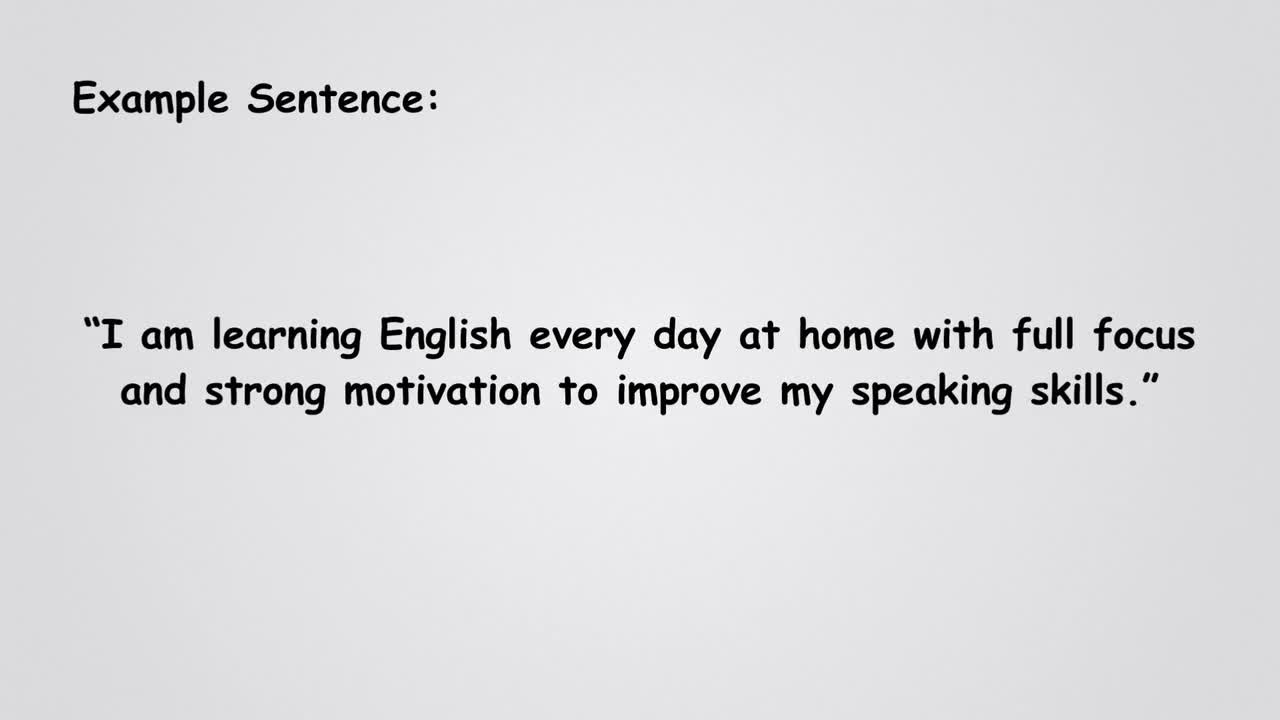
- Purpose: "I learn English every day at home by watching videos to improve my speaking skills."
The "Questioning" Method for Natural Flow
To ensure your sentences remain clear and natural, the speaker suggests a specific order: Subject, then Verb, then Main Information, followed by phrases.
To practice this, you should adopt the "questioning" method. After stating your simple sentence, ask yourself the following:
- When? (Time)
- Where? (Place)
- How? (Method)
- Why? (Reason/Purpose)
Each answer to these questions becomes a new phrase added to the end of your sentence. This technique was effectively demonstrated using the example of "The train arrived." By systematically answering when (early in the morning), where (at the station), how (without any delay), and why (because the weather was clear), the sentence grew into a detailed and descriptive statement while maintaining perfect clarity.
Conclusion: Fluency Through Practice
Building long English sentences is not about complex grammar; it is about modular construction. By mastering the basic pattern and learning how to append phrases sequentially, you can speak longer, more fluent English without the fear of confusion. The key takeaway is to start small, ask yourself those simple questions to expand your thoughts, and keep practicing until the process becomes second nature. This approach will inevitably lead to more confident and clearer spoken English.
Deep Learning with ListenLeap


