I'm going to show you how to become a confident person even if you see yourself as being naturally shy.
And there's one simple sentence that completely destroyed the way I thought about shyness in my 20s.
Which helped me transform from shy to someone who's now spoken on thousands of stages to millions of people.
And once you hear this sentence, you won't be able to unhear it.
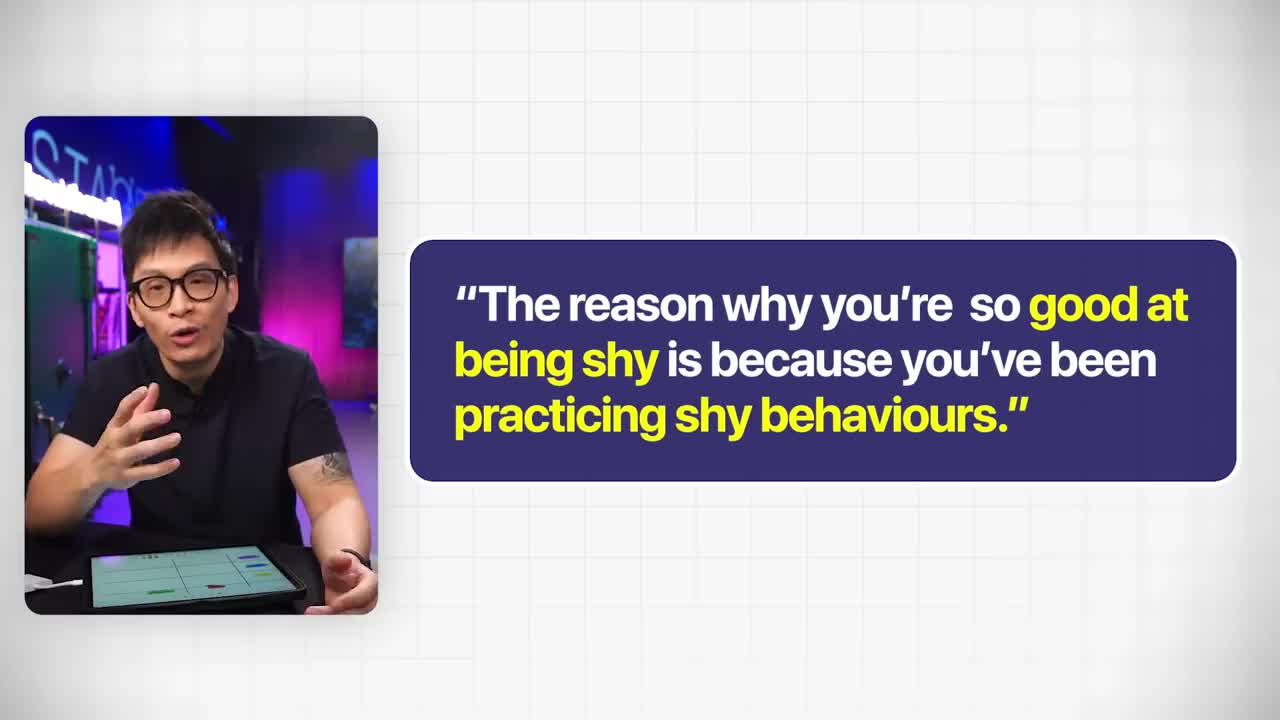
The reason you are so good at being shy is because you've been practicing shy behaviors for the last 10, 20, 30 years of your life.
In communication,
You become what you practice.
And because you've been practicing shyness consistently, of course you're great at it.
Now, here's what this means.
Shyness is not a personality.
It's not who you are.
It's just a set of behaviors that you've practiced so
So consistently for so long that they now feel like they're a part of your identity.
But they're not.
Confident people, on the other hand, they're doing the exact same thing.
They're just doing it in reverse.
They're practicing confident behaviors consistently.
And they've become what they've been practicing.
Which means if you want to be more confident, you don't need to change your identity and who you are.
You just need to change what you practice.
And think about this.
Have you ever met someone who's... Look, I'm going to be a bit honest here.
Someone who's a bit of a dickhead.
Yeah, you know the type, the selfish, self-centered, always interrupting people, always making the conversation about themselves, never lets anybody finish a sentence.
Yeah, that person.
That person became that way because they've been practicing those behaviors their entire life without ever realizing it and they don't have any friends who care about them or love them enough to tell them the truth that they're being a d**khead and also because they've never stopped to examine themselves
They've got zero self-awareness and trust me I'd much rather be shy
Then be a d***head.
Back to my point.
This video isn't for d***heads.
It's for those of you who are shy.
So let me ask you this question right now.
Who are you practicing being every single day?
That's the question I want you to just take a moment and think about.
If you're not happy with how you come across and you're not happy with how people perceive you and you're not happy with the way you perceive yourself even, then change the things you're practicing and it will change the person that you become.
You are not stuck.
You're not stuck being shy.
And yes, even the d***heads aren't stuck being d***heads.
If they practice more compassionate, more kind, more loving behaviors, they could become a wonderful person.
You too could become a more confident person, a more charismatic person, a more authoritative person if you practice those behaviors.
Now, before I get into the confident behaviors, let's first become more aware of the shy behaviors that are no longer serving you.
You probably can't tell right now from the way that I'm speaking, but when I was younger, I was really, really shy.
And I'll be honest, I was a bit of a d***head as well.
But luckily, I practiced that part out of me.
You're still a d***head, Vin.
So is your face, Peter.
That doesn't make sense.
So does your face.
So does your face.
Always makes sense.
This video that I'm about to share with you is footage of me from about 16 years ago.
I was trying to just turn on the camera and speak.
And as you watch it, I want you to look for the shy behaviors.
See if you can spot them.
Hey everyone.
Welcome to...
My garage office slash home, where I sleep, everything.
I just had to make this video.
I think I said my name was in the video already, I'm not sure.
But I pressed record and I just want to see what comes out.
But that's enough of that.
Did you catch the shy behaviors?
Because once you can name the shy behaviors, you can actually start to change and transform them.
But if you didn't catch them, and if you didn't know what to look for,
Let me break down specifically what shy behaviors are.
Shy behaviors fall into three categories.
You've got visual, vocal, and verbal.
Let's start with visual.
That's what you do with your body.
And the first thing is poor eye contact.
When you speak, your eyes are either looking down, they're darting around really quickly, or they're avoiding the other person completely and you're not even looking at them.
In the world of communication, eye contact signals trust.
When you avoid it, people unconsciously read it as nervousness, a lack of belief in what you're saying and low levels of confidence.
Now the next one is bad posture.
Here's where your shoulders are rolled forward, your head is slightly down and your body is caved in.
Most people don't realize that your body actually introduces you before you introduce yourself.
If someone sees you from across the room with that posture that I had before, they've already made a judgment.
They will look at you as being someone who's shy, low status, low levels of confidence before you've even said a single word.
You've been categorized without being given a chance to speak.
That's how powerful posture is.
It's the loudest form of body language.
And lastly,
Limited gesture vocab.
Here's where your hands are generally clasped to get clasped.
Is it clasped?
This is where your hands are clasped
Here's where you have your hands in the prayer position.
Your elbows are close to your sides.
You are taking up as little space as possible.
Gestures are the amplifier for your words.
When you strip them out, everything you say becomes flatter.
It becomes less convincing.
Think about the most confident speakers you've ever watched.
Their hands are alive.
They're moving with purpose.
They're taking up space compared to that someone who's standing completely still, arms pinned, prayer position.
They're being as small as humanly possible.
I mean, doesn't this look like somebody who's shy?
The second category of shy behaviors is vocal.
That's what you do with your voice.
And the first limiting behavior here is a low default volume.
What I mean by this is that if you imagine volume having a scale from 0 to 10, you're speaking at about a 3 and you're staying there as a default.
And then as an example for you, if I stay at about a 3 out of 10 and I stick to this, how do you perceive my level of confidence?
Seems pretty low, doesn't it?
Next is mumbling and poor articulation.
When you do this, people have to work really hard to understand you.
Do you know who mumbles in life?
Babies and mumble rappers.
And do they deserve respect?
Absolutely not.
Watch what happens when I start to mumble.
I'm going to start talking like this now.
I mean, you know how you perceive my level of confidence.
It's so bad, isn't it?
And the last thing is monotone delivery.
That's where you speak at one level, no variation.
A big part of confidence is aliveness.
When you speak in a monotone, for example, if I spoke like this, how alive do I sound?
I don't sound alive, do I?
A core component of confidence, once again, is aliveness.
So you've got to be careful of the monotone delivery.
And the final category of shy behaviors, verbal.
What you do with your words.
This is where you are talking in circles, rambling, and speaking with no clear point.
And more often than not, people who are really good at being shy tend to not speak up at all.
And sometimes you think by not saying anything at all, you're able to avoid judgment, avoid being in the spotlight, and you think it's a good thing.
But what you don't realize is that you're also avoiding career growth.
The people who speak up during team meetings and at work-related events, they have more visibility.
And the more visibility you have when it comes time for promotion,
Guess who gets picked for the promotion?
Those who are the most visible.
Because if you're invisible, they don't even consider you.
And then guess who gets the promotion?
Bloody Jason, the d***head.
He's always speaking up in team meetings
Even when he's got nothing brilliant to say.
But he's the only one doing it.
And as a result of that, he's the only one that is visible.
And as a result of that visibility that he has, when it comes time for promotion, he's the one that gets it.
And you're sitting there going, damn it, it should have been me.
If you're sick and tired of Jason and you want to learn how to be more visible in your workplace and you want to learn how to turn your thoughts into words quickly so that you can speak up in a team meeting, so that you can ask questions without feeling stupid, then join me for a free two-hour masterclass where I take you through three powerful communication frameworks that are going to allow you to speak up at a moment's notice while under pressure
And speak in a way that has high levels of authority, high levels of clarity, that's also concise.
So come learn with me, click the link in the description or scan the QR code on screen.
Go check it out.
Now that you're aware of the shy behaviors, let's learn about the confident behaviors.
And they're actually relatively simple.
It's literally the opposite of what we just spoke about, starting with the visual behaviors.
The first one is strong, deliberate,
Eye contact.
Next is great posture.
And let me get up and show you what I mean by this specifically.
Great posture is where your feet are shoulder width apart, shoulders down and back, head held nice and high, large gestures, elbows away from your body, and you move.
You use the space that you've been given.
So if you're speaking in a boardroom, use the space that you have with purpose.
And by doing this, it communicates and radiates confidence.
And the final thing just to note here is that when you're willing to take up more space,
You will appear more confident.
I want you to watch how one of my students immediately upgrades their perceived levels of confidence just by taking up space and using more hand gestures.
Check this out.
Hi, I am Binkan from Jakarta, Indonesia.
And I would like to take this challenge from Venth from the one of break the mold.
Hello everybody my name is minkan and i'm here to improve my communication skills why do i want to improve my communication skills it's because
I would like to make my world bigger than it is currently.
How much more confident did they look?
All right, on to the next category, vocal.
The first thing is strong volume, great articulation, pronunciation, and lots of melody.
And the thing about confident people is that they have lots of vocal variety.
Now, I want you to listen to another student of mine here play with their volume.
One simple change, but watch the transformation.
Check this out.
So if I did improve
My communication, it will give me confidence that I can take my career to the next level.
It will give me the confidence that I can do the things that I really want to do in life.
The reason why I'm doing this course
Is so that I can take my career to the next level.
I will be able to do what I have not yet able to do until now.
People will take me seriously if I am able to communicate those things, clearly articulate my point, make them so that they learn.
What I'm trying to say.
Once again, how much more confident did they sound as they started to practice these new set of behaviors?
It's wild, right?
Verbal.
The number one thing that all confident people do when they're speaking is they use frameworks.
They don't just wing what they say, they follow frameworks, which helps you structure your thoughts so you can speak more clearly, concisely, and coherently.
And if you wanna learn the three most powerful frameworks, click the link in the description or scan the QR code.
Now, I want you to watch how one of my students uses one of the simple frameworks they learned from that training to be able to share their thoughts in a more concise, coherent, and clear way.
That's oftentimes my problem with communication as I'm rambling, as you put it yesterday, is to be more direct, but also to be more empathetic
Typically at work, but also I've got a wife and two daughters.
So if there's one key takeaway for this course, it's for me to have more control over my message.
Oh, how good is that?
Now I know what you're thinking.
The biggest question at this point is, all right, Vin, I get it.
I understand now that shy is not my identity.
Shy is just a series of behaviors.
And now that I've identified that I do a lot of these behaviors and I've also identified the behaviors that I should practice, the confident ones, then my question to you, Vin, now is how long does it take for me to change?
How long does it take for me to see the transformation?
Well, that's a very long question you just asked me, but here's what I'm going to say.
The changes that you saw with my students in the videos that I've shared,
It took them three days.
Most people will wait their entire lives before they change the way they communicate.
Some actually never do.
So most of them spend their entire lives living inside the illusion that they are shy, that they're stuck with being shy.
And then from that belief, they build a stack of limits around themselves.
I'm shy so I can't ask for a pay rise.
I'm shy so I can't get that damn promotion.
Jason's probably gonna get it.
I'm shy so I can't advance in my career.
I'm shy so I can't step into the life that I actually want.
All of these are myths.
They're false beliefs.
They're not real.
They're built on a case of mistaken identity.
Shy is just a series of behaviors, and behaviors can be changed.
So here's what I want to leave you with.
You are not shy.
You've been practicing shyness.
And the most important question you can ask yourself right now about your communication skills, about how you show up is this, is the person that I'm practicing the person I want to be?
If the answer is no, you know what to do.
Start practicing confident behaviors.
The ones that I shared with you in this video.
Do it consistently.
Do it with intention.
And give the future version of yourself a chance.
And this is just the beginning.
As you're practicing new communication behaviors, you're gonna make some common mistakes that can be avoided.
So make sure you watch this video up here to learn what they are.
These are simple things you can adjust to help you level up your confidence even more.
See you in the next video.