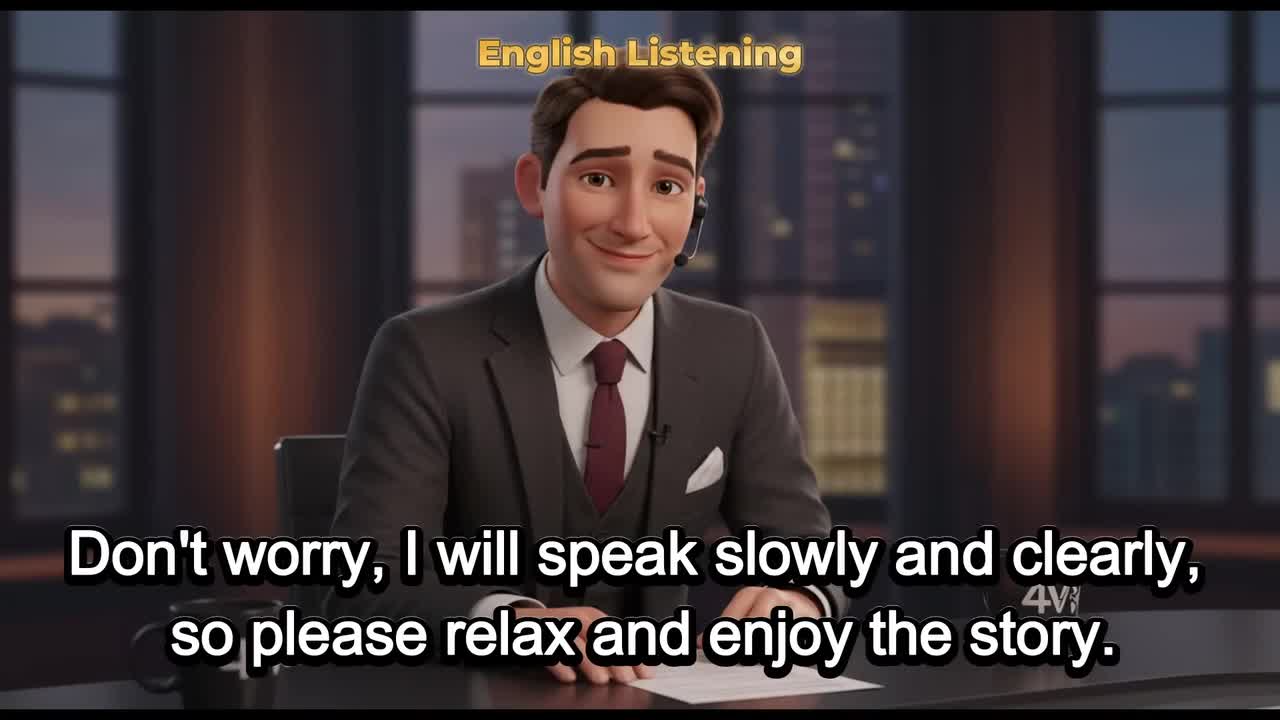
Welcome to English Listening Channel.
Hello everyone.
Today we're going to look at a story about asking for directions in English.
In this video, you will follow a simple and practical conversation between two friends who get lost and try to find their way.
Don't worry, I will speak slowly and clearly, so please relax and enjoy the story.
Before we start, I have a small question for you.
Please listen carefully to find the answer.
This will help you understand English more deeply.
So here is today's question.
Where are Sam and Mina trying to go?
The answer is mentioned in the conversation.
If you find the answer, please write it in the comments section.
By writing your answer in English you can improve your English skills even more effectively.
Alright, let's start the video.
Are you ready?
Okay, let's begin.
Okay, let me check the map on my phone.
Sam, wait.
Something feels wrong.
What do you mean?
Look around.
I don't remember this street.
Hmm, let me see.
Yeah, I don't remember it either.
We didn't see this building before, and I don't know that store over there.
You're right.
This doesn't look right at all.
I think we are lost.
Yeah, I think so too.
The map on my phone is not working.
Really?
What's wrong with it?
I don't know.
Maybe the signal is bad here.
It keeps showing the wrong place.
Oh no.
So we can't use the map?
Not right now.
But it's okay.
We have another way.
Another way?
What do you mean?
We can ask someone for directions.
That's what people did before phones.
Ask someone?
In English?
I'm not sure I can do that.
Of course you can.
It's easier than you think.
Just use simple words.
Simple words?
Like what?
Like, excuse me.
And then, where is green park?
Or how do i get to green park?
That's it, excuse me, where is green park?
Like that yes, that's perfect.
You can also say can you help me?
People are usually happy to help when you ask nicely, Can you help me?
That's easy.
I think I can remember that.
Great.
And if they give you directions, just listen for the key words.
Words like straight, left, right, and turn.
Straight, left, right, turn.
Okay, I'll listen for those words.
And don't worry if you don't understand everything.
You can always ask them to say it again.
That's true.
Okay, I'll try, but I'm still a little nervous.
That's completely normal.
Everyone feels nervous at first, but you'll be fine.
Thanks, Sam.
That makes me feel better.
Good.
Now, let's find someone to ask.
How about that person over there?
Okay.
I'll go talk to them.
Here I go.
Good luck.
I'll be right behind you.
Excuse me.
Can you help me?
Oh, hi.
Of course.
How can I help you?
Thank you.
I'm looking for Green Park.
How do I get to Green Park from here?
Green Park?
Sure.
I know that place.
I can help you.
Oh, great.
Thank you so much.
Okay.
It's a little bit far, but I'll explain step by step.
Okay.
Step by step.
Thank you.
First, go straight on this street.
Just keep walking this way.
Go straight on this street.
Okay.
You will walk for about three minutes.
Then you will see a big, wide street with a lot of traffic.
A big street with a lot of traffic.
Okay, I understand.
At that big street, turn left.
Make sure you turn left, not right.
Turn left, not right.
Got it.
Good.
After you turn left, walk for a few minutes, maybe two or three minutes.
Walk for two or three minutes after turning left.
Then you will come to a crosswalk.
Do you know what a crosswalk is?
A crosswalk.
Is that the place where people cross the street?
The white lines on the road?
Yes, exactly.
The white lines on the road.
Cross the street there.
Cross the street at the crosswalk.
Okay.
After you cross the street, turn right, then walk straight for about five minutes.
Turn right, then walk straight for five minutes.
Yes, and you will see Green Park on your left side.
It has a lot of trees so it's easy to find.
On my left side, a lot of trees.
Got it.
Is it far from here?
How long does it take?
It's about 15 minutes on foot.
15 minutes.
Okay, that's not too bad.
I can do that.
Yes, you'll be fine.
Just remember, go straight, turn left, cross, and then turn right.
Do you need me to say it again?
No, I think I'm okay.
Thank you very much for your help.
You're welcome.
Good luck finding the park.
Thank you.
Have a nice day.
You too.
Bye.
Hey, nice job, Mina.
That was great.
You spoke really well.
Really?
Thanks.
But to be honest, I'm not sure I understood everything he said.
That's totally okay.
You don't need to understand every single word.
What parts did you understand?
I think he said, go straight on this street first.
I understood that part.
Good.
And then what did he say?
Then, turn left at a big street.
A big street with a lot of traffic.
I remember that, too.
Perfect.
You're doing great so far.
What about after that?
After that?
Hmm, I'm not sure.
Something about a crosswalk, right?
Yes.
He said cross the street at the crosswalk, the street at the crosswalk, right.
And then what?
After you cross the street, turn right, turn right and then then walk straight for about five minutes and the park should be on your left side, on the left side.
Okay, I think I understand now See,
You actually understood most of it.
You should feel proud.
I guess so.
But it was hard to remember all the steps at once.
There were so many turns.
That's normal.
It's a lot of information.
Don't worry about it.
Can you say the directions one more time, slowly?
I want to make sure I remember.
Sure, no problem.
First go straight on this street, go straight, then turn left at the big street.
Turn left at the big street, walk for a few minutes, then cross the street at the crosswalk.
Cross the street at the crosswalk, Then turn right and walk straight for five minutes.
Turn right, walk five minutes, and the park is on the left.
You got it.
That's exactly right.
Okay, I feel much better now.
Let's go before I forget.
Good idea.
Let's go.
Sam, hold on.
Something isn't right.
What's wrong?
He said we would see a crosswalk, but I don't see one anywhere.
Hmm.
Let me look around.
You're right.
I don't see a crosswalk either.
Are we lost again?
I think so.
Maybe we turned too early.
Or maybe we went the wrong way.
Oh, no.
Not again.
We already walked for a long time.
I know.
I'm sorry.
But these things happen sometimes.
It's not your fault.
It's not your fault either, Sam.
We both got confused.
Yeah, I think the directions had too many steps.
It was hard to follow everything.
I agree.
There were so many turns.
Left, right, cross the street.
It was too much.
Maybe we should try the map on my phone again.
Let me check.
Is it working now?
No, still not working.
The signal is still bad.
We can't use it.
Oh, that's too bad.
So what should we do now?
I don't think we should go back to where we started.
That would take too long.
You're right.
So, should we ask someone again?
Yes, I think that's the best idea.
Let's ask someone again.
And this time, let me do it.
You already did a great job the first time.
Now it's my turn.
Really?
You'll ask this time?
Of course.
You can watch and listen.
Maybe you'll learn some new words.
Okay, that sounds good.
I'll listen carefully.
Oh, look, there's a coffee shop right over there.
Let's ask someone inside.
Good idea.
People at coffee shops are usually friendly and nice.
That's true.
Let's go.
Excuse me.
Can I ask you something?
Hello.
Welcome to our shop.
Of course.
What can I do for you?
Thank you.
We are trying to find Green Park, but we are a little lost.
How do we get to Green Park from here?
Green Park?
Oh, you are lucky.
It's not far from here at all.
You are very close.
Really?
That's good news.
We walked a lot today.
How many minutes is it?
Not at all.
It's only about a ten-minute walk from here.
Very easy to find.
Ten minutes.
That's not bad at all.
Which way should I go?
It's very simple.
When you leave the shop, turn right.
Turn right when I leave the shop.
Okay?
Then just walk straight.
Keep going straight for about seven or eight minutes.
Walk straight for seven or eight minutes.
Got it.
You will see a bookstore on your right side.
It's a big bookstore with a big red sign.
You can't miss it.
A bookstore with a big red sign on the right side.
I'll look for that.
Yes, and the park is right next to the bookstore.
It's on the same side of the street.
You will see the park right away.
Next to the bookstore.
That's really easy to understand.
Also, in front of the park there is a big green sign that says Green Park.
So you will know you are in the right place.
A big green sign in front of the park.
Perfect.
That's very helpful.
I'm happy to help.
Is there anything else you need?
No, that's everything.
Let me repeat.
Turn right from here, walk straight for about eight minutes, look for the bookstore with the red sign and the park is right next to it.
Is that correct?
That's exactly right.
Yes, that's correct.
Thank you so much.
You were very kind and very clear.
No problem at all.
Enjoy your time at the park.
It's beautiful this time of year.
We will.
Thanks again.
Have a great day.
You too.
Bye.
Mina, look.
Can you see it?
There's the bookstore with the red sign.
Oh, I see it.
It's really big.
And look, right next to it, the park is right there.
We made it.
We made it.
Finally.
I'm so relieved.
Me too.
How do you feel?
I feel amazing.
I was really worried for a while.
I thought we would never find it.
But we found it, and we did it together.
You know what?
That was not so hard after all.
Really?
You think so?
Well, the first time was a little scary.
I was really nervous when I talked to that person on the street.
But you still did it.
You walked up to a stranger and asked for help in English.
That's brave.
Thanks, Sam.
I'm glad I tried.
And the second time was much easier, right?
Much easier.
The person at the coffee shop explained it very clearly.
Simple and easy to follow.
Yes, and the directions were much shorter.
Turn right, walk straight, find the bookstore, and the park is next to it.
Very simple.
See?
Sometimes simple directions are the best, and using landmarks like the bookstore really helps.
That's true.
The red sign was so easy to find.
I learned something important today.
Oh?
What did you learn?
I learned that asking for help is important.
Even when I feel nervous, I should try, because most people are happy to help.
That's a really great lesson.
And you know what?
You're better at this than you think.
You really think so?
I really do.
You asked for directions by yourself, you understood the answer, and we found the place.
That's amazing.
Thanks, Sam.
That makes me very happy.
But you helped me a lot.
Oh, come on.
You did most of the work.
I was just standing there and watching.
That's not true.
You helped me stay calm, and you explained the directions again so I could understand.
Well, I'm just glad we're here now.
The park looks really beautiful.
It really does.
So, next time I get lost, what should I do?
You tell me.
What will you do?
I'll take a deep breath, find someone, and ask for help.
In English, with simple words.
That's the perfect answer.
I'm proud of you, Mina.
Thanks, Sam.
Now let's stop talking and enjoy this park.
That's a great idea.
Let's go.
Let's go.
How was it?
I hope this video helped you improve your English.
Now let me ask the question from the beginning one more time.
Where are Sam and Mina trying to go?
The answer was mentioned in the video.
Did you find it?
If you did, please write your answer in the comments section.
By practicing English output like this, you can improve your English skills more efficiently.
On this channel I share stories in slow and easy English, with small but useful tips to help you learn.
I will keep uploading videos like this, so if you enjoyed it, please subscribe to the channel.
And please don't forget to like the video and leave a comment.
I also offer channel memberships.
If you enjoyed this video, please consider joining as a member.
Alright, that's all for today.
I hope to see you in the next video.
See you next time.
Bye!