Julius Caesar is dead, stabbed by a group of Roman senators, including his friend Brutus, who feared that Caesar had the ambition and the ability to become a tyrant that would destroy the Roman Republic.
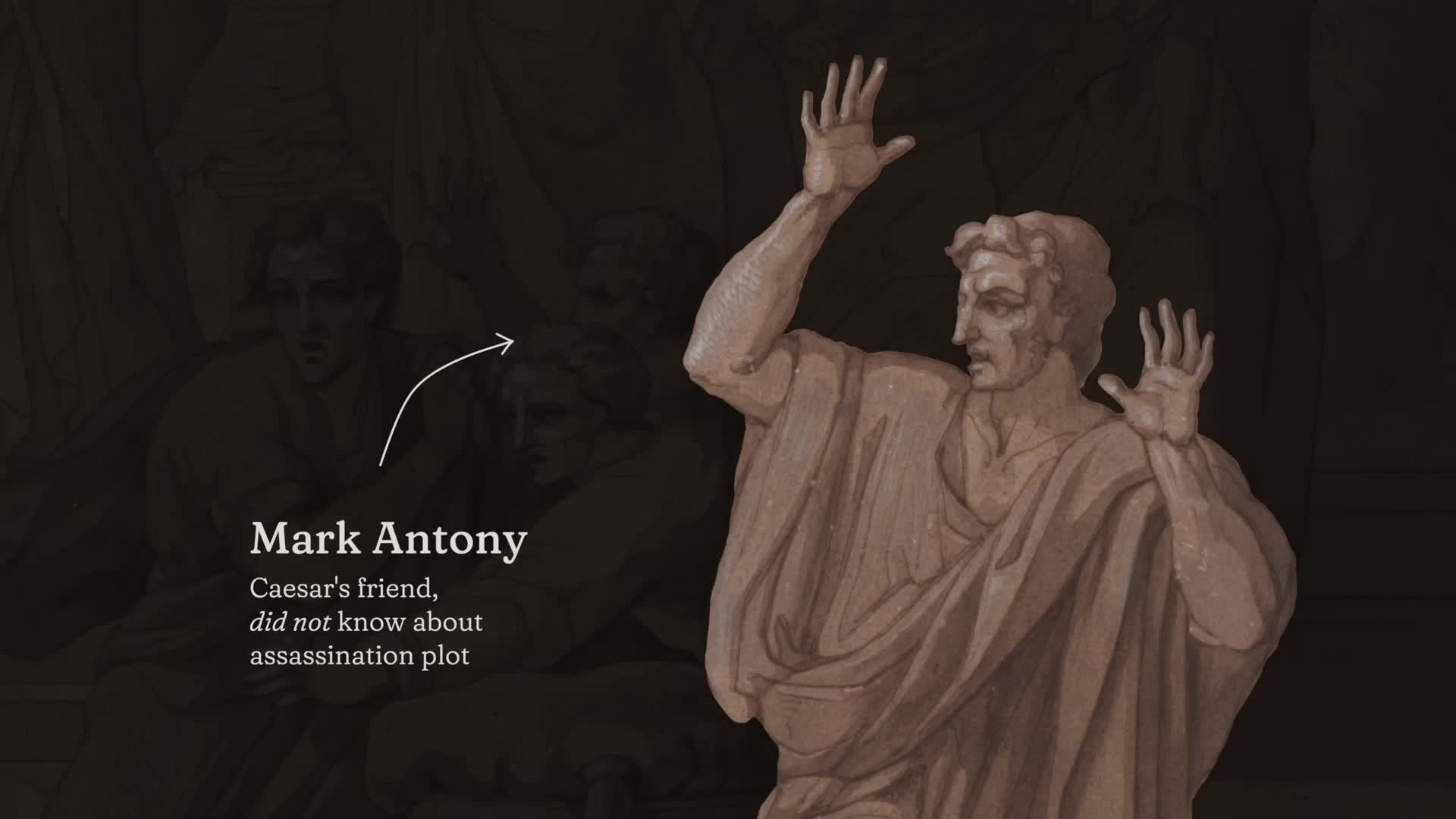
Mark Antony, another friend of Caesar's, arrives after the murder and is shocked and saddened, but ultimately plays along with the conspirators to save his own skin.
Brutus is is going to go outside and justify the assassination to the Roman crowd and agrees to let Antony deliver a eulogy, but only if he promises not to condemn the conspirators.
Antony agrees and they all go outside to face the people.
Brutus speaks first explaining that, even though he loved Caesar, Caesar had to die because he represented a danger to all free Roman citizens.
Had you rather Caesar were living and die all slaves than that Caesar were dead to live all free men?
He doesn't give specific examples of Caesar's tyrannical ambitions, but appeals to the crowd's faith in his own honor and judgment, and it seems to work.
At the end, the crowd cheers Brutus and condemns Caesar.
Then Antony steps up.
Friends, Romans Antony's facing a hostile, rowdy crowd, so he has to get their attention right away.
Instead of the typical iambic rhythm of da-dum da-dum, an unstressed syllable followed by a stressed syllable, Antony hits us with a stressed syllable right away, friends.
In fact, the first three words all begin with stressed syllables.
Boom, boom, boom.
Now we're listening.
That first word is important to note.
In his speech, Brutus began with Romans, appealing to the crowd's reason.
Antony starts with friends.
He's aiming for an emotional connection and friendship will be a key theme in the speech.
I come to bury Caesar, not to praise him.
Yeah, if Antony were attached to a lie detector right now, it would be spiking.
Praising Caesar is exactly what he intends to do, that and condemn the conspirators.
But the crowd doesn't want to hear praise of the would-be tyrant, and Antony vowed not to condemn the assassins.
His impossible rhetorical mission in this speech, should he choose to accept it, is to praise Caesar and condemn the conspirators, while appearing to do the opposite.
The evil that men do lives after them.
The good is often turd with their bones.
So let it be with Caesar.
These lines seem to follow on from Anthony's promise not to praise Caesar, but they throw up all kinds of red flags in the mind of the listener.
So we remember the bad things someone does, but often forget the good.
Is that supposed to be a good thing?
Shouldn't we seek to remember someone in all their complexity?
Subtly, Antony gets the audience to start thinking about the good Caesar did in his life.
In fact, he's associating good with the bones the corpse of Caesar that is right now in front of them while evil he associates with the men who still live.
Who exactly is asking the crowd to forget the good Caesar did?
The answer comes right away in the second part of that last line.
Now, Antony's not saying Caesar was ambitious.
He's saying that Brutus is saying that Caesar was ambitious.
This is a trick he'll return to many times.
In the third line, he's opening up that door of doubt even further by saying, if it were so, suggesting that there's a chance it's not, so that Brutus is mistaken or lying.
If Caesar was ambitious, it's a criminal fault, and the appropriate price is death.
If he wasn't ambitious, well, what does that make the killer?
Damian Lewis is so brilliant delivering this speech.
In this whole first part, he hasn't betrayed his true goals as Antony.
He's been gently pulling the crowd, his friends, into his perspective, and yet you can feel that there's something brewing in him.
The way he delivers that word.
Another stressed syllable to start the line.
It's explosive, but his head barely moves.
Lewis fixes your attention like a general demanding obedience, but before you have a chance to register that he shifts back into the friendly demeanor.
For this part of the sentence, which is really a parenthetical interruption, Lewis's head loosens and moves around, as if to communicate.
The fact that Brutus and his conspirators are honorable is so obviously true it almost doesn't need mentioning.
But under the cover of this aside, Antony has just laid his trap.
He was my friend. faithful and just to me.
But Brutus says he was ambitious, and Brutus is an honorable man.
There's that word friend again.
What is a friend after all?
Faithful?
Just?
Notice how Lewis lights up at that word.
Just.
It's an odd way to describe a friend, but it is how you describe a good ruler.
Here we have a repetition of the premise that he slipped in so casually before.
He ties Brutus's honor to Brutus's assertion that Caesar was ambitious.
Really, Brutus did this himself. in his own speech, but Antony is making it plain.
He's creating a causal link between Brutus's honor and the truth value of his assertions.
Now he doesn't have to attack Brutus directly.
He can interrogate the truth of what he says and accomplish the same goal.
He has brought many captives home to Rome whose ransoms did the general coffers fill.
Did this in Caesar seem ambitious?
When that the poor have cried, Caesar hath wept.
Ambition should be made of sterner stuff.
Yet Brutus says he was ambitious, and Brutus is an honorable man.
Brutus didn't bother to give examples of Caesar's ambition, but Antony provides examples of ways in which he wasn't ambitious.
He increased public funds for Rome's welfare.
He cried for the poor like an empathetic friend.
That empathy is evoked by rhythmic association between Caesar and the poor, which Lewis emphasizes.
When that the poor have cried, Caesar hath wept.
Antony uses a rhetorical question to further engage the audience and then encourages them to imagine ambition as something stern and cruel.
Of course these examples are not really incompatible with ambition.
But hey, if the audience can't see through a populist leader's crocodile tears, they're not gonna see through Antony's manipulations either.
You all did see that on the Lupercal, I thrice presented him a kingly crown, which he did thrice refuse.
Was this ambition?
Yet Brutus says he was ambitious and sure he is an honourable man.
Now, in a society that thinks of itself as a republic, an ambitious autocrat would probably be smart to refuse a crown, but Antony knows that this crowd will read Caesar's actions as the exact opposite of ambition, and he helps the information go down easy with three lines of nearly perfect iambic pentameter.
By the time we get to the final refrain.
Louis' sarcasm is hard to miss, but now it's inflected with rage.
There's so much contempt in that word, sure.
It's likely that Antony is genuinely angered by Caesar's death, but the emotional display is also a rhetorical tactic.
He's not instructing the audience to get angry.
He introduces a premise that they buy into without question, and as the dissonance grows with each repetition between that premise and the evidence he presents, he gradually fills the gap with his own, seemingly spontaneous, authentic emotion.
Antony worked to elicit a dramatic identification at the start, and now he's used that to trap the audience into mirroring his anger.
I speak not to disprove what Brutus spoke, but here I am to speak what I do know.
You all did love him once.
Not without cause.
What cause withholds you then to mourn for him?
This is a risky move.
Not only is Antony telling the audience how they felt about Caesar, he's redirecting a little bit of that anger and frustration toward them.
So far, the speech has been all about creating identification with the audience.
Now he's creating distance, to suggest, like a parent, might that maybe they should feel a little guilty for cheering the murder of someone they once loved, maybe even a little complicit?
Oh, judgment!
Thou art fled to brutish beasts, and men have lost their reason!
Here Antony moves into a higher poetic register, suggesting even more forcefully that the audience lost their reason, that just minutes ago they were acting like beasts.
He's even slyly comparing them to Brutus, whose honor has been discredited.
Why doesn't the audience get defensive here?
Well, if Antony had started with these lines, they likely would have.
But he's earned their trust, and now he's spending that coin.
And his challenges are softened by the way he says them.
Instead of a direct accusation, he uses a rhetorical question.
Instead of scolding the audience directly, he's addressing the abstract concept of judgment.
But this section depends so deeply on the performance, and Lewis shows us why it really works.
His anger here is not the anger of condemnation or revenge which he seems to have for Brutus.
The anger that spills out into the audience is the anger of grief.
And that kind of anger doesn't elicit anger in response, it elicits pity.
Bear with me.
Miraculously, Antony, or really, Will Shakespeare, achieves the best of all worlds here.
He simultaneously places Antony below, with, and above the audience.
They feel sorry for him, sorry with him and sorry for their own thoughtless response to the death of his friend and theirs.
Now all he needs to do is pause and let the audience decide for themselves who deserves their sympathy and who deserves their fury.
I don't think the verdict will be a surprise for Marc Antony.
My heart is in the coffin there with Caesar and I must pause till it come back to me.
Hey everybody, thank you so much for watching.
This episode was brought to you by Squarespace, the all-in-one website platform for entrepreneurs to stand out and succeed online.
To get started, you can use Blueprint AI, Squarespace's AI-enhanced website builder, to get a fully customized site in just a few steps, or choose from their library of professionally designed templates that are sleek and engaging.
Every website you make will be optimized for SEO, so you'll show up more often in search results.
And you can do so much within Squarespace, like creating members only content videos blogs courses, creative work that you can monetize via one time payments or subscriptions.
The bottom line is that Squarespace is going to make a home for your products or your work that looks and feels professional, something that will impress your customers and fans.
Head over to squarespace.com for a free trial.
And when you're ready to launch, go to squarespacecom.
Slash nerdwriter for 10 off your first purchase.
Thanks, guys.
I'll see you next time.