Public media counts on your support to ensure that the reporting and programs you depend on thrive.
Make a recurring donation today to get special access to more than 20 NPR podcasts.
Perks like sponsor free listening, bonus episodes, early access and more.
So start supporting what you love today at plus.npr.org.
You're listening to shortwave. from NPR.
Hello from freezing cold Washington, D.C.
I'm Regina Barber.
And I'm NPR climate reporter Rebecca Herscher.
And it's super cold where you are too, right, Becky?
Oh my gosh, yes.
Let me check my window thermometer here.
Yeah, it is 14 degrees right now in Baltimore.
Oh, wow.
Wow.
I don't even want to check for here.
It's gross.
It's cold.
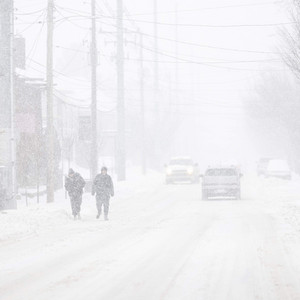
There's like eight inches of snow outside plus a couple inches of ice.
We got hit by this storm.
Yeah.
I mean, me, you, tens of millions of other people.
Like, this is a big one.
Well, if you wanted a snowy winter, you are getting it tonight.
The storm stretches over 2,300 miles with more than 40 states.
It is windy.
It is pelleting.
About half the United States population today shoveling, scraping and slogging their way through heavy snow.
Yeah, at least 29 states were affected by this storm.
It knocked out electricity for hundreds of thousands of people.
And listen, winter storms happen.
It's a thing.
Yeah.
In the winter.
But as a climate reporter, one thing that was interesting to me about this storm was how much warning we got.
Like, I've been preparing for almost a week before any snow even fell, which is a lot of lead time.
Now that you mention it, I did start hearing about the storm a long time before it arrived.
Was there more warning than usual?
Well, that's what's interesting to me.
You know this is actually par for the course these days, getting a lot of warning, but it didn't used to be that way.
So last week I called up this climate scientist named Kevin Reed at Stony Brook University to talk about the storm.
And he said this thing that was kind of interesting.
I mean the fact that we're talking about an event in New York City where, I am right, that's happening in a few days from now.
You know that wasn't something we could do 50 years ago.
And that's because there have been these pretty amazing advances in computer weather models.
The ability that we are able to predict them days in advance is centered on the fact that the United States has made large efforts in coordinated observations of the Earth's system, so that we can build better and better models.
So today on the show, we're taking a closer look at those models, how they work, what they tell us and why this storm felt like a slow-moving train in a good way.
I'm Regina Barber, and you're listening to Shortwave from NPR.
This message comes from Wix.
Nothing beats seeing your ideas turn into cold, hard cash.
Well, if you use Wix Harmony, you better get used to it.
Wix Harmony makes it unbelievably easy to create a fancy new website that's built to sell.
Get the perfect blend of AI and drag-and-drop tools that puts you in control of every detail, plus an AI agent to help you every step of the way.
Try it for free at wix.com slash harmony.
This year's Oscar nominations are here, and we are unpacking record-breaking nominations for Sinners, plus nominations for Marty Supreme and One Battle After Another, and we'll talk about some of the surprises and snubs.
Listen to Pop Culture Happy Hour in the NPR app or wherever you get your podcasts.
Valentine's Day is coming up and the perfect gift for the NPR lover in your life is waiting at the NPR shop.
From cozy sweaters and mugs made for slow mornings to our tiny desk hoodie, there's something for every NPR fan.
Each purchase supports public media and the journalism you love.
Find something meaningful at shopnpr.org.
Okay, so today we're talking about the winter storm that just walloped, like the United States, with NPR climate reporter Rebecca Herscher.
A lot of us knew this storm was coming for almost a week before it actually arrived.
What allows meteorologists to give this kind of early warning, Becky?
So really good computer models are the key.
And there are a bunch of them.
Like, I don't know, Gina, are you a weather nerd at all?
Or are you more of a functional weather consumer?
You know, look at your phone, see if it's going to rain, put on a jacket.
Yeah, I'm very functional.
I look like, I'm like, woo, we can do it.
But like, no, I'm not a weather nerd.
You're not like asking more questions and Googling it.
No, no.
That's fine.
Very reasonable way to consume the weather.
So this might be new to you.
There are lots of weather models.
They have different names, usually acronyms or nicknames.
You'll see the European model, which sounds very fancy.
And the weather forecasts that you see on your phone or on TV are usually based on a bunch of these models.
Okay, so like an average of all these models?
Yeah, like a weighted average, because some models are better at predicting different types of weather or they can handle different scales, like a whole region, versus zooming in on your specific city.
Anyway, we could go down a whole rabbit hole on these models, but for our purposes it's just important to know that there are a bunch of them, and the better the models are, the better the weather forecast is going to be.
Right, because these computer models kind of model how the atmosphere actually works in real life.
Exactly.
And in real life, there is a lot going on in the atmosphere, as Kevin explained.
The way we estimate clouds, for example, and the processes that go into them, and how that then links to wind and temperature.
So there are a lot of elements that the computer model has to get right.
But if you can get it right, then you can ask that model questions.
Basically say hey, we're seeing this kind of wind, these kinds of temperatures, this atmospheric pressure.
It's this time of year.
What do you think is going to happen next?
And it gives you some scenarios with probabilities.
Like usually when the conditions are like this, it'll snow later this week, but there's a chance it could rain instead.
You know, the better the model, the more accurate those predictions are going to be.
Yeah no, I had friends that were meteorologists and it was like fascinating to me that it was basically every field of science that goes into weather prediction.
Totally.
So like what makes a model good?
Is it about computing power?
That is one element, yeah, but the most crucial requirement is good data.
So have you heard the saying garbage in, garbage out?
Yes, that relates to my food intake, right?
Gross.
Yes, yes, it does, I guess.
No garbage in, garbage out.
Important for our health also.
True, I think, of many fields of science, especially things where you have a large number of observations.
So for weather models you need good data, and good data looks like plentiful granular, continuous data.
And I'll go through each one of those.
Okay.
Right, so first, plentiful data.
The atmosphere is so complicated.
There are layers of clouds.
There are currents of air and moisture and changing temperatures and interactions with the land and the water underneath.
If you want to capture all of that in a computer, you need a lot of measurements.
Which brings us to number two, granular.
You need to know what's happening all over the place and not just in one dimension, like down on the land, or in one layer of the atmosphere.
You need to have weather stations all over the world.
And you also need to have measurements from the air column.
You know weather balloon measurements radar.
Measurements from planes.
Planes, 100 percent.
Measurements from ships and the ocean, satellite data looking down from space.
All of it.
And that leads us to the last requirement.
Your data needs to be continuous.
It can't stop.
It won't stop.
Yeah.
The most valuable data for weather models and this is true of a lot of climate science as well are data sets that cover a really long period of time, like decades, particularly if you're looking for patterns in extreme weather, because the more extreme the weather, the less often it happens.
So you need to be able to look over long periods of time to understand what conditions happen that lead to that type of weather.
Yeah, I mean, that makes sense.
Like if a giant winter storm only hits five or 10 years.
That's going to be tough for a computer model to predict.
And I can see how you'd need like a lot of continuous granular data to see that coming.
So, given that we had all of this like lead time for this storm, I'm guessing that that type of data is available.
Yeah.
I mean it's not perfect, but there have been huge investments in data collection in the last 50 years or so, really starting in the late 70s, early 80s, when Earth-observing satellites started collecting continuous data about the planet.
And at this point, there are a lot of data sets that go back 50 years or more.
All the different computer models, they use all that data.
And where does all this data live?
Oh, I'm so glad you asked.
A lot of it is... See, you're becoming a weather nerd already.
It's happening.
I can feel it.
A lot of it is maintained by governments because the satellites and the buoys and the balloons that collect this information, a lot of them, are publicly funded.
Yeah, makes sense.
But here in the US, some of that data is under threat right now because of budget and staff cuts that the Trump administration is pursuing.
So the National Weather Service, you might remember this, was interrupted pretty badly last year by mass staffing shortages which led to missed launches of weather balloons, for example.
The administration is trying to cut the budgets of agencies like NASA and the National Oceanic and Atmospheric Administration NOAA, both of which employ people who manage these continuous data sets and make them available and useful to scientists.
Oh, wow.
Yeah.
There's also a federally supported research lab in Colorado called the National Center for Atmospheric Research.
The administration is moving to dismantle that lab.
The White House Office of Management and Budget didn't respond to questions that we asked them about that plan.
But it all adds up to a lot of headwinds for the kind of data and research that feeds these computer models and that in turn spit out weather forecasts many days in advance, so that you and I and millions of other people can get over to Home Depot in time to buy shovels and hand warmers and salt.
So this lead time that we got for this storm, is this not maybe going to be the norm if this data is no longer readily available?
I would say that, as the weather gets more and more extreme, it will be difficult to keep up this level of like accurate, early forecast if scientists and data are stymied in the ways that they could be if all of these cuts were to go through.
It's not happening right now, but it's something that could happen for sure if we don't see the kind of government investment in this type of data that we have in the past.
Wow.
Well, the next time there's a big storm, we're going to have you back on and we'll see how well we predicted it.
If I have power.
Yeah, if you have power.
Thanks for coming to talk with us today.
Of course, you're welcome.
If you like this episode, follow us on the NPR app or wherever else you're listening from.
It helps us out and helps you never miss a show.
Speaking of, if you're interested in weather science, check out our episodes on better storm prediction in the tropics and how the Santa Ana winds impact the California fire season this time of year.
We'll link to them in our show notes.
This episode was produced by Hannah Chin and it was edited by our showrunner, Rebecca Ramirez.
Tyler Jones and Rebecca Herscher checked the facts.
The audio engineer was Robert Rodriguez.
News clips were from CBS Boston, Fox Weather, Fox 4 Dallas-Fort Worth, and PBS News Network.
I'm Regina Barber.
Thank you for listening to Shorewave from NPR.
This week on Up First, more violence in Minneapolis.
Democrats say they will block a spending bill in the Senate after another deadly ice shooting.
How will Republicans respond?
And could the Trump administration rethink its strategy on immigration?
We'll keep you posted every morning with three stories you need to know to start your day up first.
Listen on the NPR app or wherever you get podcasts.
For 47 years, Iranians have lived under a dictatorship many no longer want.
Now the country may have reached a breaking point.
Iranians have recognized that they need to take matters into their own hands, pushing back against authority.
We ask three central questions about how Iran got here and what comes next.
Listen to ThruLine on the NPR app or wherever you get your podcasts.