Support for NPR and the following message come from Freshworks, who believes complexity is the enemy of efficiency.
Stop wrestling with bloated, expensive software.
Uncomplicate with Fresh Service for IT and Freshdesk for customer support.
Learn more at freshworks.com.
You're listening to Shortwave from NPR.
When I was younger, I was excited to get older.
And not just my 20s and 30s, but maybe even my 60s and 70s.
At the time, the Golden Girls were cool.
I loved science and I thought if any part of my body didn't work anymore, it could probably be replaced.
My heart.
My lungs.
My legs.
But I recently read a book that made me think again.
It's called Replaceable You by nonfiction author Mary Roach.
Fairly far along in the process of writing this book.
I was like is there anything that we humans have built or designed or cooked up that is a hundred percent perfect or pretty much just does what the original part does does?
And i thought okay, the tears.
How about tears?
Have we got a perfect artificial tear?
You know, i found this guy who works for tear lab and he spent decades working on tears.
When we got on to a zoom call and i said okay, so artificial tears?
He's like yeah, that'll help for an hour or two, but they kind of wash away the good stuff.
So we don't even have, we can't really even replace tears.
So my cyborg dreams may not become a reality just yet, but science has still made huge progress when it comes to fixing the human body when it fails.
And Mary covers a lot of that progress in her book, from hair to pig organs to her experience visiting a burn unit at a hospital in Boston.
Third-degree burns are really tough because the cells that would regenerate from below, like on a second-degree burn, those are destroyed.
So the body tries to heal by contracting, by kind of pulling like a drawstring.
But there are ways now to... culture the person's skin off-site.
So, rather than waiting for the place that you took the skin to heal so you can take more skin, you can take a biopsy and they can grow out these very thin layers of the person's own skin.
There's spray-on skin, which you're spraying cells over the wound area.
Today on the show, how replaceable are you?
We join Mary Roach on her adventure through the human body and learn how far we are from going full cyborg.
I'm Regina Barber, and you're listening to Shortwave, the science podcast from NPR.
This message comes from AT&T.
America's first network is also its fastest and most reliable.
Based on RootMetrics, United States Root Score Report 1H2025, tested with best commercially available smartphones on three national mobile networks across all available network types.
Your experiences may vary.
RootMetrics rankings are not an endorsement of AT&T.
When you compare, there's no comparison.
AT&T.
This message comes from Superhuman, the AI productivity suite that gives you superpowers everywhere you work.
With Grammarly Mail and Coda coming together, you get proactive help across your workflow so you can outsmart the chaos.
Experience AI that proactively helps you go from to do to done faster.
Unleash your superhuman potential today.
Learn more at superhuman.com slash podcast.
That's superhuman.com slash podcast.
So, Mary Roach, we're going to focus the rest of this episode on three chapters from your book.
We're going to start with the lungs.
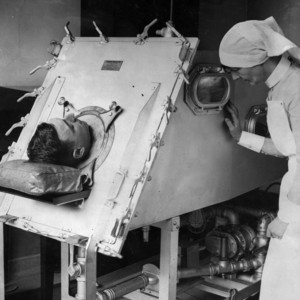
You write about the history of the human lung and the invention of something called the iron lung, which was particularly important during the polio epidemics in the 1940s and the 1950s.
And for someone who doesn't know, polio is a disease caused by a virus that can lead to paralysis, including chest paralysis, so patients can no longer breathe on their own and the iron lung helps with breathing.
How does the iron lung work?
People think about ventilators and they think about, you know, when somebody is intubated and put on a ventilator.
That's a system where you're kind of just blowing up.
You're forcing air under pressure.
Like a balloon.
Like a balloon.
Like you're blowing up a party balloon.
So you're forcing air into the lungs.
But we don't breathe that way.
Breathing is a very natural state of affairs where... your muscles are expanding.
The muscles of your diaphragm and your rib cage, they open out the area.
So they're lowering the pressure.
So the air rushes in.
And the iron lung works the same way.
It's called negative pressure ventilation.
But you actually went in an iron lung.
What was that like?
I did.
I did.
I was in an iron lung.
And it is.
I mean I haven't been on a positive pressure ventilator, which is a whole.
I mean most people are sedated when they're on them, so I can't compare it.
But I will say, your breathing feels the way your breathing does when you're not in an iron lung, except that
You have absolutely no control over when you're going to inhale and when you're going to exhale.
The machine has taken over.
So if you're trying to talk with somebody and this is something I mean I know that when you speak, you're speaking on the exhale.
You can't speak and inhale.
I just tried to do it.
So that's what happens.
Wow.
So I would be talking to this guy whose iron lung I was in and I would try to just talk normally and it just cuts you off.
Wow.
Wow, that's cool.
Which is a weird, yeah, it's kind of a weird thing.
So it's this very relaxed kind of luxuriant breathing.
But the other thing about the iron lung, your head is outside and it has to be a tight seal.
So you have this thing around it, kind of like.
So you're simultaneously breathing in this very luxuriant way and feeling like somebody is choking you.
Wow.
Because it has to be a tight fit.
Right.
It's not choking you, literally, but it is a tight... It's not...
It's not a comfortable way to spend the night.
And I thought, I'm going to sleep in the iron lung.
Did you last the whole night?
I lasted about seven minutes.
We started talking about this with like.
Now we have this kind of like ventilators.
You said like blowing up, like a party balloon.
How does that compare to the iron lung?
Is it much, much better?
Are there pros and cons?
Like, what is the difference?
Yeah.
Yeah, for sure.
Well, a positive pressure ventilator, you've got to intubate the person.
So, you know, you've got to thread this tube down and it's going through the voice box.
And it's so you can't talk, you can't swallow.
But what can happen with a positive pressure ventilator?
Is you just like with a party balloon?
You know how the top part inflates easily and the bottom part doesn't, doesn't.
So you can end up with the lower part of the lungs not taking in the air, and people tend to be sedated.
And when you're sedated for a period, I mean, it's fine for a short period of time.
But if you're sedated on positive pressure for days and weeks, then you start to get sometimes cognitive issues, muscle deterioration.
And it takes a certain amount of rehab to get you back to a place where you can breathe on your own and move around well on your own.
So you don't want to be on a positive pressure ventilator for extended period of time.
But people who were in iron lungs, they were in there for weeks, months.
People in them would often regain some muscle control.
So they'd be able to get by during the day outside, but then they'd sleep in the iron lungs.
So they weren't always 24-7
Yeah.
So we're going to talk about the next chapter, the vagina dialogue.
This is the chapter that focuses on vaginas made from parts of the intestine.
And I hadn't heard of the surgery before and I was fascinated that using the colon could create this new organ.
What is the process like and why the colon?
Yeah, this was a chapter where I was just fascinated by the body's kind of adaptability.
So what you can do is...
The colon.
Well, when you think about it, it makes a lot of sense.
You know, it's tubular, it's moist, it's pink, it's stretchy.
That's what you said in your book that the doctor was like, yeah, OK, makes sense.
I can't think of any other body part that would do double duty as a vagina.
I was talking to Dr. Garcia.
He's the head of the Cedars-Sinai Transgender Surgery and Health Center.
And this is a technique that is sometimes used if the more common way of building a vagina doesn't work out.
It's an option.
It's not used all that often.
You can take an eight inch, six or eight inch section of the ascending colon.
You know, make a cut and you're going to stitch back the pieces of the colon, right?
So that it's still a working tube.
Um, but you, you can keep, but you can swing down this section that you've liberated and you keep it attached to the blood supply, right?
It's got a long enough connection to the blood supply that you can swing it down and stitch it in place.
Uh, and, and There you have a vagina.
Yeah.
So this chapter, it kind of led you to this other realm of like replaceable.
I'm just going to say it, penises.
And you traveled to Georgia to pursue this like story you had heard about of like middle fingers being used to rebuild penises.
What kind of research is happening in Georgia?
What happened?
Well, let me tell you okay fascinating uh, this came up.
I was having a conversation with a she actually does.
She's a stem cell researcher, but somehow in the course of the conversation she mentioned she saw a paper um about a technique whereby a man's um The man had had cancer and his penis was rebuilt using his middle finger.
I, of course, imagined the finger removed and installed pretty much as is, you know, with the nail.
So I was determined to talk to this surgeon who is, I found out, in Tbilisi, in Georgia, and The country Georgia.
The country, yes, the country.
And I wrote to him in English, in Georgian using Google Translate.
God knows what that note said.
In Russian.
I didn't hear anything.
Especially talking about replacement penises.
I would love to see actually how that actually read to somebody who speaks Georgian.
So I went there and I showed up.
The surgeon wasn't there, apparently on vacation.
And I'm like, but we've come all the way from America.
To which the logical response would be, well, you're a couple of idiots.
But I was able to talk to another surgeon there who kind of showed me the images of the procedure.
It's not as is.
It's wrapped in skin.
It's not just a finger on a body.
I don't know why he chose to use the finger, but I will say the penis.
At the after photo it looked quite normal, except that it does actually bend at the knuckle.
In order to show how strong it was.
I guess there's an image of the penis kind of bent upward partway along and there's a ceramic water pitcher being held by the penis.
That was the funniest part, I think, of that chapter for me.
The ceramic water pitcher.
This is so great.
So, after working on this book, in your opinion, what does the future look like for transforming the human body?
Am I going to be a cyborg?
Because I would really like that.
Not yet, Gina, but it'll happen.
I mean, it'll happen.
All these things are on the way.
Same with bioprinting.
I spent time at a lab, a bioprinting lab, the Feinberg Lab at Carnegie Mellon, which is doing really cool stuff.
But I said so, how far are we from printing an organ that can be implanted and ready to go in a human being?
And he said, we're kind of at the Wright Brothers stage, if you want to compare it to aviation.
I see.
Which is both really exciting.
I mean the Wright Brothers.
My God, they got the thing off the ground and down to the end of the pasture.
Yeah.
Pretty cool.
But a long way off from thousands of flights going back and forth every day.
Thank you so much for talking to us today and sharing this book with the world.
Oh, thank you, Gina.
It was so fun to talk to you.
If you liked this episode, give us a follow on the platform you're listening to us from.
You can also check out our episodes on synthetic cells and the first pig kidney transplant.
We'll link to those episodes in our show notes.
This episode was produced by Rachel Carlson and edited by our showrunner, Rebecca Ramirez.
Tyler Jones checked the facts.
Kwesi Lee was the audio engineer.
Beth Donovan is our vice president for podcasting.
And I'm Regina Barber.
Thank you so much for listening to ShoreWave from NPR.
The first amendment protecting the right to free speech and a free press in the us came first for a reason it was a bold declaration that set the young republic apart.
Today we ask you to make your own declaration.
Stand up for npr and a free press by giving now at donatenprorg.
Thank you This holiday season.
Give a gift that gives back.
The NPR Shop is back with the iconic logo tee, the tiny desk hoodie and fresh gear for fans of public media.
What you wear funds what you hear.
Shop meaningful gifts now at shopnpr.org.
This week on Up First.
Affordability is the latest buzzword in politics, so President Trump is hitting the road to tout his economic record.
His message, the economy is thriving, but will Americans buy it?
We'll bring you the latest this week on Up First, now a Golden Globe nominee for best podcast.
Listen on the NPR app or wherever you get your podcasts.