This message comes from NPR sponsor Capella University.
With Capella's FlexPath learning format, you can set your own deadlines and learn on your schedule.
A different future is closer than you think with Capella University.
Learn more at capella.edu.
This is Planet Money from NPR.
The other day, I donned a hair net and a very unfortunate beard net.
Hey.
Here we are.
And got to visit a place I'd wanted to for a very long time.
Shipping dock, smell of produce, pallets, racking, the whole thing.
This place is low-key one of the wonders of the modern world.
It's an enormous refrigerated warehouse filled with enough food to feed an entire city.
My guide to this miracle is Nicola Twilley.
We're heading in.
It's noisy.
Food journalist, host of the podcast Gastropod and author of a recent book about refrigeration called Frostbite.
Nikki has become obsessed with places like this.
She's spent the last decade visiting them and even worked in some of them.
It's a cool, it's a cool world.
The warehouse we're in today is enormous.
The size of two football fields.
Don't get run over.
Careful, careful.
Fruits and veggies are coming in from all over the world and going out to supermarkets and restaurants across Southern California and beyond.
There are all these storage rooms with very particular microclimates, each the perfect temporary home for a bell pepper or a jackfruit or a horseradish.
Because, as Nikki tells us, just because a fruit or a vegetable has been harvested doesn't mean it's dead, exactly.
It's just in a sort of suspended animation.
It's like us, it's still breathing.
It is breathing and it has a certain number of breaths it can take before it dies.
I'm sorry, a head of lettuce has been decapitated.
How could it possibly be alive?
I mean, it is dying, but so are we.
I hate to break it to you.
And, like us, it has a certain number of breaths it's gonna take before it dies, and the whole trick with produce is making it breathe more slowly, which you do by refrigerating it.
Each fruit and vegetable has a perfect temperature to optimize that breathing.
Nikki leads me through one of those vinyl-stripped doors with all the pieces of plastic hanging down and into a slightly louder room.
This one is for things like eggplants and tomatoes.
Okay, so did you notice the temperature change?
Yeah, it's much warmer in here.
It is much warmer.
There are pallets full of Roma tomatoes, but also beefsteak tomatoes, heirloom tomatoes, grape tomatoes, cherry tomatoes, probably some other tomato varieties I've never heard of.
All kept at a balmy 45 degrees.
Tomatoes, which I'm going to say tomatoes.
I'm sorry.
I grew up in England and I haven't made the leap for that word.
Deal with it, people.
Exactly.
Listen, try it yourself.
You might prefer it.
Tomatoes are really, really sensitive.
If they're stored too cold for too long, they actually lose their ability to generate flavor.
Yeah, so news you can use, do not refrigerate your tomatoes.
That's why supermarket tomatoes often taste so bad.
Being there in that warehouse, it was like being in a cathedral devoted to everything humanity has learned in the last 150 years about how to refrigerate our food.
And being there with Nikki, well, that was like getting a tour from the Pope of refrigeration.
It literally changed everything from the contents of the microbes that live in our gut to the invention of the hoodie.
You're wearing a hoodie right now that wouldn't exist without refrigerated warehouses.
To Irish independence, you know, the politics of Central America.
The cheeseburger did not exist until refrigeration made it possible.
So it is transformative on every level.
Hello and welcome to Planet Money.
I'm Alexi Horowitz-Ghazi.
And I'm Nick Fountain.
Today an entire show about refrigeration, how it changed the course of history and remade time and space.
We'll meet the chemist who crisscrossed the country by train in her quest for food safety and the notorious cheapskate who brought meat to the masses.
I'm going to make a suggestion.
We should do the rest of this interview in a warm place.
I'm so on board.
I love the cold, but not that much.
This message comes from Capital One with the Venture X card.
Earn unlimited double miles on everything you buy.
Plus, get premium benefits at a collection of hotels when booking through Capital One Travel.
What's in your wallet?
Terms apply.
Details at CapitalOne.com.
This message comes from ServiceNow.
People should do the creative work they actually want to do, not boring, busy work.
Now, with AI agents built into the ServiceNow platform, you can automate millions of repetitive tasks in every corner of your business IT, HR and more.
So your people can focus on the work that they want to do.
That's putting AI agents to work for people.
It's your turn.
Get started at servicenow.com slash AI dash agents.
To truly appreciate the miracle of widespread refrigeration, let us go back to the time before that miracle.
Say, the mid-1800s.
It was a simpler time, but also a smellier time, in part because of food.
Unrefrigerated food rots pretty quickly, and this is especially true for meat.
Yeah, without refrigeration.
If you want fresh meat, you have two, maybe three days between when you slaughter an animal and when you have to eat it.
Otherwise, bad things will happen.
And one interesting thing Nikki's book points out is that this was just really economically inefficient.
In the mid-1800s, cows were raised in one place and then brought to the big urban centers.
They would either have to walk or come in on trains.
Cattle would commute hundreds of miles to get slaughtered in the city.
And you can imagine they're losing a bunch of weight while they're doing that.
So kind of wasteful, but also pretty unsanitary.
Then they have to be slaughtered in the city center, which you know is relatively close to where all the people are living.
And so you get these horrific scenes of sort of blood and gore.
To cut down on the cattle commutes and clean up all that blood and gore.
The world needed a special kind of hero.
One who would revolutionize how America got its food.
Enter into this world a notorious cheapskate.
Who is that?
Gustavus Swift.
Yeah, he's a New Englander with a New Englander sense of thrift.
Cheapskate Gustavus Swift was born in 1839.
His brother, Noble, was a butcher.
And young Stav, as he was known, followed in his brother's footsteps at the age of 14.
Yeah, Gustavus would travel from Cape Cod, where he lived.
He would buy a cow outside of Boston slaughter and quarter it there and then bring the meat back to the Cape to sell it door to door.
But he couldn't help but notice that he always had to leave like half of the cow behind.
Only 50% of it is edible.
The rest is essentially trash.
What are we talking about?
The bones, the sinews, that sort of stuff?
Bones, intestines, blood.
There's a lot of hide there.
There's a lot of hoof there.
And this drove Gustavus Swift up the wall.
He is famous for not wanting to let a single thing go to waste.
And there were uses for these byproducts.
These were the raw materials for things like soap or fertilizer or glue.
But you had to have a certain scale to make it worthwhile.
Gustavus figured if he could just centralize meat production and slaughter all the animals in one place, he could gather up all the bones and sinews and hooves anyone would ever want and sell them.
So he moves to Chicago, which is sort of the hub for all the beef coming off the Great Plains, and gets to work setting up giant butcher shops or, as they came to be known, meatpacking plants, where cow carcasses would be yanked around on hooks and each worker would do a little discreet part of the slaughtering and butchering process.
These were called disassembly lines, which, fun fact, inspired Henry Ford's assembly lines.
Also not so fun fact.
Meatpacking plants were horrendous for animals and for the people who worked there, And so they also inspired Upton Sinclair's book The Jungle.
Yeah, pretty nasty stuff.
But at least now they could use all the cow.
Hooray!
Still, it wasn't like there was a market in Chicago itself for all that meat.
To get this to really work, Gustavus needed to figure out how to get his very perishable product his meat to cities on the East Coast.
And at the time people had started to experiment with using ice on railway cars to keep meat cold, and they could not make it work.
Oh, what was the problem?
You might think ice just would make it cold and no big deal.
That works in your Yeti.
It does not work in a rail car full of slaughtered meat.
So if any of the meat touches the ice, it gets frozen burn and wet.
If the ice melts too fast, there's too much water.
Meat doesn't like that.
It gets slimy.
Bacteria grows.
If the air doesn't circulate well, you'll get hot spots and cold spots and the hot meat will rot and the cold meat might freeze.
I mean, if the train pauses, you could lose the entire load.
I mean, it was just a disaster.
And so everyone had sort of decided this isn't going to work. but not Gustavus.
Gustavus said about this with gusto, I guess, and tried everything.
He tried putting the ice at the bottom.
He tried putting the ice at the top.
He tried putting ice at the sides.
He had one brilliant idea where there was a fan attached to the axle of the rail car which made sure the air circulation was there.
Great idea until the train stopped and then the wheel wasn't turning and the fan wasn't blowing.
But finally, Gustavus and an engineer succeeded in designing a train car that would keep meat cold.
It was well insulated.
You could add ice from the top along the journey and it would automatically push cold air down from that ice.
In the end, Gustavus' plan to centralize meat processing and make it more economically efficient totally worked.
He was able to significantly undercut what his competitors were charging for meat.
He was able to sell it so cheaply because...
Think about it.
He's not paying to ship the half that you can't sell.
And he's monetizing all the byproducts.
So he was able to just slash the price.
And there were enough meat-starved poor working people in the cities who had not been able to afford meat before, who suddenly could afford meat, that his business took off.
Now, there was one last innovation that Gustavus popularized that we have not mentioned yet.
One that was maybe even more important than those refrigerated train cars.
He figured out how to cool down his packing plants full of meat almost immediately post-slaughter.
And that meant his beef was refrigerated from the time that it was butchered to the time that it arrived, in whatever city he was going to.
This technique ended up being applied to all kinds of foods.
Nikki says it's how we got the world we live in today.
I mean, think about all the things you can buy at the grocery store.
Green beans from California, strawberries from Mexico, butter from New Zealand.
And you have to imagine a series of refrigerated links extending and connecting your fridge all the way back to the farm.
So when something like a green bean is harvested, immediately it is pre-cooled.
Then you store in a cold storage unit.
You ship in a refrigerated truck.
It goes to a refrigerated warehouse like we saw today.
They ship it in a refrigerated truck.
The grocery store puts it on a refrigerated shelf, and you purchase it.
The fancy term for this end-to-end refrigeration?
The cold chain.
So the cold chain is all of those cold spaces that mean that your food should be able to move from the farm essentially to the point of purchase without ever being outside of the cold.
But to understand how we got to this cold chain connected world we live in now, we need to talk about one more big chapter in the history of refrigeration.
Because sure, Gustavus Swift had come up with new ways of keeping food cold all along the supply chain.
But that did not mean that Americans were immediately ready to trust those foods.
Oh, yeah.
Well, just imagine for all of human history, you have known what fresh means.
And fresh means it was picked or it was slaughtered in the past couple of days within, like I don't know, a dozen miles nearby, and recently.
And now people like Gustavus were trying to sell you meat from halfway across the country that had been slaughtered who knows when.
Sounded like a recipe for food poisoning.
And it's not like this fear was unfounded.
At the beginning, refrigeration was a pretty imprecise art.
There's no one overseeing this.
Uh-huh.
Warehouse men are like, well, seems like a good temperature for eggs.
We'll store them at this temperature.
No one's studied.
Is this the right temperature for eggs?
And what about for milk or chicken or seafood?
No one had done the research until who walked onto the scene.
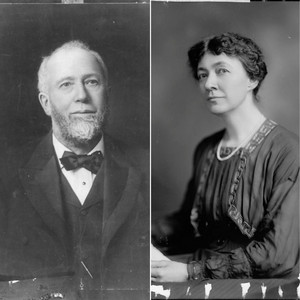
One of my favorite people in the book, M.E.
Pennington went by Polly, except for when she was going as Dr M Pennington, so that the men of the era would not realize that she was a woman.
And she is the person who basically made Americans trust refrigeration.
That is her legacy.
Polly Pennington was a chemist.
Around the turn of the century she started working for the Philadelphia Bureau of Health, cleaning up the city's milk supply.
From there, she moved on to the federal government.
Her job?
Figuring out how to safely store and transport all of these different kinds of foods, which was way more exciting than it sounds.
She traveled the country.
She had a little train car that she would attach to you know, Gustavus' rail cars and she would sample a chicken to make sure it was at the right temperature.
I love this.
She is amazing.
She was riding the rails for food safety?
She was riding the rails for food safety.
There's amazing pictures of her in her sensible divided skirt, reaching into these ice-filled rail cars, and she became an absolute icon in the food industry.
Name a person in the food industry more iconic, Lexi.
Do it.
Guy Fieri.
Sorry, sorry.
The truth hurts.
But leaving that particular icon aside, if you've ever checked the grade on the side of your egg carton, you have Polly Pennington to thank.
If you've ever eaten American chicken or shrimp or fish and not gotten sick, tip your hat to Polly.
But if you've ever thrown donkey sauce on it, that's going to have to be credited to all-American food icon Guy Fieri.
But OK, Polly Pennington's legacy is maybe a bit more substantial.
She did change the way people in the industry stored and transported their food.
And she did launch a kind of public relations campaign about all this stuff.
And at the end of her life she had managed to make Americans go from thinking that refrigerated food was a dangerous scam to to believing that anything that wasn't refrigerated couldn't possibly be fresh.
Literal 180.
She made Americans believe in refrigeration.
Polly Pennington, fully pasteurized, grade A legend.
Pour some out for her, some 2%.
Because look at all the things that her work and the work of Gustavus before her brought about.
Yeah, let's just take a moment Nick, to kind of sit and revel in all of the incredible ripple effects from the mass adoption of refrigeration and the cold chain here.
Let us.
Yes, like how refrigeration is this kind of time machine.
An apple can be picked and stored for 10 months.
The cold chain means that we can live in this sort of endless summer, where everything is always in season.
And it didn't just shift our sense of time.
Nicky says it also shifted our sense of space. it totally transformed the geography of farming.
It used to be if you wanted salad greens, you bought them from whatever farmer happened to live near you.
But these days a large majority of the lettuce our country eats comes from the two places with the climate best suited to growing lettuce the Salinas Valley in California and Yuma Arizona.
That concentration wouldn't be possible without the cold chain.
So it allows the advantage of climate and soil to overtake the advantage of proximity that previously someone close to a city who was growing lettuce would have had.
And when you start to change how people put food on the table, you start to change all sorts of things.
Nikki says, think about how refrigeration changed the role of women in society.
So pre-refrigerator, you know women were had a huge amount of labor canning fruits and vegetables in the summer to last through the winter, and then shopping every day, if they lived in the city, trying to buy fresh food for that evening's meals.
There's no such thing as leftover.
There's no such thing as frozen convenience food.
And as home refrigeration, frozen food expands in the 20th century well, guess what rises in lockstep.
Women in the workforce.
So...
Also, divorce rates.
There you go.
I know.
No comment.
And it's not just the slow erosion of the patriarchy either.
Nikki says, you can see the cold chain's influence on so many historical events, like how refrigerated shipments of blood for transfusions helped American soldiers in World War II.
Or how the ability to transport fruit from Central America changed the economies of some of the countries there.
And...
Next thing you know, American corporations were doing everything they could to turn them into Banana Republic.
One of the most astonishing stories I came across while writing the book was an economist who was like would Ireland have become independent without refrigeration?
To be clear, even the economist here.
He's not saying definitively that the cold chain caused Irish independence.
But here's how his thinking worked.
A lot of beef for the English was raised in Ireland.
But once frozen beef could be imported from places like South America, then the price of Irish beef went way down.
And that made life really hard in Ireland, fueled discontent among the Irish tenant farmers and made British landlords more willing to sell their land.
Before you know it, you have Irish independence.
So many surprising ripple effects.
Who knew?
Quite the theory.
I might buy it.
I'll take it.
Coming up in a hot minute, the downsides of our cold, cold world.
Starting with one of the most fundamental things about food itself—
This message comes from NPR sponsor, U.S.
Bank.
With U.S.
Bank Business Essentials, you get more than just a bank.
You get a dedicated partner that provides you a powerful combo of checking and card payment processing with quick access to the money you've earned, proving that there is nothing as powerful as the power of us.
Visit usbank.com today to learn more.
Member FDIC.
Copyright 2025 U.S.
Bank.
This message comes from NPR sponsor Adobe.
Introducing the all-new Adobe Acrobat Studio, now with AI-powered PDF spaces.
Need to turn 100 pages of market research into five insights with a click?
Templates for a sales proposal that'll close that deal?
Or an AI specialist to tailor the tone of your market report?
You can do all that with the all-new Adobe Acrobat Studio.
Learn more at adobe.com slash do that with Acrobat.
Okay, obviously refrigeration is not perfect.
So real quick, let's run through a few of the downsides according to Nikki.
Starting with... Food actually doesn't taste the same anymore.
In places that have not adapted to refrigeration.
They taste American food and they say it tastes dead.
Are they just tasting the tomatoes?
Not just.
Not just.
Yeah, it's cool to be able to eat cherries that were picked a month ago in Chile, but they're not going to taste as good as fresh ones.
As soon as a cherry is picked, it starts to lose its acidity and its flavor.
But still, you can get cherries pretty much all year round.
All kinds of food.
We have more of it and it is cheaper, but it is not as delicious.
Okay, so that's taste.
Problem number two has to do with waste.
And this is a little surprising, right?
The whole point of refrigeration is to keep food from spoiling.
Prior to refrigeration, between 30 and 40 percent of food would go bad before it ever even reached the market.
It would have to be thrown away.
So refrigeration has minimized that.
But that waste hasn't gone away.
It's just moved further down the timeline.
The food waste on the consumer end, where we've purchased it from the grocery store, or it's gone to restaurants.
That has gone up to 30 or 40 percent of all foods.
Refrigeration, along with a bunch of other things, has brought the cost of food way down, which makes it easy to be a little careless with our food purchases.
I mean, right now in my crisper drawer, there are like three bags of aspirationally bought arugula.
One of those is going to get tossed.
A shutter to even look in my crisper drawer.
And last but certainly not least, there's the problem of how much energy all this refrigeration uses.
So yeah, it's a sad irony that as we build more and more artificially cold space, our naturally cold space disappears thanks to climate change.
Refrigeration accounts for 2% of the world's emissions.
That's on par with aviation.
And that number is set to grow rapidly as much of the developing world builds out its own cold chain.
Some teeny tiny good news here.
There is some low-hanging fruit when it comes to the energy consumption of the cold chain.
Nikki says there are some folks in the industry who are right now trying to get everyone on board with slightly turning up the thermostats in their freezers from minus 18 to minus 15 degrees.
Those are Celsius.
It's okay.
Very, very cold, way below freezing to a little bit less below freezing.
Exactly.
Turns out, minus 18 degrees Celsius, that might be colder than it needs to be.
And it's been estimated that just that tiny move, moving frozen food around at minus 15, which is perfectly safe, is equivalent of getting like 4 million cars off the road.
Wow.
So just three degrees will have a huge impact.
Huge impact.
So, just like every other major new technology, the cold chain has come with all sorts of tradeoffs and unintended consequences.
But refrigeration has made our food system cheaper and safer and more abundant than ever.
Yeah.
Before working on this story, I got to admit, I kind of took refrigeration for granted.
We've grown up with it just quietly humming along in the background.
But after reading Nikki's book, I started to think of the cold chain as like this, force that can bend time and space and change the economy, even change history.
Yeah now, every time I walk by my fridge these days I can't help.
But just, you know, crack a smile, give it a little pat on its sweet stainless steel little belly and say thank you.
You know, that'll do fridge.
That'll do.
Is there some undersung technology or person who didn't get their due in the economic history textbooks or podcasts?
Let us know.
Send us an email at planetmoneyatnpr.org or you can find us on a lot of different social media.
Today's episode of Planet Money was produced by James Sneed.
It was edited by Keith Romer, fact-checked by Sierra Juarez and engineered by Valentino Rodriguez-Sanchez.
Alex Goldmark is our executive producer.
I'm Alexi Horowitz-Ghazi.
I'm Nick Fountain.
This is NPR.
Thank you for listening.
And give your refrigerator a pat on its belly.