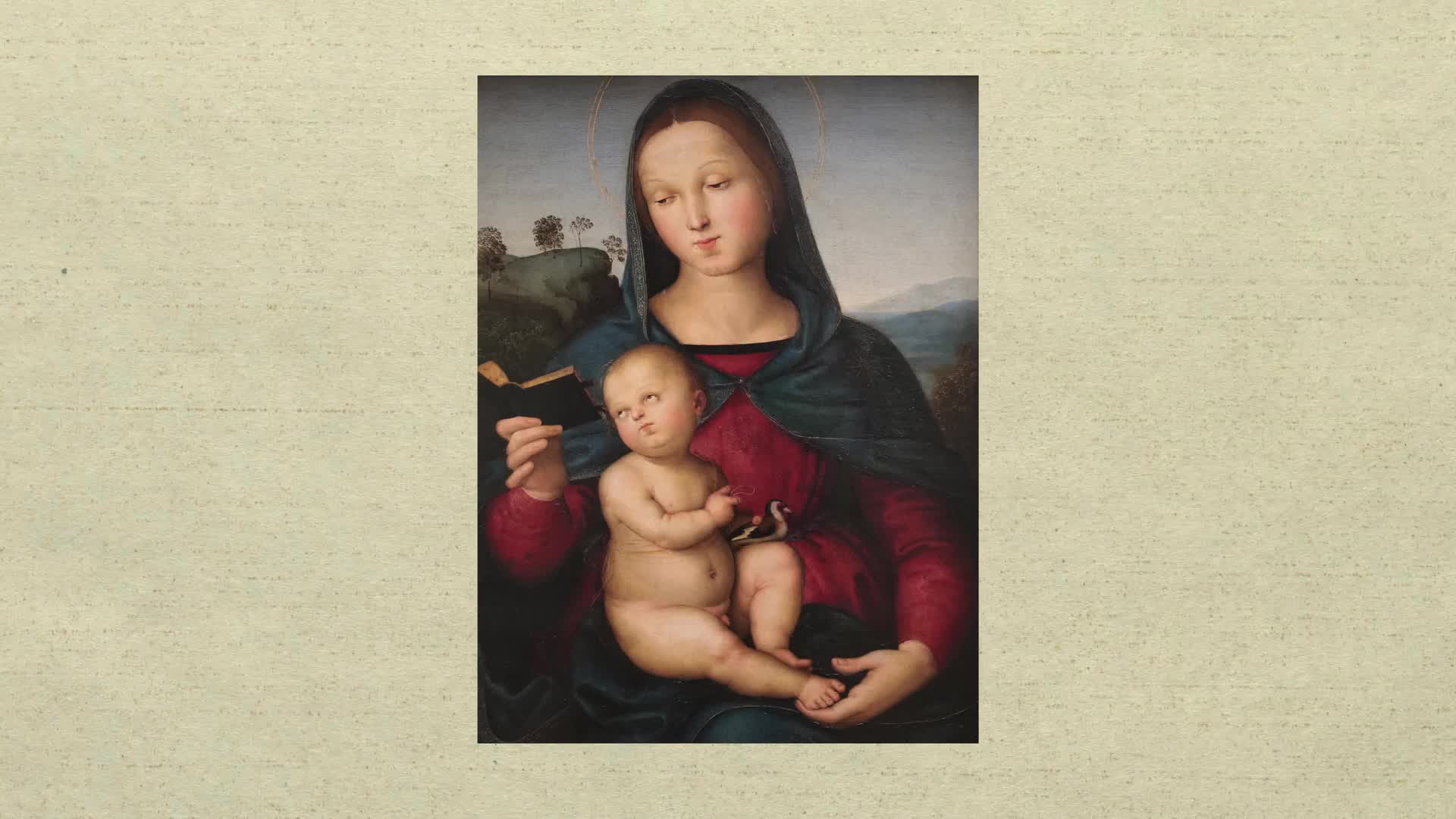
If you wanted to understand an artist's creative evolution, the best case scenario is that they painted the same subject at two different points in their career.
That way, you could see exactly where and how their craft and vision advanced.
It'd be even better if they treated that theme three times or four.
Then the course of their progress, the integration of their influences, their experiments and realizations would reveal itself in greater subtlety.
Fortunately for us, we do have a best case scenario in Renaissance artist Raphael's treatment of the Madonna and Child.
Only he didn't paint it just four times.
He made a lot more than that.
Most of us know that Raphael was one of the big three high Renaissance artists, along with Leonardo da Vinci and Michelangelo.
His most famous work is the magnificent School of Athens fresco in the Vatican Papal Palace.
But of course, he painted many more works.
He didn't have Leonardo's problem of constantly starting things and rarely completing them.
Raphael completed a lot in his two short 37 years of life.
And he didn't have Michelangelo's problem of, well, of a thorny personality.
By all accounts, Raphael was nice, courteous, and a pleasure to work with.
If there's one thing you should know about him, it's that he was a sponge.
He had an amazing ability to rapidly absorb the innovations of great artists around him and incorporate them into a style that always remained uniquely his own.
His first influence was his dad.
Giovanni Santi was an accomplished artist in his own right, good enough to become a court painter to the Duke of Urbino.
His work was shaped by the geometry of Piero della Francesca, the first person to write a treatise on perspective.
And by the clarity, realism and landscapes of early Netherlandish painters.
All these influences filtered through the father to the son.
Giovanni died when Raphael was only 11, so he never got the chance to see his son surpass him, which he did quite quickly.
Raphael was only 19 when he made the painting on the right, probably his first treatment of the Madonna.
You can see that Raphael has a better sense of three-dimensional bodies and how to make them feel like they're part of the space that they're in.
In this sense, he already outshines his father and even Piero, whose figures have a flatness to them.
Where he doesn't outshine Piero is in the composition.
There's an awkwardness in the arrangement of the figures here, especially Saint Jerome and Francis, who are cramped in at the sides and pushed forward so that there's no separation from the Virgin and Child in front of them.
The other things this painting lacks are emotion, relationships, or any sense of narrative.
In this way, it's like a thousand other Madonnas that came before.
Since the early Middle Ages, the depiction of the Virgin had been a mainstay of devotional painting.
These were static, iconic images meant for worship.
She's often enthroned and following the Byzantine style, backgrounded by a flat plain of gold with golden halos.
It wasn't until the late medieval and early Renaissance period that religious painting became interested in the humanity and story of such scenes.
The key text here is Leon Battista Alberti's On Painting from 1450, in which he praises historia, or dramatic narrative, as the highest work of a painter.
The artists that influenced Raphael in his youth, people like his father in Piero, people like Perugino and Pintorecchio at work in Umbria, had not fully taken up Alberti's call for expressive narrative.
Their work retained the static, iconic quality of earlier devotional painting and you can see that quality in all of Raphael's early Madonnas.
And then, in 1504, he went to Florence, where narrative psychology and an obsession with human anatomy and movement were infusing the art of Leonardo da Vinci and Michelangelo.
You can just witness Raphael absorbing their influence, especially Leonardo's in his Madonna of the Meadow, from 1505 to 6.
This, to me, is a great leap forward.
Raphael adopts a pyramidal structure that he learned from Leonardo and a technique called sfumato, in which transitions between colors and tones shade gradually into one another, creating a more realistic sense of depth and volume.
These three characters feel like they're in this landscape, The composition is sophisticated.
Mary holds Jesus in a gentle, motherly way.
She is in a contrapposto pose, with her body facing to the right and her head to the left, giving us the sense that she's turning to look at the young Saint John.
And her eye line leads us down to him.
He's in a pose derived from Leonardo's Virgin of the Rocks, and his eyeline directs us toward the young Jesus who returns the gaze.
The two children make their own smaller triangle with the top of the cross at its peak.
There's a narrative here.
St.
John is handing Jesus a symbol of his future suffering, which Jesus accepts.
Mary, looking at John, accepts this too, and yet her gentle holding with both hands suggests protection.
We're invited to imagine how a mother might feel about all that is to come for her child.
In the Florentine Madonnas of this period.
Raphael is learning fast, but he hasn't discarded the lessons of his earlier teachers.
I said before that artists like Perugino retain the static quality of earlier devotional painting, but he also elevated that quality to a new level of serenity and harmony.
In Madonna of the Meadow, Raphael strikes a balance between the harmony and clarity of Perugino and the drama of Leonardo.
He takes from both to make something new.
Of course, Raphael's other great influence was Michelangelo, and though their relationship did become tense, most of that bad energy came from the older grumpier, cattier artist, who famously wrote in a letter that Raphael was quite right to be jealous of me, for all he knew of art he learnt from me.
As we've already seen, that isn't true.
Raphael didn't learn everything from Michelangelo, but he did learn a lot.
Namely, how to use the human body as an expressive tool.
Michelangelo's sculpture and painting is filled with monumental bodies stretching twisting grappling, emoting with every muscle.
Of particular importance to Raphael was the Tadei Tando, a Tando being a circular work of art.
Michelangelo's relief sculpture is unfinished, but what he did do here is extraordinary.
Jesus sprawls across Mary's lap and looks back at a young St.
John.
This child carved in cold marble feels like he's alive, like he's moving.
Raphael sketched this posture and eventually used it for his Bridgewater Madonna of 1507 in reverse.
This is unlike anything Raphael had done before.
Just compare the poses of these two figures and how they interact to his Madonnas of just a few years before.
The difference is shocking.
In the later one, we have narrative, psychology, movement, bodies with a sculptural reality.
Look at how he foreshortens this foot.
Look at the shading on Mary's neck.
X-ray analysis showed that he originally planned a landscape background for this, but chose to remove it in favor of this dark wall isolating the figures and the space so that all our attention is on the sinuous way they interact.
Still utilizes the pyramid shape, the sfumato.
He still has Mary in a Leonardo-esque contrapposto.
His colors are rich like Paragino's, but a bit more muted, and to this he adds an expressive, dynamic posture that he learned from Michelangelo.
The baby looks like he's just woken up frightened from a dream.
Reaching out for his mom, he grabs her shawl.
What was he dreaming about?
Did he have a vision of the passion?
Mary looks down at her child with calm and comfort and just the slightest hint of concern.
In these later years in Florence, Raphael's Madonnas are incredible.
The compositions are much more innovative and complex, but he executes them in a way that feels effortless, and that really is his signature.
Raphael moved to Rome at the invitation of Pope Julius II and was soon commissioned to work on what would become his masterpiece, the so-called Raphael Rooms in the Vatican Palace.
In this early Roman period, he also made what I believe is his greatest Madonna, the Alba Madonna in Tondo form.
Raphael attempted Madonna's on circular canvases three times before.
The first is an uninspired run-of-the-mill devotional image.
The second is more interesting, but the composition clashes with the shape of the frame.
In the third, you can see him engaging with this exact problem.
He's designed the poses to work with the circle, curving the postures of Mary and Joseph.
The intense look here between Jesus and his foster father tells a story of real emotional potency.
It's a beautiful painting, but it has nothing on the Alba Madonna of five years later.
Everything Raphael has learned comes together in this image.
The arrangements of Leonardo, the physicality of Michelangelo, the serenity of Perugino, the geometry of Piero, the clarity of the Netherlandish landscapes.
It's all here filtered through and augmented by Raphael's genius.
With Mary reaching around to enclose both boys.
The three figures make an oval shape that fits perfectly in the Tando form.
Raphael had never painted such an expressive posture for Mary.
It speaks to Michelangelo's influence, as does Jesus' contrapposto.
You can feel the weight he's putting on his left arm.
It recalls Adam from The Creation of Man.
The details here are never-ending.
Mary's intricate leather shoe, John's tactile fur garment.
Don't miss the anemones he's gathered into his arms or the super tiny figures on horses in the distance.
Raphael's become a master at depicting the folds of fabric, at situating figures realistically in a three-dimensional landscape.
And at this point in his career he's really learned how to capture the haziness of atmosphere and light in the blue distance a crisp, pale blue that echoes the blue of Mary's robe.
The colors here are my favorite in any Raphael painting.
And we can't forget the narrative Mary and John looking at the cross and Jesus not so much taking as grabbing his future and pulling it closer.
Raphael surpasses himself in the subtlety of emotion that he layers into the Virgin's face.
There's less than a decade between this painting and Raphael's first Madonna.
In that period, he learned, practiced, absorbed, and experimented.
We're lucky to have any of his work, but we're especially lucky that the Madonna was such a popular genre of painting for wealthy private owners, for churches, convents, confraternities, because what we have isn't just evidence of Raphael's artistic evolution, we have the story of it.
The story of a young painter's journey into greatness.
Hey everybody, thank you so much for watching.
This episode was brought to you by Squarespace, the all-in-one website platform for entrepreneurs to stand out and succeed online.
To get started, you can use Blueprint AI, Squarespace's AI-enhanced website builder, to get a fully customized site in just a few steps, or choose from their library of professionally designed templates that are sleek and engaging.
Every website you make will be optimized for SEO, so you'll show up more often in search results.
And you can do so much within Squarespace, like creating members only content videos, blogs or courses, creative work that you can monetize via one time payments or subscriptions.
The bottom line is that Squarespace is going to make a home for your products or your work that looks and feels professional, something that will impress all your customers and fans.
Head over to squarespacecom for a free trial and when you're ready to launch, go to squarespacecom.
Slash nerdwriter for 10 off your first purchase.
Thanks, guys.
I'll see you next time.