NPR.
This is The Indicator from Planet Money.
I'm Darian Woods.
And today I'm joined by Betsy Joles, NPR's regular contributor from Pakistan.
Thanks for joining us, Betsy.
Glad to be here, Darian.
So you've been reporting from Pakistan for several years now, which means you've seen some major economic bumps, including a near default in 2023.
That was a recent low point, for sure, and it came just before a bailout from the International Monetary Fund, which is a serial lender to Pakistan.
Pakistan's economy has recovered somewhat since then, but there are still some major structural issues, and one of them is seriously low tax collection.
Ah, yes, taxes.
A thorn in the side of Pakistan's economy and in the side of every worker.
That's definitely how Pakistanis feel.
So millions of people here just opt out of paying income taxes entirely.
And the country has been trying to change that so it doesn't need to constantly borrow from the IMF.
Of course, Pakistan has its own version of the IRS, which tracks incomes, but it's not that simple or effective.
So tax authorities have launched something they call lifestyle monitoring, which essentially means scouring social media accounts for people flaunting extravagant lifestyles but not paying taxes.
It may sound gimmicky, but it's meant to send a message to all those tax evaders out there.
So on today's show we will be talking about why there are so many tax dodges in Pakistan, what the government is trying to do about it, and whether those plans will work.
With its ultra-thin design and all-day battery life, it's built to keep up from your morning coffee to late-night inspiration.
Powered by Series 3 Intel Core Ultra processors.
The XPS is made for editing photos, mixing tracks and more.
Check out the all-new Dell XPS at dell.com slash XPS.
This message comes from Wix.
Nothing beats seeing your ideas turn into cold, hard cash.
Well, if you use Wix Harmony, you better get used to it.
Wix Harmony makes it unbelievably easy to create a fancy new website that's built to sell.
Get the perfect blend of AI and drag-and-drop tools that puts you in control of every detail, plus an AI agent to help you every step of the way.
Try it for free at wix.com slash harmony.
Let's start with a comparison.
So around 47% of Americans filed their federal income taxes last year.
In Pakistan, tax authorities say around 2 to 3% of Pakistanis did the same.
Yeah, there are a few major reasons for that.
The first one is pretty crucial.
Lots of people don't earn much.
I spoke with Hamid Adiq Servar about this.
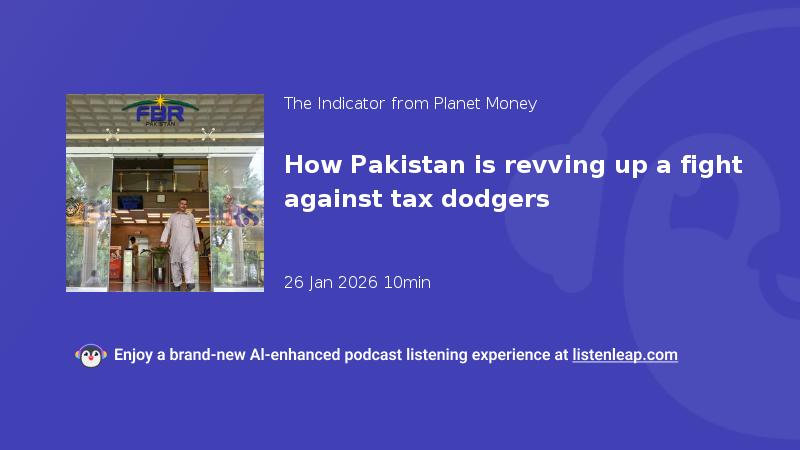
He's at Pakistan's Federal Board of Revenue, the country's tax authority, aka the FBR.
The focus is to convert information into tax dollars as soon as possible.
He believes around 5% of the population should be paying taxes.
Which is still a pretty small number of taxpayers.
Right?
But Hamid says the rest probably don't even qualify.
The threshold to start paying taxes in Pakistan is around $2,000 per year.
In the real, very real sense.
It's the 6 million people who actually earn big income here, who have sufficient amount of wealth.
Okay, so 6 million out of 250 million in Pakistan.
That is the top 2.5%.
Absolutely.
The World Bank estimates that about 40% of the population lives below the poverty line.
But then there's this small section of the Pakistani public that's extremely wealthy, even by global standards.
We're talking multiple luxury cars and real estate in Dubai type of rich.
And Habib says some of these people still report zero income on their tax returns.
And that's where he says this so-called lifestyle monitoring cell comes in.
Social media visible people, we start from there.
Some are visible through their extravagant, maybe marriages and big houses.
Some sort of investigation starts from there.
Then tax authorities check that person's tax data to see if they're paying what someone who can afford those things should be paying.
And this isn't unique to Pakistan.
Tax authorities in other countries have also been known to look at social media during audits.
And it's not turning up too many people in Pakistan.
But Hamid says it's as much about deterrence as anything.
The FBR has created ads to basically let people know they're out there and watching.
We want to increase the perception of this probability of being caught through this, because you cannot actually appoint a tax person or policeman on every door.
The best taxes are the taxes which are voluntarily paid.
This obviously isn't the only way the government looks for tax evaders.
They can also follow paper trails through big purchases, public records and bank data.
If tax dodgers don't pay, they are charged a penalty.
Then the government can take them to court.
That still doesn't exactly ensure taxes will get paid, since courts are backlogged in Pakistan and cases can drag on for years.
And there are probably millions more Pakistanis who do earn enough to be taxed but slip through the cracks.
That's why the numbers don't add up.
Yeah, we have to remember that more than 40% of Pakistan's population is under 18 years old.
And the majority of women here aren't formally employed.
So that cuts the size of the workforce way down, officially at least.
And it takes us to the second big issue with tax collection in Pakistan, which is its massive informal economy.
This is common in a lot of developing lower- and middle-income countries.
Pakistan's tax authorities say only a fraction of income tax filers are from the salaried class.
These are people who get paid by an employer and have taxes taken directly from their paycheck.
Akbar Zaidi from the Institute of Business Administration in Karachi says that's the group that gets squeezed because they're firmly on the government's radar year after year.
If you're in the tax net, you become a victim because you're the one who's going to pay more for it.
The tax rate for the salaried class can go up to 35%.
So you can understand Akbar's complaints.
The issue here is there just aren't enough people in this group.
It means that every year there's a shortfall, there's a deficit, and the government needs to borrow.
It needs to go to the IMF, it needs to go to the other financial institutions bilateral, multilateral to raise finances.
So the IMF definitely plays an important role in this tax equation.
It's been pushing Pakistan to raise revenues for years.
And these increases have often fallen on those salaried workers.
And bringing more people into the formal workforce would totally change how Pakistan runs.
Oh yes, the limited size of that salaried class gives you an idea of just how big Pakistan's informal economy is.
This is made up of anyone from domestic helpers to high-end property dealers.
And the key here is cash.
I spoke to economist Amir Khan about this.
He says cash is one big way people avoid paying taxes.
He gives the example of the wedding industry, which the government has targeted in the past.
Instead of doing transactions in a formal manner, everyone just reverted to cash.
Amr says that it will be impossible to collect more taxes without first reducing the dependence on cash.
This is a big effort since a lot of Pakistanis don't even have bank accounts.
So that is a thing.
How do you formalize this as that payments move away from cash to formal banking instruments?
That I think is step one.
Anything else is just goes and is over and above that.
We had Pakistan's finance minister on the show early in 2025 and he spoke about a push to digitize financial systems to help reduce corruption.
Yes, that big C word, corruption.
The third fact in Pakistan's struggle to collect taxes.
Akbar explains how people think about it.
Connections matter, who I know.
Can I avoid paying taxes?
Can I ask somebody to help me out?
And you know, just grease their palms or you know under-invoice and things like that.
He says people do this without a second thought.
Many are wealthy and powerful.
It's impunity in a sense that, you know, you can't catch me, you can't touch me.
Then there's the general trust deficit.
But there's also those who say, you know, why should I pay taxes?
I'm not getting any service for the taxes that are collected.
Look at the water situation, the roads, the security, the schools, the health sector.
But then the government can turn around and say well, if you paid your taxes, if everybody paid their taxes, things would be better.
We should mention here that Pakistanis do pay taxes on many goods and services.
I went out to a shopping mall in Islamabad to ask people if they thought the government should be looking for tax evaders on social media.
23-year-old Kamal Mehdi is a crew member for an international airline.
They are cheaters, obviously.
They are, you know, they're earning black money and they don't want to, you know, give taxes.
And they are cheating with their government.
But banker Shabazz Khan is skeptical.
In Pakistan, it's not practical to regulate people this way.
He thinks people will still find ways to avoid paying taxes.
Government efforts over the years to bring more people into the tax net have had some impact.
Yes.
Hamid from the FBR says there were around 2 million income tax filers in 2019, so that number has come up.
But the situation still isn't where it needs to be.
He says tax authorities are even considering a whistleblower system where people can report on family members who aren't paying taxes.
They can get cash rewards if they do.
Well, thanks, Betsy, for joining us.
My pleasure.
Thanks for having me.
This episode was produced by Angel Carreras with engineering by Jimmy Keeley.
It was fact-checked by Sierra Juarez.
KK Cannon edits the show and The Indicator is a production of NPR.
On River to River, we talk to people impacted by change.
Unless they hear our stories, it's not going to have the same effect.
And how to accept change.
A little bit of humility and a little bit of genuine human interaction really matter.
Understand our changing state on River to River an Iowa Public Radio podcast part of the NPR Network.