But Why?
A podcast for curious kids is known for serious answers to silly questions sent in by kids just like you.
But did you know that But Why is now a book series?
Our first book, Our Llama's Ticklish, answers questions from real kids about farm animals.
This colorfully illustrated book is perfect for kids ages 8 to 10.
And our second book, Do Fish Breathe Underwater?, explores the underwater world of the ocean.
Learn more at butwhykids.org slash books.
This is But Why, a podcast for curious kids from Vermont Public.
I'm Jane Lindholm.
On this show.
We take questions from curious kids all over the world and we go out and find answers.
This fall, on an exceptionally rainy afternoon, the Boat Y team drove over to New York City to visit a place called Governor's Island.
We had to take a ferry to get there.
We went all the way to Governor's Island in the rain because we wanted to learn about a very specific project and a very specific animal.
See if you can guess what it is.
These animals live in salt water.
They're pretty small.
Most species could fit in the palm of your hand when they're an adult.
They filter as much as 50 gallons of water per day per animal, straining out pollutants and cleaning the environment around them.
They have no brains and no eyes, but they do have a heart.
And they're famous for making pearls.
That last fact might have given it away.
We're learning about oysters today.
When you think about New York City, oysters probably aren't the first thing that springs to mind.
But over a hundred years ago, New York was known as the oyster capital of the world.
You could buy oysters from carts all across the city, and oyster shells were used in building construction.
The oysters themselves helped keep New York Harbor clean.
Over time, though, the oyster population declined, a result of over-harvesting and water pollution.
And when New York Harbor lost its oyster reefs, it also lost a lot of biodiversity, the wide variety of plant and animal species that make a healthy ecosystem.
And that underwater environment became more bare, less full of crags and reefs and different kinds of textures, which made it less resilient and less able to absorb floods and erosion.
But a group of young people, scientists and teachers have been working for the last decade to restore oysters to the harbor in the hopes of reversing some of those negative consequences.
The project is called the Billion Oyster Project and it's headquartered on Governor's Island, which is why we were there.
When we got off the ferry, we weren't sure exactly where we were supposed to go.
But then we saw a tall man drive up in a golf cart and wave at us.
Okay, tell me who you are.
My name is Mike McCann.
I'm director of science and research at the Billion Oyster Project.
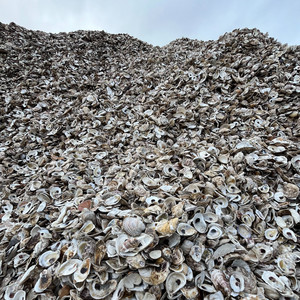
We piled into Mike's golf cart and he drove us to the other side of the island, where there was a giant pile of empty shells.
Describe these shells because I'm looking at them and some of these shells are really big.
Some of these shells are really small.
Some of them are kind of purpley.
This one is huge compared to the other one.
So what are all these shells?
So 99% of the shells here are from oysters.
So we should back up and say, what's an oyster, right?
An oyster is an animal.
It's a mollusk.
Um, it's an animal that has a shell that makes its own shell.
Um, Among the mollusks, you'll probably know snails and slugs, but octopus and abalone, all these things are mollusks.
And there's a branch of the mollusks called the bivalves, and that's where oysters live.
So that's mussels and scallops and clams and oysters.
So they have bivalve two that's what that root bi means and valve like these two shells which you can maybe hear me clicking together.
What kind of oyster shells are you holding?
So...
From the Gulf all the way up to Maine, up into Nova Scotia, we have one single species of oyster.
Scientists call it Chrysostria virginica, the common name Atlantic oyster or Eastern oyster.
So most of this pile is of the Eastern oyster.
Hi, but why?
My name is Benjamin.
I am eight years old and I'm from Long Beach California, and I want to know how to Oysters make their shells.
Yeah, so oysters are really special.
Like all these bivalves, they produce their own shells.
So you might be familiar with a hermit crab, but a hermit crab doesn't make its own shells.
It's a crab that stole it from a snail.
So oysters have this very special tissue called their mantle and it's sort of a very thin tissue that's at the edge of their body and they can take minerals that are in the water, primarily calcium, which is, you know, in our teeth and in our bones.
So they're taking calcium, extracting it from the water which there's plenty of calcium in seawater and they mix it with protein.
And then they can secrete layer by layer.
That mantle tissue can sort of build more and more layers of shell.
So as their body's growing, their shell can grow around it.
And does their shell grow for their entire life?
Yeah, that's right.
They have a shell when they're baby swimming, free swimming in the water for those two to three weeks.
And then that shells with them for life.
So, unlike a crab, who you may know that a crab can molt its exoskeleton, where they basically climb outside of their hard shell.
An oyster never does that.
It never malts.
It never sheds that shell.
It has it for life.
My name is Bennett.
I'm seven years old and I live in Grafton, Massachusetts.
How long can oysters live?
In New York City many of our oysters.
We've restored reefs and they might be seven or eight years old on those reefs.
Occasionally 10, 12.
I think we've heard from other harbors, other estuaries, you know, 20 years old.
20 years old.
So you can have an oyster that's 20 years old.
Yes.
Old enough to go to college.
That's right.
Yeah.
So if I look at one of these shells here, I can see kind of rings on the shells.
Does that tell me anything about how old the oyster is?
Not precisely.
You can get a general feel when you see those sort of ridges and breaks that there was probably a period of rapid growth, but it's hard to infer.
It's not as precise as a tree ring, if you're familiar.
So you can sort of tell when summers and winters are if you slice a tree trunk in cross-section.
An oyster shell is a little bit less precise.
I was trying to concentrate on Mike's answers about what oysters are and how long they live, but the giant pile of shells in front of me was really distracting.
It was just so big.
If I had climbed up on it, I bet I could have seen all of Governor's Island.
These are some good ones.
How many shell pieces do you think there are?
A billion?
Oh boy, that's a tough question.
We have collected three million pounds of oyster shells from New York City restaurants since our program's been around.
And you can imagine each pound probably has a few hundred.
So, you know, a hundred.
So we could do some math.
Three billion.
Yeah, well over a billion.
But wait, it's called the Billion Oyster Project, not the Three Billion Oyster Shell Project.
So what's going on with all these shells, and where do the billion oysters come in?
Stay tuned.
This is But Why.
I'm Jane Lindholm, and today we're learning about oysters from Billion Oyster Project's Mike McCann on Governor's Island in New York City.
When we visited, Mike had driven us across the island from the ferry dock in his golf cart to gaze in amazement at a pile of about three billion oyster shells.
These shells, which also included some clam and scallop and other mollusk shells, come from restaurants all over New York City.
After people are done eating their shellfish dinners, the restaurants give the shells to Mike and his team.
And the shells wind up on that pile.
This is sort of the raw materials, the building blocks for a restored oyster reef or created oyster reef where humans get involved.
So we've got tens of thousands of pounds of oyster shell.
It's been collected from restaurants all over New York City.
Those are all oyster shells.
I'm on a pile.
I could climb up this and I would be, you know, queen of the mountain if I climbed it.
And so these are going to spend about a year outside curing.
So there's probably, you know, little specks of oyster tissue and other things on it.
So we leave them out here exposed to the elements so they get really nice and clean.
Then we clean them up, we crush them up, and we combine them with eco-concrete.
And we build what are called reef balls.
It turned out those reef balls were actually right behind us.
So we turned around and walked over to them.
So they look like sort of concrete domes with holes maybe the size of volleyballs in it.
And so that's made of oyster shell eco-concrete, which is a special blend of concrete that oysters and other marine life really likes.
And this will be the sort of base of the reef.
If you were to look at one of these, it looks kind of like a very, very large plant pot, but the way they're stored here, upside down and it's got holes in it.
So it's a little bit like maybe, if you use a colander to clean your raspberries or to drain your pasta.
It's kind of like a colander for a giant.
And it weighs about 500 pounds.
So a giant size colander.
Okay.
So this is made up of echo concrete and oyster shells.
And that's not enough to get a reef, right?
We could put these in the harbor and, you know, some fish would be interested in maybe start building a home around it.
But we need to introduce living oysters.
So also on Governor's Island, we have what we call our remote setting facility.
And these are giant shipping containers, big steel cubes that we've retrofitted to hold the reef balls.
And then we introduce baby oysters.
We can buy them from professional hatcheries, where we'll import 70 million oysters at a time, 70 million, and we'll add those to these shipping containers with about 40 reef balls.
And then those oysters.
We're basically gonna recreate that process that they'd be doing out there in the harbor, where they'd spend a couple of days find their home on the reef balls.
And then that can be the mobile unit that we can then deploy wherever we want into New York Harbor.
Let's recap.
The Billion Oyster Project takes billions of shells from people who've been eating shellfish for dinner.
It grinds them up and mixes them with eco-concrete and then turns those shells and the concrete into these structures, these reef balls that they then can drop into New York Harbor to start forming the infrastructure for oyster reefs.
They add millions of baby oysters to the reefs and those tiny oysters swim around and latch onto the reef balls and start building their shells out of the calcium in the structures.
As the oysters get older and bigger, they stay latched onto the reefs and other animals begin using those big open structures for safe habitat as well.
Hi, my name is Cecily.
I'm 10 years old.
I live in Winnipeg, Manitoba.
And my question is, what do oysters eat?
Oysters eat algae.
So they don't eat the big leafy green seaweed kind of algae that you might be familiar with.
But in our harbor, and in most harbors, there's lots and lots of microscopic algae called phytoplankton.
So these are single-celled algae that are really abundant in huge numbers.
And the oysters filter those microalgae out of the water.
They eat algae and that helps filter the water, but how are they actually doing that?
Yeah, it's an amazing process.
Inside their body, between the two shells, is a special tissue called the tenidium.
Can you spell that?
C-T-E-N-I-D-I-U-M.
It's hard to spell out loud.
I did not think it was going to start with a C. Yeah, it's a tricky word.
It comes from a Greek word for comb, and it looks like a tiny little comb.
There's all these sort of branches like you would for the comb you use in your hair, but they're covered in cilia.
And these are these really tiny sort of hair-like cells.
And those cilia just are constantly beating, pulling the water in.
And this organ is amazing because the oyster can actually choose the particles that it wants to eat, and choose the particles that says nah, that's not food.
I don't want to eat that.
And so on, this comb-like structure, there's all these sort of conveyor belts, and they can actually move an individual microscopic algae cell and move it to their mouth.
And then if there's, you know, say, a piece of plastic, they might say, let me get rid of that.
And they bind it up with some mucus, and it comes out as pseudothecese.
Pseudo means fake, feces means poop.
So it's fake poop.
It never went through their body, but it kind of looks and feels a lot like poop.
So if they're filtering bad stuff out and then putting it back into the water, how is that cleaning the harbor?
Right.
So there's two ways that they can either bind up or transform pollutants.
So in that process of creating pseudophyces, what they're doing is sort of taking it from the water and depositing it and burying it into the sediment.
So it stays there in many cases, and that's a good thing.
But for some of the pollutants, they can actually get rid of it entirely.
So in many estuaries, too much nitrogen is one of the biggest pollutants.
70 of the air we breathe is nitrogen, but too much nitrogen in the water is actually a really bad thing.
It can cause... algae blooms and all these other problems in an estuary.
But the microbial community that lives in and around and all those nooks and crannies on the oyster reef, actually take that nitrogen that's dissolved in the water and convert it into nitrogen gas, which then goes into the atmosphere, where it's perfectly fine for nitrogen gas to be.
So they're transforming and removing nitrogen, one of the biggest estuarine pollutants.
So an individual oyster can filter nitrogen tens of gallons, maybe up to 50 gallons of water a day.
That's just one big full-grown oyster can really just move a lot of water through its body and clean it up.
So what would a billion oysters do?
Billion oysters could filter, you know, a good chunk of New York Harbor in a few days.
That's pretty awesome.
And you plan or hope to be able to put a billion oysters into New York Harbor by... 2030.
2030.
Whoa.
Okay.
So you've got five years.
We're feeling optimistic.
How many are you doing a year?
So far, we have returned 150 million oysters.
So we're currently doing about 25 million a year.
But in the next year, our facility is going to expand to do about 100 million a year.
Good, because you're going to have to get speedier.
You've got to get moving.
Yeah.
Hi, my name is Aurora.
I'm five years old.
I'm from Brownsville, Texas.
Why do oysters live in the ocean but not in the lake?
Oysters live in oceans because that's where their mom and dads lived.
So that's where most mollusk species originated.
So if you go back tens of thousands, hundreds of thousands of years ago, when mollusks originated, it was in the oceans.
And we know some mollusks like snails and slugs have made it onto land.
Some have made it into freshwater ponds.
But the majority of mollusks live in the ocean.
And it's a really tricky thing to live both in the ocean and in the fresh water, because all of your cells in your body need to be able to Osmo regulate, which is basically balance salt and water.
And so you could really, for most organisms, only specialize in one place, because the way your cells are trying to balance they're saying Hey, I need to get rid of excess salt or I need to get rid of excess water.
Most species have adapted to just one of those environments and not both.
There are a few exceptions.
Some fish species can span freshwater and saltwater, but it's a really hard task to do.
My name is Camden.
I'm four years old, and I live in Grafton, Massachusetts.
Where do oysters go in the winter?
So oysters, except for when they're a baby, can't move.
So they are staying cemented in place on that reef that they chose when they were just two or three weeks old.
So what that means in a place like New York City, where it gets really cold in the winter, the water goes down to 33 degrees Fahrenheit.
That means they're staying in place and they are basically slowing their metabolic rate and they're living off all the food they ate all summer and all of those reserve energy stores.
So an oyster can survive in, you know, ice cold water.
For 20 years.
Well, you know, for one winter at a time for 20 years, yes.
My name is Bennett.
I'm seven years old, and I live in Graff, Massachusetts.
My question is, what animals eat oysters?
So oysters are food for other animals, and that's a pretty natural and normal thing.
So there are crabs that will eat oysters, like blue crabs and mud crabs.
There are fish...
Like the oyster toadfish.
It's got special crunching teeth that can break through a shell.
There's snails.
Can we just pause on the oyster toadfish?
Absolutely.
Because first of all, it has a fantastic name, but also it is a weird looking fish.
It looks kind of grumpy.
It sounds like a toad.
That's how they communicate with each other.
And it loves to live on oyster reefs.
It's one of the reef residents.
It sort of makes their home on the reef reefs.
More predators.
Oyster predators.
So we said crabs, we said fish, also snails like the oyster drill, which is a snail that's smaller than a quarter but it's got a special mouth part that can drill holes into oysters and then they slurp out the insides.
So even though it's a fellow bivalve, it isn't like, oh, you're cool.
There's no loyalties from the oyster drill.
And then sponges.
There's a sponge called a boring sponge.
Boring not because it's uninteresting, but boring because it bores holes into the oyster shell.
So if we look through that pile, we could probably find some oyster shells that have had some boring sponge.
It looks like Swiss cheese.
Oh, I think I saw one of those.
And then, of course, humans eat oysters.
Yeah, that's right.
Oysters are, I think, famous because of the fact that they're really delicious and many people love to eat them.
And that's The source of these oyster shells that we have here at the Shell Pile.
These all came from New York City restaurants where diners enjoyed a dozen oysters on a night out on the town, and then they end up here to be restored back to New York Harbor.
New York City was once the oyster capital of the world, in terms of how many oysters were grown and produced and harvested here and shipped across the United States over to Europe.
Most oysters at one point in time were coming from these waters in the 1800s, but it's been 100 years since we've had that.
We're not trying to restore a population of oysters in New York City to eat anytime soon.
Our water is still much too dirty for that.
So that's one thing that you should be aware of when you're thinking about eating oysters is that they are incredible filterers.
So you want to make sure you're eating oysters from clean water, not plucking one out of polluted water.
Yeah, that's right.
Oysters really reflect the water that they're in.
So, you know, there are many places in New York, not in New York City.
If you go out in Long Island where you know The state has said these waters are clean and you can grow and harvest and farm oysters here.
My name is Lucy.
I'm six years old.
I live in Guelph, Ontario.
Why is it safe to eat oysters without cooking them?
Yeah, so it's only safe to eat oysters if they've come from clean water.
And any oyster you see in a store, in a grocery store, a fish market, a restaurant, has come from waters that have been designated safe for harvest.
So oysters that have been harvested from clean water and have been kept cold are going to be safe to eat.
So you should always check with your adult and maybe check where you're buying the oysters from.
And don't harvest them from New York City.
Also because we want the oysters to stay here because they're doing important work.
That's right.
My name is Sarah.
I'm from Portland, Oregon, and I'm eight years old.
How do oysters make pearls?
Do you know what a pearl is?
You might have seen pearls on someone's earrings or a necklace.
When you see them on a piece of jewelry.
Pearls are typically round and a lot of them look milky, white and shiny.
But some pearls are other colors too, like yellow or pink or shimmery black pearls are produced by mollusks like oysters and clams.
So we can talk about how oysters form their shells first, right?
So all mollusks, for the most part, are taking minerals like calcium from the water, mixing them with protein and building their own shells.
And then their body sort of grows and the shell grows around them.
And so that shell typically has multiple layers.
There's a sort of harder layer on the outside and a smoother layer on the inside.
It's called nacre n-a-c-r-e, or it's kind of a mother of pearl is another way to describe it.
It looks shiny and pearlescent and it's really smooth when you touch it.
Any mollusk that makes a shell can make this nacre or mother of pearl layer, and so even oysters that you see here, like the chrysostria virginica of new york city, has that an acre layer, but only some species of bivalves.
And unfortunately this species doesn't make the really round and beautiful pearls.
There's only a few species that are, you know, often cultured, which means humans really get involved.
Sometimes they'll even plant a little seed to start the process.
So what's happening is, anytime there's an irritant, a grain of sand and infection, the animal's basically encapsulating or growing a layer of nacre around that object.
So if you were to find a pearl in an oyster, it would be probably really weird shaped and irregular.
It wouldn't look like a perfect sphere.
Most of those come from species in places like Australia and the Pacific and they're completely different species and they are cultured pearls.
Basically, anytime you see a pearl, you can think of it as something that really annoyed that animal.
That what they made was something to put around something that was annoying.
That's a great way to look at it.
Absolutely.
It's a way to get rid of that pest.
But it stays with you forever.
Yes, much like our siblings sometimes.
One of the coolest things about the Billion Oyster Project is how many young people are involved in it.
There's a high school on Governor's Island and the students there are deeply involved with this project.
We really believe that restoration is not just the job of adults.
And we think that young people and kids and students are the next.
They're the leaders of what the harbor is going to look like in the future.
So a lot of what we do is work with students and young people and give them opportunities to High schoolers at the New York Harbor School, work with us to drive boats and learn how to operate boats safely.
They learn how to scuba dive and monitor oyster reefs.
They learn how to weld and fabricate some of the structures that get used in restoration.
These are real hands-on learning opportunities for kids, for young people, because they're the ones who are going to be taking care of New York Harbor in the future.
The day we were visiting was actually a holiday, so none of the kids were at school.
But normally they'd be doing all kinds of work, helping to restore New York Harbor and racing to accomplish the goal of getting a billion oysters restored into New York Harbor.
I wish I could have done that kind of project when I was in school.
Maybe you have some projects near you that you could get involved with.
Maybe not as big as the Billion Oyster Project, but there are lots of science research centers, museums and animal care facilities or universities that encourage citizen science and and help young people get involved.
Ask your adults to help you find one if you're feeling inspired.
Back on Governor's Island.
It was getting really, really rainy and the last ferry back to the city was about to depart.
So we had to go.
That's it for this episode.
Thanks to Mike McCann for teaching us about oysters and sharing the work the Billion Oyster Project is doing to restore oysters and oyster habitat in New York Harbor.
As always, if you have a question about anything, have an adult record you asking it by using a smartphone.
You can use an app like Voice Memos and then have your adult email the file to questions at butwhykidsorg.
Our show is produced by Melody Beaudet, Sarah Baik and me, Jane Lindholm, at Vermont Public and distributed by PRX.
Our video producer is Joey Palumbo and our theme music is by Luke Reynolds.
If you like our show, please have your adults help you.
Give us a thumbs up or a review on whatever podcast platform you use to listen to us.
It helps other kids and families find us.
We'll be back in two weeks with an all-new episode.
Until then, stay curious.
Why is the sky blue?
Why do birds sing?
Why do we need your support?
Because, but why is powered in part by listeners like you.
If, but why sparks curiosity and learning in your home, help us keep the show going strong head to.
But why kidsorg slash?
Donate to become a but why?
Fan club member or to make a gift in any amount to support the show.
Thanks and stay curious.
From PRX.