With NPR Plus, there's more to hear, like extended interviews with some of the experts we
talk to at Planet Money and the Indicator.
It's a mistake for economists to only think about economic efficiency when considering policies
because you'll actually wind up with a worse outcome.
And with NPR Plus, you help keep NPR going.
Learn more at plus.npr.org.
This is Planet Money from NPR.
Hey everyone, it's Erica Barris to show you're going to hear today originally aired in
2015.
Here's Jacob Goldstein and David Kestinbaum.
Francis Galton was the kind of person who believes in experts.
You know, people who had studied things, people who knew stuff.
He figured they knew things that ordinary people just did not.
I mean, of course they did, right?
Obviously.
A one day, Galton goes to a country fair.
This is about 100 years ago in England.
And there's this contest going on at the fair.
Guess the way to the ox.
He's a scientist and a statistician.
And he figures, hey, I can do an experiment here, right?
He figures, I'm going to take everyone's guesses, take the average, and compare that to the
actual weight of the ox.
We heard this story from James Sirwicky.
He's an economics journalist.
So he thought what you were going to end up with was a really flawed guess.
Because in his mind, what you were doing was you were taking guesses of a few smart people,
a few mediocre people, and then a lot of morons because he basically thought everyone
was done.
So he figured the group's guess was going to be way, way off the mark.
The contest organizers gave Galton the little slips of paper with everyone's guesses on
them.
He took them, calculated the average.
The average was 1197 pounds.
And the ox?
The ox weighed 1198 pounds.
So that in other words, the crowd's judgment was essentially perfect.
One pound off.
One pound off.
This is super creepy, right?
Like, what's going on here?
Is there some kind of like collective unconscious magic?
It's like a Ouija board or something, right?
But the idea that underlies this, it is everywhere.
It's the idea of the stock market, you know, thousands of random people buying and selling
shares.
Like when you hear that Apple stock went up or the Dow plunged, that's basically people
guessing the weight of an ox.
Yeah, it's everywhere, right?
It's the price of oil.
It's the price of orange juice, all kinds of things that are really important to the world
work exactly this way.
But why should it work? Why should a bunch of random people, a lot of whom have no idea
what they're doing somehow magically produce an answer that makes sense?
Does this really work?
And if it does, why does it work?
Hello and welcome to Planet Money.
I'm Jacob Goldstein.
And I'm David Kestinbaum.
Today on the show, Mr. Galton, we redo your experiment.
What's the count's name?
Penelope.
Hi, Penelope.
Thanks for letting us weigh you.
Can I pet her?
Yeah.
She's chewing.
One pound off.
Come on.
This message comes from NPR sponsor Grammarly.
What if everyone at work were an expert communicator?
In box numbers would drop, customer satisfaction scores would rise, and everyone would be more
productive.
That's what happens when you give Grammarly to your entire team.
Grammarly is a secure AI writing partner that understands your business and can transform
it through better communication.
In 70,000 teams who trust Grammarly with their words and their data, learn more at Grammarly.com.
Grammarly, easier said, done.
Support for this podcast and the following message come from Wise.
The app that makes managing your money in different currencies easy.
With Wise, you can send and spend money internationally at the mid-market exchange rate.
No guesswork and no hidden fees.
Learn more about how Wise could work for you at Wise.com.
So we came up with a plan to repeat Galton's experiment.
Find a fair and a cow and a big scale to weigh the cow and then...
Secret in secret.
And then we were going to throw the question out to the crowd.
Ask the world how much does this cow weigh?
We didn't want to just limit it to people at the fair.
So we figured we'd take some pictures, post them online and ask the whole world to guess.
So we went out to a county fair in Burlington County, New Jersey.
We met Penelope the cow in the dairy tent.
She was sitting on a bunch of hay.
And her stincuzments was taking care of her.
Can you just describe what she looks like?
Yeah, she's mostly black.
She has white legs and she has a white spot in the middle of her head.
But she's a big black cow.
What did you say?
I said, I said holy cow without even realizing what I was saying.
She's much bigger.
She just stood up.
She's walking out of the barn now.
And she's way bigger than I thought when she was sitting down.
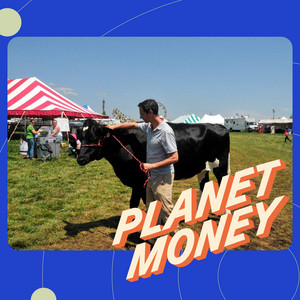
We took some pictures of you, Jacob standing next to the cow for scale.
And just for fun, we decided to ask people at the fair how much they thought Penelope
weighed.
Does it happen it was kids day?
So there are a lot of kids there.
Hi, Penelope.
Which was fine.
You know, they're non-experts.
What's your name?
Caleb.
How much do you think Penelope weighs?
6 pounds.
How'd you come up with that number?
Because I'm 6 years old.
You guys want to guess how much this cow weighs?
6,000 pounds.
Like 6,000?
Yes.
OK.
Do you know how much you weigh?
Not at all.
I'm sympathetic.
Looking at Penelope, I had no idea how much you weighed.
Like I didn't even know how to think about it.
Did you weigh more than my car?
Did you weigh less than my car?
I don't even know how much my car weighs.
More than a cow.
I want to say more than a cow.
We found an older group of kids.
And yet, they also guessed on the low side.
But they had this bigger problem, this really more worrying thing.
And it was a problem that adults also seem to have.
And it was this.
The first kid said a number.
And then all the other kids said basically the same number.
Numbers that were like too close to the first kid.
It's like they're incapable of guessing anything different.
My name's Issa.
And you said, how old are you?
I'm 10.
How much do you think that cow weighs?
200 pounds.
My name is Gabriella.
I'm 10.
And I think the cow weighs 300 pounds.
My name is Caleb. I'm a 9, 7 years old.
And I think the cow weighs 300 pounds.
OK.
People are not that different from cows.
We heard.
If we don't know something, we look for a leader.
Even if the leader maybe doesn't know anything.
To not be finished chewing, and we took her over to be weighed.
It's actually pretty unusual to want away a cow.
And the scale they had at the fair was not for cows.
What kind of scale is this?
It's actually like a truck scale is what it's for.
Same size scale I'll use for big trucks and stuff.
Which we use it to weigh the tractors during the tractor pull.
It'll work for a cow.
Yep.
Test and Bum, you were obsessed, paranoid,
arguably paranoid about keeping the results of this secret.
You didn't want it to leak out, I guess.
Again, all of these people had gathered.
You know that.
Can we seriously clear everybody out,
except for just a minimum of people?
Can we swear you the secret?
OK.
Everybody else over there.
Kirsten walked Penelope up onto the scale.
And we watched this little digital display.
Oh.
Yep.
OK.
It's 1,355 pounds.
We're good.
1,355 pounds.
We walked Penelope back to the dairy tent, and then we went home.
The next day we posted photos online of the Cowan You.
And me, right.
I was there to give some sense of perspective.
We put you on the tractor scale.
Yes.
165 pounds.
That's how much I weigh.
And then our colleague, Kwak Trung Buie here,
put it all up online.
Guest the weight of this cow.
And the idea was our hope was that lots and lots of people
would guess, because the fundamental question here,
the thing we're trying to figure out
is if you have a bunch of random people
making their best guess at something,
do you get close to the truth?
Do you get close to the right answer?
So we put it up, and we waited for the results to come in.
All right.
It's been up for how long now?
Two minutes.
How many entries?
15 entries.
Reload.
Reload.
OK.
Here we go.
Still 15?
Still 15.
Come on.
Oh my god.
That's all we're going to get 15.
I'm going to retweet this.
LAUGHTER
You were, sorry, been buried after two minutes.
We also showed the pictures of me and the cow to James
Swaricki.
He's the New Yorker writer we talked to at the beginning
of the show.
He actually wrote a book called The Wisdom of Crowds.
So we asked him to guess.
Remember here the actual weight of the cow?
1,355 pounds.
All right.
I will guess that the cow weighs 725 pounds.
How did you come up with that number?
Ah, I don't know.
Maybe it looks like four, five times Jacob's size, I guess.
Although I'm sure cows are, I don't know.
Are they denser or not than humans?
So, you know, whatever.
It's pretty random, actually.
Pretty random and pretty wrong.
We told them, Penelope, he's actual weight.
Twice as heavy as his guess.
LAUGHTER
It's so bad.
It's a sad commentary that someone who's
been talking about an ox for this long
has absolutely no clue how much a cow weighs.
We get a crowd of people like you.
Get to be terrible.
We're going to be in bad shape.
I'm praying somebody was guessing 2,200 on the other end.
Because the key question is, what's the average going
to be, right?
Is it the crowd going to get it right?
Or at least how close are they going to get?
So we left this up online for five days,
let people guess for five days, are calling Bui tallyed it all up.
David, you and I came into the studio.
We didn't know the results.
And Bui came in to give us the numbers.
First of all, how many people guessed?
So the number of people that guessed, 17,205 people.
17,000?
That's legit.
That's good.
That's good.
It's as if you got a small town to all guess.
Bui took those guesses, added them up,
and calculated the average.
This was the big moment.
You guys ready?
1,287 pounds.
1,287?
And I'll be actually weighed 1,355?
Pretty close, right?
So that's to within like what, 60-ish pounds?
That was pretty impressive.
Yeah, I mean, they're only like 5% off.
And OK, sure, the Galton thing was one pound off.
This isn't that.
But remember, this is just a bunch of random people
looking at this little cow picture
and their Facebook feed on their iPhone.
And here's another amazing thing.
When we asked people, I guess, we also
asked in this other question, we asked, are you an expert?
Have you ever worked with cows?
Because remember, Galton thought experts might be better.
And 3,000 people answered yes to that question.
Jacob, you wondered where they really, really expert.
I made sure these are just people clicking a button online.
So we emailed a bunch of them.
And we heard back and they did seem pretty expert.
You know, a lot of them were farmers.
One of them mentioned the, quote, absence
of a visible utter.
Actually, a few of them mentioned that.
And apparently that tells you something about how old the cow
is, how much it weighs.
So how did the experts do?
Here's the answer.
So the average guess for the experts was 1,272 pounds.
They were worse.
They were worse.
It's amazing.
So OK, so maybe that is wisdom of the crowds.
To be fair, the experts were only marginally worse.
But they did not beat the crowd.
We told Sir Wiki about these results.
And he wasn't surprised.
In fact, he writes in his book, chasing the expert
is a mistake.
We should ask the crowd.
And the fact that the larger crowd got it to within 5%.
He said that seems about right to him.
When people do versions of this experiment,
asking people to guess the number of jelly beans
in a jar, for instance, the crowd usually
gets it to within 3% to 5%.
You know, one of the things that's interesting about this
is even though I've written a book
and done this experiment a number of times,
every time I do it and every time I hear the results,
I'm like, it's not going to work this time.
Because the idea is so counterintuitive.
It's pretty extraordinary in that regard.
The power of this to actually let the group arrive
at really good decisions is it's eerie.
There's something eerie about it, I think.
It is eerie, right?
Yeah, it is.
There's something magical about it that seems magical, I think.
It's not magic.
It's just math, but it seems magical.
Sir Wiki says, the reason this seems to work
is that every person's guess is contributing
some new little piece of information.
Everybody is different.
Everybody thinks slightly differently
when they're trying to guess the cow's weight.
Maybe one person studies that photo of the cow
from the side.
Some people are probably trying to figure out
how many Jacobs would fit in the cow.
Someone else might know how much a horse ways
and kind of go from there.
Like every person's guess in some ways
reflects their specific life experience
of judging the size of things in the world
just from decades of living.
It's like every person's mind is a different scale
for weighing the cow.
Any one of those scales isn't gonna be a great scale, right?
Each one of those is probably gonna be wrong.
There's gonna be some error in every single one.
They're good in some way, but they also have
some problem with them.
Yeah, and one of the essential things is
those problems tend to cancel each other out, right?
Maybe one person is wrong, 200 pounds high,
but the next guy is wrong, 200 pounds low.
So the wrong parts, the wrongness kind of washes out.
And in the end, what you're left with
is all those little bits of information.
And the result is amazingly good.
You know, collectively we do seem to know what we're doing.
Seroke says there are certainly times
when this does not work.
Like think stock market panics or bubbles.
Yeah, a big problem is that thing we saw
with the kids at the beginning,
where one person says a number and then everybody else
around them just kind of latches onto that number.
There's actually a technical term for this.
It's information cascade.
It's like my neighbor just bought a house.
That seems like a lot of money paid for a house,
but he did fine.
I'm gonna do the same thing.
Or everyone's buying that stock.
Must be a good stock.
I'm gonna buy it.
The stock market is not perfect,
but what is amazing about the stock market
is that investors individually,
even very good investors are oftentimes irrational.
They have tiny bits of information.
They're making decisions based on emotion or on,
you know, some tip they got.
And yet collectively, we trust them to set the value
of all of these companies.
It's kind of scary when you think about it,
but the interesting thing is,
I don't think there's a better way to do it.
And there is not a more effective way of doing it either.
This is why it is so hard to beat the stock market.
The wisdom of the crowd is pretty good.
And the people who seem to beat it who say,
I can beat the stock market.
Often they are just plain lucky.
In our experiment, for example,
there were 15 people who got the cows weight exactly right.
They were off by zero pounds.
We picked one of them at random as our winner.
We called them up to tell them the news
and to see how he did it.
BEEP
Hello.
Is this Harris?
Yeah, how's it going?
Harris Pollock is 20 years old.
He's a student at Hamilton College,
never touched a cow in his life.
In fact, could not even remember his guess.
We told them he'd guessed 1,355 pounds
and that the weight of the cow was also 1,355 pounds.
Oh my God.
You won.
That's amazing.
You want to know how I got to that, yes?
Yes.
I googled it.
I googled average weight of female cow
and it said, here I'll get it.
So it pops up in a little box
and it comes from dairymove.
dairymoose.os.com
dairymove.com says average weight of a cow is 1,500 pounds
depending on the age and whatever.
Harris looked at the picture of a penalty of the cow
and said, she looks a little bit on the small side.
He went with 1,355.
It was just a guess.
Yeah, completely guess.
So we're going to send you
the cheapest plastic cow trophy we can find.
We talked to the Harris about what we should put
on the trophy because it's a bit of a puzzle, right?
Like should it say, I got lucky?
He was actually fine with that.
He said that made sense.
I was pushing for mutual fund manager of the year.
Robert here suggested someone had to win.
In the end, I think we are just going to say, congratulations.
Congratulations.
NPR Plus is a new way to support public media
and get more from your favorite NPR podcasts like Fresh Air.
Sometimes I'll actually preface the question with
if it makes you uncomfortable to talk about it's too personal.
Just tell me.
Here's the question.
For behind the scenes content, bonus episodes and more,
sign up at plus.npr.org.
In a stressful,
election year, we know that a good show, movie or book can feel
like a sacred thing.
At Pop Culture Happy Hour, we believe Pop Culture can be good for you.
So we're here four days a week to bring you a book, movie or show
recommendation to put you in high spirits.
For a dose of old fashioned Pop Culture therapy,
listen to the Pop Culture Happy Hour podcast only from NPR.
For the seventh year on the Code Switch podcast,
conversations about race and identity go way beyond the day's headlines.
Because we know what's part of every person is part of every story.
We're bringing that perspective with new episodes every week.
Listen on the Code Switch podcast from NPR.
We all hear things differently and that can be tough
when there's so much noise.
The selection year, we're a space to spend time with.
The selection year, we're a space to speak up and to listen.
Listen to one A for the latest on election 2024 only from NPR.
All right, we got some footnotes.
You know, at the end of research papers, they put all the technical details there.
A couple things we want to tell you.
When we calculated the averages of the guesses,
we did throw outliers like the person who just held down the nine key
as their guess 999999999999999999999999999999999999999999999999999999999999999999999999999999999999999999999999999999999999999999999999999999999999999999999999999999999999999999999999999999999999999999999999999999999999999999999999999999999999999999999999999999999999999999999999999999999999999999999999999999999999999999999999999999999999999999999999999999999999999999999999999999999999999999999999999999999999999999999999999999999999999999999999999
Penelope the Cow among other things on our Instagram feed at Planet Money You can also email us on at money at npr.org Thank you also to everybody for guessing Thank you to Penelope the Cow and to Rosemary K and the other folks at the Burlington County Farm Fair
This episode was originally produced by Nadia Wilson and today's rerun was produced by Liza Yeager and Rachel Cohn with additional audio support by Valentina Rodriguez Sanchez
Brian Urstad edited this episode Alice Goldmark is our executive producer America Barris this is NPR Thanks for listening
How heavy is the cow? Absolutely no idea
Absolutely no idea I really wouldn't
Like is 10,000 pounds sound too heavy or who knows? I really have no idea
20,000 pounds? 20,000 I think is going over the limit? Yeah no
So less than 20,000? But less than 20,000 more than five pounds more than five pounds more than a bird
This message comes from Think Fast Talk Smart each week host Matt Abrams teaches listeners how to excel at small talk, write winning emails
and keep the nerves in check when speaking in front of crowds listen every Tuesday where you get your podcasts
On the next all songs considered from NPR music we play and guide you through songs to slow the blood and calm your nerves
My stress level on a scale of 1 to 10 has been at an 11
Look for all songs considered every Tuesday wherever you get podcasts
From the campaigns to the conventions from now through election day and beyond the NPR politics podcast has you covered
As Joe Biden and Donald Trump square off again we bring you the latest news from the trail and dive deep into each candidate's goals for a second term
Listen to the NPR politics podcast every week day