I'm Austin Mitchell, and for the past couple years, my colleague Azeem Qureshi and I have been reporting on the story of medical care for transgender kids.
Where it came from, the lives it changed, how it became a protocol that spread around the world, and how the politics and a Supreme Court legal fight now threaten its existence.
You can hear that story on The Protocol, a new six -part series from The New York Times.
Listen wherever you you get your podcasts.
From the New York Times, I'm Michael Barbaro.
This is The Daily. On this vote, the yeas are 218, the nays are 214.
The motion is adopted.
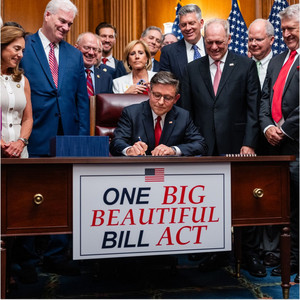
after months of emotional debate weeks of tense negotiations and 24 hours of aggressive Republican arm twisting President Trump has muscled his giant domestic policy bill through both chambers of Congress there could be no better birthday present for America than the phenomenal victory we achieved just hours ago when Congress passed the one big, beautiful bill to make America great again.
It's a major legislative victory for the president that paves the way for much of his second -term agenda, and it will have profound impacts across the country.
Today, what the legislation changes and who it changes it for.
It's Friday, July 4th.
President Trump called it the one big beautiful bill for a reason.
It's a sprawling octopus of a bill.
It spans nearly 1 ,000 pages.
It encompasses trillions of dollars in new spending and spending cuts.
and its tentacles will touch and remake entire industries, reorient the role of the government, and alter the lives of tens of millions of Americans.
It's a lot to wrap your head around.
And so as a starting point, we asked our colleague in Washington, Tony Rahm, who writes about economic policy and has studied the bill very closely, to give us a framework for understanding it.
The most important thing to know about this package is that it delivers its greatest benefits to the wealthy, and it extracts its greatest cuts on the poor.
Every economist, or almost every economist here in Washington, has come to the same conclusion, which is that people who are on the bottom actually stand to see financial losses when you consider the full range of things that Republicans are looking to do here.
Hmm. So one example we got was an analysis from the Budget Lab at Yale, which is this really important research center that produces a lot of fiscal analysis that's closely watched here in Washington.
And what they found is that people who are on the lowest end of the income spectrum would lose about $560 on average in after -tax income over the next 10 or so years.
And people who make more than $3 million would gain about $118 ,000 in after -tax income.
Wow. And that just sort of shows the kinds of things that Republicans put in here and the ways in which that has a disproportionate effect on people based on where they sit on the income scale.
And so what's really counterintuitive about this is that Trump's biggest electoral gains have actually been with lower income Americans across the country.
He's remade this Republican coalition by bringing so many of these voters into the Republican Party.
And yet it'll be his is voters who bear many of the costs from the tax package that Congress has just passed.
At the heart of the bill's unequal distribution of benefits and costs are really two components.
A sweeping tax cut that delivers its biggest rewards to the well -off and enormous cuts to the social safety net that will hit Americans with the least, especially its cuts to healthcare.
Hey, Andy. Hey. So I next turn to my colleague Andy Duren who has been studying those tax cuts.
Why, Andy, do the tax cuts in this just -past legislation legislation, end up disproportionately benefiting America's well -off.
Because that is not how the president and the Republicans who voted for this bill talk about this legislation.
They have described it as very populist, very wide -reaching across the income spectrum.
Yeah, so the main part Part of this bill has been extending these broad -based income tax cuts that Republicans first passed in 2017.
And so, you know, as the name maybe suggests, the more income you have, the more income tax you're going to pay.
When you cut income taxes the way that Republicans are now, which is broadly lowering income taxes up and down the income spectrum, the people who have the most income and pay the most income taxes are going to get the biggest benefit from a cut in those taxes.
Mm -hmm. And then there are some tax cuts in the bill that are particularly valuable to the wealthy.
There are changes to taxes that only really affect the top, top tier of the income spectrum.
And those tax cuts, again, just based on the way taxes work, essentially, are in general going to provide their biggest benefits to the people who owe the most in taxes to begin with.
Okay, let's stay with these 2017 tax cuts.
The point of this legislation, as you told us just a few days ago, was to ensure that they didn't expire, which they were about to, and instead to make them permanent.
So within that now extended and permanent set of tax cuts, give us a couple of specific examples of how it's going to end up skewing its benefits towards those in the higher income brackets.
Yeah. So thinking about the bill overall, the distribution is bad.
I mean, for somebody making less than $10 ,000 a year, they'll only save $10 because of this tax cut starting next year.
And that's according to an analysis from the Tax Policy Center.
But if somebody is making more than a million dollars a year, they'll on average save more than $66 ,000 because of this tax cut.
And so that reflects a bunch of different provisions in the bill, not only the cuts, the income rates up and down the income spectrum.
But also there are some provisions that are very clearly going to benefit the wealthiest Americans or very wealthy Americans.
I mean, an example of this is the estate tax threshold.
So the estate tax is a tax that people pay or that is owed on your estate after you die.
It can be a rate up to 40%.
And so what Republicans have done is they've made it so that only increasingly rich people ever have to owe this tax.
So right now, if you are are worth less than $14 million, you will not owe any estate tax.
Republicans bump that up to $15 million.
And so that is obviously a change that many people, the vast majority of Americans, you know, are not affected by that.
Right. There just aren't that many Americans with 11, 12, 13, 14 million dollars to pass on to their families.
But if you are one of those people, you just gave your descendants an extra million dollars tax -free.
That's right. But as I recall, this bill includes a second batch of tax cuts that were specifically targeted to lower -income Americans.
And I want you to talk about why those new policies are not in any way making up for the way that this is disproportionately benefiting the well -off.
So yeah, there is a slice of things that is brand new.
A lot of these reflect campaign promises President Trump made in 2024, and these are tax cuts that have a certain kind of populist tinge to them.
They are aimed at working Americans.
These are ideas like no tax on tips, no tax on on overtime.
And all these tax cuts are aimed at being available to kind of working people and not billionaires and large corporations.
Right. And they've just passed both the House and the Senate.
And so in theory, they would immediately start to give financial relief to working class, lower income Americans.
So they will to the working class Americans that can qualify for them.
But you have to make a specific kind of money to get these tax breaks, as their name suggests.
You you have to earn tips or you have to earn overtime.
And in the case of tips in particular, there are not that many workers in the United States who work for tips.
I think it's only two or three percent of the entire American workforce who earns tips.
And so you'll have a situation where if you're a bartender who makes, say, $40 ,000 a year and much of your income comes in the form of tips, you might get a decently sized tax cut because of this.
But if you work across the street from the bar at a retail store where maybe you can't get tips or you work in an Amazon warehouse where you're not tipped, you make the same money, you work just as much, you will not get a tax cut because of the no -tax -on -tips provision.
And so that's the reason why, you know, these tax cuts or the no -tax -on -tips provision in particular and some of the other tax cuts that Trump put in this bill are not generally considered, you know, if you're kind of making optimal tax policy or you're trying to offer a tax cut to the working class broadly, it's not the way that, you know, many tax policy experts would actually do it.
What about something like no tax on overtime?
There's a fair number of wage earners in this country, I have to imagine, who rely on overtime.
I'm thinking about my now retired father who was a firefighter who spoke very openly about how important working overtime at the firehouse was was for him, it represented a pretty significant amount of income for him.
Yeah, so definitely there will be a lot of people who work overtime now who will get this tax break, but overall the same challenge exists with the no tax on tips provision in that not all workers earn overtime and not all workers are eligible for earning overtime.
So in some cases, there are entire categories of jobs where you can't get overtime under federal law, and then And there are other situations where maybe you could get overtime, but in your workplace, the manager has it so that they won't give you that many hours.
And so there will just again be the same disparity where you have someone who is a firefighter and makes however much money and they can get this tax break because they work overtime.
But somebody who lives across the street and delivers the mail and makes the same amount of money but maybe doesn't work overtime or isn't eligible for it won't get anything because of that tax cut.
So overall, the idea that these more populist tax cuts are broadly reaching working class Americans is just not panning out and they are not making up for the disparities that the bigger income tax cuts ultimately bring to the well -off.
off. That is generally right.
And then there's the fact, too, that all of the new tax cuts, President Trump's campaign priorities are only temporary provisions of the tax code.
So these could all expire within a few years, whereas this law makes the overall across the board broad based income tax cuts permanent.
In other words, the tax cuts that most benefit the wealthy are permanent and the tax cuts that in theory most benefit lower income Americans are not permanent.
That's right. There is also the fact that in addition to cutting taxes, this bill also includes many important cuts to the social safety net that somebody who works for tips or overtime might be taking advantage of and they might lose that benefit.
So if you're a waiter or a bartender who suddenly finds themselves maybe saving a couple thousand dollars a year in income taxes because of this bill, you might also lose your health insurance, which could be worth far more than just a couple thousand dollars a year.
There is basically a net loss for some people.
You know, there will be many people who don't get the tax cuts or don't get new tax cuts because of this bill.
And then they also just lose benefits.
So it could certainly be a messy picture for how it affects people up and down the income spectrum.
Well, Andy, thank you very much. Thanks for having me.
After the break, my colleague Margot Sanger -Katz walks us through the bill's cuts to healthcare.
We'll be right back.
I'm Jonathan Swan. I'm a White House reporter for The New York Times.
I have a pretty unsentimental view of what we do.
Our job as reporters is to dig out information that powerful people don't want published, to take you into rooms that you would not otherwise have access to, to understand how some of the big decisions shaping our country are being made, and then, painstakingly, to go back and check with sources, check with public documents, make sure the information is correct.
This is not something you can outsource to AI.
There's no robot that can go and talk to someone who was in the Situation Room and find out what was really said in order to get actually original information that's not public, that requires human sources, and we actually need journalists to do that.
So as you may have gathered from this long riff, I'm asking you to consider subscribing to The New York Times.
Independent journalism is important, and without you, we simply can't do it.
morgo where exactly does this legislation leave the country's health care system i think it's important to think about this bill as an absolutely huge health care bill on top of everything else it's the biggest change to the u .s health care system since obamacare and i think it's helpful to think about it as being relatively similar in scope to the repeal of obamacare that republicans attempted in 2017.
Wow. Yeah. If you look at the Congressional Budget Office estimates of how many Americans are going to lose coverage as a result of this bill and some other policies that are changing next year, the magnitude of those coverage losses is actually quite similar to how many people were expected to lose coverage from that last Obamacare repeal bill that John McCain famously defeated with a thumbs down on the Senate floor.
How many people are we talking about here?
From the bill alone, we're looking at almost 12 million more people who will become uninsured.
And then there is a Obamacare provision that is set to expire at the end of this year.
And the CBO thinks another four to five million people will lose insurance as a result of that change on top of the changes from the law itself.
Right. And suffice it to say, this bill does not make up for that expiring benefit.
benefits. So you're saying taken together, something like 16 to 17 million people in the short term are about to lose their health insurance.
That's right. And some people think it could even be more.
So talk about the mechanisms through which this legislation is going to be taking away so many millions of Americans' health care.
I know one of them clearly involves cutbacks to Medicaid.
Yeah. So Medicaid is this huge program.
It's the biggest health insurance program in the country covering about 70 million Americans.
That's more than Medicare, which I think we often think of as the real biggie.
Traditionally, Medicaid covered sort of narrow populations of poor Americans, pregnant women, children, people with disabilities, elderly people who lived in nursing homes and had spent down all of their savings.
But starting with Obamacare, Medicaid expanded to cover this new population of working poor adults who don't have kids, About 20 million Americans have gotten coverage this way.
And that's the population that this bill is really targeting.
And just explain how it is targeting them.
This bill is creating a lot of changes in the program that are specific to this population, this adult population without kids.
It's asking them to have to renew their coverage more often.
It is asking them to pay new copayments when they go to the doctor that they didn't have to pay before.
But the biggest change that it's making is it's setting up a work requirement for people who in this population who have Medicaid.
And what that means is that in order for people to sign up for Medicaid and to keep their Medicaid coverage, they're going to need to be able to prove to their state government that they're working or volunteering at least 80 hours a month or that they qualify for one of a long list of exceptions.
And why would that knock people off of Medicaid?
For so many reasons and for such a long time, work requirements have been described as a fairly logical qualification for getting health care.
Many people, you and I are among them, who have insurance, we get it through work for our employer.
Claire. I think there's two reasons why this is going to cause a lot of people to lose their insurance.
The main one is that it's actually like pretty hard to implement.
Say you're a working class person and you work part time in a bodega or you have a bunch of gig economy jobs that have uneven hours and there's no digital HR system where you're downloading your time sheet.
How are you going to prove how many hours you work that month in order to qualify for your work requirement?
And also, if you're just like a busy person who's like not keeping track of this stuff all the time, I think it will be very easy for people to make mistakes that will cause them to lose their health insurance, even if they are technically eligible.
Then there's like this other category of people, which is people who qualify for exceptions.
So the law doesn't say everyone has to work 80 hours a month.
They say, if you have one of these really good excuses, like we will give you a pass on the work requirement.
Like say you're caring for an elderly adult in your household, or you've just been in the hospital and you've been too sick to to work.
You could get out of it.
And I think on its face, that seems pretty fair.
They've kind of accounted for a lot of the reasons why people who otherwise would be working couldn't work.
But again, those are all going to be things that people are going to have to figure out a way to prove to the government that they are doing.
So how do you prove to the government that you're taking care of your disabled relative?
How do you prove to the government that you were sick last month?
These are going to require like very complicated bureaucracies, different kinds of paperwork requirements.
People are going to have to obtain these documents.
They might have to get a letter from their doctor saying they're too sick to work, which if they don't have health insurance, they might not have a doctor to do that.
And so when you look at what has happened in programs that have had these kinds of requirements in the past, what you see is that, sure, some people will lose coverage because they're not meeting the work requirement and they don't qualify for one of these exceptions.
But what happens on a much larger scale is people who technically should still keep their benefits will just lose them because they just can't get They can't get the document, they can't figure out how to upload it in time, or some state official misinterprets some document that they get.
Got it. You're basically saying a new burden of proof will be created, a new level of bureaucracy that didn't exist before, and these will create points of friction at which people are likely to, for whatever reason, not meet their requirements, even if they should, and then they're going to lose their health care.
Totally. And there actually are a couple of different models for how to do this that we've seen from states that experimented with work requirements.
And the way that Republicans wrote this law is they picked the strictest version that has had the most success in kicking people out of Medicaid.
They haven't picked the ones that seem to have the best track record of getting eligible people in.
They really were looking to maximize the dollar savings for the federal government and Medicaid.
And if you're using this mechanism to save money, the only way you're really going to save money is by kicking a lot of people out of Medicaid.
So then the government has to pay less.
Right. And that's because they have viewed these cuts to programs like Medicaid as the cost savings required to offset the spending that will occur because of the tax cuts.
Absolutely. You know, Republicans were considering a whole bunch of different kinds of changes to Medicaid.
And the big challenge that they faced the whole way through is that they kind of have this math goal.
When the House designed the budget that set off this whole process, they said, OK, like to make our math work to hit our budget targets, we're going to need to save $880 billion in Medicaid.
There are only so many ways that you can do that.
It's a lot of money.
And when they looked at the kinds of cuts that were more obvious, direct cuts, the kinds of cuts that Republicans tried when they tried to repeal Obamacare in 2017, I think they got a little queasy that they could be too easily lobbied and fought against politically.
But instead, I think this approach of using paperwork and Medicaid work requirements to achieve a similar quantity of savings, to have a similar number of people losing coverage is a little bit harder for people to demagogue against. And you've seen repeatedly throughout this debate, President Trump, House Speaker Johnson and other leading Republicans saying we are not cutting Medicaid at all.
We are just cutting waste, fraud and abuse.
And so they're saying, OK, like if you're cheating the program, we're going to take this away from you.
But we're not just like cutting for the sake of cutting.
And I think that is actually extremely misleading if you think about what the practical consequences of this set of policies as designed will do.
In other words, they framed this as the opposite of kicking people off Medicaid.
They framed it as creating highly logical requirements that weed out those who might abuse Medicaid.
But you're saying the outcome is essentially still just kicking a lot of people, millions of people, in fact, who qualified for Medicaid off of it.
Yeah. And it could be even worse than that.
You know, a lot of times getting access to health care actually makes sick people more able to work.
So if you imagine a person, say, that has clinical depression, that has a drug addiction, that has really severe diabetes or epilepsy or any number of serious problems, getting health insurance, going to a doctor, getting medicine and treatment that helps them with their health care, that actually could be a prerequisite for them being able to work.
Whereas if they don't get their health insurance and they are sick and unable to work, then they can kind of never get back into the economy.
What else should we understand about the changes to Medicaid beyond the work requirements that have skewed the costs of these changes against working and lower -income Americans?
So there's one other really big bucket of cuts to Medicaid that the Republicans are making with this law.
And it's a little bit complicated.
But I think the simplest way of thinking about it is that Medicaid as a program kind of splits its costs between the federal government and state governments.
And in general, the federal government pays about 60 percent of the bills and the states pay 40 percent of the bills.
What this law will do is it will tinker with that formula in certain states so that there are states that are going to be left with responsibility for a larger percentage of their Medicaid costs going forward. And they're going to have to figure out what to do about that.
And I think it's reasonable to expect that a lot of them are going to adjust by just paying medical providers less.
And those lower payments could really affect the finances of hospitals, and I would say particularly rural hospitals that tend to be in the weakest financial position.
And perhaps may have the most patients on Medicaid.
Sure. And, you know, it also kind of compounds the problem.
If you imagine all of these poor rural working class people are losing their health insurance at the same time the hospital is getting paid less for the people that keep their Medicaid coverage, then it's kind of double the losses for the hospital.
They're going to have a lot of sick people coming into the emergency room who aren't paying at all.
And then they're going to have other patients who come in who are paying them less effectively.
And so those are kind of two holes in that hospital's budget that the hospital is going to really struggle to recover from.
Mm -hmm. We heard a lot of members of Congress, senators in particular, thinking about Senator Lisa Murkowski of Alaska, Josh Hawley of Missouri, worry about this, worry about what would happen to rural hospitals.
And I think what they were also communicating in that moment was a worry that these cuts to Medicaid were going to hurt essential constituencies of the Trump era.
They recognize the reality that this president has broadened the party's appeal to working class and the working poor in ways that this party has never achieved before.
And they seem to be saying, this is not a good idea.
In the end, they still voted for this bill.
Yeah, I think Josh Hawley of Missouri is the best avatar for this position.
he has been saying over and over again that these are changes that are going to hurt the Republican coalition, the MAGA coalition, these kind of poor, rural, working class voters are going to lose their health insurance.
And the health care providers that help them are potentially going to lose their shirts, too.
But in the end, Republicans decided that they were still going to vote for this package, even though it had these Medicaid cuts that would hurt their constituents.
What they did at the last minute, though, is they put in a fund to help pay some of these rural providers who might be harmed by the bill.
So there's $50 billion that the Department of Health and Human Services can give to states to do rural health transformation grants.
But I think it's important to put that $50 billion fund next to the total magnitude of cuts to Medicaid, which is $1 trillion.
I mean, on paper, it doesn't seem to make a lot of political sense for the president, these Republican senators, to do something this injurious to their own voters.
Is it possible that the Republicans know something that Democrats in particular don't about the fundamental popularity of cutting taxes on the one hand and cutting back programs like Medicaid on the other and the message that that sends.
If you look at the statements that some of these lawmakers who were uncertain about this package made after they ultimately decided to vote for it.
So I mentioned Senator Hawley, you mentioned Senator Murkowski.
I think those are good examples of Republican senators who understood that the Medicaid cuts would be damaging to their constituents.
So what did they say?
They said, well, I only had a choice to vote for this whole thing or to vote against it.
And this is President Trump's agenda.
And my voters support President Trump.
And I really support these tax cuts.
And there's no way we're going to get these tax cuts through the Congress if they're not part of this big package.
And I think that was always the strategy.
You know, if you just did a giant health care bill that effectively repealed large parts of Obamacare, that would be really unpopular.
And they learned in 2017, they couldn't pass it and it was politically damaging.
And if they just did a big tax bill that blew out the deficit, I think that might be more popular, but it would be hard to get past the fiscal hawks in their own party.
And by sort of marrying these two things together, they were able to get enough votes to pass this bill through both houses of Congress.
Right. The tactical success of this bill and the reason why it's now headed to the president's desk to be signed is that it did not give lawmakers a chance to separate its elements.
And in the political environment that we're in, many of these lawmakers, despite their serious objections about the inequities of this, said, I got to back it.
Yeah. And they did some other things too.
This little rural health fund, I think, was a way that they could say, OK, we're trying to soften the impact of these cuts.
And then there was another thing that they did that I think was pretty smart.
The tax cuts in this bill are going to kick in right away.
People who are filing their taxes for this year are going to get more money back.
But these Medicaid cuts that we've been talking about are happening after the midterm elections.
And so the inequities in this bill are really coming down the road.
The pain for the poor is a couple of years from now.
Oh, Margot, thank you very much. We appreciate it.
Thanks for having me.
President Trump is expected to sign the legislation into law during a ceremony at the White House this afternoon.
We'll be right back.
Here's what else you need to know today.
On Thursday, new government data showed that employers added 147 ,000 new jobs to the economy in June and that unemployment fell slightly to 4 .1%.
The healthy rate of hiring surprised economists who feared a slowdown because of ongoing uncertainty over the president's tariffs, interest rates, and immigration rates.
And the heatwave gripping Europe has shattered records in countries like Spain, where temperatures have reached as high as 114 degrees Fahrenheit and fueled wildfires in Greece.
As temperatures have soared, several nuclear power plants were forced to shut down reactors after the river water that they used to cool them down became too hot.
Today's episode was produced by Mary Wilson, Anna Foley, and Shannon Lin.
It was edited by Rachel Quester and Liz O 'Veilley.
Fact Check by Susan Lee contains original music by Pat McCusker and Dan Powell and was engineered by Alyssa Moxley.
Our theme music is by Jim Brunberg and Ben Lansford of Wunderlay.
That's it for The Daily.
I'm Michael Barbaro.
See you on Monday.