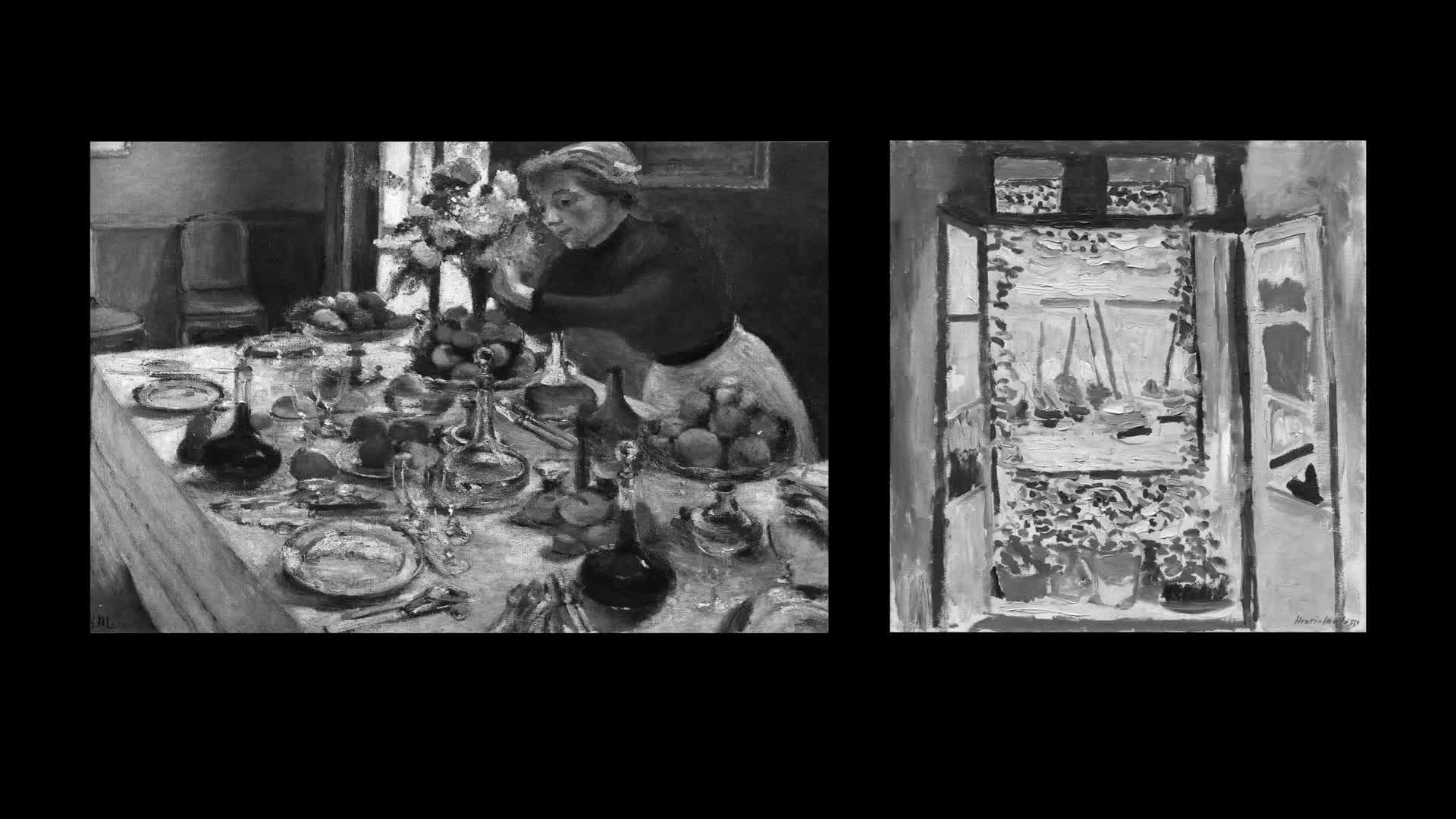
Okay, so here are two desaturated paintings by the French artist Henri Matisse.
The left one is called The Dinner Table and was painted in 1896.
And the right one is called Open Window Cagliore and was painted a decade later in 1905.
What do you think the colors are like in the first one, the one on the left?
Does that match your expectation?
I bet it does.
Now, what about the other painting, this view of boats from an open window?
Is that what you expected?
Okay, what about this painting from five years later in 1910 of dancers?
Are those really the colors that you thought you were going to see?
If not, you're not the only one.
On October 1st, 1910, Matisse debuted this painting called Dance at the Autumn Salon in Paris.
And to say that it wasn't well received is an understatement.
A few critics applauded the boldness of the painting, but most attacked it savagely.
And the public was no kinder.
They crowded in front of the massive canvas and shouted insults at it, jeering, laughing, mocking.
Unfortunately, this was not new for Matisse.
Five years earlier, at the Autumn Salon of 1905, he exhibited a number of paintings that got a similar response, including this one Open Window from before and this one, Woman with a Hat.
The critic Louis Vaucell disparaged Matisse and the other painters who were using colors in revolutionary new ways as wild beasts, or fauves in French, and that was how Fauvism was born.
Well, that was how the name was born anyway.
The style of painting was born in the mind of Matisse and a loose affiliation of other artists.
As early as 1898, when Matisse was in Corsica with his wife, he began gradually to lean into the dramatic power of color.
In a painting like The Old Mill, for example, you can see him taking the lessons of the Impressionists using short strokes of pure, unblended color to capture the flickering, transient quality of the light, but also liberating that color so that it's not strictly representational, but emotional and personal.
I mean look at the difference between this painting and the dinner table from the beginning of this video.
Look at the difference that two years can make.
In 1902 he pushed the colors even further away from representation in his paintings of the Luxembourg Gardens.
And by 1904, when he was spending the summer at Saint-Tropez, a coastal fishing village in southern France, Matisse's colors exploded.
The most important painting to come out of that trip is this one, The Gulf of Saint-Tropez, which he reworked when he returned to Paris into one of his most famous paintings Luxury, Calm and Voluptuousness.
See, in Saint-Tropez, Matisse was joined by Paul Signac, one of the leaders of Neo-Impressionism, who applied scientific color theories to the technique of the Impressionists and developed a style where you put small dots of contrasting colors on the canvas and when the viewer stands at a distance, the dots mix optically and generate more luminous colors.
Signac's theory is called divisionism and the technique is called pointillism.
I know, too many isms.
The most famous execution of this style, you probably know, is Georges Chiraz's A Sunday Afternoon on the Island of La Grande Jatte.
Now, going back to Matisse's painting, you can clearly see the influence of Signac and divisionism, but you can also feel Matisse forging his own path.
His colors are rebelling against their subjects.
The painting is anarchic, fantastical.
It's pulsing with wild energy.
The next summer, in 1905, Matisse followed that energy to Collioure, another fishing village in southern France, and let loose.
Colors became sticks of dynamite, he said, and then detonated them across his canvases.
And then those canvases detonated the 1905 Salon, where he was labeled a wild beast.
The reaction really isn't surprising.
Even now, more than a century later, these paintings still retain their defiant power.
The colors still sing with the daring, the creative recklessness of that summer.
As Hilary Sperling says, Matisse was attempting to overturn a way of seeing evolved and accepted by the Western world for centuries.
He was substituting for their illusion of objectivity a conscious subjectivity, a 20th century art that would draw its validity essentially from the painter's own visual and emotional responses.
The critics didn't appreciate what Matisse was doing, but thankfully a few collectors did, namely the American Sarah Stein and her in-laws Leo and Gertrude Stein, as well as the Russian businessman Sergei Shukin.
Shukin was at the Salon of Independence in 1906, where he saw Matisse's Joy of Life, a painting that Signac hated and that the public laughed at with even greater intensity than they did at the first Fauvist paintings just a few months before.
Shukin, though, he was mesmerized.
For the next decade.
He gave Matisse financial and moral support, while the French art establishment derided him during arguably his most experimental and, I think, most exciting period.
You see, in his Fauvist years Matisse used non-naturalistic colors to generate an emotional response, but after this He learned how to use color to define form itself.
Influenced by Cézanne, by Giotto, by African and Islamic art.
His new paintings were flatter simplified, more abstract and used large areas of uniform color to compose scenes not of real life, not even of real life transformed by new colors, but scenes that express deep, primal feelings and rhythms.
In 1909, Shukin commissioned two giant panels to be hung in his Moscow mansion.
Matisse wanted one of them to express energy and, above all, movement.
He remembered a scene from Kalior in 1905 when Catalan fishermen pulled him into a dancing ring and whipped him around violently on the beach.
A version of this memory can be found in The Joy of Life, but now Matisse endeavored to recapture this scene with a new style and new tools.
The result is dance, a masterpiece of energy consisting of just three colors blue, green and the shocking scarlet of the naked dancing leaping, spinning figures who are less like people than mythological satyrs.
That red vibrates off the background and captures exactly the movement Matisse intended.
It took him almost a year to make this painting. and the public hated it.
I guess that's the way it goes sometimes.
You can't expect the instantaneous acceptance of something radically new.
If it was accepted, it wouldn't be radical.
With the perspective of a century, knowing the directions that modern art went in, we now can appreciate the full significance of Matisse's work.
We can be shocked by it without being scandalized.
We can marvel at the creative distance that he traveled in just 14 years after, which color was never the same.
Hey everybody, thank you so much for watching.
This episode was brought to you by Squarespace, the all-in-one website platform for entrepreneurs to stand out and succeed online.
Whether you're just starting out or managing a growing brand, Squarespace makes it easy to create a beautiful website.
You can make a completely personalized website with design intelligence, combining two decades of industry-leading design expertise with cutting-edge AI technology to unlock your strongest creative potential.
And if you're selling something, Squarespace Payments makes that easy too.
It's compatible with popular payment methods like Klarna ACH, Direct Debit, Apple Pay, Afterpay and Clearpay.
Basically, a Squarespace site looks and feels professional, something that will impress all your customers and fans.
Head over to squarespace.com for a free trial.
And when you're ready to launch, go to squarespacecom.
Slash nerdwriter for 10 off your first purchase.
Thanks, guys.
I'll see you next time.