Are you really a prizefighter?
I used to be.
How did you get interested in that?
And here, he changes movie acting forever.
What is he doing here?
He's checking to see something under the table, adjusting his chair?
It's hard to overstate how revolutionary a choice like this was in 1954.
Actors just didn't get distracted in this way.
Trained in theatrical techniques.
They hit their spots, articulated their lines and performed instantly legible emotions for the audience.
They didn't pause a conversation to look under the table, turning their head away from the microphone in the process, and they certainly didn't speak while chewing food.
Sorry, what was that?
That was the famous Brando mumble.
He was as loose in enunciation as he was in physicalization, sometimes to the point of unintelligibility.
For the most part he stayed on the right side of that line, but the risk was worth it, because in real life we don't often articulate with the clarity of a stage actor.
We stutter and mumble, especially when a conversation veers into a place that makes us uncomfortable.
Come to think of it, another thing we do when uncomfortable is fidget and instinctively turn away.
Maybe there was something more to that moment of seeming distraction from before.
Well, as a kid, my old man got bumped off, and never mind how.
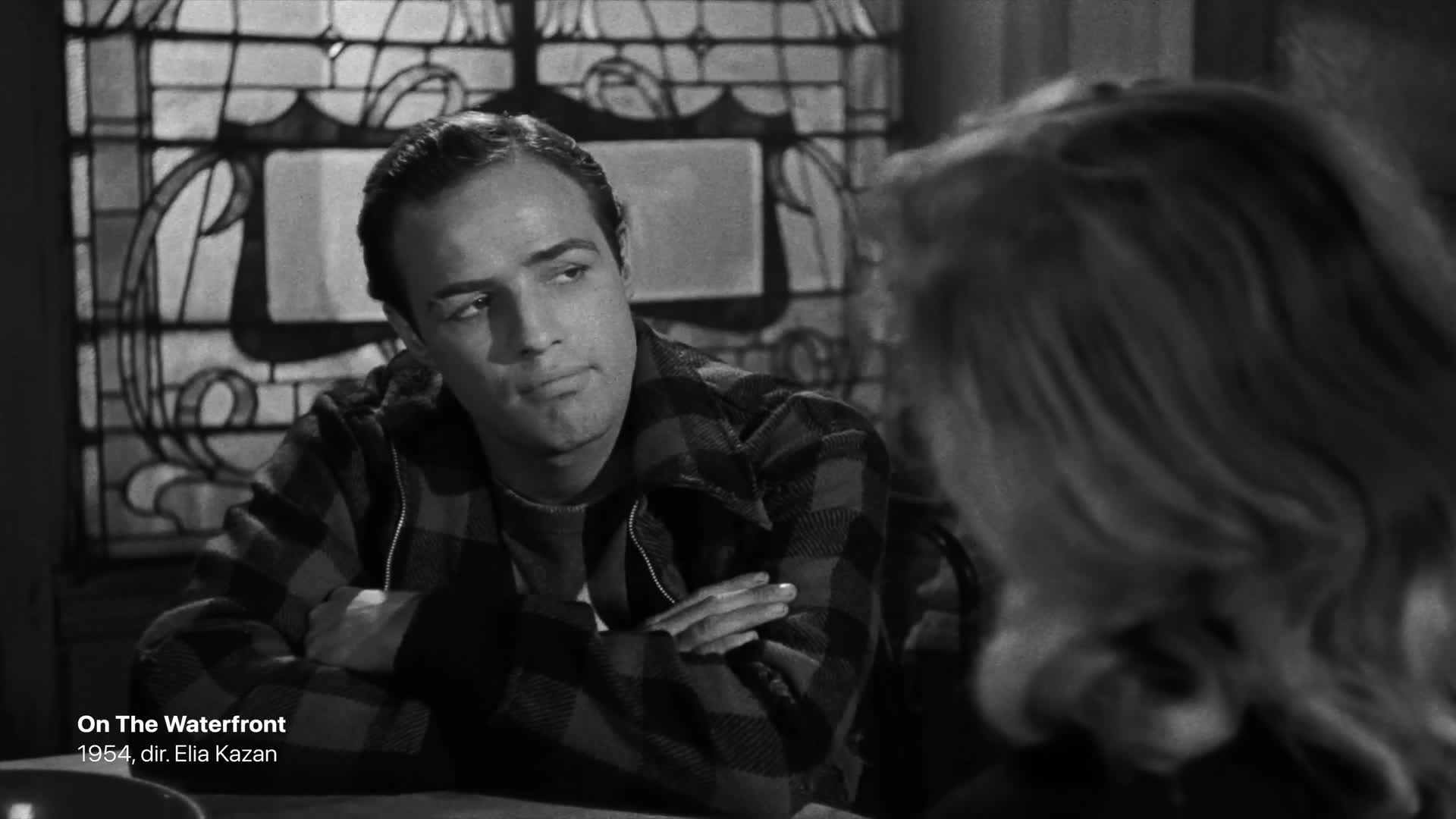
With a shrug, a head tilt and a look down Brando, as Terry Malloy dismisses, or tries to dismiss, the murder of his father.
And it stuck Charlie and me in a...
Everything about the awful experience in that foster home is evoked by that silence and that look.
And what you're about to see is another attempt to dismiss the memory, to push it back under.
But this time, it's going to look more like a flinch of disgust, nausea, even shame.
In my book, it's one of the great gestures of acting history.
Don't they call it children's home?
Keep in mind that Terry didn't have to mention these things.
He's choosing to bring up the two most harrowing events in his life.
He wants to communicate his pain to Edie, because he's never had the chance to before and because Edie is in her own pain and he's trying to connect with her.
In the opening of the movie, her brother is killed by gangsters gangsters that Terry Molloy associates with, albeit reluctantly.
Terry was, unwittingly, the one that lured Edie's brother to her death.
He feels guilt about this, just as he feels a deep sadness about his memories.
He of course built a hard exterior to survive, but Brando's great gift is in the ways he lets us catch glimpses of the desperate sensitivity beneath.
Anyhow, I'll run away from there.
And I fought in the club smokers and peddled papers and Johnny Friendly bought a piece of me.
Bought a piece of you?
Yes.
Here, Edie just rephrases something he said, and you can see that moment where Terry realizes the deeper connotation of a piece of him being owned by another man.
I was going pretty good there for a while.
And after that... What do you really care, am I right?
And this is what makes Brando a genius.
When his eyes betray his words, his voice says, what do you really care?
But his eyes say, please care.
Please show me that you care.
Shouldn't everybody care about everybody else?
Oh, what a fruitcake you are.
I mean, isn't everybody a part of everybody else?
And you really believe that, Drew?
Yes, I do.
With the slightest relaxing of the eyebrows, the scoffing challenge becomes a sincere question.
He wants her to believe that we're all connected, that empathy is possible.
He wants to let go of his cynicism.
He can feel for a moment the hard shell softening, but then the drinks come and snap him out of it.
Well, here we are.
One for the lady and for the gent.
Here's to the first one.
I hope it ain't the last.
Thank you.
Go ahead.
He wanted my philosophy of life.
Do it to him before he does it to you.
And there the walls come up.
Terry doubles down on his old schtick and Brando's movements become more precise and harsh.
His eyes become intense.
And when things and people get in your way, you just knock them aside.
Get rid of them.
Is that your idea?
Listen, don't look at me when you say that.
It wasn't my fault what happened to Joey.
Fixing him wasn't my idea.
Who said it was?
Well, everybody's putting a needle on me.
You and a mug and a church and Father Barry.
I didn't like the way he was looking at me.
Brando is cycling through so many emotions here, each with its own subtext.
He goes from persecuted.
Don't look at me when you say that.
It wasn't my fault what happened to Joey.
To defiant.
Fixing him wasn't my idea.
Edie, at this point, doesn't know what role he played in her brother's death.
You can sense that he wants to apologize, but not be blamed.
He doesn't want her to know what he did, but he also wants to admit it.
Then he turns self-pitying.
Well, everybody's putting a needle on me.
You and a mug and a church and Father Barry.
Then, accusatory.
I didn't like the way he was looking at me.
You don't believe anybody, do you?
Listen, down here it's every man for himself.
It's keeping alive.
It's standing in with the right people so you get a little bit of change jingling in your pocket.
And if you don't?
If you don't, write down.
You know.
It's worth mentioning here that, despite his revolutionary unpredictability, Brando was a great craftsman too.
He's fully aware that he's framed in close-up here, and so he has to keep his gestures close to his face, even as they remain natural and authentic.
I also love the almost sing-song inflection he puts on.
If you don't, write down.
To living like an animal.
Alright.
I'd rather live like an animal than end up like... Like Joey.
Are you afraid to mention his name?
Edie, played brilliantly by Eva Marie Sane, is as direct in this scene as Terry is evasive.
Watch how Brando just deflates when confronted by her.
Are you afraid to mention his name?
No.
Well, why do you keep hopping on that fort?
He knows he messed up.
Come on, drink up.
You gotta get a little fun out of life.
Come on, I'll stick some music on.
What's the matter?
And now seeing Edie in her pain, her naked grief.
Now is the moment when Terry finally becomes tender.
What's the matter?
What's the matter with you?
And she asks him with astonishing vulnerability.
Help me if you can, for God's sakes.
Edie, I'd like to help.
I'd like to help, but there's nothing I can do.
But there is something he can do, and his body language shows that he knows that.
In this reaction.
The words Terry says are less important than this iconic gesture, this thumb on the chin.
All his helplessness, his frustration, his guilt is displaced into that gesture.
It's childlike, and he becomes more and more like a child as the scene comes to a close.
What for?
Well, for not being no help to you.
Finally, in an almost motherly way, Edie puts her hand on his face, easing his distress, when he should be easing hers.
You can feel the warm energy of her touch infusing his body, mingling with all the shame and confusion, with all the doubt and sympathy and growing compassion.
This scene, this movie, this performance is as alive and electric as it was in 1954.
After seeing something so true like this, or Brando's Livewire performance in A Streetcar Named Desire, it was hard to watch that traditional kind of acting in the same way.
And it's easy to see why Brando became a North Star for an entire generation of actors.
They wanted to affect audiences in the way that he affected them, in the way that he's still affecting all of us.
Hey everybody, thank you so much for watching.
This episode was brought to you by Squarespace, the all-in-one website platform for entrepreneurs to stand out and succeed online.
To get started, you can use Blueprint AI, Squarespace's AI-enhanced website builder, to get a fully customized site in just a few steps, or choose from their library of professionally designed templates that are sleek and engaging.
Every website you make will be optimized for SEO, so you'll show up more often in search results.
And you can do so much within Squarespace, like creating members-only content videos, blogs or courses, creative work that you can monetize via one-time payments or subscriptions.
The bottom line is that Squarespace is going to make a home for your products or your work that looks and feels professional, something that will impress your customers and fans.
Head over to squarespacecom for a free trial and when you're ready to launch, go to squarespacecom.
Slash nerdwriter for 10 off your first purchase.
Thanks guys.