Japan's economy has been going sideways since the 1990s.
Economic growth was barely there and it was even grappling with deflation, you know, prices falling.
But now, for the first time in about 30 years, inflation has started to bite.
And that's helped pave the way for a new prime minister with a colorful and radical streak.
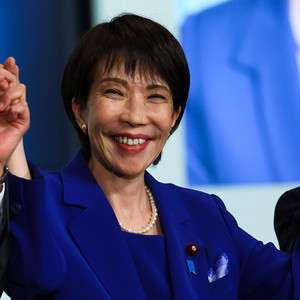
In October, Sanae Takeichi became leader of the Conservative Liberal Democratic Party, or LDP.
She was soon sworn in as Japan's first female prime minister.
In one of her early speeches, she said she's throwing away the phrase work-life balance for her son.
She's saying she's throwing away the work-life balance and she would work and work and work.
Yes, Anaya Takeichi is a little hardcore.
As the most indolent member of the Indicator staff, I simply cannot relate.
Her secret is...
True story, drumming heavy metal.
She was also a TV personality and has sung karaoke in front of the nation.
Takeichi is nationalistic and telegenic.
So naturally, Xi and U.S.
President Donald Trump got along famously when Trump visited Japan in October.
She presented Trump with a gold leaf golf ball and a putter that belonged to the late Japanese Prime Minister, Shinzo Abe, who was her mentor.
Less positive is Takaichi's relationship with China.
Beijing is steaming after her comments on Taiwan.
And on Japan's ailing economy, Takaichi's moves have been no less bold.
This is The Indicator from Planet Money.
I'm Darian Woods.
And I'm Waylon Wong.
Today on the show, Sinaionomics.
We visit the world's fourth largest economy and learn how Sinai Takeichi wants to fix it.
This message comes from NPR sponsor Capella University.
Learning doesn't have to get in the way of life.
With Capella's game changing flex path learning format, you can set your own deadlines and learn on your own schedule.
That means you don't have to put your life on hold to earn your degree.
Instead, enjoy learning your way and pursue your educational and career goals without missing a beat.
A different future is closer than you think with Capella University.
Learn more at capella.edu.
This message comes from Capital One with the VentureX card.
Earn unlimited double miles, a $300 annual Capital One travel credit, and access to airport lounges.
Capital One.
What's in your wallet?
Terms apply.
Details at CapitalOne.com.
This message comes from Capital One.
Capital One offers checking accounts with no fees or minimums.
What's in your wallet?
Terms apply.
See CapitalOne.com slash bank for details.
Capital One N.A., member FDIC.
To better understand whether Sanaya Takeichi can reinvigorate the Japanese economy, we have to first make a diagnosis.
And we can read Japanese economic indicators all day.
Lost 30 years of basically flat incomes, the yen falling.
But what does it feel like to live in Japan right now?
We hit the streets of Kobe, one of Japan's large cities.
Hi, my name is Julie Nguyen.
Julie works at a mental health clinic.
Things are a bit tight financially recently.
I just got divorced and I'm raising four kids.
I work for a part-time job.
Julie wasn't happy about rising prices.
Everything's increasing so much, like groceries, electricity, like just basic costs for living.
We also spoke with Kanoa Konda, a grad student at Kobe University.
She echoed this complaint.
I was like, life price is going high.
So did Yukihiro Imanari, an advisor at a science and policy network.
Basically, we have enough money to live, but you feel the rise of the prices.
The people we spoke to had their own views of what they were hoping for from the prime minister.
Support for working mothers, more money for scholarships, avoiding immigration crackdowns.
Sounds awfully familiar.
Yeah, things like childcare, college costs, immigration, and of course, the cost of living.
That was the common thread.
So what could Sanaya Takeichi do to combat price rises?
As we've talked about before, most economists would agree that politicians don't actually hold the big lever to fight inflation.
That's primarily the responsibility of the central bank raising interest rates to slow down borrowing and spending in the economy and bring down inflation.
So step number one.
One is to get out of the way of the Bank of Japan.
The Bank of Japan has been slowly raising interest rates from basically zero, where they were for about two decades.
Yeah, for decades they were struggling to get any inflation.
And, you know, a small amount is good for an economy.
And that return to lifting interest rates has been called normalization.
Fumigato is a lecturer in East Asian political economy at the University of Sheffield.
The prime minister wants slower pace of normalization.
Basically, Takaichi wants lower interest rates than the central bank does.
Lower interest rates would be the opposite of what's needed to curb inflation.
Sure, it could mean cheaper mortgages or car loans.
But all that extra borrowing by people and businesses would mean more spending, which would lead to higher prices.
We asked Fumigato whether the prime minister could influence the central bank in Japan.
There may be some kind of theoretical independence.
But I think it's difficult for the central bank to directly go against what the government wants.
It's difficult for the Bank of Japan to go against what the government wants, partly because there's government representatives actually sitting at the table when the central bank makes its decisions.
Yeah, those eyeballs are kind of quite intimidating.
Oh, yeah.
So, even though the Bank of Japan is legally independent from the government, the reality is more complex.
You often see the two coordinate policies.
So Fumi thinks it could be possible that Takeichi's preferences for lower interest rates could be taken into account.
But politicians can do more than get out of the way of the central bank.
They can also make the central bank's job easier by taking their foot off the fiscal accelerator.
And that's step number two, basically pulling back on spending or taxing more, less borrowing.
The current administration is more interested in fiscal expansion and then strengthening the military.
So the opposite of cutting back.
In November, Takeuchi's cabinet approved a $135 billion stimulus package.
That means more borrowing and spending.
Broadly, this kind of borrowing and spending worsens inflation.
There is a third step that could reduce inflation, and that's if Japan's productivity increases.
Productivity could be the skeleton key that unlocks not just stable prices, but increased wages too.
So it's important.
One way to increase productivity could be to invest in infrastructure or industries that allows Japan to make more stuff or be more efficient.
Fumi says Takeichi is trying to spend more money to make Japan's exports more competitive in certain industries like semiconductors.
So the result of this is to be seen.
Another potential way to increase productivity is increased immigration.
Bring in more skills and ideas and labor.
That could grow Japan's businesses.
But Fumi says Takeichi is a nationalist, so that's not her first instinct.
She would like to... restrict the influence of immigrants.
So overall, Sanae Takeichi seems like a bold leader, but not one that follows economic orthodoxy.
She wants lower interest rates, more spending, less immigration.
That explains why investors aren't convinced.
The day that Takeichi's big stimulus package was announced, the Japanese Nikkei stock market fell 25.
And interest rates on loans to the Japanese government are even higher than they were in the 2008 financial crisis.
The everyday people we heard from in Japan didn't vote for Takeichi directly.
Japan has a parliamentary system, so you vote for parties and representatives, not for prime ministers.
But these people in Kobe had their views.
Julie Nguyen, the mental health worker and mother, had positive first impressions.
She seems like strong and reliable.
So, yeah.
Hopefully she can help families or working moms.
But we also need to see how she actually does.
Kanekonda, the graduate student, was more circumspect.
I don't know.
It's not going to really directly affect my final situation.
And Yukihiro Imanari, the science and policy advisor, was less of a Takeichi supporter.
In fact...
He was worried.
I'm a little bit afraid of this person because I see her on the far right wing of WDP.
Because I'm Japanese national, I think I will be fine.
But my wife is...
I could imagine that at some point I would say, oh, let's go away from this country.
I cannot live here anymore.
Overall, though, Sanai Takeichi's rambunctious approach is winning over Japanese voters.
Takeichi's administration now enjoys around a 70 percent approval rating.
But with inflation showing no signs of slowing down, we'll see how long that lasts.
This episode was produced by Angel Carreras, Catherine Yang and Corey Bridges, with engineering by Kweisi Lee and Sina Lafredo.
It was fact-checked by Sierra Juarez.
Caken Cannon edits the show, and The Indicator is a production of NPR.
This message comes from Mint Mobile.
Starting at $15 a month, make the switch at mintmobile.com slash switch.
$45 upfront payment for three months.
Five gigabyte plan equivalent to $15 a month.
Taxes and fees extra.
First three months only.
See terms.
This message comes from Mint Mobile.
At Mint Mobile, their favorite word is no.
No contracts, no monthly bills, no hidden fees.
Plans start at $15 a month.
Make the switch at mintmobile.com slash switch.
That's mintmobile.com slash switch.
Upfront payment of $45 for 3-month 5GB plan required.
Equivalent to $15 a month.
New customer offer for first 3 months only.
Then full price plan options available.
Taxes and fees extra.
See Mint Mobile for details.