Hey, Alexi Horowitz-Ghazi here to ask you to pre-order The Planet Money book today.
It's filled with great stories, just like you hear on the podcast, gorgeous illustrations and a few surprises we will share soon.
We put a lot of energy into thinking up ways to make a book explaining the economy as creative as possible, and we are so proud of it.
It's perfect for anyone wanting a primer on money and decision-making, or to just enjoy a good nerdy read.
If you preorder, you get a free gift and a free month of Planet Money Plus, if you don't already subscribe.
You can go to planetmoneybook.com.
That's planetmoneybook.com.
And thank you.
This is Planet Money from NPR.
There is a basic mismatch between how much our government takes in in revenue, mostly in taxes, and what it spends on defense and Medicare and roads and that sort of thing.
And the reason we can sustain that structural mismatch is is because we can borrow the difference.
We go get the money we need in the big international bond market where people and institutions with money lend it out to people and institutions who want money in exchange for periodic interest payments.
The U.S. government's promise to pay back what it borrows, plus interest, that is a treasury.
It's an IOU.
And all over the world there are people and institutions who want to loan the US government money, in part because it is perceived to be such a safe bet.
The U.S. is rich, and it's basically always paid its debts.
So treasuries are seen as one of the safest things you can buy.
So they're pretty popular.
People are always in the market buying them.
Every other debt manager in the world wishes they had a government debt market like ours.
That is Dilip Singh.
For a few years, he was the one selling these IOUs to people all over the world at the U.S.
Treasury.
There's a lot of envy, you know, because the Treasury market, it is the deepest, most liquid market in the world.
And Now, this is a double-edged sword.
That also just means we have a lot of debt.
We're now spending more on the interest costs.
Than we do on defense.
Than we are on the national defense.
We've amassed a mountain of debt, and that puts our fiscal finances at risk.
Puts our fiscal finances at risk because other people hold our debt.
We don't generally control who.
And we're kind of subject to their whims.
Like, for example, we don't get to pick how much we pay in interest.
They decide.
And if they all suddenly stop liking us and sold all the treasuries they had?
Well, we would have a big problem.
And this is something that Dilip and a lot of other economists and regulators and policymakers and academics they have all been talking about this.
It's a whole debate.
Some people are pretty worried because in recent years, someone less predictable has been buying up more and more of our trusted IOUs, our treasuries.
And that someone is hedge funds.
Hedge funds, those loosely regulated risk-taking financial companies which only invest money on behalf of people rich enough to lose the money.
Hedge funds are bringing their own hedge fundy attitudes to the Treasury table.
If this new player decides to take reckless risks and make a big mess we, the taxpayers of the United States, we are probably going to end up paying for it.
One way or another.
I think there is something wrong if Main Street's bailing out Wall Street in those moments.
Hello and welcome to Planet Money.
I'm Mary Childs.
And I'm Kenny Malone.
The market for U.S. government debt is the most important one in the whole world.
All of global finance relies on the safety and stability of this one market.
So should we worry that more and more of it is going to the hedge funds with their hedge fundy ways?
Today on the show, we will go see how an IOU from the federal government, the venerable U.S.
Treasury, is now making its way into the hands of hedge funds.
And we will meet one of these new players who I thought would never, ever talk on the record.
A hedge fund guy comes to the NPR studio to explain what he's doing and why.
This message comes from Wealthfront.
It's time your hard-earned money works harder for you.
With Wealthfront's cash account, you earn a competitive APY on your cash from program banks, higher than the average savings rate, with free instant withdrawals to eligible accounts.
Go to Wealthfront.com slash money.
Cash account offered by Wealthfront Brokerage LLC, member FINRA SIPC, not a bank.
Funds are swept to program banks where they earn the variable annual percentage yield.
So you can try it yourself.
Just go to linkedin.com slash NPR pod.
That's linkedin.com slash NPR pod.
Terms and conditions apply.
Okay, so today we're going to walk you through how so many of the IOUs, our government rights, are now ending up in the hands of hedge funds, and why that might be something people are worried about.
But to help understand this potentially wild and risky journey, we are starting out in a very somber place.
The U.S.
Treasury, where the federal government writes out all those IOUs.
That was Dilip Singh's job.
He sold new treasuries at the U.S.
Treasury in a suit and tie almost every day.
Not on the weekends, unless I came to the office.
Okay, so you're not playing football with your kids in a suit and tie.
That's safe.
Usually not.
Yeah, that restrains me.
Big strangulation hazard.
We don't want that.
The Treasury is a big safety first operation.
They are laser focused on being as safe and boring as possible.
Because the more safe and boring they are, the less they will have to pay in interest.
And that is their goal, to borrow as cheaply as possible.
So that over the life of the loan, the U.S. taxpayer doesn't have to pay a ton of interest.
To get those low interest rates, the U.S.
Treasury has to make potential investors feel happy and calm and trust us.
That's why this is just a very it's a sober, serious place filled with people wearing dark, blue and gray suits, because you're there to simply give investors an experience just like the one they had last time.
Now those investors are traditionally pension funds and insurance companies and rich people and sovereign wealth funds and central banks of other nations, and also individual investors like me and you, Mary.
Absolutely.
The Treasury sells debt at auctions.
And to be trustworthy, they need those auctions to operate smoothly.
No surprises.
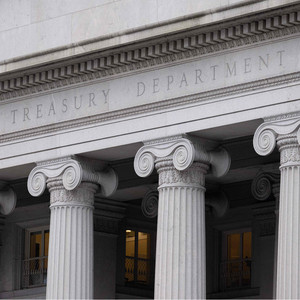
So back when this was his job, Daleep would arrive at the Treasury Department building and make his way to the one tiny special room where everything happens.
What are the carpets like?
Um.
I remember them being very 1970s-esque, sort of orange and brown and in need of an upgrade.
Okay.
So it's not the most uplifting decor.
We're not indexing for aesthetics here.
No, it's not meant to foster creativity.
It's meant to foster quiet, disciplined execution.
There's no special key to this room, but there are only so many people who are authorized to be there.
During an auction, Dilip said, there would be like 15 people max.
And all those people know each other from working together forever.
There were never any strangers.
But that room is silent during a treasury auction.
You can hear a pin drop.
Do you do anything special in the office to commemorate its auction day?
No, I mean look, there's so many.
There are auctions every single week, usually on Tuesdays, Wednesdays and Thursdays.
And so we have so much debt and so many auctions that every auction day is like any other day.
Because we now borrow so much more than we used to.
Here's how it works.
So the week will start with an announcement.
The U.S.
Treasury is going to borrow $100 billion this week.
And so the question that's put to the market is who wants to lend the US government money, and how much interest do you need to get paid?
They ask potential lenders how much would you need to get paid to want to lend to the US government?
So like, how much would you need in interest payments to lend to the US government for three months, for five years or for 10 years?
They all write down their answers.
30 to 60 minutes before each auction closes, they each submit a bid.
A bid for how much they want to buy and how much interest they want to get paid.
This used to be done with pencils.
Now they type their bid into a little box on a computer all by 1 p.m.
So OK, now we will go to the other end of the magical pipes in the silent room of the Treasury, to one of the people typing in that little box on a computer by 1 pm.
And that someone is at a bank, an investment bank, a Wall Street bank.
In this case, Goldman Sachs.
That is where Anshul Sehgal works.
He is wearing, for what it's worth, a polo shirt.
It's a t-shirt.
Is this a polo t-shirt?
It's got a collar.
It's got a collar.
That's because I was going to be interviewed.
What is happening at Goldman Sachs these days?
We're going to have to restart this.
You're typically wearing your ACDC t-shirt.
Essentially.
Or my Pink Floyd t-shirt.
So definitely a step down from the formality of the U.S.
Treasury, but still very much part of the formal structure.
Because Goldman Sachs is actually a very official part of this process.
It's one of 25 banks they're called primary dealers that have made a special deal with the US government because the government wants to make sure it can always get these loans.
So the banks get special perks as long as they uphold their end of the deal.
Like to always bid at treasury auctions.
Real good faith bids.
And it is part of Anschul's job to submit that bid to decide how much Goldman wants to loan the government and at what interest rate.
Like, if they're not going to get paid back for 10 years, they want say, 41 in regular interest payments.
If the loan's for longer, they're going to demand to get paid more, within reason.
And even though the auctions themselves are so stable and boring, Anschul says that the actual moment of the auction is still nerve-wracking because of what the auction can reveal about the world.
1 pm.
The system closes, so your bids are submitted and it takes them somewhere between 30 and 120 seconds to come back with the results of the auctions.
So for those two minutes, everyone's sitting quietly on their desk waiting to see where the auction comes out.
Anshul says this is a clearing event.
Like you've been in the dark and for one quick minute.
The lights come on and you can see everybody else.
You can see how they feel about the future at that moment, if they feel brave or scared.
So in those 120 seconds, you're just like, what's the rest of my day slash week going to look like?
That's right.
Am I going to have an easy week or is this about to get turned upside down?
That's right.
The auction, because it's a clearing event, essentially gives you a very good picture of the market landscape, whether people are risk averse or not.
So at 1 pm all the bids are in.
The Treasury sorts through all the numbers and by about 102 pm they publish the auction results.
The winning interest rate.
Our darling little Treasury bonds have hatched.
Soon, tons of these new little Treasuries will leave their birthplace, the Treasury, and fly to their first homes.
And Anshul's role here is kind of just as facilitator, as conduit.
He's there to catch the treasury as it leaps from the nest and give it a little boost as it goes out into the world.
Because he's going to turn around and sell it to someone else.
And something important to understand about treasuries.
Some people buy them to hold on to them forever.
Yes, because they are an interest and they're safe.
Some people buy them to trade them like normal stocks and bonds.
But also, people use treasuries as collateral.
If someone wants to make some risky bet in financial markets, like they want to bet a lot of money on the stock of a company plummeting to zero tomorrow, any responsible bank or broker is not going to sign onto that bet unless the trader hands over enough collateral.
That's where treasuries come in.
Yeah, the trader can say, don't worry, broker.
If this goes awry, I have all these treasuries that you can hold onto as collateral.
If my trade goes terribly south and I owe you more than I can pay, you can sell these for cash.
And the reason treasuries are so good as collateral is because there are so many of them and because people are buying and selling them all the time.
So if you want to buy and sell them, even a lot of them at once, you can do it fast and pretty cheap.
That's what people mean when they say that the treasury market is deep and liquid.
It is the largest collateral market in the world.
And all of us are cogs in that wheel trying to basically provide liquidity in this market.
Because in order for something to work as collateral, it needs to be as good as cash.
And what makes treasuries basically as good as cash is how easy it is to trade them.
And the more people trade treasuries, the easier it is to trade them, which gives them more confidence.
So they trade them more.
A virtuous circle.
So, on Shul's job at Goldman Sachs, he does have basically the same goals as Dilip at the treasury, which is be boring.
How do you know on an auction day if you did a good job?
As a primary dealer, you did a good job if the auction came right around where the market expected it to come.
Okay, no surprises.
No surprises is a good day.
Later, on what's called Settlement Day, the magical transfer actually happens.
Anshul's wire goes through to the U.S. government, and the new treasury lands in Anshul's account.
By the time that happens, Anshul will have most likely sold it already.
To whom?
Well, that's the thing that's been changing.
Our little baby treasuries are about to make a big, huge leap from the somewhat government-sanctioned safety of our safe and regulated banks into the big crazy way-less-regulated, risk-loving world.
Our next stop?
A hedge fund.
So our little baby treasuries were born in a somber little room with 1970s carpeting at the treasury.
And then they were sold to a big bank, a primary dealer working to help nudge our little treasuries safely along.
And that part of the process that is a weird intersection of government and private sector where governments and banks are working together, intentionally intertwined in a mutually beneficial boring, stable market.
So those careful handlers of treasuries, they have to follow a lot of rules and regulations, even more in the past 15 years or so.
Because after the financial crisis of 2008, we decided that banks had taken risks that were too big.
They tanked the global economy and we did not like that.
So we restricted their activities, how much risk they can take, how much stuff they can buy.
Which is good if you want safe banks.
Banks do serve societally important functions holding people's savings and deposits, making loans to businesses.
We want those safe, so we made banks safer.
But markets are made up of peoples.
People looking for opportunities to make money.
So when you squish risk out of one area, it always shows up somewhere else.
Which brings us to hedge funds, who have started buying a lot of treasuries.
And, depending on who you talk to, are maybe threatening to destabilize the whole system, or they're maybe helping the government to borrow even more money.
Or both.
Here to explain, a guy from a hedge fund, of course.
My name is Phil Prince.
My job title is partner and head of treasury at Pine River Capital Management.
Phil is somewhat anomalous in the hedge fund world.
For starters, hedge funds generally have more of a T-shirt kind of vibe, but not Phil.
I am here today in my blue button-down shirt and my gray wool slacks and my business shoes.
Oh, my God.
It was approximately a billion degrees when we spoke.
Phil is also anomalous in the fact that he is in the NPR studio talking to me right now.
I called a lot of hedge funds to ask them about their new interest in treasuries.
None of them would talk to me on the record.
Phil would.
And the way Phil found his way to this treasury trade he's going to tell us about, he says, is by doing what he always does identifying people's needs in the market.
It's someone paying you to help them do something that they need to get done.
The trade Phil does is called the treasury basis trade.
And the reason this trade has become so big, with so many hedge funds doing it, is because of the enormous amount of treasuries out there now.
The fact that the U.S. government is borrowing more money than ever.
There is now 29 trillion worth of treasuries in the global market, up from 17 trillion at the start of 2020.
The U.S. government needs to sell treasuries to people like Anshul at Goldman, who we met earlier.
And then Anshul needs to find them a home with his clients.
So Phil buys treasuries and he uses those treasuries to solve someone else's problem.
Example one, money market funds.
You got your money in a money market fund?
Probably.
Yes, I do.
I do.
Yeah, I do.
It's a good place for money.
Thank you.
Money markets are where you store money that you might need right away.
So money market funds have cash from you.
And then their problem is that they want to invest that cash and make a little interest, but only for a short time because their clients might demand it back.
The stuff that they hold has to have a pretty short shelf life.
So Phil does these one-day deals with money market funds.
He borrows their cash overnight, and then he lends them his treasuries as collateral.
And he just does this day after day borrowing cash, buying treasuries, lending them out as collateral.
Hallelujah.
Solved the problem.
Wait, the money market fund has cash and is giving it to you in order to borrow your treasuries?
Yes.
That you bought and you're funding the treasuries with the money market fund money?
Yes.
That's so silly.
Why?
Why can't they just buy treasuries?
Because we're talking about, like, seven-year treasuries.
They're a money market fund.
They only think about tomorrow.
Right.
They need their money back tomorrow.
And then there's a whole other side of this treasury basis trade that Phil and his peers are doing.
And it has to do with the needs of big old index funds and retirement funds.
A lot of those funds focus on the bond market.
And they need treasuries because treasuries are a bigger and bigger part of the market.
And those funds are supposed to look similar to what's out there.
But the managers of those funds also want to perform well.
You think of your Vanguard mutual fund.
They buy things for their investors.
And they measure how well they've done by saying the market, quote unquote, did this.
And I did a little better.
So their problem is treasuries are relatively unprofitable compared to stuff that's riskier.
They don't help you beat your peers.
So these fund managers wish they didn't have to spend so much money on boring old treasuries.
Enter Phil and the other hedge fund managers.
Here is their pitch.
What you can do is buy futures.
Treasury futures.
When you buy a treasury future, you are promising to buy a treasury at a certain price in the Future.
Do you get it?
Future.
Do you get it?
I get it.
Yes.
Now the upfront cost is going to be lower and they can still check the box of basically having treasury bonds.
It's just that it's tomorrow's treasury bond, not today's.
The future will become a bond at some date in the very near future.
It's an egg.
I love that.
I had never thought of a future as like a little egg about to hatch.
Yeah.
That's so cute.
Do you think of futures as eggs?
I think of futures as forward buying.
So no, okay.
The way Phil sees it, he is meeting the needs of all those funds that need to check the treasury box by selling them treasury futures.
So that multi-pronged set of things Phil is doing with treasuries buying them, loaning them out on a nightly basis, selling their future selves, their eggs.
You can only do this if you are not subject to all those rules and constraints.
And if you're going to make money at that, you have to be efficient at it.
You have to be able to do it at the minimum cost, or someone else will do it cheaper and you won't be able to do it at all.
To get all this done and to make sure he makes a good profit.
Phil has borrowed money, is borrowing money, a lot of money, from the money market funds, basically every day, so that he can do this trade as big as possible.
And all these other hedge funds who are also doing this treasury basis trade.
They all also borrowed money to do this trade as big as possible.
A lot of money.
There's something like $800 billion currently tied up in this trade.
Phil's money, the money he borrowed, his competitors' money, and their borrowed money, all of that.
And this is the part that becomes worrying.
This is what regulators, other traders, academics, journalists, this is what they're fretting about.
What if something suddenly goes terribly wrong in the stable state treasury market?
If prices start jumping all around, what would happen?
Phil has thought about this too.
In this scenario?
Yeah, everybody in every prong of these multi-pronged basis trades will most likely be scrambling to get their money back or their treasuries back.
But often the same treasuries get pledged as collateral over and over.
So if Phil wants his treasuries and he calls up the person he pledged them to who pledged them to someone else, I can't get them because.
I don't know where they went.
And then this versus that and the other versus the other.
Each one of those bases has been taken apart into its pieces and there's disorderly buying and selling and everything is washing back and forth.
Disorderly buying and selling means prices get jumpy.
If prices drop suddenly, all those treasuries that are being used as collateral all across the financial system, all across the world, they are suddenly worth nothing.
Less.
They are not worth what people promised.
And Phil is all tangled up with all of those people making all of those promises.
Now Phil does say that he has calculated very carefully how much he would stand to lose on a bad day where everything goes haywire.
And he prepares for these scenarios.
He says he keeps enough cash sitting around that he can weather a financial storm.
He of course cannot be sure about all of his peers who are also doing this trade and all of the many people trading with them.
How much cash have they set aside for bad days?
Have they done their math well?
And we did get to see what happens when things go wrong, if the risk takers are not prepared for surprises.
This happened back in March 2020.
And you're forgiven if you don't remember this thing that we're about to talk about, because this was the beginning of the pandemic.
Lots going on for all of us.
But in that moment, markets were falling and everyone was panicking and they wanted cash, cold hard cash.
And this treasury basis trade totally blew up.
How did that feel?
Yeah, this is painful.
On the one hand, it hurts because you're losing money.
On the other hand, wow, what an opportunity.
You just have to have enough cash on hand that you don't go bankrupt, so that you can make back the money that you lost and make more.
Did you?
I'm afraid I'm not at liberty to say because the SEC rules around.
Oh, sorry.
Don't do crimes.
But you're still here, which means you didn't go bankrupt.
Yes.
In a way, those hedge funds weren't allowed to go bankrupt because they and everybody else got a huge boost from the Federal Reserve, which jumped into the market and started buying to stabilize the whole system.
Hedge funds, dealers, fund managers, everybody.
You may remember Dalip Singh, who we talked to earlier, formerly of the Treasury, in his dark blue suit.
He was actually at the New York Fed during this time doing the buying.
Yes.
I mean, I was on the front lines and we bought close to 3 trillion worth of Treasuries in March and April 2020 alone.
You know, to save many innocent people their livelihoods, you sometimes have to benefit those who are kind of less deserving of being helped in that moment.
When you did this, how did that feel?
Necessary.
Because otherwise there would have been thousands, tens of thousands of needless bankruptcies.
And we would have had, once again, another lost decade of unemployment.
And that could have had enormous scarring effects psychologically, with real political and geopolitical consequences.
So there are no good choices in those moments.
That's the least worst option.
The U.S. government does benefit from hedge funds buying treasuries.
Their participation means we can borrow more.
But on the other hand, hedge funds are independent actors.
They are less regulated than you know.
The primary dealers that we talked about, those big banks like Goldman Sachs, where Onshul works.
Hedge funds have no special relationship with the government.
They have no obligation to it.
The stability of the market is not actually their concern, but they are a concern for the stability of the market and, in turn, for the government's ability to fund itself and function.
The treasury market's functioning was always predicated on being boring and safe.
But now it also kind of needs hedge funds to have good days.
Look, I mean, you welcome investors of all different kinds with different objectives.
And, you know, God bless if you make a lot of money out of it.
But we need to get away from the idea that you're going to get bailed out if you're one of these investors.
In talking about this, there is one phrase that everyone always uses.
Moral hazard.
I asked Phil to define it.
Moral hazard is having the incentive to do things that make you better off, by shifting risk onto society as a whole.
You don't pay the consequences of your actions.
The rest of us do.
The problem with that is the moral hazard that leads some less careful hedge fund to do this trade with less cash on hand.
If you're just going to get bailed out when you make a mistake, you don't have to figure out how much rainy day cash to hold.
You can just take whatever risks look most profitable and fun.
So the government could regulate hedge funds more.
The government could also borrow less.
But if we do want hedge funds to keep buying treasuries allowing us to borrow a bit more, then we probably need to be prepared to bail them out on a bad day.
That's the structure we have built.
On purpose or not on purpose?
Because this seems to be the deal.
You can have safe banks, stable markets, or people taking real risks in the market.
But you can't have all three.
The Planet Money book is available for pre-order starting today.
You can order early at planetmoneybook.com.
This episode was produced by Willa Rubin and edited by Marianne McCune.
It was fact-checked by Sierra Juarez and engineered by Jimmy Keeley and Sina Lafredo.
Alex Goldmark is our executive producer.
Special thanks to Jeffrey Mellie at NYU Stern for the trilemma framing, and to Suresh Sundaresan at Columbia Business School, Yehshay Yadav at Vanderbilt Law and Josh Younger and Matt Levine.
I'm Kenny Malone.
And I'm Mary Childs.
This is NPR.
Thanks for listening.