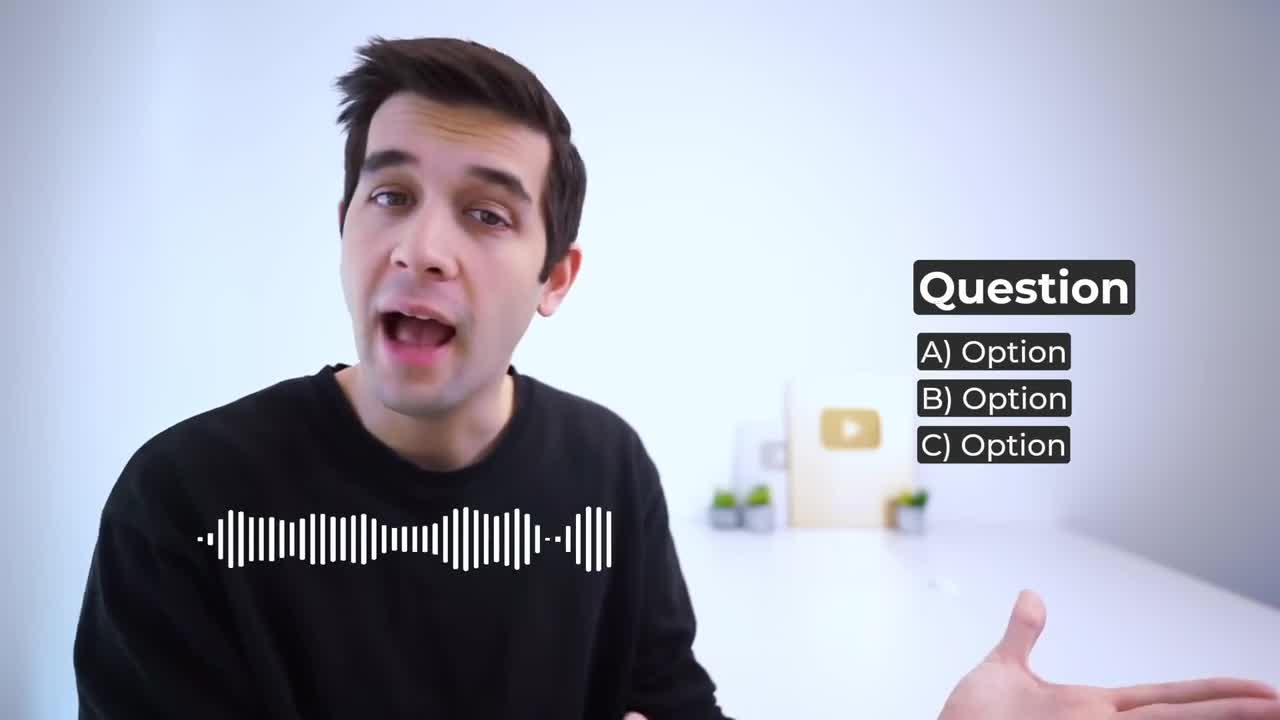
Which one of these do you and I am here to challenge your English listening skill.
I have 10 questions for you, from A1, very easy, to C2, the most difficult.
First, I will show you a question with three options, then you will listen carefully to an audio file and finally you will choose the answer and I will explain it to you now.
If you need to listen more than once, feel free to pause the video, rewind and play again.
Okay, are you ready?
Let's go with the first one.
This is the easiest question of A1 level.
Here's a question.
What does the speaker like doing on weekends?
Option one, watching TV.
Option two, visiting friends.
And option three, going for walks.
Let's listen.
I like weekends.
On Saturdays and Sundays, I do not work.
Sometimes I call my friends, but I do not often visit them.
We talk on the phone instead.
In the evenings, I sometimes watch TV for a short time, but it makes me tired.
I prefer to go outside.
Every weekend I put on my shoes and go for a walk near my house.
It is quiet and nice.
I feel good after my walk.
This was the easiest, and here's what the speaker said.
Every weekend, I put on my shoes and go for a walk near my house.
The speaker goes for a walk, and that is option C.
Let's go to question two, which is A1, A2 level, slightly more challenging.
Here's the question.
What did the speaker buy at the market?
Option A, vegetables.
Option B, fruit.
And option C bread.
On saturday morning i went to the market near my house.
There were many things to buy fresh vegetables, fruit and bread.
I looked at the vegetables first.
The tomatoes looked nice, but i already had some at home.
Then i walked past the bread stall.
It smelled really good, but i had made bread the day before.
At the end of the market i saw a woman selling apples and bananas.
Everything looked fresh, so i bought some to eat during the week interesting.
This is what the speaker said.
The speaker bought apples and bananas.
Apples and bananas, which option?
Fruit.
This was the small challenge.
You don't directly hear fruit.
You hear apples and bananas, and then you have to decide, okay, what are apples and bananas?
Fruit.
Let's go to question three.
This question is A2, so it's slightly more challenging.
Here's the question.
What did the speaker do after dinner?
Option A, watch the film.
Option B, called a friend.
And option C, read a book.
Let's listen.
Last night, I finished work late and felt quite tired.
I cooked a simple meal at home and sat down to eat.
After dinner, I wanted to relax.
My friend had sent me a message earlier asking me to call her.
I thought about it, but I did not have much energy to talk.
I also thought about putting on a movie, but I was not in the mood to sit in front of a screen.
Instead, I made a cup of tea, sat in my favorite chair and opened the novel I had started the week before.
I read for about an hour before going to bed.
Hmm, interesting challenge.
It was easy to understand what the speaker is saying, but what was the correct answer?
Look at the script.
The speaker said opened the novel novel.
What's a novel?
It's a book.
See, here's the challenge.
You need to know the meaning of novel to be able to answer this question, because you don't directly hear book, you hear novel and then you say ah, a novel is a book, it's a storybook.
So that's the correct option.
Option c read a book.
Okay, let's go to the next question, question four of a2 level.
Why did the speaker leave the party early?
Option A, they felt unwell.
Option B, they had an early start the next day.
And option C, they were not enjoying themselves.
Are you ready?
Let's listen.
My colleague invited me to a birthday party.
I was happy to go because I like spending time with people from work.
When I arrived, the music was good and there was a lot of food and drinks.
Everyone seemed to be having a great time and honestly, so was I.
At some point during the evening, I started feeling a little dizzy.
I sat down and drank some water and after a while, I felt better.
So that was not the reason I left.
Around 10 o'clock, I said goodbye to everyone.
My colleague asked me why I was leaving so soon.
I told her I had to be up at six the next morning because of an important meeting.
She understood, and we said good night.
Hmm, interesting, interesting.
What was the correct answer?
Look at the script.
The script says I had to be up at six the next morning.
So the speaker has to get up early.
So which answer is correct?
Option B, they had an early start the next day.
It's six in the morning.
Wow.
Okay, let's move on.
We are going to jump from A2 to B1, from beginner to lower intermediate.
Are you ready to see this harder question?
Let's go.
Why did the speaker decide to change gyms?
Option A, the membership was too expensive.
Option B, the equipment was often unavailable.
Or option C, the location was inconvenient.
Let's listen and find out.
I had been a member of the same gym for nearly two years.
It was not far from my house.
Actually, it was quite easy to get to, so the location was never really a problem for me.
The monthly fee was higher than average and my friends often told me I was paying too much.
I thought about it, but I did not mind so much.
I felt the price was acceptable for what they offered.
What really started to bother me was that every time I went in, the machines I needed were being used by someone else.
I would wait and then wait some more.
Sometimes I finished my workout without using the equipment I had actually planned to use.
After several months of this, I decided enough was enough and started looking for somewhere new.
How was it?
Look at this script.
Here's what the speaker said.
The machines I needed were being used by someone else.
The machines I needed, the equipment.
So you need to know that machines here is a synonym for equipment.
And so the correct option is option B. The equipment was often unavailable.
The machines I needed were being used by someone else.
Let's continue the intermediate level.
We're going to the upper intermediate, B1, B2.
Let's see the question.
Why did the speaker stop working with the agency?
Option A, the pay was too low.
Option B, the working hours were difficult.
Or option C, they lost trust in how the agency operated.
Are you ready?
Let's listen.
I worked with a freelance agency for about three years.
There were periods when the workload was heavy and the hours were unpredictable.
I won't pretend that was easy.
There were nights I genuinely considered walking away just because of the exhaustion.
The pay was another story that came up often, especially among colleagues.
A few of them left over it and I understood their frustration.
For me personally, it was tight but manageable.
What eventually made the decision for me was harder to put into words at first.
It was a tough one, right?
This kind of question is difficult because you do not find the exact answer in the audio file.
You don't hear the exact answer, but you have to understand the context.
You have to understand the story and decide what the correct answer is.
Here's the script.
Look at this part.
The speaker said i started noticing small things like what?
Like projects described to clients in ways that did not quite match reality.
So the description didn't match reality.
Okay, my work occasionally credited to others without any explanation.
So the company is operating in a bad way and the speaker doesn't trust the company anymore.
That's option c.
That was the correct answer.
See, slightly more challenging.
But let's increase the challenge.
Let's go to upper intermediate b2.
And here's the question what does the speaker believe was the main reason the project failed?
Pay attention to the question, guys.
What does the speaker believe was the main reason the project failed?
Option A the team lacked the necessary skills.
Option B, the budget ran out.
Or Option C, key decisions were made too late.
Let's listen.
The project failed, and afterwards, everyone had an opinion about why.
Most of my colleagues blamed the budget.
They said the funding simply was not enough to do the job properly.
I understood why they felt that way, but I never fully agreed.
Others pointed at the team, questioning whether we had the right people for something so complex.
Personally, I thought that was unfair.
Everyone worked hard and knew what they were doing.
My own view was different, and I will admit I went back and forth on it for a while.
But the more I thought about it, the more I kept coming back to the same thing.
There were moments where we all knew exactly what needed to happen, and we just sat there waiting for someone above us to say yes.
By the time that yes arrived, it no longer mattered.
This was relatively easy.
Look at this script.
This is what the speaker said.
We just sat there waiting for someone above to say yes.
By the time that yes arrived, it no longer mattered.
So they were waiting a lot for a yes from above, which means option C key decisions were made too late.
Okay, how's it going so far?
Are you doing well?
We're going to go from intermediate to advanced, from B2 to C1.
Are you ready to stand up to this challenge?
Let's see, let's find out.
What does the speaker believe was the main factor in the company's success?
Again, pay attention.
What does the speaker believe was the main factor?
A, a strong marketing campaign.
B, good timing.
Or C, the quality of the product.
Are you ready?
Let's listen.
People in the industry still talk about how that company grew so fast.
There are different theories.
The most popular one, and the one you will read about in most articles, is that their marketing was exceptional clever campaigns, strong branding, the right message at the right time.
I spent years believing that myself.
There is also the timing argument.
They entered the market just as demand was growing, and some people say that any decent product would have succeeded under those conditions.
There is probably some truth in that.
But the more companies I have worked with since then, the more I have shifted my thinking.
Good marketing can sell something once.
Fortunate timing gets you through the door.
Neither keeps customers coming back year after year the way this company's did.
When I looked closely at their retention numbers and the way people talked about what they were actually selling, it became harder to argue against the thing that was there all along.
Okay, the challenge in this one is that again, you need to listen and you need to gather information, analyze and choose the correct answer.
You don't hear the correct answer directly.
This is what the speaker said.
Good marketing can sell something once, so good marketing is okay to sell something once.
Not huge success, but sell it once okay.
So good marketing is not the option.
Fortunate timing gets you through the door.
That's also a good factor.
Neither keeps customers coming back.
So marketing okay, timing okay, but neither keep customers coming back.
So what's the third option?
Good product.
See how i got to the conclusion.
Correct option is the quality of the product.
Option c Let's go to question 9.
Guys, I have saved the most difficult question as question 10.
So let's see if you can get the correct answer for questions 9 and 10.
This is C1, C2.
What does the speaker think was responsible for the neighborhood's decline?
Option A, rising crime rates.
More burglars and thieves and gang members on the street, local businesses closing down or people moving away.
Let's listen.
I grew up in that neighborhood and watched it change slowly over the years.
Most people I know blame the crime.
And yes, it got worse.
But I always thought that was more of a symptom than a cause.
Others point to the empty shops on the high street.
Businesses did close one after another, and it was painful to watch.
But ask yourself.
Why did they close?
Because the customers had already gone.
That is what nobody wants to say directly.
Families left first.
Quietly.
One by one.
Once that started, everything else followed.
The shops lost customers, the streets felt less safe and the area just hollowed out from the inside.
How was it?
Not that challenging, was it?
Look at the script.
Here's what the speaker said.
Families left first.
So people moved away first.
One by one.
Once that started, everything else followed.
So businesses closed down, crime rates went up.
But what led to all of these?
People, families leaving the neighborhood.
So the correct option is option C.
Okay, we're getting to my favorite question.
I tried to make this question the most challenging.
So if you can have the correct answer to this question, your English is fantastic.
Oh, enough talking.
Let's see the question.
This is a C2 proficiency level question.
What is the speaker's main criticism of the reform?
It's a political topic.
It was poorly communicated to the public.
It ignored expert advice.
It solved one problem by creating another.
Ready, set, The reform was not introduced carelessly.
Experts were consulted at every stage.
Reports were made publicly available.
And by all accounts, the rollout was handled transparently.
I will give it that much.
And yet, here we are.
The original problem is largely gone.
So on its own terms, the reform delivered.
Most commentators take that at face value and move on.
What they failed to reckon with is what crept in under the radar.
The mechanisms introduced to redress the imbalance ended up redistributing power rather than dismantling it.
A different group now bears the brunt of a system they had no hand in shaping.
The reform, in other words, did not level the playing field.
It simply tilted it in the opposite direction.
That to my mind is not progress.
That is substitution dressed up as solution.
This text was full of C2 proficiency idioms and phrases.
That's what made it a bit challenging.
What was the correct answer?
Let's have a look at the script, a beautiful script.
This is what the script says.
The mechanisms introduced to redress the imbalance ended up redistributing power rather than dismantling it.
So yes, there were efforts to have reform.
Yes, the reform worked.
However, it solved one problem.
It took away power from one party, but then it created another problem, which is redistributing power rather than dismantling it.
So instead of removing power, it moved power from one side to another side.
It solved one problem, but created another problem.
And that is option C. Now, also within this script, we have a lot of idioms.
Go ahead and check the meanings of these idioms.
They are very useful.
So now it's your turn.
Go to the comment section and let me know how many correct answers have you had.
One.
2, 3, 4, 5, 6, 7, 8, 9, 10?
How many?
Go ahead in the comment section, let me know.
And if you want to have the summary of this test, all the questions options, the script and the correct option and the explanation in one file, simply click on the link above this video and download it for free.
It's a very useful document.
I hope you've enjoyed this challenge.
Now to the comment sections.
Let's go.
Bye-bye.