Ted Audio Collective You're listening to Ted Talk's Daily where we bring you new ideas to spark your curiosity every day.
I'm your host, Elise Hugh.
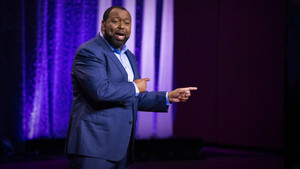
Entrepreneur Jay Bailey says so many ideas are never seeing the light of day because of a problem of belonging.
In his 2023 talk, he shares his journey to entrepreneurship.
He started when he was just 11 years old and explains how it became a catalyst for black owned businesses across the United States.
It's coming up after the break.
These days we're surrounded by photo editing programs.
Have you ever wondered what something or someone actually looks like under all the manipulation?
It's me, Elise, and this October I'm giving a Ted Talk in Atlanta about finding true beauty in a sea of artificial images.
I'm so excited to share the stage with all the amazing speakers of the Ted Next conference and I hope you'll come and experience it with me.
Visit go.ted.com slash Tednext to get your pass today.
And now our Ted Talk of the day.
I've got this new definition of hell that I'm still testing out.
My theory is this, that when we leave this earth, the vast majority of us are actually going to take the elevator up.
But when we get there, whatever God we believe in is literally going to show us every single thing that was possible in our lives while on earth had we only believed.
See, our biggest regrets are never rooted in our actions or the things that we did do.
It's in our inactions, the things that we did not do or even try.
And it's usually because we didn't believe we could.
I'm not good enough. I'm not smart enough.
I'm not rich enough. I didn't have time.
Beliefs are generally formed by two things.
Other are experiences, our environment, our inferences or our own deductions or by accepting what other people tell us to be true.
And most of our core beliefs are former we're children.
Now I was a horrible student.
I was branded gifted in kindergarten.
I was a really smart kid, but I hated school.
I was always in a prize. I was the kid that used to make popsicles in the ice tray and sell them for a dime on my driveway.
I was so cold with it, y'all, that I used to charge people 50 cents to fight in my back yard so they wouldn't get in trouble getting fighting in the front yard.
And that is a true story.
That is a true story. I love the transaction.
And I was riding my bike to the barber shop one day and I'll never forget this day.
I was 11 years old. Riding my bike to the barber shop and you got to understand when I grew up in the 80s, you could have put a Bentley next to a Ferrari.
And I would have taken a Ford Mustang GT5.0 every day of the week.
So as I pull up to the barber shop on my bike, I'm frozen in my tracks.
I'm talking deer in headlights.
Why? Because oh my God. There it was.
A black, on black, on black convertible.
Mustang GT5.0 parked illegally in front of the barber shop and I lost my mind.
I ran into the barber shop and screamed.
I'm 11. Whose car is that?
And so I see my barber in the corner of my eye just chilling in the cut.
Then he gave me the nod. Ask the universal soul, brother symbol, if it asks me.
And so because of my environment, my examples, my inferences, my deductions, there was only one thing that he could have possibly done to afford that car.
And because it was so normalized in my community, I didn't think anything of it.
So when I got in this chair as a matter of fact, as I'm asking about the weather, I asked him, I said, John, I didn't know you were a dope boy.
Dick turned off the clippers, screamed at him, shut the F up and turned around and count how many chairs you see in this shop.
I said, I don't know, 10.
He said, well, each one of these barber's pays me $50 a week to cut hair in my shop.
Jay, you're smart, do the math.
So little Jay Bailey started tabulating.
And he stopped me. He said, you got to realize I got two more shops just like this, finished the math.
So now things got interesting.
Remember, this is the early 80s that I'm an 11 year old kid and I had never seen zeroes like this.
I was like zero, zero, zero comma, zero.
And then he said it. He said, I am an entrepreneur.
I own this business and I own those other two shops.
And what you need to do is go find you something you love and go make money doing it.
Two very powerful things happened in that one moment.
For the first time in my life, I had ever heard the word entrepreneur.
And it's what I had always been, but I didn't have a name for it.
And so literally, once I started to understand what entrepreneur really meant, my life started to make sense and I had direction.
And the second thing was that nobody had ever explained to me the whole concept of ownership.
And those two things fundamentally changed my trajectory.
I can't understate or overstate the power of that chance encounter that lit a fire in the belly of an 11 year old kid.
They became a 12 year old business owner who now stands before you leading the largest center in the world dedicated to growing, scaling, and developing black businesses.
Touching thousands of entrepreneurs.
Wow. And so for what we did there and for now touching thousands of entrepreneurs, I knew that we lose GDP every year because the brilliant ideas to reside on the south side of the tracks of every city in America never reach the marketplace because they don't believe they belong.
And I'm also a firm believer that the only difference between that north side of the tracks and that south side of the tracks is access, opportunity, and exposure.
And that's it. You want to talk about innovation?
Show me somebody on the planet, more innovative than a single mother with two kids making $17,000 a year.
The way she thinks, the way she problem solves, her grit, her determination, her resilience, how is she able to smile and still spread joy to her kids at Christmas when there are no gifts under the tree and there is literally no food in the pantry.
But somehow she still makes it work.
How does she do it? In this example she feels like a warrior.
But what does she believe when she stares in the mirror?
And now back to the episode.
I don't condone them, I don't celebrate them, but I did grow up around them.
And I got tons of my friends that are twice as smart, twice as sharp, ten times as charismatic as me.
But they made different decisions and choices in life and they came with severe outcomes.
But I'm still enamored by them why?
Because we can go to any hood in America and find me the biggest baddest dope boy on any block.
And y'all are going to have to convince me that that kid doesn't understand import, export, wholesale, retail, supply, demand, customer attention, customer support, loss prevention.
All what a gun do is head.
And the cops and his competition, literally trying to eviscerate him from the equation every single day.
What if that kid had different experiences, different exposure, different income, inputs, better role models?
If he did, he run circles around everybody.
What was whispered in his ear that he believed?
And what were the environments that he was placed in where he felt like he belonged?
That's the power of what we are trying to do with the Russell Center.
Because when I started to think about an opportunity to create this safe space where literally I started to tap into the most powerful examples of economic mobility in our community's history.
Motown and historically by colleges and universities, our HBCUs.
We wanted to be disruptive to the typical incubator accelerator model because statistically they just haven't worked at scale for black entrepreneurs.
And the thing about Motown and HBCUs, the beautiful similarity is that you were surrounded by black brilliance every single day.
Your ideas matter. You saw value in your own reflection.
Literally you understood greatness at a higher level because you experienced it every moment of every waking minute.
And so we got started. And you can read it in my bio that I have the high on of leading the HJ Russell Innovation Center for entrepreneurs right here in Atlanta, Georgia.
In honor of one of the greatest entrepreneurs this city has ever produced, Mr.
HJ Russell. So when we started to think about HBCUs and Motown and what made them so special, we thought what could make us so special and different.
And so with our platform we got started.
Creating this space that was rooted in belonging.
The undergirded self-esteem, self-confidence and belief that literally looked at looking at the whole entrepreneur and not ignoring the loneliness, the depression, the isolation that goes along with any entrepreneurial journey.
But also making wellness just as important as learning about a P&L or a balance sheet.
And just four years from getting started, we support now 360 entrepreneurs full time that have created 1500 new jobs in our community.
We touched 10,000 annually through our network of partners and our stakeholder companies have generated over 450 million dollars of new economic value in our community.
We created this space where our ideas matter and we have the freedom to believe.
We created this space where we knew without a shadow of a doubt we belonged and we're just getting started.
We're closed with this.
If you are black, brown or a woman, without ever having a single conversation with you individually, I can assume this to be true.
But if you are black, brown or a woman in some way shape or form, you have heard the speech.
You've got to be twice as sharp, three times as smart, five times as perfect, just as sometimes compete with mediocre.
And so every day we put on the mask.
Every day we put on this heavy suit of armor to protect ourselves and it gets so heavy never being able to show up as your true authentic self.
You're being able to take off that mask or take off that armor and the world suffers because of it.
Because the world never gets to meet the real you, the authentic you, the you that is brilliant, the you that is full of ideas, the you that is powerful, that gets hidden every single day.
So I'm asking each of you and finding this place, the you that gets hidden every single day, the powerful you that never gets seen because guess what, there is a beautiful you that maybe even your best you that you've never even met yourself.
When we started this journey, there were no seats for us in these spaces.
So we started to build our own.
We had to surround ourselves with the people and the places that allowed us to believe.
We started to ignore these seeds of doubt and only started to plant seeds that would grow trees who shade you may never sit under owning your space, believing in you, your best self and introducing yourself to your best self because literally the world suffers every day it does not have your full self in it.
The best you, the real you and we can't wait to meet you.
Thank you. That was Jay Bailey speaking at Ted Women in 2023.
If you're curious about Ted's curation, find out more at Ted.com slash curation guidelines.
And that's it for today.
Ted Talks Daily is part of the Ted Audio Collective.
This episode was produced and edited by our team Martha Estefanos Oliver Friedman, Brian Green, Autumn Thompson and Alejandra Salazar.
It was mixed by Christopher Faisy-Bogan, additional support from Emma Taubner, Daniela Balorezo and Will Hennessy.
I'm Elise Hugh. I'll be back tomorrow with a fresh idea for your feed.
Thanks for listening.