From Disney on March 21st to musical movie event of the year arrives in theaters.
Oh my name is Snow White.
Flaw Laughs. Good tickets now.
Fighting on a way. Snow White will have you on your feet.
I think that's a wonderful idea.
And cheering for more.
I was thinking the same thing.
Experience the magical story.
Magic mirror on the wall.
Who's the fairest one of all?
Snow White. Disney Snow White only in theaters March 21stby to PPA.
...ennial guidance suggests data gets on sale now.
Well, thanks so much for taking me on that tour of the Forever Go Topiary Garden Joy.
Of course, Cassandra.
It's a beautiful day to be outside, looking at all the different ways that just can be trimmed into shapes.
I thought that rose ADA does really look like a wedge of Palmethan cheese.
Huh, I thought it looked like a wedge of cheddar cheese...
...or maybe Gooda? No. Definitely, man -chaygo.
All right, let's head back inside...
Oh no. The door's locked.
Do you have the key?
I left it inside. What about your phone?
I'm inside. It's side.
Let us in. Hello, please.
We're stuck out here.
Ah, there's no one else here.
They all went to the grocery store to buy cheese.
You can't scope the perfect Manchago Shape Topiary without inspiration, Cassandra.
Make sense. Well, at least it's beautiful outside.
and we can just hang out and enjoy each other's company until they get back.
I do enjoy your company, but I have a very important and urgent message that I need to send right away.
And if I can't text or email or call, I don't know what I'm going to do.
Don't worry Joy. We'll figure something out.
You're listening to Forever AGO from APM Studios.
I'm your host Joy Doleau and I'm here today with Casandra from Wellington, New Zealand!
Hi Joy! Today we're talking all about messages, Casandra, you sent a great question to us about this.
Yeah, I wanted to know how sending messages has changed throughout history.
What makes you think of this question?
Well my dad told me that my great -granddad, he was in the war in Egypt, and he was a postman, and I was wondering how that changed, like, before that, and after that through history.
So how do you usually send messages?
I know my texts, or, um, email prefer not to cool, because it gets kinda confusing.
Do you have a right letters?
I write letters to my overseas friends they occasionally reply.
Sometimes we like, try all off and don't write letters anymore, but occasionally, yeah.
I'm there put these and stuff.
I used to do that too, like my families in Liberia in Africa.
We used to write letters when I was younger to them and I was like, Dear grandma, dear grandpa and it always started off with how are you?
I am fine. Yeah. I was starting off that way.
Like, I don't know what else I'm supposed to write.
Is there any like, old way of sending messages that you'd like to bring back?
I would like to know Morse code.
Oh, that sounds very interesting.
Yeah, the BPP, BPP, BPP, yeah!
Well, there are so many ways that people send messages today.
Takes messages! Letters through the mail.
Emails. And there are so many apps and websites that send messages to, like social media.
But unfortunately, being stuck out here without a phone or computer means that we can't send your urgent message.
The message needs to get there today, and the mail would take way too long.
Think, Joy, think! What is this message needing to send anyway?
Oh, I know. I bet history has a solution to this problem.
Quick, how do people send messages before computers and phones?
Well, I know about smoke signals.
Oh, right, I've heard of those.
Tell me everything.
Well, think about it.
Before we had modern technology, what something from the natural world you could use to get a message to someone far away.
Really quickly? Yelling as loud as you can!
No, that's not what I was thinking of.
I was thinking of smoke signals.
Oh yeah, that's good too, yeah.
People would build a fire, and then the smoke from the fire would rise up.
And then others could see that smoke from far away.
Exactly. people all over the world used to have different ways of using smoke to communicate.
I live in New Zealand and the Maori people dare use smoke signals to send messages.
If the smoke killed one way, I meant one thing, and if the smoke killed the opposite direction I meant another.
Controlling the way the smoke moves sounds tricky, impressive.
Indigenous people in North America and Australia also use smoke signals.
But like language, different groups of people had different ways of doing it.
So smoke signals meant different things depending on where you were in the world.
And they could control the way the smoke looked, too.
They could burn different things to make colored smoke or make the smoke plumes narrower or wider.
They could even cover and uncover the fire to release the smoke in different patterns.
And there were lots of different messages these signals could communicate, like news, sightings of animals or people, requests for help, or warnings.
Yeah, an ancient china.
Soldiers would send smoke signals from the towers along the Great Wall to one of approaching enemies So awesome Okay Cassandra let's do it.
Let's send our message through smoke signals Well in order to send smoke signals, we need to find a spot that can be seen from far away Like a hill or a tower or a cliff.
I love cliffs and then come up with a system for what the signals mean No problem.
I want Spoke in my own mate -up language for a week.
Or should I say, Blia blue brush not only are gonna go her little bit through!
And then we'll make sure the person receiving the message also understood what we mean.
Great. I'll just text them to let them know the code.
Joy... Oh, right. I don't have a way to send text messages right now, because my phone is locked inside!
Which is why we started talking about this in the first place!
Right well, maybe we should try smoke signals anyway Except I don't have anything to make a fire.
All I have in my pockets is string cheese a pen the world's tiniest violin a gum wrapper and Oh, all these bread crumbs.
Brade crumbs. You never know when you might need some Italian seasoned crunch and all right God my crumbs No. Back off pigeons?
Those are my crumbs!
Oh my. Wait a second.
Pichons. They're the answer!
That's it. Hello, Taurus lru.
Here, Piggy, Piggy, Piggy.
Here, Piggy, Piggy come here, Piggy, Piggy, Piggy.
Piggy. Joy? What do you mean by pigeons, all the answer?
Pichons could be the answer to our message problem.
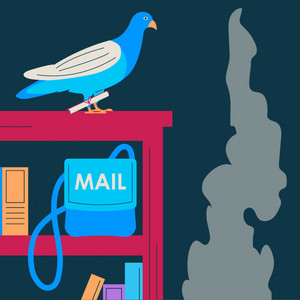
Did you know that for thousands of years people trained pigeons to send messages?
Yeah, I've heard of that.
They're called carrier pigeons.
Yes, also known as homing pigeons.
In ancient Greece, people use these pigeons to declare the winners of Olympic champions from town to town.
How'd it work? Pigeons have a great sense of direction.
So people would train them to always fly back to their home location.
Homing pigeons fly home makes sense.
Exactly. Once the pigeons were trained, people transported the birds to different towns or areas and waited until they needed to deliver a message.
Wow, I didn't realize using home ingredients took so much planning.
Right? When you had a message to deliver, you would write your message on a piece of paper, roll it up, and attach it to a pigeons' leg.
Then you'd release the pigeon and it would fly back to its own location to deliver the message.
That's impressive! Home and pigeons were used well into the 20th century, including during wars like World War II.
Right, World War II was a huge war that happened 80 years ago, starting in Europe.
There was no Internet, but phones and radio had already been invented then.
So why didn't the soldiers just use those to talk to each other?
Well during the war, phone lines or radio weren't always reliable.
Sometimes they'd go down during battle, or messages could be heard by the enemy.
so soldiers turned to pigeons.
Homing pigeons were a speedy way to deliver messages to military bases.
Some pigeons could fly hundreds of miles in a single day, sipping through the air as fast as 60 miles per hour.
That's so fast for such a tidy bird. These pigeons delivered lifesaving messages throughout the war, and some of them were even awarded medals for their service.
Oh hey Pidgey! I bet you're just as honorable in Speedy.
I know I'll write my Very Important urgent message on the back of this gum wrapper, roll it up and hmm how can I attach it This string, chase.
Ah, Cassandra, genius.
Here, Pidgey, Pidgey, hot, hoo -hoo -hoo -hoo -hoo.
Good, Pidgey, and ta -da!
Now fly my fast friend, the fate of the world rests on your wings.
Fly, fly. Joy, one Earth duty ride on that gong wrapper.
Oh, give me my extremely important urgent message?
Well, it said, Hey, Pidgey, why are you landing You've got a message to send.
Whatever you do don't you dare eat that string cheese.
Oh he's definitely eating the string cheese on his league.
Noo! Make extremely important urgent message, ford it again!
At least the pigeon was very well feared.
I guess that's true.
You're welcome. Let's take a moment to rest, reset and play a game up.
This is the game where we take three things from history and try to put them in order which came first, second and most recent in time.
We're sticking with the message memo and talking about three forms of messaging.
We've got semaphor, a system that uses flags to send messages, pagers which are little devices that beep and pneumatic tubes.
Those are tubes that carry canisters containing messages through buildings using the power of air and suction.
Cassandra, what do you think came first which came second and which came most recently in history?
The first one I think is it semaphore?
Semaphore, yeah, the system of four eggs.
I feel like that will be first because it seems my simple.
Yeah. Next, one I might think, is it pages?
Yeah, yeah. Pages. They just be, right?
So I think that's pretty easy too.
Yeah. They used to be called beepers.
Yeah. And then the last one, I'm pretty sure the latest in history would probably new magic tubes.
They sounded almost complicated.
So I'm pretty sure they'll come latest. I think, yeah.
Yeah. Yeah. Because it's got the air going in and out and bring the tubes from one thing to another.
Yeah. a sound is really complicated.
Alright, so we have Semaphore Beepers and the pneumatic tubes.
Yeah. That's great.
Ok, so if you had to choose one of these to send a message to someone what did you use.
I think the beeping ones, I think, is pages because lots of people can understand it, I'm pretty sure.
Yeah, yeah, I don't think this will give anything away, but I was around, beepers were around.
Oh, yeah, and they are cool, they're like these little bricks that you put in your body and they're all having, you could always see people checking their beepers and then you get a check of bread and then you go find a like a pay phone and then you call someone.
Cause like, oh, you beeped me.
It's like a phone, but like, they've beep instead.
Yeah, yeah, so you couldn't get in it.
It just like, it beeps and then you get like a number.
You don't get like any messages or anything.
It's like it beeps and it means that you got to call this number.
Yeah. Well, I don't think that I'll ruin the game.
I don't know when they were invented or when they were.
But I don't know when they are.
And that means me as old as time.
So when you're the answers that the end of the episode right after the credits.
So stick around. We've been talking all about different ways we've sent messages in the past, but we asked you, our Forever Go listeners, to send in ideas for how we might send messages in the future.
Here's what you had to say.
Hi, my name is Rosalie and I think How messages will be set in the future is you can have tubes like built between you and another person's house, and instead of having to have your mail or like your pictures or whatever you want to send, go through the whole mail system.
You can just put it in the tube, press it right, and you know, go straight to their house.
Hi, my name is Al Dander.
I'm from Owaytha, Kansas.
But I think we would send messages in the future with sound -moving drones, because when you talk to one of the drones, you sit the drone, move the voice all the way to the person who you want to talk to.
My name is Fiona, and I'm from Ball Harbor, Maine.
I think messages from the future would be robot -carry messages to us.
I will go, my name is Ariin and I'm from Andover for March. In my way, I think we're going to set messages into future, if there's a box and it's metal and you put your note in the box.
And then there's a drone.
And then you plug up and then you press the button to wherever you want.
There's one on the fly and I'm putting the number code and then it flies straight to wherever you want it to fly to.
treat to your opinion to your My name is Even.
I'm from Minneapolis Minnesota.
My idea for messages of the future is the bubbles that you can choose to color of and where the message to put in and you can also choose the shape of it.
Thanks everyone for sending in those amazing ideas for how we'll send messages in the future.
Cassandra, how would you send a message in the future?
I was thinking in the future.
We could have like these mind caps and then we to think of like what other people are think, not really what they're thinking, but what they want to send to you.
I like telepathically send it to you?
I thought that would be quite a lot.
Like through your brain.
So like, no one else can know.
It's only just like you and then, kind of.
Oh yeah, it'd be so cool.
So you put it on your phone hat.
And then it's like, okay.
Well, I have my very important message.
I just sent you a message in my phone cap.
Did you get what I said to you?
Yeah, I got the message.
Listeners we love hearing from you.
If you have a question about history or ideas for a future episode, send it to us at ForeverGo .org and keep listening.
Brain Zone Universe is a family of podcasts for kids and their adults.
Since you're a fan of ForeverGo, we know you'll love the other shows in our universe.
Come on. Let's explore.
Here we are in brains on universe.
Until my favorite podcasts.
Brains are. Smash boom best. Four ever ago.
I found one. Smash boom best. The smart funny debate shows.
Please give us the skinny on my C shells are superior.
Ultimately, seashells are great because beach. Hey friends, Molly, Sanden, and Mark here with some very big news.
We're hitting the road in search of adventure, fresh air, and you.
That's right. We're gonna be live at the Boulder Theater in Boulder, Colorado on Sunday, April 27.
Our Science Theme Thee Live stage show takes the audience on an adventure through the brain, complete with magics, stands, moves out of body experiences mystery, sounds and a game show.
Molly, you almost left out the most important part.
Yup, Molly. Don't forget the big party.
Oh, right. After the shows, we're throwing a brain -tastic bash.
Join us afterward for a VIP party where we'll play games, guest mystery sounds, post -reporos and give as many high fives as humanly possible.
Snag a spot by purchasing a VIP pass when you buy your show ticket.
Oh, that reminds me, I've got to start training!
These hands aren't going to high five by themselves.
Good idea! And remember, spots are limited, so grab your tickets today at brainson .org -events.
The soldestory podcast is about how teaching kids to read went wrong.
But now we have a story about a school district where things are going very bright.
Let me make sure my friends are sitting across Apple's office and then they're laughing.
I've never had a child that couldn't read.
How did they do it?
When I tell some of my other colleagues that may be at other schools that this is what I do and they would say, you're good, me?
New episodes of Souls of Story are available now in your podcast app.
You're listening to Forever Go.
I'm Joy and I'm Cassandra.
And we're trying to figure out how to send a very urgent message without phones or computers.
Turns out, it's not easy.
Wait so what about using smoke signals?
But we didn't have a system for what the different kinds of smoke meant.
Or a cliff, or anything to build a fire with.
And then we tried sending the message by Persian.
But the pigeon was very uncooperative, and now it thinks it can just hangout on my shoulder waiting for more string cheese.
We'll keep waiting because I'm all out.
Yeah, you kind of skipped the whole training position to deliver the messages part of the process.
Oh, maybe I should just try yelling the message.
Joy, we talked about that already.
You do have a very loud voice, but even you can't yell that far.
Less thing. How do people send messages before the postal system?
Pidgey would like you to explain what the postal system is.
It's a network of male carriers, post -stoffers' trains, planes, and trucks that get litters and packages from one place to another.
I'm always amazed that I can put a letter in a mailbox and it will eventually arrive at its destination.
Like the many, many Christmas cards I send every year, they're heavier than normal Christmas cards because they have a surprise inside.
What's the surprise?
I can't tell you, because it's a surprise.
But it rhymes with, Smush -minded smudge smudge.
Smudge, smudge, sm lots more, smo -mo.
A side headshot of Joy -Doh -la?
How'd you guess? Shoot, I don't think there's something else.
Maybe Smustered Smack -A -Tz?
Mustered Peck -A -Tz?
Cassandra, stop things so good at guessing what I'm trying to hide from you or what.
Massachusetts not saying it out loud.
Good point, good point.
Anyway, back to the Postal Service, here in the United States the Postal Service is about as old as the country itself.
Let me set the scene!
It was the 1700s. English colonists had sailed to North America and claimed land on the east coast for themselves.
Yeah, even though indigenous people have been living there for a really long time already.
England set up colonies here and brought a lot of their own British customs and ways of doing things, including the British Postal Service.
These male carriers would deliver letters by foot or horse, since there were no cars or trucks or even trains back then.
Eventually, the colonists in North America got really fed up with the British rollers forcing them around.
If colonists set mail through the British Postal Service, the British could open their letters and read them.
This made it pretty hard for colonists to complain about the British rollers or make plans against them.
So, the colonists set up their own Postal Service, where they could talk smack about the British rulers without them knowing.
They established their own post offices with their own male delivery people.
They had to promise to keep the male under lock and key until it arrived at his destination.
So, the colonists were able to make plans and exchange information without the British rulers reading it.
The flow of letters and information was super important for the planning of the American Revolution.
Where the colonists declared their independence from the British.
This led to a war which the colonists won, and the birth of the United States of America.
And one of the first acts of the United States government was to turn this unofficial postal service into an official one.
And there are way older postal systems in the US or British ones, ancient Persia, India, Rome and China all had postal systems. They relied on horses in oxen to get the letters where they needed to go as fast as possible.
Hmm any horses are on here for us to use.
Oh no. Oxen? Also, no. No, PIGI.
We still don't have any more string cheese.
Ah! I'll never get this super urgent and important message delivered in time.
I just realized you never told me what the message is, or where it's going.
That might help to know.
Oh gosh! So sorry. I was so caught up in the urgency of it all.
I need to get this message to the deli across town before they close at 5pm.
The deli? Is there a bagel emergency?
Do you need to order more cheese as the inspiration for the cheese theme Topery Garden?
No. I need to let them know that my recent Sandwich Order had...
...manees on it. That's the urgent message.
I hate mannees. I need to register my complaint before the deli closes today.
This can't happen again.
It mustn't happen again It shank happen again.
That deli is like so close.
If you start walking there now, you'll definitely make it before five Oh, that sounds like a lot of work Pidgey come here What's in it for you?
I'll buy you more string cheese if you fly this message to the deli Okay, fine.
Two more string cheeses.
10. That's absurd. I can do three more string cheeses.
15. That's not how negotiations work.
5 string cheeses. And that's my final offer.
Thank you. Thank you for taking my message, Pidgey.
Now fly, Pidgey. Fly.
We did it, Cassandra.
The message is on its way!
Uh joy, the Delis and the Alva direction.
Pidgey, come back! You're going the wrong way!
I meant going north, you're going west!
No, that's... that's south!
Pidgey! Pidgey! No, no. Don't eat the string, Pidgey." Pidgey, Pidgey, come back here.
There are been so many different ways to seeing messages throughout history.
from telephone, and texting, to the letters, and email.
Many different indigenous cultures across the world use smoke signals to communicate.
For thousands of years, people used homing pigeons to deliver the messages, including during World War II.
Different cultures have had their own versions of the Postal Service for centuries.
In the US, the Postal Service became a way for colonists to plot against the British.
And thus eventually led to the American Revolutionary War.
This episode was written by Molly Bloom And Ruby Guthrie.
It was produced by Ich Ogans -avas -whbuster.
And Ruby Guthrie. Our editors are Shayla Farzon and San Len Todd Fact -checking by Ruby Guthrie Engineering help from Alex Simpson and Peter Molteno with Sound Design by Rachel Dres Origenoth seemed music by Mark Sanchez We had a additional production help from the rest of the brains on university Rosie Dupont and Goldfield Lauren H Tombburg Joshua Ray Mark Sanchez Charlotte Traver And a wiggle.
And, Aron Woldas -Ola -Sysi.
Beth Perlman is our executive producer, and the executive and charge of APM Studios are Chandra Cavati and Joann Griffith.
Special thanks to Tomoyo, and Simon Gibson.
And feat. Cassandra's great -granddad Don Gibson for inspiring this question.
And if you want access to ad -free episodes and special bonus content, subscribe to our Smartie Pass.
Okay, Cassandra! Are you ready to hear the answers for first things first?
Yeah! Yeah, yeah, okay, so as a reminder we're putting these three messaging systems in order of when they were invented.
We've got Semaphore, a system that uses flags to send messages, pagers, also known as beepers and pneumatic tubes.
The system of tubes that carry canisters containing messages through buildings using the power of air and suction.
And that is actually the same order that you put in, right Cassandra?
Yeah, I feel good for it too.
Okay, here we go. here we go Oh my gosh okay you did really well Cassandra First up right out of the gate.
You got it right summer for was the old history.
Yeah So that was invented in seventeen ninety -four and so ancient cultures have used visual signals for centuries like smoke signals, but the official flag system was invented in 1994 in France The signer holds flags or paddles in each hand then moves their arms in different positions and combinations to communicate different things There's even a specific sign for each letter of the alphabet Semaphore is still used by the us navy today.
Oh Now that I think about it, my friend told me about some flag language that they used for voting.
Oh Really, okay, so maybe something in like the ocean world there's a lot of somewhere happening So second up was actually pneumatic tubes.
So those, yeah, those were invented in the 1850s.
So the British post office started building a huge network of pneumatic tubes to carry mail throughout London and by 1886, London's postal tube system was over 30 miles long and carried over 30 ,000 messages every day.
By the early 1900s, systems like this started popping up in cities across the US like Philadelphia, Chicago, and St. Louis.
And most pneumatic tube systems phased out by the 1950s because they were too expensive to keep up, but some places like mail rooms and banks still use pneumatic tubes today.
Oh, yeah! I didn't think that I would still use it because it seems very complicated so I thought they'd make it more simple by now, but.
Yeah, you'd think so.
And last but certainly not least is pagers or beepers.
The first pager like device was invented in 1921 And the pager really took off decades later, starting in the 1980s, and by 1994 over 60 million people used pagers worldwide.
Today, lots of hospital workers still used pagers to communicate.
Oh, well, what'd you look at that?
So that means that they use basically all of them still.
Yeah, they're all still working, so these are things that are like in our world in our backyard. So we can go look up semaphores and pamatic tubes and pagers.
Yeah, that's so cool.
Which one of these were most surprising for you?
I think the... um...
the newmatic tubes?
Mmm -hmm. I thought that was most surprising.
Cause I thought they would have moved on by now.
Because it seems the most complicated and...
yeah. Yeah. Yeah. Yeah.
Doesn't even like, kind of like, old school.
You think they'd be like a new...
...a new -neumatic tube.
Yeah, yeah. I thought so too.
Maybe we should advent it.
Yeah. Just like all the ways of messaging.
Yeah. Yeah. We'll be back next week with an episode all about Jack -o -lanterns.
Thanks for listening.
The Soul To Story podcast is about how teaching kids to read went wrong but now we have a story about a school district where things are going very right.
How did they do it?
When I tell some of my other colleagues that may be at other schools that this is what I do, they would say, you're kidding me?
New episodes of Soul To Story are available now in your podcast app.