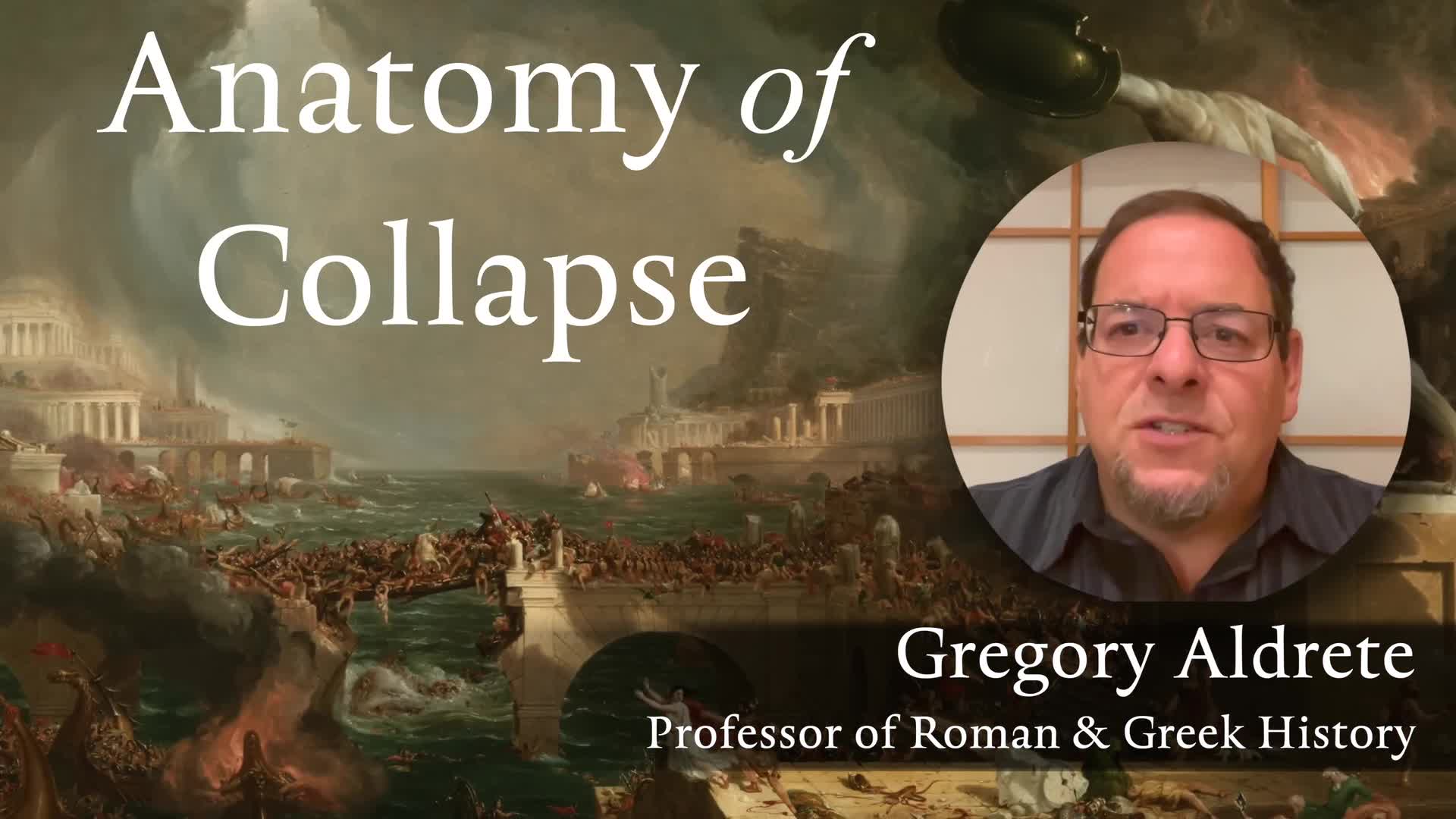
Hello, and welcome to another episode of After School.
My name is Greg Aldrette, and I'm a history professor who studies ancient Greece and Rome.
Today, we're going to explore two of the most famous and widely debated questions in all of history.
When did the Roman Empire fall and why did the Roman Empire fall?
Over the centuries, dozens of thinkers have proposed hundreds of different answers to these questions, and even today, historians do not agree on the answers to either question.
Recently, in a triumph of orderliness, one German scholar even compiled an alphabetical list containing no fewer than 210 possible causes for the decline and fall of the Roman Empire, beginning with Aberglaube, a superstition, and methodically proceeding through the alphabet to Zolabat celibacy.
Since the influence of roman civilization still remains hugely important to the modern world in many fundamental areas, such as language law architecture, government and religion, it's worth taking a look at some of the most popular dates and causes that have been proposed for the fall of the roman empire and see what merits each has.
First, when did rome fall?
Some have argued that 31 BC and the Battle of Actium marks the beginning of the end for Rome.
Proponents of this date see Octavian's victory at Actium, which led to the fall of the Roman Republic and the establishment of the Empire, with Octavian becoming the first emperor under the name Augustus, as being the moment from which everything inevitably went downhill.
Most historians however, seem to accept that, despite the switch from republic to empire, Roman civilization not only continued but did not actually reach a peak until about a century later, during the reign of the five good emperors in the second century AD.
The end of that era gives rise to one of the most frequently suggested dates for the fall of Rome the death of the philosopher, Emperor Marcus Aurelius in 180 AD and the accession to the throne of his mentally unstable son, Commodus.
The appeal of this date is that it marks a clear transition from a period that is regarded as the Golden Age of Rome and a time when the Empire was challenged by a variety of disasters, both internal and external.
Thus, although the Empire clearly continued for some time, AD 180 is often cited as the moment from which affairs assumed an irreversible downward momentum.
Interestingly, this seems to be the date favored by Hollywood, since it's the focal point of several high-profile films, including the 1964 classic The Fall of the Roman Empire and the 1999 Oscar-winning epic Gladiator.
Even the Romans themselves seemed to be aware that this was an important turning point.
For example, speaking of this moment, the ancient Roman historian Cassius Dio wrote that quote our history now descends from a kingdom of gold to one of iron and rust.
The next popular date for the fall of Rome comes at the beginning of the fourth century AD, when there were civil wars, one of which ended in 312, with Constantine emerging as the victor and becoming the first emperor to convert to Christianity.
Proponents of this date claim that the personal, inward-looking ideology of Christianity was fundamentally antithetical to the outward public focus of Roman civilization.
The next set of dates focus on invasions by various barbarian tribes during the 4th century.
The death and defeat of the Roman Emperor Valens at the hands of the Goths in AD 378 at the Battle of Adrianople has been put forward as demonstrating the moment when the Western Empire proved incapable of dealing with the threat posed by the barbarians.
Another barbarian-related date is AD 410, when King Alaric of the Visigoths invaded Italy, captured the city of Rome and sacked the ancient capital.
Now, in reality, the damage from this event was limited, but there's no denying that, in symbolic terms, this was a devastating blow to the image of Rome.
Others prefer the slightly later but much more severe sack and thorough looting of Rome by Gaiseric and the Vandals, which occurred in 455 AD.
The final major barbarian-related date for the end of Rome is 476 AD, when the last supposedly legitimate Western emperor, Romulus Augustulus, was deposed by the barbarian king Odoacer, who then proclaimed himself king of Italy.
Some have tried to answer the question by focusing less on military disasters and more on when supposedly legitimate or real Romans passed from the scene.
This, however, raises the complicated question of just who counts as a real Roman.
Sometimes this leads people to equate the Italians with the Romans, but the Roman army had been largely composed of non-Italians long before any of the dates in question.
Similarly, to find an era when the members of the Roman Senate had been selected entirely from Italy, one would have to go all the way back to the time of the Roman Republic.
By the 3rd century AD, the emperors were regularly being drawn from the provinces, such as Septimius Severus, who was a North African.
Even at Rome's height, in the 2nd century AD Trajan, the first of the five good emperors, was of Spanish provincial origins.
For much of its history, Rome's emperors, senators and legionaries were a mixture of people from Italy Europe, Africa and what today is called the Middle East.
In fact, one of the strengths of the Roman Empire, and a secret to its longevity, was its openness to incorporating foreigners, Romanizing them and thereby reinvigorating the empire.
Perhaps the trickiest question concerning the fall of Rome however, is that, even if the western half of the empire can be considered to have collapsed by around the end of the 5th century AD, The eastern half of the empire just kept cruising along for centuries more.
An unbroken succession of Roman emperors ruled over this eastern Roman Empire, sometimes called the Byzantine Empire, all the way up until 1453, when its capital city of Constantinople, fell to the Ottoman Turks.
It might seem odd to speak of a Roman Empire that does not include Rome or Italy, but the Byzantines certainly regarded themselves as real Romans, and pretty much everyone at the time thought so as well.
Thus, a legitimate argument can be made that the Roman Empire did not fall until 1453.
We're already up to the 15th century in our quest for possible dates for the end of Rome, but it is possible to stretch it even further.
If one looks at continuity of titles or self-proclaimed heirs to the Roman Empire, one can push dates for Rome's fall nearly to the present.
After all, the title with which Charlemagne, the first great king of medieval Europe, was crowned by the Pope on Christmas Day 8800, was Charles Augustus, Emperor of the Romans.
One of the most coveted titles throughout the Middle Ages remained that of Holy Roman Emperor.
And there was a continuous string of such Holy Roman Emperors until the last one was deposed by Napoleon in 1806.
Then there are the Russian Tsars, who regarded themselves as heirs to the Roman legacy and whose very name is a corruption of the imperial Roman title.
Caesar the last Tsar ruled until the Russian Revolution in 1917.
When then did Rome fall?
As we've seen, quite reasonable arguments can be made for 31 BC and AD 180 312 378 410 455 476 1453, 1806 and 1917.
Even this long list, spanning almost 2000 years, by no means exhausts the range of possible dates that can and have been proposed as the end of the Roman Empire.
If the date for Rome's fall is contentious, the reasons for its decline and collapse are no less so.
But let's now turn to the second question and see if we can find more clarity by considering some of the most influential explanations for Rome's downfall.
Many of these suggested dates for Rome's fall center around the idea that Rome was simply overrun by hordes of barbarians.
In this view, Rome's fall is primarily due to an external factor.
This viewpoint was given vivid and succinct expression by one French historian who wrote Roman civilization did not die a natural death.
It was murdered.
He and others argue that the Roman Empire was essentially sound, but that it fell to repeated and overwhelming attacks by barbarians.
Edward Gibbon, the author of the most famous work on Rome's fall the decline and fall of the Roman Empire, also emphasized the importance of this factor, bluntly stating that the Roman world was overwhelmed by a deluge of barbarians.
This is an interpretation that is essentially military in nature, that there was a conflict and the Roman military proved inferior to the enemies that they faced.
Some variations on this theme lay the blame on related conditions, such as a decline in the quality of the Roman legions, poor generalship, a manpower shortage that left Rome without enough troops or resources to resist, or simply that the numerical superiority of the barbarian armies was irresistible.
A second set of explanations concentrates on economic circumstances.
Some hypothesize that there was a decline in arable land or in available workers, resulting in reduced tax revenue and economic strain.
Other scholars have suggested that the soil became exhausted through over cultivation.
Still, others find evidence for a growing inequality between rich and poor or a disengagement of local elites from public life, resulting in redirection of resources and diminished civic patronage.
Some point to economic stagnation due to over-reliance on slave labor, while others assert that there was a shortage of new slaves to provide adequate labor.
The later Roman Empire certainly did suffer severe economic crises, with periods of steep inflation and debasement of the currency.
While, at the same time, barbarian incursions, civil wars and supporting the large military all drained and weakened the economy.
A third explanation sometimes offered is that the emergence of Christianity as the dominant religion resulted in a decline of Roman power.
The church acquired large tracts of land and kept the income for its own purposes, reducing the resources available to the state.
Monks nuns, hermits and members of the church added up to large numbers of people who, at least in economic terms, were parasites on society and had to be supported by the labor of others.
In psychological terms, it has been argued that christianity, with its emphasis on the next life and finding personal salvation, undermine traditional roman virtues of service to the state and civic engagement.
Christianity offered an alternative power structure, social hierarchy and value system which competed with those of the earlier Roman world for allegiance and talent.
Some historians have advocated a kind of biological model in which all nations, just like human beings, inevitably go through a natural progression of birth growth maturity, decline and death.
In this view, nothing ever remains constant, but must follow an inevitable cycle.
Some adherents of this theory further believe that prosperity and growth themselves carry within them the inevitable seeds of decay and decline.
While plausible arguments can be made for all these explanations, there are other, often repeated ones, that enjoy more popularity than they probably deserve.
These include the notions that Rome fell because of lead poisoning from the pipes that carried water or because of a descent into moral degeneracy.
Both explanations are oversimplified and contradict chronology.
While lead pipes can and do cause health problems, the Romans used them throughout their entire history, including the periods of Rome's rise, its expansion, when it was at its peak and during its decline.
Since lead pipes were a constant factor, lead poisoning cannot be the cause that precipitated Rome's fall.
What about the idea that Rome declined and fell due to moral decay?
This notion appears in the writings of moralizing Victorian authors and really got cemented in the popular imagination due to sensationalist Hollywood movies, which love to depict degenerate Romans.
Uh, spending all their time indulging in lavish feasts, holding debauched orgies and attending blood drenched public spectacles like gladiator games.
There are several problems with this argument, however.
The number of Romans who had the time, wealth and inclination to engage in this sort of behavior was minuscule.
In fact, most of the commonly cited stories of sexual debauchery or cruel violence involve a handful of admittedly crazy emperors, such as Caligula, Nero and Commodus.
While these men absolutely did engage in acts of sexual depravity and extreme violence.
Remember the Roman Empire contained around 50 million inhabitants at its peak.
And the behavior of a few individuals is not representative of everyone else.
The average Roman citizen would have been an impoverished, hard-working farmer living in the countryside who ate a monotonous diet, never got anywhere near an orgy and, if he was lucky, saw a spectacular public entertainment maybe once or twice in his lifetime.
Characterizing all of Roman civilization on the basis of a couple of nutty emperors would be analogous to saying that the daily experiences of the average American can most accurately be represented by studying the lifestyles of LeBron James, Mark Zuckerberg, Taylor Swift and Beyonce.
There's also a chronological problem, since almost all of these lurid anecdotes date to the late Republic or early Empire, when the Roman Empire was still expanding and growing in power and had not even reached its peak, rather than from the much later phase of its decline and fall.
Sometimes the existence of slavery is cited as having caused Rome's moral decay.
Slavery is unquestioningly immoral, but it was a standard component of almost every ancient society, rather than being unique to Rome.
And again, it was most widespread and essential to the Roman economy during the period of Rome's growth, not its fall.
In fact, during the time when Rome is usually thought of as being in decline, institutions such as slavery and gladiator games were diminishing in popularity and being criticized on moral grounds by Christians as well as some pagan intellectuals.
So, if anything, one could potentially make an argument that Rome declined when it became more moral, not less.
In recent years, explanations that focus on environmental factors have become especially prominent.
Some of these ascribe to changes in climate not just Rome's fall but its rise as well, arguing that the roman empire was only able to attain the size it did because roman imperialism had the good luck to coincide with a period of unusually warm, wet and stable climate across the mediterranean basin that began around the 3rd century bc and lasted until the mid 2nd century ad, precisely the time of rapid roman political and economic expansion.
They label this fortuitous era of favorable environmental conditions the Roman Climate Optimum and suggest that it is largely responsible for allowing the density of population that enabled the growth and prosperity of the empire.
According to this theory, around 150 AD, environmental conditions became unstable and shifted towards drier, cooler averages, causing negative impacts on agriculture.
Concurrently, there were waves of epidemic disease, most notably plague, that further eroded economic production and reduced the population.
Finally, during the 5th century AD, an upsurge in global volcanic activity sparked a late Roman Little Ice Age which lasted until the 8th century AD.
Adherents of this environmental explanation have cited a range of scientific data, from tree rings to solar output, in support of this particular theory.
And whether or not one is convinced that environmental changes were the primary cause of both the rise and the fall of Rome, this body of evidence suggests that they were at least contributory influences.
There is a further twist to this debate, however.
Have we been asking the right questions in the first place?
Whether due to barbarians environment, economic collapse, Christianity or some combination of factors, All these dates and explanations still center around the core assumption that a powerful civilization fell and that the history of this era is essentially one of decay and decline.
However, the arrival of the Germanic and other barbarian tribes during these centuries was not a simple story of one culture replacing another, because the barbarians themselves were profoundly influenced and changed by the Roman civilization that they had supposedly conquered.
Many of the political structures, institutions and titles established by the Romans either endured or were copied.
Latin and, in the East, Greek survived and remained vital languages.
In assessing the history of this period.
It's too simplistic to fixate on a supposed struggle to the death between Romans and barbarians, not least because the barbarians were very often invited within the borders of the empire by the romans themselves, who hoped to enlist them as allies or to enroll them in their military.
Not only was the reality of barbarian invasions more complicated than often depicted, but the division between roman and barbarian was frequently blurred.
With so many barbarians fighting for Rome and holding Roman titles, it was often hard to tell who is a Roman and who is a barbarian.
In recent decades, even the basic premise that the main story of this era was the fall of the Western Roman Empire has been challenged.
Some historians have chosen instead to highlight the elements of culture in which there were growth and innovation.
They assert that our single-minded focus on the political and economic collapse of the Western Empire has blinded us to the more important things that were going on at this time in other areas, especially religious and intellectual history.
Rather than seeing the period between, let's say, AD 300 and 700 as a time of decline destruction, collapse and chaos, Adherents of this view argue that it was an era when invigorating changes, bold new ideas and stimulating interactions transformed the stagnant classical world.
While the life of Jesus had occurred several centuries earlier.
It was during this later period that Christianity became dominant and defined many of its key doctrines.
Brilliant Christian thinkers such as Origen Eusebius Augustine, Jerome and Ambrose poured over religious texts and engaged in lively debates.
Popes, bishops and intellectuals met in church councils and wrote treatises arguing various theological positions.
The judgments reached at these councils, such as the Nicene Creed formulated at the Council of Nicaea in 8325, became the basis for official Christian doctrine.
Important religious phenomenon such as the monastic movement and the cult of the saints also arose at this time.
And it was not only Christianity that emerged and grew to prominence.
Towards the end of this era in the 600s, Islam was established and spread as well.
Therefore, during the very period when there was widespread political and economic disruption and collapse, we also have the birth of new religions, states and social forms which constitute the foundations for the modern world in terms of borders religion, law and culture.
While it might seem that the traditional interpretation of this era that focuses on invasion, death and destruction is incompatible with the one that emphasizes growth, innovation and creativity, the two may not be as irreconcilable as they appear.
If you are primarily concerned with levels of economic prosperity or traditional political structures, then the negative interpretation is an accurate assessment.
But if you're mainly interested in spirituality, then the more positive appraisal of the period can genuinely be the more truthful version.
All of these debates about when, why or even if the Roman Empire ended demonstrate much about the way that we conceive of history and how it unfolds.
There's a natural tendency on the part of human beings to want to neatly divide the past into separate epochs and then list a set of defining characterizations for each one.
In our desire to establish distinct historical eras.
Such periodizations result in oversimplifications and generalizations.
This is an interesting debate.
But at some point what we call Roman civilization did surely fall, or at the very least became so transformed that it should be considered something different.
So let us return to the two big questions that I started with.
When and why did the Roman Empire fall?
You might be wondering where do I, as a history professor who has spent a great deal of time studying ancient Rome, stand on those questions?
Well, as this brief survey probably already suggests to you, I do not believe there is any single right answer.
I think there can legitimately be multiple right answers, depending on which specific aspects of history or culture one is interested in.
This is especially true with regard to the question of why did Rome fall?
In my opinion, the fall of Rome was due to a set of circumstances and causes, rather than to one in particular.
The collapse of the Roman Empire is simply too complex and multifaceted a phenomenon to be attributed to a single cause, but it can perhaps be convincingly explained as the confluence of a constellation of different factors.
When it comes to the other question, when did the Roman Empire fall?
Even if you think there's good arguments to be made for multiple dates, as I do, it should be possible to pick one that you think is the best answer.
So if i had to choose just one date to mark the end of rome, i personally would choose ad 1453, at the conquest of constantinople by the turks.
I believe that the byzantine or eastern roman empire does constitute a legitimate branch of roman civilization, And thus Roman history stretches from the foundation of the city of Rome in 753 BC to the fall of Constantinople in AD 1453.
That's an astonishingly long time span of 2,200 years.
There are very, very few civilizations that can claim to have lasted for over 2000 years or to have had as much success and influence as Rome.
In the end, perhaps a better and more important question to ask than when or why Rome fell would be to inquire How did it manage to last so very, very long?
Thanks for tuning in to this episode of After School.
If you want to know more about ancient Rome, you can check out any of the audio or video courses that I've made with The Teaching Company, The Great Courses, or any of my books.
All of them are listed on my website, gregorysaldrette.com.
And remember, it's easier to make sense of the present if you know about the past.