You're listening to brains on my way serious about beingcurious.
Brains on is supported in part by a grant from the National ScienceFoundation.
Leon, overhere! HeyMolly, nice beachsetup.
Yes, I've got the loungechairs, the umbrellas forshade, a cooler full of super exotic and-or-made-upbeverages.
Mang will be in lime-freespritz.
Don't mind if Ido. And I even set up a studio right overhere.
Come check itout. I figured if we're gonna do an episode all aboutsand, why not tape it at the sandiest place ofall?
Thebeach! The studio is right overhere.
Mark, what are you doing in ourstudio?
Shh,shh,Molly,Molly, he's in the middle of sayingsomething.
Are you using the studio to interview aseagull?
Yeah, and he's been talking for over an hournow.
He really has a lot tosay.
Areyou? Areyou? What is hesaying?
Honestly, I have noidea.
And at thispoint, I'm a little too embarrassed to tell him that I don't speakseagull.
Areyou? Areyou?Uh-huh,wow, ohyeah.
Fascinating.Well, we need him to stop talking so we can do ourepisode.
I have anidea. Ihate!Look, someone dropped a plate of french fries overthere.
Greatthinking,Leon. Now we can start theshow.
Yeah, goodwork.Now, would you pleasemove?
I gotta get those fries before that seagull hogs themall.
Hey, save some forme! You're listening to Brains on from APMStudios.
I'm Molly Bloom and my co-host today is Leon fromIpswich,England.
Hi,Leon.Hi. I'm very excited to be doingthis.
Well, we are very excited that you're heretoday.
Is there a beach near where you live inEngland?
Um,yes, the beach where I go to quite a lot is called Felixthough.
And what is your favorite thing to do at thatbeach?
Um, probably makesandcastles.
Do you doit? Like you put sand in a bucket and kind of like flip itover.
Do you have another technique youuse?
Um, sometimes I just almost make a pile ofsand.
Veryfun. So when you make yoursandcastles, do you like imagine that there are people there or like animals or it's forcrabs?
Like what is your imagination doing when you make asandcastle?
Um, normally like I make it a castle and then I put something inside ofit.
Then I have to like try and protect italmost.
Fun. Areyou, what are you protecting itfrom?
Thewater.Yes. That water always has a way of coming and wrecking oursandcastles, doesn'tit?
Yeah. Not verynice. So as you've been on thebeach, have you wondered aboutsand?
Like what have you been curiousabout?
I've wondered how it made and how it gothere.
Excellentquestion.Well, we're not the only ones who love to think about thebeach.
Today we're answering this awesomequestion.
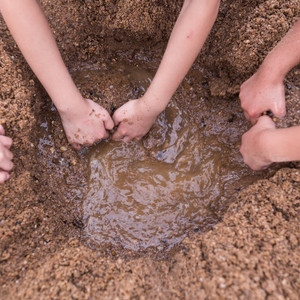
Hello, my name is Sophie and my question is how deep does the sand go on thebeach?
Greatquestion. We know beaches have lots of sand but there must be something under all those littlegrains.
What's holding it allup?
I know one way to findout.
Got yourshovel,Molly?
Ofcourse.Well, let's startdigging.
While wedig, we do need to say that every beach isdifferent.
Right. Some beaches may just have a few centimeters ofsand.
Picture a layer of sand as tall as a turkey lettuce tomatosandwich.
While others can have 40 to 50 meters ofsand.
That's like a 12 story tall buildings worth ofsand.
Sofar, we've talked about four inchesdeep.
Whoa. And now our beautiful hole is filling in with water at thebottom.
Where is the water comingfrom?
I was expectingthat. If you're very near to where water hits thebeach, you'll get to water prettyfast.
Ohright. There's underground water in lots of places and here at thebeach, that underground water starts at the same level as theocean.
If we'll further away from thewater, you'll be able to dig until you hitrock.
That's a solid part of the Earth'scrust.
Yeah. Remember how our Earth has layersinside?
Go check out our episode about what would happen if you dug a hole to the center of the Earth to learn all about thoselayers.
The top layer of the Earth is called thecrust.
So if you dig deep enough anywhere in theworld, you'll eventually get to thecrust, which is made out ofrock.
So the short answer to Sophie'squestion, how deep does the sand go on thebeach?
Itdepends. But no matter how deep the sand goes on your particularbeach, we can allagree.
Sand is supercool.Yes, we canagree.
Sandin is supercool.Well, hellothere, SandinTotten.
Andno, we didn't say sandin is supercool.
We said sand is supercool.
Well, I agree with you on thattoo.
Sand is supercool. And because sandin is also supercool, I'm proud to announce the grand opening ofDrumroll,please.
Molly,Leon,Drumroll.
Oh,yeah, sorry aboutthat.
Yeah,sure.Sorry. Muchbetter.
The grand opening of Sandin's super cool sandstand.
You're sellingsand? I suream.
At thebeach?Absolutely.
ButSandin, we're surrounded bysand.
Why would we want to buyyours?
Because no one knows sand like sand in super cool sandstand.
Plus, it comes in a nifty glass bowl with my photo onit.
Well, you do have a winningsmile.
Thankyou,Leon. So where did you get all thissand?
Where anyone gets sand from a thousands or even millions years long process of rocks and minerals breaking down into tinypieces.
That wasn't what Imeant,but...
Yousee,Molly,Leon? Sand is made up of rocks andminerals, which includes stuff made from minerals likeseashells.
And there are different kinds of sand that are made from different kinds of rocks andminerals.
Here, see thisbottle?Ooh, it's superdark, almostblack.
That sand is made from tiny bits of stuff that came fromvolcanoes.
Imaginethis. A volcanoerupts.
It spewslava.Oh,oh,oh,oh,oh, the lavaheartens.
And turns black once it startscooling.
Then, overmany,many, manyyears, wind and rain andanimals, hoofing it across that hard black rock breaks it into tinypieces.
Those pieces break into even smaller bits and on and on until you have blacksand.
You gotit,buddy. And this bottle of white sand comes from the famous white sand beaches inHawaii.
And he guesses what it's made outof?
Dry, deunicorntears. Petrifiedmarshmallows.
Heatresistance,no? Thewhite,t-shirt, belly button fuzz of one milliondads.
Well, I loveenthusiasm, but the answer is even moresurprising.
It's made out of parrotfishpoop.
Honestly, surprised we didn't guess fishpoop.
Parrotfish love to snack oncoral.
And the parts they can't digest come out of their booties as this beautiful whitesand.
Ah, overhere, check thisout.
This bottle of beige sand looks kind ofboring,right?
Yeah, plain oldsand.But, take a look now with my handy-dandy sandyray.
Isn't that just the zoom ray from brains onheadquarters?
And you've just taped a photo of yourself on theside.
Sand and super cool sand stand is an in-demand brand with a plan to expand to zoomrays.
Hard to argue withthat, impishgrin.
OK, carryon. Let's zoomin.
Whoa, seeing the sun zoomed in like this isincredible.
There's all kinds of cool stuff here and so manycolors.
I see orangeseashells, pink translucent seaglass, dark shiny rocks and tiny bits of whitecoral.
It'sgorgeous. Itis. And for the low price of whatever cash you have in yourpockets, this bottle can beyours.
So many different materials have been broken down to makesand.
Some of those bits even made their way to the beach all the way from themountains, traveling downrivers, breaking down more and more until they made their wayhere.
Zoom out handy-dandy sandyray.
OK, you definitely know yoursand.
Well, I should know my sandfacts.
Afterall, sand is named afterme.
I'm pretty sure sand has been around longer than youhave.
So, can I interest you in sand and hand bottledsand?
How about one bottle for three or two forten?
I think I'll pass fromnow.
I'm literally sitting on a giant pile ofsand.
Well, you want to bottle some while you're just sittingthere?
I can always use a hand at the sandstand.
Heyguys, nice beachchairs.
Hey, it's producer NicoGonzalez-Whizzer.
What'sup? Notmuch. Just trying to enjoy my beachday.
What's thematter? The sun isshining.
The waves aren't tooscary.
There's a gentlebreeze.
Look. I'm drinking a pineapple-freeze out of apineapple.
What more could youwant?
It'sjust, I was at this beach a few years ago and there's way less sand here now than there was backthen.
Haha, Imean, I don't know what you're talkingabout.
It looks like there's lots of sand stillhere.
And not just in themany, many bottles I currently have forsale.
Okay, gotta gobuy.Wow, he packed that hole stand up veryfast.
I've never seen someone exit likethat.
Wait,Nico, what were you saying about there being lesssand?
Well, a lot of people think sand is always just here and it'll always behere.
Like, it's a resource that keeps gettingreplenished.
More and more keepscoming.
But turnsout, sand isn't likethat.
Infact, we might be running out of beachsand.
What?Yeah, it's a majorbummer.
What about you tell us all about it in aminute?
Butfirst, would it cheer you up to listen tothe...
Oh,definitely.Okay,Leon, are you ready for the mysterysound?
Yep.Okay, here itis. I think we need to hear itagain.
It's kind of a shortone.
Okay,Leon, what is yourguess?
I think it's someone like pouring a jug of ice and water into acup.
Ooh, that is a very goodguess.
I loveit.Well, we will hear itagain, get another chance toguess, and hear the answer after thecredits.
So, stickaround. We're working on an episode all aboutmatches, those incredible little wooden sticks that make fire when you strike them on asurface.
And we want to hear fromyou.
If you could come up with a new name formatches, what would itbe?
Maybe Sparkle sticks orfirepixies?
Leon, what do youthink?
What would you rename matches if youcouldn't?
I would probably rename them SparkScratches.
Oh, verynice. Why thatname?
Because normally you scratch them against something and I makeSpark.
Yes, I love thatname, SparkScratches.
And I love something that has twoS's, alitteration.
I loveit. Allright,Leon, I'mSolt.
Listeners, record yourself delivering your new name formatches.
You can send them to us at brainson.org slashcontact.
And while you'rethere, you can send us mysterysounds,drawings, andquestions.
Like thisone, what happens if you take a party wound tospace?
Again, that's brainson.org slashcontact.
And keeplistening. You're listening tobrainson.
I'mLeon. And I'mMolly.
And today we're exploring sand while at thebeach.
And our pal Nico is heretoo.
Hi.OK, soNico, you said we might be running out of beachsand.
How can thatbe? We just learned that sand comes from natural materials breaking down into tiny pieces inWashington,sure.
Isn't new sand being created all thetime?
Well,yes. But that process takes millions ofyears.
And we're using up sand much faster than it can bereplaced.
We use sand to make building materials for stuff likeroads,bridges, andhouses.
Huh, that stuff is veryimportant.
And you need sand to make glass for windows andmirrors.
Oh, gotta have windows andmirrors.
And you need it for lots of metalproducts, like pots andpans, street lampposts, and even carparts, which are often shaped usingsand.
Wow.OK, sand is reallyimportant.
I'd say scientists think humans use about 50 billion tons of sand everyyear.
Whoa. That is a lot ofsand.
It's the same as if every single person on Earth used about 40 pounds of it everyday.
My dog is about 40pounds.
So imagine me and you two and every other person on Earth making an exact sand replica of my dog every single day of theyear.
So is construction where the sand from the beach isgoing?
Molly,Leon,sadly, there is another reason sand isdisappearing.
Picture a sandybeach. As the waves slap up onto the shore and slide back out to see they drag some of the sand withthem.
Sand might also be pushed further down the beach when there's a strongwind.
But isn't it natural for sand to get washed out to sea by big waves or pushed farther down the beach by the currents andwind?
Yeah, these processes are totallynatural, but they're getting moreintense.
Climate change is making storms like hurricanesstronger, which means bigger waves and morewind, which also means more sand getting sweptaway.
Ohyeah, and glaciers and icebergs are melting into theocean, causing sea levels torise, which means even if the sand on our beaches isn't goinganywhere, more of it isunderwater.
Right. And even when the sand on the beach could be replenished by newsand,remember, we're taking a lot of sand out of rivers so we can use it to buildthings.
So that sand never has a chance to make it to thebeach.
Plus, humans have also built roads and houses right along the beach and dams that stop rivers fromflowing.
Huh. So all of that would block a new sand from making it all the way to thebeach.
Exactly. Youknow, I hadn't thought aboutthat, but my family used to go to Florida every year and the sand would beless.
Basically every time wewent, it was prettysurprising.
Leon, have you noticed any change in the sand where you go to thebeach?
There's a lot less sand than there wasbefore.
It's a lot morerocky. Veryinteresting.
Yeah, so sandy beaches are really important because they help protect the communities behind them from flooding duringstorms.
That's because when storms send really big and intense waves crashing onto thebeach, the sand absorbs some of their energy and slows themdown.
So the waves don't rush up past thebeach.
Sandy beaches are also home for countlesscreatures.
You might see sea lions socializing or crabs scuttling back on forth to find food or even BBC turtles taking their very first steps towards theocean.
Dang. Is there anything humans can do to make the problembetter?
Actually, I've gotit.Sandin, there youare.
Where did yougo?Well, after you guys accused me of taking all the sand off thebeach.
No one accused you ofthat,Sandin.
I decided to read more about theproblem.
Atfirst, I just wanted to clear my goodname, but it turns out Nico was totallyright.
Beach is all over the world really are losingsand.
So then I had to do a dramatic whale likeso.
Oh,no! Imean, sand is such an exquisitesubstance.
Withoutit, a beach day would just be aday.
Nobody wants to make grass castles or bury themselves in plain olddirt.
So I started working on aprototype.
Prototype? Did you know Mars is covered insand?
Hear the schematics for a big shoot inspace.
A sandshoot.Ah, Sandin's sandshoot.
To send all that sand down here toEarth.
It's rain andsand.Hallelujah, it's rain andsand.
So you guys likeit? That is not a realisticsolution,Sandin.
But I love yourenthusiasm.
And the good news is there are some solutions with realpotential.
Like inLouisiana, which is a state that's seen a lot of beacherosion.
There's a company that's recycling glass back intosand.
Oh, we did a whole episode a few years ago about how glass ismade.
The main ingredient is silicasand.
Then it can be used for things like makingconcrete, filling in playgrounds or volleyballcourts.
You can even put some of it back in beaches andwetlands.
That's socool. Itis. But recycled glass doesn't work for everybeach.
So scientists are trying other thingstoo.
One of them is beachnourishment, which is just a fancy way of saying putting sand back on thebeach.
But instead of building a shoot forMars, this sand is usually pumped from the ocean floor and dumped onto thebeach.
Does itwork?Well,sometimes.
Buteventually, that sand usually gets washed out or pushed awaytoo.
One of the best ways to keep sand on beaches is to make sure all the sand washing down from rivers makes it there in the firstplace.
Some communities have done that by removing dams that blocked uprivers.
And other communities are considering removing roads and buildings next tobeaches.
But should allow the beach to go back to its normal cycle of losing and gainingsand?
Yep. And ofcourse, if we manage to slow down climatechange, we'll have fewer intense storms and less sea levelrise.
That's a tallorder. But I know one place we canstart.
The sand from my sand stand should stay right here on thebeach.
Bye-bye, little bottlebuddies.
Now, if you'll excuseme, I need to go figure out my next big money-makingscheme.
Ooh, maybe coconut freezes that you drink out ofcoconuts.
Ah, greatidea,Sandin.
Sand is made from rocks and minerals breaking down over millions ofyears.
And how deep it goes depends on the beach and how close you are to theocean.
And while it's great for makingsandcastles, we use sand for all kinds ofthings.
Like building roads andbridges, making glass andmirrors, and shaping things made ofmetal.
But beaches and riverbeds are losingsand.
Luckily, some very smart people are thinking of ways to replenish it so that we can keep enjoying our beach chase for many years tocome.
That's it for this episode of Brainson.
This episode was written by Molly Blue and NicoGonzalez-Whissa.
It was produced by RosieDuPont, AnnaGoldfield,Aron, OdeaCelaci, AnnaWego,Ruigafri, and MarkSanchez.
Our editors are Sandin Totten and ShailaFarzon.
This episode was sound designed by RachelBreeze.
We had engineering help from GarithPatch, JakeIlward, and JessBurke.
Our executive producer is BethProman, and the executive's in charge of APM Studios areChandrakavati, AlexShaffert, and JoanneGriffith.
Special thanks to LannitaBishop.
Brains on is a non-profit public radioprogram.
There are lots of ways to support theshow, subscribe to Brains on Universe onYouTube, where you can watch animated versions of some of your favoriteepisodes, or head toBrainsOn.org.
Molly, overthere, you can send us mystery sounds drawings andquestions.
Okay,Lian, are you ready to hear the mystery soundagain?
Yep.Okay, here it isagain.
Allright, any new thoughts you're going to stick with your originalanswer?
What do youthink? I think I'm going to stick with my originalanswer.
Hey, remind us what thatwas.
Someone with a jug with water and ice in it pours it into acup.
Very goodguess. Are you ready for theanswer?
Yes.Okay, here itis.Hi, I'mMiles, and I live inPasadena,California.
The sun that you just heard was me pouring water andice.
Oh, mygoodness.Lian, holycow, excellentears.
How do youfeel? Veryhappy.
Yeah, it's an excellentguess.
So I'm guessing youhave, we must have poured water and ice at some point in your lifethen.
Yeah, I really like having ice inwater, so I do it almost everyday.
Oh mygosh, sogood. Excellentwork.
Now it's time for the brains honorroll.
These are the incredible kids who keep the show going with their questionsideas, mysterysounds,drawings, and highfives.
Amira fromIndianapolis, Hartley and Hope fromBath, NewYork, Liam from NewOrleans, Bird and Woods fromBaffle,Washington, Tino fromFramingham,Massachusetts, BriarWolf, and Aspen fromToronto, Cooper from NorthLima,Ohio, Zan and Ava from BoytonBeach,Florida, Sam fromHouston,Texas, AdleyEden, Abel and Odin fromLashburn,Saskatchewan, Grant fromKarlsbad,California, Deva and Nova fromOmaha, Jack fromAustralia, Josephine fromColumbus,Ohio, Cade and Dax fromLongmont,Colorado, Casey fromMilton,Massachusetts, Madeline from ChinoHills,California, Nicolo and Javi fromManila,Philippines, Shauchen fromSingapore, Simone fromDearfield,Massachusetts, Deakin fromColumbus,Ohio, Ellie fromDurham, NorthCarolina, Caleb fromFairfax,Virginia, Claire fromAnderson, SouthCarolina, Nora fromHermitage,Tennessee,Calvin,Emily,Anna,Eliza, Matthew and Benson fromManacan,Sabot,Virginia, Peter fromSeattle, Everly from PortWashington, NewYork, Latisha fromSingapore, Kazimir fromSpokane,Washington, Elizabeth and Andrew fromMaui, Madeline fromCanada, Marion and Paul from CollegeStation,Texas, Zoe fromMilpitas,California, Kazuma from DailyCity,California,Sully,Lively, Matilda and Violet fromAshland,Oregon, Mateo fromIndiana, Bianca fromTaiwan,Evan, Noah and Caleb from SouthGrafton,Massachusetts, Renee from MiamiBeach,Florida, Clara fromMinneapolis, Liam fromFranklin,Tennessee, Vivian from LosAngeles, Llea fromParis,France, Otto fromBelmopan,Belize, April from Living inSt.
NewJersey, Salleja from SanJose,California, Olive fromVancouver,Washington, Danny fromUxbridge,UK, Uzum fromToronto, Cooper from SpringHill,Tennessee, Reese from WhiteRock, BritishColumbia, Nora from Half MoonBay,California, Gordy and Maxine fromBuffalo, NewYork, Ruhan fromChicago, Ishaan fromSunnyvale,California, Madison fromWimberley,Texas, Ramona fromOakland,California, Vivian from ValleyVillage,California, and Caled fromDavis,California.
We'll be back next week with a fire episode all about the magic ofmatches.