Today's episode is sponsored by Indeed.
You just realized your business needed to hire someone yesterday.
How can you find amazing candidates fast?
Easy. Just use Indeed.
When it comes to hiring, Indeed is all you need.
Stop struggling to get your job posts seen on other job sites.
Indeed's sponsored jobs help you stand out and hire fast.
With sponsored jobs, your post jumps to the top of the page for your relevant candidates so you can reach the people you want faster.
there's no need to wait any longer speed up your hiring right now with indeed listeners of this show will get a 75 sponsored job credit to get your jobs more visibility at indeed .com slash brains on just go to indeed .com slash brains on right now and support our show by saying you heard about indeed
on this podcast indeed .com slash brains on terms and conditions apply hiring indeed is all you need Whistle while you work From Disney, on March 21st, the magical tale Snow White Snow White Snow White That started it all I believe you're looking for me Arrives in theaters Magic mirror on the wall Experience
the Disney classic Who's the fairest one of all?
Like never before We haven't even been in her goes yet Disney Snow White, only in theaters March 21st Rated PG, parental guidance suggested.
You're listening to Brains On, where we're serious about being curious.
Brains On is supported in part by a grant from the National Science Foundation.
What a beautiful day.
The sun is shining.
The birds are singing.
Time to sit in my big comfy chair and start learning about coral for our episode this week.
Let's see. Molly! Thank goodness I found you.
Brains on editor Shaila Farzan?
Um, what are you wearing on your head?
Oh, this? It's my coral hat.
It's a perfect replica of my favorite sea creature.
Coral! You know, that colorful, rocky -looking stuff on the ocean floor.
Believe it or not, I made this hat myself out of papier -mâché.
Yeah, it's really eye -catching.
Plus, check this out.
It's my membership card for the Coral of the Month Club.
Every month they send you an autographed photo of a different kind of coral.
Uh, autographed by coral?
And I got a new bumper sticker for my bike.
See? It says, I break for coral.
You gotta watch out for those little corals in the road, you know?
Well, coral lives in the ocean.
I know, right? I can't help but notice that you're really into coral.
Do you? Desperately want to host the new Brains On episode on Coral like the baddest I've ever wanted anything in my life, so I'm showing you all my cool Coral stuff to help convince you I should get to do it.
You want to host the Brains On episode about Coral?
I thought you'd never ask.
I'd love to. And great news.
Since you have the week off now, I got you tickets to that convention you were talking about.
The Backward Pants Convention where enthusiasts from around the world come together to discuss the latest developments in backwards pants wearing technology that's the one looks like somebody's gonna be spending a lot of her time with her pants on backwards this week if you know what i mean oh and i almost
forgot i made you something you know just to say thanks for believing in me a present i love presents you really shouldn't have oh wow shayla it's your very own paper mache coral hat get it.
You're listening to Brains On from APM Studios.
I'm Shayla Farzan and I'm filling in for Molly while she's away this week.
Here with me is Eben from Aurora, Illinois.
Hey, Eben. Hi, Shayla.
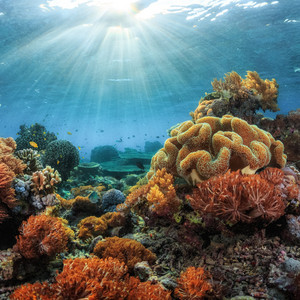
Today we're talking all about coral, that hard, sometimes colorful stuff on the ocean floor that can form coral reefs.
Eben, what do you picture when I say coral?
I picture rocky looking, colorful guys that come in lots of shapes, sizes, and colors.
Yeah, that's actually pretty close to what I think of too.
Like if I am picturing coral, I'm picturing something that's underwater, and usually something that's like, it kind of looks like a big, bumpy, rough boulder with just like a bunch of fish around it.
Coral's pretty amazing, and so is this question, which inspired today's episode.
Hi, my name is Finnegan and I'm from Ontario, Canada.
And my question is, how does coral communicate?
Whoa, that's a great question.
I know. Coral might look like a rock or a plant, but it's actually an animal.
Right. It might not talk like we do, but maybe it has its own special way of sending signals to other creatures.
We'll talk more about that in a bit.
But first, I want to know, Eben, what do you think is cool about coral reefs?
I think coral reefs are cool because it takes lots of corals to make a coral reef.
You mean like a lot of kind of corals all linked up together into one reef?
Yeah. That's cool. Do you have a favorite sea creature?
My favorite sea creature is a sea turtle.
A sea turtle? What do you like about sea turtles?
I like how when they go through the water, they just seem so calm.
mm -hmm i know i love the way sea turtles move through the water where it almost looks like they're flying like they kind of move their flippers up and down in the water yeah kind of looks like they're gliding through it the water yeah i know it really does actually have you ever seen coral in real life
like out in the wild or in an aquarium maybe once but probably a long time ago because I don't remember.
I have been really lucky to be able to see coral out in the wild.
So cool fact about me, I actually used to live on the Marianas Islands, which is this tiny little group of islands way out in the Pacific Ocean by Japan.
And I was working out there as a scientist studying the forest there on the islands.
But after work, I got to go snorkeling pretty much every day around the coral reefs.
Okay, that's pretty awesome.
I know. It actually was awesome, but I have to be honest with you, the first time that I actually jumped in the ocean to go snorkeling, I was really nervous.
The water wasn't super deep, but I'm not a really strong swimmer, and I've always felt kind of scared in the water.
But once I got in there and I relaxed, I realized that there were all of these just incredible sea creatures around me just swimming all around the coral reef.
So things like these rainbow -colored parrot fish and really big fish called grouper.
I even saw this giant barracuda once that was like three feet long.
And I think the really cool thing for me was that swimming around the coral reefs just made the water feel a lot less scary to me.
And it was fun. Do you think that's something that you'd ever want to do, Eben?
Go snorkeling in a coral reef?
I think that'd be really fun.
I get to see all the fish and the coral.
And wait, are you able to touch the coral?
Do you know what it feels like?
You're not technically supposed to touch the coral because it can be kind of fragile, like you can break it off by accident.
But one time I was snorkeling and my leg, I was in like kind of big waves and my leg touched the coral and it was really rough.
So you can find coral in oceans all over the world, from the rocky coasts of California to the shores of Mozambique and Eastern Africa.
It comes in all different shapes and sizes.
Some coral is flat like a big pancake.
Some looks like bright yellow flowers or stars.
And some coral even looks like brains.
But those cool shapes aren't the living part of coral.
They're more like its colorful, bony armor.
More on that in a second.
But first, in honor of today's coral -tastic episode, I've got a surprise for you, Eben.
Is it a 100 % unique handmade papier -mâché hat in the shape of my favorite kind of coral?
Because I actually brought one with me.
See? It looks like brain coral.
I was going to give you a 100 % unique handmade papier -mâché coral hat, but yours?
It's gorgeous. Hey, thanks.
And check it out. We match.
I've got one that looks like fire coral.
See? It's got little orangey branches all over it.
Eben, I wish we were at a coral reef right now.
Same. Wait, Molly specifically said we can do whatever we want today.
Um, she did? Oh yes.
Or at least, I'm sure she would have said that if she'd thought of it, and that's good enough for me.
And since we can do whatever we want, I think we should go to a coral reef.
Like, right now. Road trip.
I mean, reef trip. To the explorer.
Dibs on the backseat.
Here, catch the keys.
Shayla, I'm 10 years old.
I can't drive. Oh, right.
I can take us. I forgot.
I totally know how to drive.
Let's go! We're coming to you live from my favorite vehicle, the extremely practical land and ocean rover exploring remote realms.
Or explorer for short.
And we just dove straight into the ocean to look at some coral reefs.
Whoa! Look at this reef.
Looks like a bunch of big, colorful sea plants.
But it's not a plant, it's an animal.
And it's stunning. So like we said earlier, the part of the coral we can see is like its bony armor.
That part is not alive.
But the parts underneath that bony armor are alive.
These living parts are squishy animals called polyps.
Coral polyps are usually only a couple millimeters wide.
That's smaller than my pinky nail.
But some can get as big as a basketball.
Sometimes coral polyps are so tiny, you need a magnifying glass or a microscope to see them.
Speaking of, I could have sworn the Explorer had a zoom ray button somewhere in here.
Oops, that just made tacos fall from the ceiling.
Mmm, I do love a ceiling taco.
Although, I guess now it's a floor taco?
Whatever, we'll clean those up later.
Maybe with our hands, maybe with our mouths.
JK, we're not gonna eat off the floor, Eben.
Or are we? Hey Sheila, what about this button?
That's the disco party button.
Classic mix -up. Oh, I know, what if we...
Press the one with the magnifying glass on it.
Oh, I was actually going to suggest that we just press all of the buttons at once.
Like how I do anytime I'm in an elevator.
But you're totally right.
That is the zoom ray button.
It lets us see stuff way up close.
Whoa, so magnified.
All the better to see coral.
Amazing to think that big, colorful reefs all start with these teeny tiny polyps.
Up close, the coral polyps kind of look like squishy little trees.
The top of each polyp has little tentacles, like an octopus.
And when these baby polyps are first starting out, they float around in the ocean until they find a hard surface to stick to.
Like rocks on the ocean floor.
Once a polyp finds a nice rock to settle down on, it starts to transform.
Kind of like how when I settle down on my couch, I start to transform into a human -shaped pile of blankets covered in chip crumbs.
Same. So once that coral pulp settles on a rock, it starts absorbing minerals that are floating in the seawater.
And it uses these minerals to form hard, shell -like exoskeletons on the outside of its squishy body.
It's like the polyp is making its own body armor.
Awesome, right? It's this armor that you're looking at when you swim past a colorful coral reef.
Another amazing thing about coral polyps is that they can make copies of themselves, like clones.
One coral polyp can multiply into hundreds, even thousands of clones.
And these clones make armor too.
When lots of coral polyps link up next to each other, they make groups called colonies.
You can think of it like this.
If each coral polyp with its hard armor is like its own little apartment unit, then a coral colony is like an apartment building made up of a bunch of individual units.
Even though each coral polyp can be microscopic, their colonies can weigh up to several tons.
About the same weight as an elephant.
When different coral colonies are built next to each other, they form coral reefs.
Which is like a bunch of different apartment buildings coming together to make up a whole city.
Yes! Coral reefs are like cool coral cities.
Here, let's zoom out again so we can marvel at them.
Wow, it really is like a city.
Pretty neat, huh? Whoa, look at the time!
Uh, Shayla? That's a piece of taco stuck to your wrist, not a watch.
I totally knew that.
Now, how does Molly always say it?
Think, think, think.
Come on, Shayla, think.
Oh, right. Eben, it's time for the...
Mystery Sound. Eben, are you ready to hear the mystery sound?
Yes. All right, let's hear it.
Whoa, okay. Evan, what do you think?
You got any guesses?
Okay, yeah. After a lot of water evaporates in the bathroom, it kind of makes a bunch of stuff on the mirror.
And you can wipe it off with your finger.
And sometimes it can make some squeaky noise.
So I'm guessing that it's someone using their finger to squeak along the glass.
Oh, like wiping the steam off of a mirror?
Yeah. Except with their hands or finger.
Oh, that's such a good guess.
I was going to say it was like some sort of tiny animal, like a distressed tiny baby animal.
Oh, yeah. Your guess is so much better.
I'm going to go with a tiny baby animal cleaning steam off of a mirror with its finger.
What do you think about that?
That's a very good guess.
that's really nice of you to say that ok Evan you're going to get a chance to guess again and we're going to hear the answer after the credits so stick around hey friends we get so many awesome questions from you every day and they make us so happy like dance around with our pants on our heads singing
at the top of our lungs kinda happy but do you know what else we love fan art Drawings, paintings, popsicle stick art.
We love all of it. Eben, have you ever been inspired to draw something or make some kind of art based on a Brains On episode?
It's not an art or anything, but it's a story about how I got inspired by Brains On Universe.
That's why I decided, well, what if there is Brains On Universe and then all the podcasts in Brains On Universe, like Forever Ago and Brains On Smash Boom Best if each of those podcasts had a separate galaxy whoa like you could have adventures in them I love that idea that is such a good idea and you know
what I think a short story that's totally art that's another form of art listeners we want to see your fan art take a picture of it and send it to us at BrainsOn .org slash contact and while you're there send us your mystery sounds ideas and questions Like this one.
How do frog's tongue stretch so far?
You can find answers to questions like these on the Moment of Om podcast, a short dose of facts and fun every weekday.
Find Moment of Om and more at BrainsOn .org.
And keep listening.
Brains On Universe is a family of podcasts for kids and their adults.
Since you're a fan of Brains On, you'll love the other shows in our universe.
Come on, let's explore.
It's Alien Laundry Day While I wash my nose mufflers and tummy togas I'll listen to a new podcast How about Forever Ago My favorite history podcast Whoa, I was not expecting that to work Or for it to sound as good That's the DJ Dolo technique.
DJ Dolo! When I say pizza, you say bagel.
Pizza! Zorp! Signal down!
Stay right there, tummy togas.
Must find Forever Ago now!
Listen to Forever Ago wherever you get your podcasts.
Today's episode is sponsored by Greenlight.
As your kids get older, some things about parenting get easier.
They can go to the bathroom by themselves.
They have playdates.
It's awesome. But other parts don't get easier, like having conversations about money.
The fact is, kids won't really know how to manage their money until they're actually in charge of it.
That's where Greenlight can help.
With the Greenlight app, kids learn how to save, invest, and spend wisely thanks to games that teach money skills in a fun, accessible way.
The Greenlight app also includes a chores feature where you can set up one -time or recurring chores customized to your family's needs and reward kids with allowance for a job well done.
As a kid, I would have found this super motivating to do all my chores of, you know, emptying the garbage bins, cleaning the windows, and other duties as assigned by my parents.
Start your risk -free Greenlight trial today at greenlight .com slash brains on.
That's greenlight .com slash brains on to get started.
Greenlight .com slash brains on.
you're listening to brains on i'm ebon and i'm shayla today we're talking all about coral at a coral reef that's right we're chilling in our go anywhere do anything vehicle the explorer checking out this amazing reef before the break we learned that coral comes in many different shapes, sizes, and colors.
Sometimes coral looks like rocks or plants.
But it's actually made up of animals called polyps.
These polyps make hard exoskeletons around their soft bodies.
Groups of coral polyps are called colonies, and colonies can group together to form coral reefs.
These coral reefs are home to all sorts of different fish, Lobsters, shrimp, seahorses, sea sponges, and sea turtles.
Did somebody say turtle?
We did. Us, inside the underwater vehicle.
Hi, I'm Eben, and this is Shayla.
What's up? I'm Rocco the turtle.
Sweet coral hats. Thanks, Rocco.
We're huge fans of coral.
Oh, me too. I'm a bit of a nomad, so I like to travel a lot.
But sometimes, I call these coral reefs my home.
They look busy. Oh, they are.
Coral reefs are home to thousands of different kinds of sea creatures all over the world.
It's true. Coral reefs take up less than 1 % of the ocean floor, but they're home to about 25 % of all marine life.
Whoa, that means one in four marine animals live in a coral reef.
Right on. Just like me and all my neighbors.
Larissa the lobster lives next door.
Frederick the seahorse is across the reef with his 700 kids.
Oh, and Carl the clownfish is about to sublet when I go up sea next month.
Gosh, I hope he remembers to water the plants.
Uh, aren't the plants always watered because we're in the ocean?
Excellent point, my friend.
But he still has to check my mailbox.
I'm expecting some very important sea snail mail.
Top secret stuff. Hmm, fun you should mention it.
Because coral also has a secret hidden inside.
No way. Way. There are tiny organisms living inside the coral polyps called algae.
You might have heard of algae before.
The green scum that grows on top of ponds and lakes?
That's algae. Seaweed is also a kind of algae.
So is kelp. Oh, I know all about algae.
I'm a big fan of scum.
I ate some for lunch today.
The algae that lives inside of coral is different from what you eat, though.
It's also super tiny.
You actually need a microscope to see it.
You're probably wondering, why is there algae inside of coral?
I was wondering that.
Well, the algae use sunlight to make energy and sugar, like a plant does.
The coral needs those nutrients to survive, but can't make it on its own.
Right, so the algae share some of its nutrients with the coral.
And in return, it gets a safe place to live inside the coral, like a house.
Whoa, algae and coral are like roommates.
Exactly. Scientists think that coral and algae have been living together like this for more than 200 million years.
In other words, this relationship started when dinosaurs were still walking the earth.
Pretty wild, huh? So wild.
And did you know that algae is what gives coral all of its different colors?
Really? You're blowing my shell right now.
Yeah, the hard coral exoskeleton is actually white, but the algae inside can be red, pink, blue, or even purple, which makes the coral look colorful.
Algae rocks. Thanks for dropping this mad knowledge, human pals.
All this algae talk has this turtle hankering for an algae smoothie.
Catch you on the flip side.
Bye, Rocco. See ya.
Okay, Eben, let's head back to the studio.
But first, ceiling tacos.
With extra salsa. Confirmed.
Coral is awesome. It's colorful and complicated and full of secret algae.
Agreed. Coral is super.
But we still haven't answered the question that inspired this episode.
How does coral communicate?
It's a great question.
Scientists think that coral does in fact communicate.
It sends messages. But there's a lot we don't understand about this communication.
Some scientists have found that coral can sometimes communicate by releasing chemicals.
For example, one study looked at corals that were being attacked by toxic seaweed.
They found that when this seaweed was taking over, corals would send out chemical signal into the water.
A certain kind of fish called goby fish would smell this chemical signal and rush to the coral's defense.
Like tiny bodyguards.
Yeah, they'd come over and start eating the seaweed off of the coral.
Yay, go bees! Other studies have found coral might be able to send and receive sounds.
To learn more, we talked to Camila Rimaldi -Ibanez.
She's a marine biologist in Jupiter, Florida, and she studied this.
Hi, Camila. Hi, Evan.
It's great to meet you.
You too. We have a couple of questions for you about coral.
First, do we know how coral communicates?
that is an awesome question so there's been a lot of really cool research that is trying to find how corals talk to each other or how they communicate and there's a few ways that we know corals already talk to each other so one of the main ones is with chemicals so corals use these actually to kind
of fight each other in like coral wars they can kind of use their tentacles and sting each other.
It's like they're hitting each other with their arms.
They can also use them to kind of talk to fish.
Oh yeah, we just talked about how they do that with gobies.
It's so cool. You think coral might be able to hear and make sound.
What got you thinking about that?
So there's a really really cool study that showed that coral larva, so the coral babies, when they're really really tiny, like so so tiny you can't even see it with your eyes, They're kind of just floating around in the ocean and they're trying to find a coral reef to go and live and make their home,
yeah? And when they're trying to find their coral reef, they use a lot of different things to find that nice big coral reef.
They use lights, they use currents, and this study found that the larvae actually use sound.
So they're listening to the sounds of a healthy coral reef, which basically sounds like a big party because you have corals, you have fish, you have lobsters, shrimp, all sorts of different animals making a lot of noise.
So it's been seen that coral larva, so the coral babies, actually swim and use sounds to find their home in a big nice coral reef.
So I thought if coral babies can listen to sound, what about big coral?
They probably have to talk to each other too well what did your research find oh yeah so in my research that's what i did i looked at big adult coral so the ones that already have colonies and i was trying to see if these corals are making sound and i found that they do i saw that corals are making
ultrasonic sounds up to 30 kilohertz.
Ultrasonic sounds is a sound that is so, so, so high that you can't hear it.
So corals are making these ultrasonic sounds that we can't hear, but maybe other animals in the ocean can.
So I found that corals, when they make these sounds, whenever they're moving their tentacles.
So whenever they're kind of swaying them back and forth in their water or when they kind of pull them inside into their little cave home.
That's so cool, Camila.
I'm like, I'm also wondering as I'm listening, like how do you know that the coral are making these super, super high sounds?
Like did you put a microphone in to record them in the water?
Yeah, great question.
So because there's so much sound in the ocean, I actually did this in a lab.
so I was in a very special room where I could control everything the temperature the lights all the different things which you have to do in an experiment and in my little lab setting I had one coral in a little tank and I had a hydrophone so a hydrophone is a microphone that can be used underwater so I
used the hydrophone and I also had a camera because I had to see what the coral was doing, what motions it was doing so that I could later see, whenever the coral talked, what kind of movement it did in the water.
That's so cool. Right?
I love, as I said, I love to talk about coral.
I find them really, really amazing.
And there's so much more.
We still have to learn about them.
So there's a lot of coral bleaching going on right now.
You might have, have you heard that word before?
Coral bleaching? Yeah.
When the coral gets overwhelmed and they start to push out all the allergy that gives them color like all their allergy friends and then because they're all overwhelmed and sometimes when animals get overwhelmed they can push out some of their friends so it pushed out their allergy which makes them
die you are quite the coral experts wow I am that is an amazing way of saying it yeah exactly so coral bleaching is when they push out their little algae friends but that doesn't mean they're dead yet.
They're not? No I know when I found that out I was quite shocked too.
Whenever they push out their little algae friends they're very very sick but they can still come back and be healthy again.
So there's a short window of time sometimes a few days sometimes a few weeks okay when the coral is bleaching but is not dead yet.
So when they're in that little window is whenever we try to help the coral so the algae friends can come back into the coral.
So if the algae friends come back to live with the coral, then they can go out and be healthy and happy again.
How do we help the coral?
A lot of the time, corals will push out their little algae friends if the water is too hot, right?
Or if they have plastic all around the coral and it's confused, and it doesn't know how to get it off.
So making sure that there's no plastic in the ocean, or if you see plastic on a coral reef, getting that out so the coral can feel healthy again.
Well, this has been so interesting, Camila.
I just really appreciate you taking the time.
We've learned so much.
Hey, I'm glad. I really enjoyed all of your questions and speaking to you guys thanks so much for talking with us bye bye that was the best backwards pants convention ever i can't wait to start wearing my overalls backwards and my sweatpants and my hang on why is the explorer sitting in the middle of the hallway And
why is it filled with ceiling tacos?
Or are they floor tacos?
And is this salsa on the seats?
Shayla! Oh, hey, Molly.
Wow. Oh, so much fun hosting today.
Thanks so much for letting Eben and I do whatever we wanted today.
Can't wait to host again sometime.
Bye. Coral is an animal, not a rock or plant.
It's made up of tiny polyps that grow tough little armor -like skeletons around themselves.
Coral polyps group together to make colonies, which group together to form coral reefs.
About a quarter of all marine life lives in coral reefs.
Coral has special algae living inside of it that help it get nutrients.
Coral does send messages.
We don't fully understand how.
Some can send chemical signals, and others might be able to make and receive sounds.
Scientists are studying coral to learn more.
That's it for this episode of Brains On.
This episode was written by Ruby Guthrie and Shayla Farzan.
It was produced by Molly Bloom and Rosie DuPont.
Our editor is Sandin Totten.
Fact -checking by Nico Gonzalez -Whistler.
Engineering help from Brian Hartman, Josh Savajo, and David Tallickson.
With sound design by Rachel Brees.
Original theme music by Mark Sanchez.
We had production help from the rest of the BrainZone Universe team.
Beth Perlman is our executive producer, and the executives in charge of APM Studios are Chandra Kavati and Joanne Griffith.
Special thanks to Serene, David, and Mahalia Hudson, Diane and Levi Velasco, and Camila Rimaldi -Ibanez.
Brains On is a nonprofit public radio program.
There are lots of ways to support the show.
Sign up for the Brains On Universe newsletter for bonus activities, reading recommendations, and lots more.
You can sign up at brainson .org.
While you're there, you can send us mystery sounds, drawings, and questions.
Okay, speaking of mystery sounds, Eben, are you ready to listen to that mystery sound one more time?
Yes. Okay, let's hear it.
Okay, Eben, what do you think?
I have some new guesses.
Okay, let's hear them.
It's kind of like your guess, except it's not an animal in distress.
It's maybe a pet, like a guinea pig, or maybe it's someone making a noise with their mouth.
Oh, I could totally imagine that because it's kind of like high -pitched and sort of squeaky sounding.
Okay, I honestly am stumped.
I have no idea what this is.
Should we hear the answer?
Yes. Hi, my name is Cameron and I live in Lethbridge, Alberta.
And this was the sound of my baby pups drinking from their mom.
What? Oh, puppies. Oh my gosh.
What do you think, Eben?
Is that surprising?
Actually, now that I think of it, it's not very surprising.
But I never thought of that.
I know. That was kind of hard.
I would have never guessed it was puppies drinking milk from their mom.
But you guessed pets, right?
Like maybe guinea pigs?
I just said maybe some sort of pet, like maybe a guinea pig.
Oh, my gosh. So you totally got it then.
Yay. I'm giving us full credit for this.
Now it's time for the Brains Honor Roll.
These are the awesome kids who keep this show going with questions, ideas, mystery sounds, drawings, and high fives.
Toby and Faye from Minneapolis.
Stephen from Warwick, Rhode Island.
Snooty from Boston.
Darby from Monterey, California.
Gemma from Capule, Hawaii.
Ara from Hanover, Germany.
Luke from Bulli, Australia.
Harper, Emmett, and Colton from LaConnor, Washington.
Britt from Ohio, Illinois.
Lua and Niko from Gainesville, Florida.
Dylan and James from Victor, Idaho.
Ho. Valentine from Springdale, Arkansas.
Cameron from Leithbridge, Alberta.
Maeve and Lucy from Hillsborough, New Jersey.
Charlotte and Audrey from Wycliffe, Ohio.
Zali from Tuwumba, Australia.
Caroline and Liam from Lancaster, Pennsylvania.
Lorena from Tianjin, China.
Autumn from New York.
Olivia from Irvine, California.
Lane from Kansas City.
Monty from Lufkin, Texas.
Nina from Plymouth, Minnesota.
Oliver from Goffstown, New Hampshire.
Hadley from Bailey, Colorado.
Sif from Pasadena, California.
Parker from Leno Lakes, Minnesota.
Hadley from Mount Washington, Kentucky.
Evie from Austin, Texas.
Declan, Isla, and Kit from Decorah, Iowa.
Cordelia from Northampton, Massachusetts.
Hudson from Charlotte, North Carolina.
Yvette from Lathrop Village, Michigan.
Xander from Murfreesboro, Tennessee.
Asher from Carrollton, Georgia.
Gabrielle from Norfolk, Virginia.
Ayala from Minneapolis, Minnesota.
Demira from North York, Ontario.
Porter and Jaylee from Draper, Utah.
Elliot from Richland, Washington.
Levi from Vacaville, California.
Zachary and Ariana from Mesa, Arizona.
Yidi from Naples, Florida.
Judah from Chevy Chase, Maryland.
Pihu from Folda, Germany, Vance and Tay from Brooklyn, New York, Maverick and Ace from Queen Creek, Arizona, Ricky and Rudy from Tracy, California, Ray from Alado, Texas, Ava from Austin, Texas, Langley and Meyer from Chesa, Washington, Aiden from Fairfax Station, Virginia, Rian from Los Altos, California, Liam from Amarillo, Texas, Vivian from Carborough, North
Carolina, Johan from Indianapolis, and Arapani from Neptune City, New Jersey.
We'll be back next week with an episode all about asthma.
Thanks for listening.