This is Planet Money from NPR.
There's this woman on TikTok who is so incredibly compelling.
The next dress is from Zonda Rhodes, and I do have an iconic photo of my grandmother wearing it, so let me show you.
Her name is Olivia Joan Ghali.
Like, so beautiful.
She's a young Black photographer.
In all of these posts, Olivia Joan is trying on pieces from a heap of incredibly fancy vintage clothing on a couch.
The beadwork is just impeccable.
It all belonged to her grandmother.
This dress weighs like 50 pounds.
It is very heavy.
There are shoes that cost more than some people's rent and have never even been worn.
And then there are some very worn things.
This used to be my grandmother's favorite top.
It even has like a bunch of stains on it from when she spilled.
And it still smells like her too.
And she was my best friend.
And so yeah, I'm running out of time.
Okay.
The thing that's so striking about Olivia Jones' posts is that these are couture dresses.
So her grandmother, a Black woman, was wearing custom Chanel, Givenchy, Yves Saint Laurent.
This is for the wealthiest of the wealthy.
Some of the same designers who dressed Audrey Hepburn, Jackie Kennedy and Princess Diana dressing this Black woman from the South Side of Chicago.
We called up Olivia Joan, and she told us that is why she's been posting these outfits of her grandmother's.
You really did not see Black men and women able to even afford designer pieces.
But to see that my grandmother had such a deep-rooted archival collection is the reason why I really kept talking about it.
Olivia Joan says it even took her a long time to clock her grandparents' importance.
Like I remember my grandmother and I were watching The Crown and she was like oh, I was friends with a queen sister.
And then I would just be like, pause, what did you say?
Who was your grandmother?
Yeah, my grandmother is Joan Betty Henderson Johnson.
Joan Johnson.
And her grandfather?
Who am I?
I'm Georgie Johnson.
That's all.
Um, that most certainly is not all.
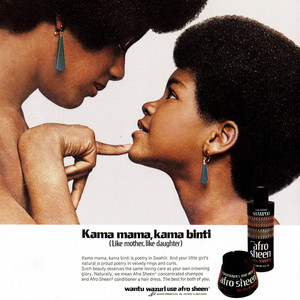
George E Johnson was Joan's husband, but he was also the maker of Afrosheen, the most iconic black hair product of the 20th century.
And don't forget Afrosheen's conditioner and hairdress the best for conditioning and highlighting your hair.
And what do you want?
Nothing I can't get from Afrosheen.
Afrosheen's blowout kit and conditioner and hairdress.
Johnson's Afrosheen, the largest selling products in the natural world.
It's hard to overstate how central Afrosheen was to Black culture. and the rise of Black business.
And in a way, the story of the Johnson's company is how they melded those two.
Because while Olivia Joan posts her TikToks, so people will understand wealthy Black entrepreneurs like her grandparents existed.
For the team here at Planet Money, how they made their money.
That's the story.
The Johnsons were among the most successful Black entrepreneurs of their time, and they did it by recognizing a key thing that if you paid enough attention to what Black Americans needed, you could make money.
The Johnsons saw Black culture as Black business.
The money they made helped fund the civil rights movement, paid for the legendary television show Soul Train and for Jones' legendary shopping sprees.
And all that money came from Black hair care products.
I still remember my grandparents coming over for dinner and we would be watching football while my mom's cooking.
And I'd have my hair down and my grandpa would come over, touch it and be like Joan.
We got to have a conversation.
Hello and welcome to Planet Money.
I'm Sonari Glenn. longtime contributor, friend of the show, and I'm Erica Barris.
Joan and George Johnson's intimate understanding of what Black people wanted and needed for their hair and for their lives helped grow the Black middle class and Black power.
And at the same time, they helped create what is today a multi-billion dollar industry.
Which, though they started it, they no longer own.
Today on the show, the rise and fall of Johnson products.
We're going to tell you this story in three hairstyles.
The conch, the afro, and the jerry curls.
OK, so we told you we're going to tell you this story in three hairstyles.
And before we get to our first, the conch, meaning chemically straightened hair, we need to paint you a picture of the times.
It's the early 1950s.
World War II is just over.
And it's the second wave of the Great Migration.
And Black workers are streaming into northern cities like Detroit and Chicago.
And at the time, the biggest music star is Nat King Cole.
Nat King Cole is the absolute epitome of Black style during this era.
His smooth voice, immaculate tailoring, and shiny straight hair.
Now, this was before George Johnson started his hair care company and well before Joan Johnson started rocking Chanel.
George wasn't straightening his hair like Nat King Cole.
That wasn't his world.
But he saw it was what a lot of Black folks really wanted.
As Black people were moving into the middle class, there was intense pressure to assimilate.
The more kink you conked out your hair, the whiter you looked, the more respectable and the better your chances in the workforce.
Not only did they straighten it, but they finger-waved it.
So they would have waves in their hair.
They were going crazy for this.
And this was when George Johnson was coming of age, though he'd actually been hustling for years already.
I started working when I was like six years old.
Did you say six years old?
Six years old, yeah.
That was during the Great Depression.
George, his brothers, and his mom had moved to Chicago from Mississippi.
They were extremely poor.
So Johnny and I started going up and down the back stairs of the building we lived in and going in the garbage cans and picking up the milk bottles, the The paper, the rags.
You were like kind of like scrapping things.
For every pound of paper, we got, I think, a penny.
The only thing that got us some real money was when we took the tinfoil that was in the wrappers of the cigarette packages.
It took a long time.
But when we got, say, a pound of that tinfoil, we get some real money from the junk man for that.
George worked all kinds of jobs, shining shoes, delivering newspapers.
And while he was poor, he was lucky enough to land at this legendary Chicago high school.
It's called Wendell Phillips.
And Nat King Cole went there, Sam Cooke, Mary T. Washington.
She was the first Black woman CPA.
And that high school was where George would meet his future wife, Joan.
Joan graduated.
George didn't finish because he needed money.
So by the 1950s, when the conch, that straight and processed hair was all the rage, George was moonlighting as a bathroom attendant and washing cars on the weekends.
And his main job was in a Black-owned company that made cosmetics, where he eventually worked his way up to mixing chemicals in a lab.
How do you get a chemistry background after two years of high school?
I took two years of chemistry in high school.
That was enough.
But no, no, no.
George learned on the job.
And then, one day after he'd become essentially operations manager, he was riding the elevator at work and he met a barber, Orville Nelson.
Orville ran a well-known barbershop on the south side of Chicago and he was trying to get the company George worked for to partner with him.
See, this guy...
Orville had created his own hair straightener, this chemical product that turned curly kinky, coily hair to straight permanently.
Orville was Nat King Cole's barber, a pretty big deal.
George says Orville would fly to California just to do Nat's hair.
But when George met Orville, he had this look about him.
When I looked at his face, He looked so dejected that it just popped out of my mouth.
What the hell is wrong with you?
What was wrong with him was that the straightening mixture he'd come up with was not working the way he wanted it to.
Orville was a barber, not a chemist, but he'd come up with a concoction based on old recipes that included mixing egg, potato and sodium hydroxide, or what we call lye.
And these were powerful chemicals.
Leave them in just long enough, and you had swinging hair.
But leave these products in the hair too long, and it might burn.
Longer than that, you might not have any hair left.
So in that elevator, Orville is venting about his frustrations.
And George, thinking about the chemistry of it all, is so intrigued that he asks Orville to come watch his barbers in action.
I went over to his shop. and walked into and shocked when I saw what was going on inside.
This wasn't your picture postcard barbershop where everyone's sitting around and talking about sports and politics.
This was pandemonium.
The barbers would run to a vat of the concoction where they'd mix it up, then pour it into a small jar, then race back to their clients and apply it to their heads.
He had four chairs.
They were always full.
And these guys were working like crazy to get this product in and out of the hair of the people they were working on.
The men were squirming in their chairs, waiting for it to work.
Then, just before it burned them too badly, the barbers would turn the chair around and lower their heads into the shampoo bowl.
And George saw what the problem was.
They needed something, some ingredient to keep it stable.
It was obvious to me when I saw the product, the way it was separated.
It told me that it needed to be emulsified.
So I thought it would be very easy because I knew, but it was not.
It took nine months.
George used his boss's chemistry lab to start experimenting.
Night after night, he'd try vat after vat of chemicals in different combinations.
And then he'd give them to Orville, who'd try them out in his barbershop.
Finally, George applied. found something he thought was going to work.
He describes it as being thicker than mayonnaise.
He took the formula to Orville, who tried it on some clients.
He said, this is it.
Don't touch it.
Don't move.
We got it.
It just popped out of my mouth when he said that.
I said, we ought to market this.
George recognized in this improved Black hair care product a massive economic opportunity.
We could make a product that would do this for everybody.
In 1954, Orville and George went into business together.
The product was Ultra Wave Hair Culture.
Gotta love those names.
Yeah.
Now, this wasn't the first hair straightener, but What was new was this product was shelf-stable and reliable.
So George started selling UltraWave to barbershops around Chicago and building trust with those barbers by teaching them how to use the product.
And almost instantly, it was a hit.
So much so that he asked his wife Joan to quit her good-paying government job to help him handle the books and the product.
Capping and labeling jars, loading trucks...
Eventually, when George and Orville's business relationship soured, Orville left and George and Joan took over.
It was Johnson Products Company.
And George says Joan turned out to be a fearless businesswoman.
Like one time, this barber owed them money.
And she went out to collect.
The day that she went he was just going to blow her off and tell her you know, I don't have the money.
I can't pay the bill right now.
So she said, OK, then I'm going to sit over here until you do.
Remember, this is the 50s when a woman was not welcome in a barbershop.
And, you know, and they tried to run her out of there with some, you know, nasty language.
But she just sat there reading Ebony magazine until the guy finally decided he had to pay her, and he did.
What kind of reputation did she get after that?
She was tough.
She had a tough reputation.
You're going to pay this lady.
Joan and George were selling Ultrawave to barbershops all over Chicago.
And then they started expanding.
The props that came out of Chicago enabled me to open up Indianapolis.
And then the money at Indianapolis helped me open up Cleveland.
And then I could go to Detroit.
And then to Memphis, to St.
Louis.
You know, just market by market.
They eventually move beyond just barbershops and get their products onto store shelves.
And they start making products for women.
They want to grow more, so they build a real headquarters in their neighborhood on the south side of Chicago.
A laboratory and factory that becomes like a monument to Black culture.
I grew up as a kid driving past that Johnson Products factory on the Dan Ryan Big Expressway in Chicago.
And it was such a symbol of Black entrepreneurship and Black business.
Yeah.
And George hired majority Black people and he paid them well in every division.
Everyone from the janitors to the executives.
In those days, if you were Black and successful like the Johnsons were, you didn't just grow your own business.
Your responsibility was to grow your business.
So George, along with a group of mostly Black businessmen, took over a failed neighborhood bank so that other Black entrepreneurs and families could get loans.
And we named it Independence Bank.
By 1965, George Johnson was one of the most successful Black businessmen of all time.
And a big part of his success was that, from the start, he saw Black people as customers and gave them what they needed needed whether it was hair straightener or a loan from the bank.
But now their customers were changing.
By the mid-1960s, young people were losing interest in straightening their hair.
The civil rights movement was in absolute full swing and hair straightening didn't align with the message of the movement.
Civil rights leaders were demanding human rights and also rejecting white beauty standards.
And that meant embracing natural hair.
Black is beautiful, and what God gave you is good enough.
We got on it right away, and we came out with a great product called Afrosheen.
Afrosheen, the company's new product, was a hair moisturizer for afros.
So, in our story as told through three hairstyles, here is the second one, the afro a dramatic new look for the era of civil rights and Black power.
And right around the time Afrosheen hit shelves, something happened that shows just how central this company had become.
I got a call from Dr. King in October.
As in Dr. Martin Luther King Jr.
Asking me for an appointment in November.
It was 1966 and King wanted to come tour Georgia's research facility.
Now, this was a low moment in the civil rights movement for King and his organization.
When Dr. King came to visit me that day, he let me know they couldn't make payroll.
And as King walked around Johnson Products headquarters, he saw Black faces everywhere.
People in lab coats, in suits and ties.
The whole staff came out to see him.
We had just put up a 30,000 square foot new headquarters.
He looked up at the building and he said, this is black power.
Part of the reason for King's visit was fundraising.
His organization needed a loan.
And Independence Bank loaned him over $100,000.
What was his response?
Oh, he cried.
He cried when we gave him the check.
The Johnsons were underwriting the civil rights movement.
And now, with their new headquarters and new product in place, they wanted to reach a new audience, specifically young Black consumers.
And that's when they took their marketing to a whole new level.
George found the perfect vehicle.
Soul Train, the television show showcasing all of the best Black musicians and dancing young people with big bouncy, afros having the time of their lives.
Sonari and I made a whole episode about it.
Go check it out.
Now, George first saw Soul Train live in a studio.
I went and I saw it and I liked it.
But it was only airing in black and white on local television in Chicago.
It lost everything that I saw when I saw it in person.
George thought the show should be in color.
So I had a 30-minute color pilot made.
And eventually, George writes a check for it to become a national program.
And part of the deal is that ads for Afrosheen and Ultrasheen are going to be on every show.
So Johnson Products became Soul Train's sponsor.
Kids loved it.
One guy at the end of one end of the hall would say, one, two, one, sorry.
And the guy at the other end of the hall would say, Use Afro Sheets.
And that's the natural truth.
That's viral marketing.
Yeah.
They had an undeniable hit.
We started on TV in October of 71.
And that year, sales ended at, I believe, 11.2 million.
In 75...
$39 million.
You attribute that to Soul Train?
Oh, absolutely.
Throughout its growth, the company's success also attracted attention from people outside the Black community.
I started getting visits from representatives of stockbrokers.
And one company started talking to me about taking me public.
In 1971, Johnson Products Company made its debut as the first Black-owned company listed on the American Stock Exchange.
Did that feel like a big deal?
It was a great deal.
It was a great deal.
We went to New York, and of course, they just, you know, they put the red carpet out.
Ooh, fancy.
Yeah, it was really an extraordinary time.
Did it feel like that was the moment you had made it?
Yeah.
Yeah, yeah.
I knew I had made it then.
People were just buttering us up all over the place.
It wasn't just the buttering.
The stock was doing really well.
George had never paid himself an actual salary before going public.
And now for the first time, he had real money in his pocket.
He bought a boat, purchased property, a nice house with a pool.
He took up tennis and skiing.
Joan was not doing the books anymore.
She was flying to Paris to shop.
And she became a staple at all the top designer shops in Chicago.
We were on a vacation to New York City and we passed by a Rolls-Royce dealer and she looked in and saw a white convertible Rolls-Royce with red interior and said I'd like to have that car.
And I bought it for him.
Oh, my gosh.
Yeah, things were good.
That kid who had sold balls of aluminum in the alley for pennies was big time.
His Black customers had never identified more with his products, and his company was on Wall Street.
What that meant was way more money, but way less control.
Did you ever start regretting it?
Right away.
That's after the break.
Up until going public, George and Joan Johnson had built their company by giving their customers what they wanted.
Straight hair and afros, a bank that would give them loans backing for the civil rights movement, and a banging TV show.
But after going public, the Johnsons had to answer to a board.
George was thinking about the Black consumer and the board.
George says they were thinking about the shareholder.
George was asked to hire a, quote, real marketing director instead of his brother and himself.
And George told us, under the new marketing director, a white guy, the company sales went flat for the first time.
But George also ran into another big problem.
Now that they were public, Everything about the company was public.
And George says, because he knew there was increased scrutiny on them as the only Black-owned company on the stock exchange, he felt extra pressure to get everything absolutely right.
So in all of their official paperwork, the Johnsons broke down exactly how much they were making on each of their products, like where they were getting the best profits.
We wanted to be out front and give a good, honest report.
And we overdid that.
And that was not smart.
Why was it not smart?
Because the white companies didn't know what we were doing until we issued that report.
And when people who hadn't been paying attention to Black Americans as a profitable market saw that?
They woke up.
Yeah, they woke up.
I think they woke up when they saw that first annual report.
So you wrote a blueprint for them.
Right.
Then they got interested.
Other bigger companies realized how much money they'd been leaving on the table.
Like Revlon, the cosmetics giants.
Now they created their own hair straightener, and they were an established international company.
Even though George now had Rolls-Royce money, he did not have Revlon money.
Their product was a good product.
It was a wonder they didn't wipe us out.
No, the Revlon relaxer did not wipe out Johnson products.
What really did wipe Johnson products out, though aside from a few sort of typical business missteps, was the final hairstyle of our episode the jerry curl.
The Jericho's exploded when Michael Jackson made Thriller.
I'm very familiar.
Okay.
And he's on the cover of that album with Jerry Curl.
So everybody was like, I need a Jerry Curl.
I need a Jerry Curl.
And you didn't have a Jerry Curl.
I didn't have it then, but we were still working on it.
Johnson Products rushed theirs to the market, but they were far too behind.
And by the way, Jerry Redding, the inventor of the Jerry curl, was white.
Though another Black-owned company was the one to bring it to the masses.
And their tagline was a Black manufacturer that understands the hair care needs of Black customers.
Oof.
So they came to eat George Johnson's lunch.
Now he had a big publicly traded company, and he seemed out of touch.
Did it feel like you guys weren't on, like, at the cutting edge?
We weren't.
We didn't match the leading Jericho products that were out there.
So that was fair.
We lost a lot of our customers, and that's when we had our first loss.
There are lots of different things you can blame for the demise of the Johnson Products Company.
The company was starting to feel dated and was losing money.
Also, regulators started requiring relaxer companies to add warning labels because of the potential health risks.
And these days, there are actually lots of lawsuits about this.
Back then, George and Joan also had marriage troubles.
They got divorced, eventually remarried, but Joan ended up in charge of the company.
So it became Joan's job to rescue what remained.
And she did turn things around.
And then in 1993 she made national news by selling Johnson products to a white-owned pharmaceutical company for 70 million dollars.
Sale of the lucrative beauty products business announced yesterday represents a milestone in an African-American success story.
It's also a recognition that Johnson's customers are part of an increasingly attractive market for mainstream investors.
This important black-owned business was now...
It got a lot of press coverage, including this one magazine cover it feels like everyone has seen.
It's Joan and her daughter.
They were on the cover of the magazine Black Enterprise in November of 1993 with this headline Should We Sell Our Firms to Whites?
Joan made $32 million in the sale of the company.
Today, the global Black hair care market is worth something like $4 billion.
And George told us he feels proud that he helped open the door for Black entrepreneurs that came after him.
I'm so happy to see all these companies, all these new people out there in the business, and especially by the
The fact that most of them are women that are running these companies.
So George feels good about that.
But for his granddaughter, Olivia Joan, with all those boxes of her grandmother's clothing, it's a bit more complicated.
I think business-wise, they paved the way for black hair care to this day.
To this day, Olivia Joan still uses the products her family created more than six decades ago.
The famous Blue Grease, I think, is probably one of their most well-known products.
I have some if you want me to show you.
Show and tell is always great for me.
Yeah.
Okay.
I love show and tell.
Yeah, yeah.
It's in my bathroom.
I got you.
Be right back.
She comes back holding this little plastic tub half full of blue goo.
Ultrasheen.
Original formula, conditioner, and hairdressers.
You're holding up the hair product that lived in my bathroom growing up.
So I know this bottle.
It's just perfect for braids.
I like to moisturize my scalp, especially in the wintertime.
This is my saving grace.
But when Olivia Joan goes to the store and looks down that hair care aisle or multiple aisles, she says she doesn't feel the same pride.
Oh, I think... I think I look at those products and...
It truly just breaks my heart to see how many are actually founded or ran by white people, even though their products are directed for the Black community.
Compared to how many Black founders or owners have products on the shelves.
And so I think to me, it's like, shouldn't there be more?
Growing up, I do remember my sister braiding my hair.
God, I wish I still had some.
And the smell of the Johnson's products.
But much more than that, I remember the building where these products were made.
My mom went to church across the expressway from Johnson Products.
And to me that mid-century masterpiece which was at the heart of this important Black middle-class community—.
It symbolized Blackness, prosperity and Black power.
But more importantly, it represented this sort of optimism about the future that is special and unique to that time.
And meanwhile, today, most Black hair care companies have white owners.
This episode of Planet Money was produced by James Sneed.
It was edited by Marion McCune and fact-checked by Sierra Juarez and engineered by Jimmy Keeley.
Alex Goldmark is our executive producer.
Sonari has a book coming out.
It's called Blackonomics.
It's about the way race explains the economy and why it matters.
And if you want to hear more about George Johnson's life, check out his book.
It's called Afrosheen.
We had production help from Cesar Osiris.
Thanks to Ayanna Contreras.
I'm Erika Barris.
I'm Sonari Glinton.
This is NPR.
Thanks for listening.