Do your little ones ask big questions about everything?
Like, why do $2 bills exist if no one uses them?
How do musicians get paid for their music?
Or maybe they're curious, how does someone make money from the stock market?
Well Million, Bazillion is back with a new season to help you and your kids understand how money shapes the world around us.
As we answer all those questions and more,
Listen to that latest season of Million Bazillion on your favorite podcast app.
This is But Why, a podcast for curious kids from Vermont Public.
I'm Jane Lindholm.
On this show, we take questions from curious kids just like you, and we find answers.
Hi, I'm Amelia.
I'm eight years old, and I live in Portland, Oregon.
And I have a question about the Macy's Thanksgiving Day Parade.
And my question is, how do those big balloons hold on just a tiny string?
Do you enjoy parades?
I do.
I love seeing all the people walking by, often in amazing costumes.
The parade floats are cool too, where trucks pull a trailer that's been decorated to look like a boat or a bear or a tropical paradise.
Sometimes people ride in the floats.
And I especially love the marching bands, usually from nearby elementary and high schools and sometimes professional musicians as well.
One of the biggest parades in the world is the Macy's Thanksgiving Day Parade in New York City.
It happens, as the name might have given away, on Thanksgiving Day, which is always the fourth Thursday of November in the United States.
The New York City government says about 35 million people line up along the parade route through the streets of the city to watch the parade in person.
And about 50 million people watch the parade on TV.
That's a lot of people.
So when the folks at Macy's asked if we'd like to go behind the scenes to see what it takes to actually make the parade, we hear it, but why?
We're happy to say yes.
So you know the parade happens on Thanksgiving Day.
It's about three hours long from start to finish, wrapping up right around noon.
But how long do you think it takes to work on the parade so that everything is ready to go for the millions of people who watch it?
A couple of weeks?
A couple of months?
How about a couple of years?
That's right.
It takes almost two years to prepare for each parade.
That work is done by a lot of different people, including artists sculptors, carpenters and designers.
And the work is overseen by this guy.
I'm Will Koss.
I'm the executive producer of the Macy's Thanksgiving Day Parade.
If you had a group of kids from all over the world, ages 5 to 10, sitting in front of you crisscross applesauce, how would you describe an executive producer of a parade?
Sort of like your teacher.
I have an opportunity to review all of the work that our very talented team here at Macy's Studios creates, and we work together as a community to execute one of the largest and most fantastic parades in America.
The But Why?
Team met up with Will Koss at the Macy's studio in Munaki, New Jersey, just a few miles from New York City.
We pulled up to a pretty boring-looking big building in an industrial complex with lots of giant warehouses and big box stores.
From the outside you probably wouldn't think anything all that exciting to you would be going on inside.
But once you open the doors, it's magical.
That's the trick.
That's intentional.
Yes.
We're going to hear a lot of noise in just a few seconds.
We're headed out to our 80000 square foot studio where all of our balloons, our floats and all of the other theatrical elements are designed and made here at Macy's Studios.
Let's go.
It is magical and it smells good.
It smells good, yes.
There's a variety of things that are happening right here.
Right now we're standing about 25 feet above our ground level.
And this is an opportunity for us to look over the entire studio, which is broken up similar to classrooms in different sections.
So we have our animation and automation, which is essentially all of the things that move.
We have our metal shop, which is all of our internal structure.
So we call it the bones of each one of our floats.
Then we have our carpentry section, which builds all of the beautiful elements around our floats.
And then on the other side over here, we have another very important department, which is our sculpting team.
It's so cool to see.
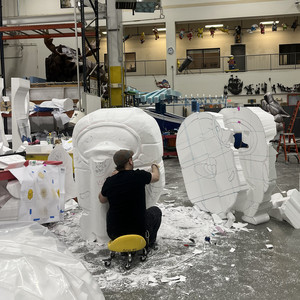
There's a lot of styrofoam.
There's some styrofoam pieces that have been painted.
And there's a giant float that has a bear and a moose that are being built on it right now.
Yes.
So that giant bear and moose that you see started as one cube of styrofoam.
And our artists here at the studio take the designs that are started on a computer and transfer them to the beautiful giant pieces of art that you see here.
We were perched high up on a balcony, overlooking all the action.
People using welding machines that shot sparks into the air.
Other workers using belt sanders to smooth out big pieces of wood.
Some people were sculpting those giant pieces of styrofoam into recognizable characters.
And still others were spray painting that foam to make it water-resistant and colorful.
Will took us down onto the main floor to get up close and personal.
There was a lot to see, like puppets.
This puppet will be 12 feet tall, so it's going to be a giant puppet, and it will be controlled.
It's similar to traditional puppet, but instead of strings it'll be metal wires that'll be connected to some motors to help us move and adjust the puppet along the parade route.
To make everything for the parade, there are a lot of tools.
This is our carpentry shop, so similar to your woodworking stations and woodworking shops at school, maybe just a little bit bigger because the things that we built are a little bit bigger, but all of the similar things you might have.
We have our saws, we have our drills, we have our tables, our cutting tables, and this is where the carpenters and our carpentry team start all of their work and start to assemble pieces that then get put onto our floats.
Yeah, your class could probably have a dance party in here.
It's a big space.
We actually have dance parties here too.
But yes, very big space.
A lot of wood, a lot of saws, a lot of tools up on the board, on the wall, and everything is very neatly organized here at the studio.
We want to make sure we know where everything is, so we actually have pictures of our tools on the wall that remind us where to return things when they're missing.
I love that, yeah.
It's like a... almost like a sticker of the tool itself, so you know exactly what to put there.
You don't even need to know the name of the tool.
You just need to match the shape.
Yes, we like to keep it simple and easy.
Not everything is made by hand.
Will showed us a giant tool called a CNC machine.
CNC stands for Computer Numerical Control.
And the machine is basically a robot that cuts wood.
The people design the shapes they want, and then the computer can cut out those shapes precisely every time.
All of this work in the carpentry shop and the welding area and the sculpting area eventually becomes a scene or a display that goes onto a float.
Will walked us over to a float bed.
Without anything on it, a float bed is just a flat trailer that gets hitched onto a car or truck.
But when the team builds a whole design on top of that flat bed, it becomes something really cool.
But why is it called a float?
We call them floats because they give you the impression, or we try to pretend, that there are these stages that are actually floating down the streets of New York City.
We build them 30 feet tall, but also we cover the wheels with what we call skirts, which is essentially different types of fabric that float in the wind.
And it gives you the impression that the floats are actually literally floating down the street.
But there's some wheels underneath there.
Now you have to make sure that they will fit on a street so they can't be too wide.
And then some streets have power lines and other things.
How do you make sure that they're not so tall?
And how do you get them to New York City from where we are in New Jersey?
That is a great question.
Each one of the floats that we design will fold down like a transformer to about 9 feet by 12 feet.
If you think about your school bus, everything in the parade folds down to about that size.
And we take all of our floats from New Jersey through the Lincoln Tunnel, up the highway in New York City and up to Central Park.
And that's where we reassemble everything.
So we use giant cranes to pick up all of the pieces and put them back together, sort of like a Lego puzzle, right on the streets the day before parade.
So if I was driving along through the Lincoln Tunnel with my family the day before Thanksgiving, I might just drive by this whole long line of folded up parade floats.
Yes.
There's over 75 units that come from New Jersey all the way to New York City.
We're out in the streets and everyone gives us a big wave and cheers us on.
It's our own little mini parade before the parade.
That would be almost as fun as seeing the parade.
Yes, absolutely.
Next, we headed over to the paint studio.
Remember, all of these areas are in one giant 80,000 square foot warehouse.
You could fit my house that I live in into that space more than 50 times, so it's really big.
That's how they can fit in all the various materials that are needed for a giant, three-hour-long parade.
We use over 2,000 gallons of paint every year for the Macy's Thanksgiving Day Parade.
We have every color imaginable, and then our team of professional painters also custom mix colors to get the perfect shade depending on the project that we're working on.
We have a team of painters who are painting different elements right now.
This is sort of like a sunburst.
It's going to be what we're calling a little bit of a dream catcher for one of our floats.
So that'll have a couple of layers that will spin and give you this nice dreamy effect.
We are now in a sea of white foam.
Hi, I'm Jane.
Nice to meet you.
My name is Cameron Carnevale.
I'm the lead sculptor here.
And we are working on several projects.
Pop Mart being one of them.
That's what everyone's on right now.
Each doing an individual character.
We've got a little bit of Netflix, Stranger Things.
This is the monster behind you.
It's behind me, isn't it?
Yes, it is.
Yes, all 10 feet tall of it.
How do you carve characters foam?
We used a bunch of things from kitchen knives to sort of a hot wire that will cut through the foam.
And then you have to coat it and paint it so that if it's a little bit rainy it's not going to disintegrate.
It'll stand up to any kind of weather.
That's right.
So it gets.
We call it a candy coating, sort of like an eminem on the soft shell and, um yeah, protects it from from everything, and it gets painted all pretty.
So if somebody ever dents one, are you like, oh my god, all that work.
No, it's okay, because we can fix that.
We can patch it up.
No, no problem.
We wanted to get a better look at the monster behind Cammy.
It was a scary character from a TV show called Stranger Things that's very popular with adults and older teenagers.
So we're walking up to the Demogorgon, which our sculptor Justin has expertly sculpted.
12 feet tall.
And then we had to take it all apart, put all of the armatures, which are the pieces of metal which is essentially like our bone, like our skeleton.
We made a skeleton and then we added the character back to it.
And Justin right now is putting all the pieces on it and putting all of the latex, which will give it an actual, realistic finish.
So the The legs will move up and down.
The head will open and close.
So after Justin is done putting all of the latex finish on it, it'll go over to our paint team to become the actual puppet it was designed to be.
Right, it's not going to look too scary or too real if it's just white styrofoam.
Yes, yeah, yeah.
So we've talked a lot about floats and all of the work that goes into it.
Now we're going to walk over to the other favorite part of our studio, which is our balloon studio.
And that's where we make all of the giant character balloons that you see in the Macy's Thanksgiving Day Parade.
That's right.
We're going to be talking balloons next.
This parade is perhaps most famous for the giant helium balloons that float high above the city streets as the parade marches through New York City.
We're going to learn all about how they're made and, yes, answer your questions about balloons.
That's coming right up.
This is But Why.
I'm Jane Lindholm, and today we're on a field trip behind the scenes at the Creative Studio in Munaki, New Jersey, where artists designers carpenters, welders and a whole team of other people work year-round to get ready for one of the biggest parades in the United States the Macy's Thanksgiving Day Parade.
I love seeing how things are made, so I am always up for a factory tour.
The Macy's Parade is really well known for having giant balloons that float through the streets.
And when I say giant, I mean really, really giant.
Some of the balloons, in the almost 100-year history of this parade, have been more than 100 feet tall or 100 feet long.
Your school bus is maybe 35 or 40 feet long, so imagine how big those balloons are.
We wanted to see how they're made and answer the questions you've sent us.
So we asked our guide, Will Koss, executive producer of the parade, to take us inside the balloon-making part of the warehouse.
Okay.
So we're standing outside of two double doors that we're going to push through and see the wonderful Balloon Studio here at Macy's Studios.
You're making it sound very exciting.
Here we are.
And it is.
We are now in the iconic Macy's Balloon Studio.
And in this facility we design and we put together all of the pieces that make up every one of our balloons.
Right now we have Super Mario.
So if you were standing here with me, you would see a giant head of Mario himself.
But his nose is not inflated and neither is his mustache.
Correct, yes.
We inflate and deflate certain areas of the balloon to help us work on certain specific spaces.
Right now we were painting the eyes, so we deflated the nose and then we'll re-inflate it once we're done.
I feel like he's staring at us.
He might be.
He's following us with his eyes.
It's like the Mona Lisa.
You know, while we're here in the balloon studio, we have a lot of questions about balloons, specifically including how do you make balloons?
Hi, my name is Molly.
I'm four years old.
I'm from Henniker, New Hampshire, and I wanted to know how are balloons made?
My name is Sage and I'm five years old and I live in London, and my question is how are balloons made?
My name is Ari.
I am from Castleton, New York, and my question is, how do you make balloons?
Hello, my name is Cora, and I am 16.
And my question, we're from Wisconsin, and my question is, how do you make balloons?
Basic round party balloons that you blow up with your mouth are made in a factory where balloon molds are dipped into liquid latex that dries and gets rubberized and sometimes is stamped with designs.
The metallic balloons that sometimes come in fun shapes and get filled up with helium are usually made with a material called mylar.
They're made by having a front and a backside that are exactly the same shape, and then the two pieces are melted together and blown up.
But the balloons made for the Macy's parade are so huge they have to be made by hand, one at a time, from a different material.
The Macy's balloons are made from a very special material that's designed specifically for the Macy's Thanksgiving Day Parade.
And what is that material called?
Or can you not tell me?
It's magic material for the Macy's Thanksgiving Day Parade balloons.
That's code speak for I'm not going to tell you.
Yes, it's a special fabric that is proprietary or designed specifically for Macy's and our balloon fabrication.
So the fabric feels kind of like a tarp that you might put down over a lawnmower or on your picnic table, but maybe a little bit thicker.
Yes, and it has a similar sound when it crunches up together.
Well, it makes sense that you need your own kind of material because you're making enormous balloons.
If you've ever seen the parade, these are balloons that float high above.
They look like they're floating in the sky, but they don't float away because people hold on to them.
But they are giant, way bigger than you or me.
They are made specifically to look like a special character or something famous that you know, like maybe Snoopy or Mario.
And so they have to be able to have this material that can make something in that shape and size and be able to withstand New York City, November wind and rain, and maybe snow.
Yes.
The material is an important part of making these balloons and making them successfully.
The size depends on the type of character that we're doing.
Our largest balloon right now is Spider-Man, which is almost 70 feet long.
How many school buses is that?
That's probably two school buses long, two and a half school buses long.
Minnie Mouse is one of our tallest balloons at over 60 feet tall.
So these are giant.
When we say giant, they are giant.
We're standing here next to Mario right now and from the floor we just come up to, about his ear and his head is the only thing that's inflated.
So they're quite big.
Some of our balloons have over 200 pieces. that get melted together to make our giant balloons.
And that's what the team over here is doing right now on the heat sealers.
The heat sealing machines look kind of like giant sewing machines, except instead of having a needle and thread to attach the various pieces of fabric, The heat-sealing machine melts the pieces together.
My name is Jen, and I'm a balloon fabricator at the Macy's Parade Studio.
You've got a ton of fabric here.
It looks like you're making a dress for Cinderella or something.
Not Cinderella, but I'm sure you guys do know who I'm making, which I'm not sure if I can say.
I can, and it's Derpy from K-Pop Demon Hunter.
So very exciting.
I'm most pumped about this balloon.
I know we're not supposed to pick favorites, but I might have one.
And yes, I'm sitting at what's called a heat sealer.
So we use really high heat to melt the pieces of the balloon together before we go and clean and paint it.
So it's really exciting and quite fun.
How do you know where to melt the pieces together?
I have a really wonderful team here that works on the computer to mark out the pieces for us.
So we have digital markings that allow us to match it up like almost like a puzzle piece.
And we attach the puzzle pieces together so that we get from hundreds and hundreds of little parts one big, awesome balloon.
And then on this fabric itself, there are lines and there are numbers.
So you're following those directions when you're using your machine?
Absolutely.
Thank goodness I learned how to count, because if not, we would not have a cat, but maybe some other animal.
So yeah, we use a series of letters and numbers as codes to go ahead and build.
And we also have Really fun little miniature models of the balloons that also help us put the pieces together.
And I use it as a guide to ensure that I'm doing the right thing.
It looks like you're holding an arm.
It is.
This is Derpy's sweet little arm.
And we're currently working on building out his limbs.
And last bit is his body.
So we're moving along really well.
Every balloon starts out white and then gets painted by hand after it's all put together.
The paint really brings the balloons to life and lets you know exactly what character is floating up there in the sky.
And we got a question from one kid who feels like a certain favorite character is being unfairly overlooked by the parade.
My name is Barry.
I live in UK.
My question is, why didn't Minnie Mouse get brought out in the Macy's parade?
And why didn't Daisy Duck get brought out in the Macy's parade?
Because they're the boys' girlfriends.
Mary, I think, doesn't know that Minnie Mouse was debuted in the parade last year, I believe.
So Minnie's here, but not Daisy.
Minnie's here.
We were excited to bring Minnie to the parade last year.
Every year we try to find a collection of characters that are known and loved, and our team sits around a table and talks about all of the most exciting characters to include in any one parade.
And last year was Minnie.
We've got some special surprises this year.
Are there any that you can tell us about that we don't reveal until our episode comes out on November 14th?
So we have Mario, who will be joining the parade this year.
Shrek will be returning to the parade this year.
We have Pac-Man, who's a legendary video game character that we're really excited, and it'll be Pac-Man's first time in the parade this year.
And the one and only Buzz Lightyear will be returning to the parade this year celebrating Toy Story.
So super excited to see Buzz.
You talk about them like they're alive when you put them away after the parade.
Do you like say goodbye to them and tell them to have a nice sleep?
Are you like, see you next year or maybe in 10 years?
Yes, we do.
We, uh, we treat all of our characters as our family.
We spent a lot of time with all of our characters.
Uh.
So after parade we do take great care and making sure that we fold them in a very specific way and then we store them in what we call our hampers.
So if you think about your hamper at home where you put your dirty laundry a giant version of that is where all of our balloons get rolled up and folded into.
We cover them, and then we store them at one of our storage facilities until the next parade.
Hi.
I am Ezra.
I'm four years old.
I live in Pittsburgh.
And my question is, why do balloons float inside the sky?
Hi, my name is Henry, and I live in Los Angeles, California.
I'm five and a half years old, and my question is, why do balloons float?
Hello, my name is Tom.
I'm six years old.
I live in Potomac, Maryland.
My question is, How do balloons float on air?
Hi, my name is Bex.
I'm six years old, and I'm from Canada, Alberta.
And my question is, why do balloons float if gravity is pushing down?
My name is Arthur.
I am four years old.
I live in Auckland, New Zealand.
My question is, why do balloons float?
Hi, my name is Tyler and I'm five and I live in Sunnyvale, California.
And my question is, how do balloons float?
How does the balloon stay up?
My name is Gabby, 5, South Burlington.
Hi, I'm Evelyn from Heinsberg Vermont and I'm 4, and I want to know how some balloons fly and some don't.
My name is Tilda and I'm 7 years old and I live in Sydney Australia, and my question is Why do balloons float up with helium inside but not without helium, like with your breath and things like that?
Hi, my name is Riley.
I am nine years old and I live in Auckland, New Zealand.
My question is why, when you blow up a balloon with air sinks to the bottom, but when you fill it up with helium, it floats.
What makes balloons float?
Our Macy's parade balloons float because we put something called helium inside of the balloon.
It's a gas that's lighter than air.
So once we put enough of that helium similar to your party balloons, it that you'll see on anyone's party or celebration.
We just do them in a giant form.
So there's a lot of helium, a lot of gas that goes into the balloon, which allows it to float up in the air.
And then, once we're done with the parade, we release the helium, we fold it back down and we store them for the next parade.
And you said something very important, which is that helium is lighter than air.
So the helium rises and the balloon is pretty light, even though it's big.
So the balloon, which is holding all that helium in, rises along with that gas.
That's correct.
Yes.
And they're actually heavier than we might think.
They're a couple of hundred pounds heavier. with all of the fabric and the paint.
But at 70 feet long, we have a lot of space for helium.
And once we fill that with helium, the balloons rise.
And then our balloon handlers grab onto what we call bones and hold them and walk them down the parade route.
Yeah, Amelia wants to know about that.
I'm eight years old and I live in Portland, Oregon.
And I have a question about the Macy's Thanksgiving Day Parade.
And my question is, how do those big balloons hold on just a tiny string?
Hi, my name is Eleanor.
I'm four years old.
I'm from San Antonio, California.
My question is, How many people take to hold one sloth?
How are those big balloons held on such tiny strings?
And Eleanor is wondering about how many people it takes.
We have over 90 tiny strings on any one giant balloon. which covers the entirety of the character.
And each one of those strings gets held by a person which walks the balloon down the parade route.
And each one of the strings is fastened to the balloon itself in a very secure way.
We actually design and engineer the balloon with a special material to reinforce what we call handling lines.
So if you think about a piece of clothing and you've got a label stitched into the clothing, you've got a little design stitched in.
It's sort of an extra layer of stitching that goes into these lines to make sure that they're strong enough to hold.
And I think you said some of the balloons have 90 of those strings.
Are there 90 people on the ground holding each balloon?
There's at least 90 people on our giant balloons.
Everyone holds one string, which is attached to a bone, which they'll hold in their hand.
And in addition to the 90 people on our giant balloons, we actually have little carts that also help to keep it safe and secure on the ground.
Because otherwise it would float away.
Otherwise it could potentially float away if everyone released it.
So if everyone, if there was a big wind gust and everyone decided to let go, we still hold our balloons to the ground using what we call a vehicle patch.
You know, it's really interesting because Not only do you have people here who are artists and engineers and carpenters, but you also have to have people who understand things like weather and wind gusts, and not just well, it's going to be cloudy and a little bit windy, but like it's going to be cloudy and a little bit more windy on this part.
Or when we go around this building.
You're going to get a wind gust and you have to take that into account.
When you're building these things and then on the day of the parade, you need to know, because you've got these huge balloons and floats and all of these things that really you need to be able to control with the weather conditions.
On each one of our balloons, we have what are called pilots and flight managers.
So that's the team that walks out in front of the balloon to help us understand.
Okay, this corner is going to have a big crosswind, so we might want to bring the balloon down a little bit so we have a little bit more control over it.
So some people are talking constantly during the parade to each other to make sure it goes smoothly.
The entire team is talking.
We encourage the team to continue to talk and to make sure that The people who are leading the balloon are communicating with all of the team that are holding the balloon, so they know exactly how high to fly the balloon, if they need to bring it down, if they need to move to one side of the street or the other side, depending on the weather.
Do they yell at each other or do they have headsets?
They yell.
They yell.
We've tried headsets.
We've tried a variety of communication devices.
Just projecting and raising your voice seems to be the most effective way to get the communication across.
So there's yelling, there's hand signals, there's also whistles that we use at certain points to help people understand where they need to be and where they need to move.
Can you tell us a whistle signal so that if we are ever watching the parade we can interpret?
We use single whistles if we're raising a balloon or lowering the balloon, so you'll hear it.
And that's one, two and that's how many essentially rotations we'll use to make a balloon go from the ground to 20 feet in the air.
And then there's a A, three chirp whistle.
That'll be a stop signal.
What about turn left?
Turn left is just a hand signal.
So now you'll know, if you ever overhear a whistle or a three chirp whistle, what's about to happen with those big balloons.
It's a massive undertaking to put this parade together.
Will told us there are more than 5,000 people who are part of the parade each year.
There are lots of performers dancing and singing and playing instruments, plus all those people who hold the balloons or stand and wave on the floats.
Will took us up to the third floor to look at the costume room, and it was massive too, and filled with everything from bowling pin to cherry pie costumes, to cakes, to clouds with propellers, to outfits that match the Spider-Man balloon, and on and on rows and rows of costumes.
Now, it's not that easy to get a job in the parade.
In order to be a balloon handler, for example, you have to meet certain height and weight requirements so that you're strong enough to hold down the balloon.
Remember, it's filled with a lot of helium.
And all the volunteers are people who work at Macy's or are the friends and family members of people who work at Macy's?
As for Will Koss, he's not holding a balloon or marching in the parade during the event itself.
He's in a TV production truck.
Which is where the producers, the director and all of our technical crew look at all the cameras and select all of the different shots that you see on your television screen.
So you might be telling a camera operator...
Quick, go down and show one of the handlers.
They look great in their costume and they're holding that bone and that string really well.
So quick, let's get a shot of them.
Now zoom up and let's see the face of Mario because his mustache and his nose is inflated now.
Exactly.
Exactly, yes.
What's your favorite part of the parade?
My favorite part of the parade...
It has to be what we call step off, which is the moment we say three two one, confetti blows and it's the official start to the parade.
There's just an excitement and an energy up on the Upper West Side.
We've spent the last 18 to 24 months building to that moment.
And it's the moment where we officially start the parade and begin the celebration for all of New York City and America.
I bet that is a pretty exciting moment for the thousands of people in the parade, not to mention the millions who are watching.
For many people, watching the Macy's Thanksgiving Day Parade is an annual tradition.
What traditions do you have during the holidays that make you feel happy and connected to your family or your community?
For me on Thanksgiving, I like to gather with my aunts and uncles and cousins and all of their kids in Maine for a big family get together.
Some of us like to run in a race in the morning called a turkey trot, and we all like to contribute to making the meal that we share in the afternoon.
If you celebrate Thanksgiving, I hope you have a good one.
Thanks to Christine Nealon and Will Koss at Macy's for helping us understand all the stuff that goes into making the Thanksgiving Day Parade.
I always love a chance to get behind the scenes at someplace cool and learn about all the work that goes into it and all the different kinds of people who have jobs making interesting things.
That's it for today.
Our show is produced by Sarah Baik, Melody Beaudet and me, Jane Lindholm, at Vermont Public and distributed by PRX.
Our theme music is by Luke Reynolds.
Joey Palumbo is our video producer and you can see a lot of what we talked about in this episode on our But Why Kids YouTube channel.
If you like our show, please have your adults help you.
Give us a thumbs up or a review on whatever app you use to listen to us.
And as always, send us your questions about whatever makes you curious.
Have an adult record you and then send the file to questions at butwhykids.org.
We'll be back in two weeks with an all-new episode.
Until then, stay curious.
Why is the sky blue?
Why do birds sing?
Why do we need your support?
Because But Why is powered in part by listeners like you.
If But Why sparks curiosity and learning in your home, help us keep the show going strong.
Head to butwhykidsorg slash.
Donate to become a But Why?
Fan club member or to make a gift in any amount to support the show.
Thanks and stay curious.