From the heart of Beijing to the edges of the global stage, you are at the Roundtable.
I'm Niu Henlin.
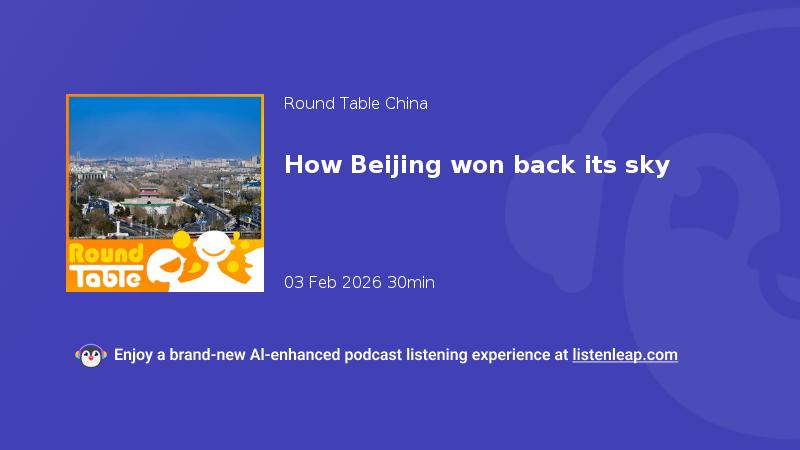
There was a time when clear skies in Beijing felt like a surprise, something worth photographing before it disappeared.
Today, clean air is no longer an exception but a measured trend, and that shift tells a deeper story about how cities can change course, even under pressure.
For today's show, I'm joined by Steve Hatherly and Yushan.
Now pull up a chair and join the conversation.
Air pollution is often framed as an unavoidable cost of growth.
Beijing's experience over the past decade challenges that assumption.
The city's improving air quality is now drawing attention not just at home, but from urban planners and policymakers around the world.
That all goes back to the year 2013 when China officially declared war against air pollution.
We use that metaphor a lot, but it's not about fighting like real fights against anything.
It's more about showing how determined we are to win the war instead of really fighting the war.
And fast forward to 2025, we see that The change is really hard to miss.
Heavily polluted days have been essentially eliminated, giving the capital its best air quality on record.
An achievement the UN now calls the Beijing miracle.
So now we're decoding the Beijing miracle because so many factors need to be discussed.
We're looking at coordinating across different regions, upgrading heavy industries, planning and phasing out millions of high-polluting vehicles to improve air quality.
So many different aspects to talk about.
But, to be fair, Roundtable talks about climate-related topics, pollute-related topics, quite a lot and air quality is often also very constant here on the show.
So why are we talking about it specifically today?
It's because Beijing has achieved its best air quality on record.
Oh, good job.
That's an official announcement. just happened in early January this year.
And the average annual concentration of PM25, which is the hazardous fine particulate pollution, has already fell to 27 micrograms per cubic meter as in 2025.
So this means that this figure is not only 115 lower than that of the previous year, but also represents the lowest level since monitoring began.
So you might be wondering what 27 micrograms per cubic meter means.
I do.
Actually, according to the WHO's latest standard, released back in 2021, The safest level is no more than 5 microgram per cubic meter, but that's the ideal standard.
That's very hard to meet.
In fact, in the 2023 to 2024 World Air Quality Report, just seven countries worldwide met that requirement, including Australia Estonia Finland, Iceland and several other countries.
But instead of jumping straight from whichever level you are just to five overnight well countries, they are kind of expected to first jump into lower level and then to interim targets like 35, 25 or 15 micrograms per cubic meter.
So that's where we are right now.
I want to go back even further and talk about PM 2.5.
It sounds like 2.30 in the afternoon.
So the PM refers to particulate matter.
And the 2.5, it looks like a measurement of the amount of pollution, right?
Two and a half units of pollution.
It is not that at all.
The 2.5 refers to the size of the particulate matter.
The particulate matter is called that because it's just a fancy term for the tiny solid stuff, or it could be the liquid droplets too that are floating in our air.
2.5 is 2.5 micrometers in diameter.
Nobody knows how big that is.
It's 1 30th the width of a single human hair.
So the reason that this PM 25 particulate matter 25 is so dangerous for us is because it's invisible, it's floating in the air and it's so small that it can enter into our lungs, deep into our lungs and then pass into our bloodstream.
And that's why it's linked over the long term to things like asthma and heart disease and other, really other serious health issues.
PM 25 does not alert me because for us here living in Beijing, having experience, we are kind of familiar with that term.
We've been educated about that term because in really drastic time 10 years ago, when the air quality is really bad, we are advised to wear our mask if we are outdoor and we were at that stage.
We were understanding or gradually learning about this term and that also showcased at that time it was kind of really bad.
And i think since 2013, since the start of the war against the polluted air, there were so many different phases, From changing and upgrading heavy industry to working on not only the city but also adjacent areas and to now, which is the 2000, the most recent year 2025.
At that time,
I think the major factor driving the record-breaking change, or making the already pretty good air even better, would be the adoption of new energy vehicles.
Yeah, just the number of NEVs in Beijing is quite impressive.
Right now it's exceeding 13 million as of 2025, with green power accounting for 36 of the city's electricity mix.
And days with good air quality has, thanks to that, surpassed 80 for the first time, all of which is contributing to Beijing's achievements in just building a beautiful and eco-friendly city in 2025.
And that's quoting from Yin Yong, the mayor, the city mayor, when delivering the report at the annual official session.
So NEV, we see it everywhere here in Beijing nowadays, too.
And I remember just a few years ago, while I was traveling to Hangzhou in eastern China's Zhejiang province, I was so impressed by how much the density of energy all over their streets.
That was back in 2022, I believe.
But now a similar view is seen in Beijing, too.
And in fact, we'll see many more EV chargers across Beijing this year, too, because the city is currently boasts. boasting an annual production capacity of 700,000 NEVs, and it plans to build 30,000 new public electric chargers in 2026.
So that means better infrastructure support for the massive NEV market we have now here in Beijing.
We have already mentioned the war against the polluted air several times.
It has an official name, and the official name was the Air Pollution Prevention and Control Action Plan.
It was adopted in 2013 and that was the time when people decided we had enough.
Um, this kind of air quality is not okay, and i do remember at that time i moved to beijing.
Well, but yushan is a beijinger.
You have even more experience living in the city and experiencing and also witnessing the change.
But my hometown is in shanxi province.
We didn't have really good air quality, especially in winter days, because when I was little, 20 years ago, we used coal for winter central heating system and the winter days were especially bad when it comes to air pollution.
And I also remember again 10, 15 years ago.
When there is a good day and also when there is a major event happening in the city, we might call it a special blue.
For example, the two sessions, which is one of the most important political meeting in China annually.
When the two sessions open and if it happens to be a good air quality day, we would call it the two session blue.
We're enjoying because it's the two session period and sky is blue.
It feels like The weather and the air quality is celebrating the special occasion as well.
It was rare like that.
Back at that time, around 2013 or maybe before, in the northern part of the country, where the temperatures are much colder than they are in the southern part of the country, coal was used predominantly to heat homes, or any buildings for that matter, I suppose.
And that's what led to the bad air quality in the winter times?
At least that was one of the major reasons.
And we also covered the coal to electricity, to clean air, to be the main energy source for central heating systems.
Several days ago on Roundtable,
If you're interested, go check that podcast out as well.
But the transformation, like Steve said, began with the coal to electricity swap.
Yeah, that means to ditch coal for winter heating, all in general, and replace that with electricity heating or cleaner energy heating such as natural gas.
So this was no small task for, at least for Beijing officials.
They had to go door to door to upgrade power grids and their household stoves and help residents transition to fulfill that transition and totally to from coal to electricity.
So here's one example in central west Beijing's Xicheng district, where I live now, of how they did it 10 years ago.
So one senior engineer, Wang Yu, at the ecological environment bureau of beijing's sichuan district actually participated in the coal to electricity conversion project and according to him, that project kind of supplied many companies and they conducted door-to-door surveys in target targeted neighborhoods all over the district and what they had to do was to address key challenges based on residents' actual conditions, while carrying out various tasks, including upgrading external power supply facilities.
So as someone who grows up in central West Beijing, I used to hear my mom say that a lot that back then each neighborhood had their own little factory of hand making a coal brick for themselves.
You do the same in Datong yes, I remember that and my mom got what do you call it?
The carbon dioxide poisoning.
She fainted out once when she was much younger because of the unfully burning of the coal that they made at home.
So that was basically how it was like for local people before the transaction.
And sometimes they expect the coal to supply the heat in their room for a whole day, but just ended up coming home after work and find the whole room is cold because they didn't put enough.
You didn't put it on all day.
Yeah.
So where would you put it in the house?
I'm trying to get an idea of like the layout.
Of where this coal is being burned.
It doesn't happen in my family but, I think in different neighborhoods, especially again so many years ago 20, 30 years ago.
It would be in a stove, I would think.
So instead of living in an apartment, most people would live in their own house.
So they can separate an area for the coal and for the stove.
And the stove can have a pipe that goes into the house to warm up the house.
But more importantly, it goes also outside.
So that's where the smoke escapes to.
That would be the more advanced situation.
Another situation would be like you should describe that it's having the stove directly in the house, so one the coal is not burned properly.
A problem definitely would happen.
Yeah, and around the year 2000 and approaching 2010, i think A lot of the Beijing household, the older versions of the houses.
They also have the indoor heaters.
That's run by hot water.
But the hot water tube were all generated from the coal-fired boilers.
That's kind of centered around.
And scattered around in the city.
And back then those boilers were all powered by coal before well, kind of until 2013, when that was all replaced by cleaner energy.
In my community, in the community where I used to stay, that was the natural gas.
They're still using that same system, only burning natural gas nowadays.
And the outcome of that transaction was huge.
Between 2003 and 2015, the district Xicheng District rolled out 10 large-scale coal-to-electricity upgrades across traditional courtyard neighborhoods and nearly 160000 households switched to electricity heating.
And by the end of 2015, the downtown Xicheng District became the first coal-free zone, as well as Beijing's pioneer in achieving complete coal-free heating.
So that's a lot that they did, and of course, the result on pm 25 level afterwards was quite turning out.
Quite good too, because in beijing's follow-up pm 25 source studies um, the engineer we mentioned at the beginning of this case said that the coal combustions contribution to pm 25 dropped from 224 percent in 2013 to just three percent in 2017.
So Yeah, that says a lot.
That eliminated coal as a major pollution source at the time.
And if you look at we were looking at Yushan and I were looking at the numbers for Beijing's air quality now versus back in 2018.
And we mentioned it already.
Now it's 27 for the pm, 25 right per cubic meter.
Back then it was what was that number?
89 or 895?
It's just such a huge, huge difference between now and 13 years ago.
Yes, so the first step was to target on heating, because during winter days we experience bad air quality days the most.
But in order to give it a comprehensive change also, Beijing decided to look at the entire structure of its industry in a holistic approach.
So the industrial and transport sectors also experienced some changes and improvements.
Yeah, they actually shut down more than 3,000 heavily polluting factories altogether.
And for another 12000 smaller, messy or high emission businesses.
The officials stepped in to clean them up.
That means to either upgrade them or relocate them or phasing them out, depending on how polluting they were.
Here's a funny and rather interesting example.
You know, you guys know I used to do internship in one of the major theaters here in Beijing.
And there were.
Once I was a translator, so I was translating for a costume designer who was looking for a certain type of tulle, a kind of like a fabric for the costume that he was designing.
But we needed to travel all the way to Hebei province, the nearby province next to Beijing, in order to find the factory who make that kind of fabric for the ideal effect he was aiming for, because there were none in Beijing.
It was all relocated outside of Beijing.
So and that's one point.
And then on the roads the changes were even more drastic, because Beijing also faced out three million high pollution vehicles, which was kind of an achievement too.
And everybody back then were.
We were only teenagers and we were taught that watch out those heavy vehicles on the road if they emit out black smoke.
You have the right to report it.
The idea about high pollution vehicles versus the new vehicles is that the new energy vehicles is almost definitely 100 clear and clean and there's the normal vehicle on the street and the high pollution vehicles and we got rid of the high pollution vehicles really early on.
Yeah, and that's an ongoing process, isn't it, right?
That wasn't like a phase one and then we're done type thing.
That's been going on for years, phase one to two to three to four to five.
I think it's up to phase six now, if I'm correct.
Yeah, since 2020, national standard level six or the six national emissions standard was already on.
Yeah.
So what that means is, with each new phase, you know, when they get to phase four, they want to get rid of the phase three vehicles and below.
And when they get to phase five they want to get rid of the phase four vehicles and below, if I'm understanding that correctly.
So what that tells me is that number one yeah, it's an ongoing process to clean up the roads, but it's also an incentive, I think, for um nev sales because, if you know, with each passing phase, if your car is an older one that doesn't meet the standards, it's going to get phased out eventually anyway, so that might actually help boost those sales.
Yeah, and those vehicles would include diesel freight vehicles, the heavy, medium light and micro trucks that's registered in beijing, um since 2013 until 2015.
And Yeah, that was a very impressive outcome that they achieved too, because in 2013 alone, Beijing accelerated the retirement of these old vehicles and phasing out over 360000 cars and trucks in a single year.
And in the meantime, they give subsidies to the car owners.
About 805 million yuan of subsidies was spent. given out to the vehicle owners.
And that's according to Beijing Municipal Ecology and Environment Bureau.
Yeah, that's basically saying we're not telling you to just throw your vehicle away.
And too bad for you.
We're going to incentivize you somehow.
You talked about Hebei.
And I think kind of a cool point as well that Beijing and the surrounding area.
You've got Tianjin, which is a neighboring city, the Tianjin municipality and also Hebei province, which is nearby.
It's a neighbor to Beijing.
They've been working together, all working together.
These regions, going back over 11 years, have used joint enforcement mechanisms and they've been working together through inspections and shutdown to shutdown violators all together.
So not just the city of Beijing itself, but the surrounding areas too.
Yes, and Beijing provided a really good example for cities and places around the country to learn from.
That is, Given the situation of the city, there are different steps.
There have been different steps to clean up the air.
There have been coordinating actions among adjacent areas.
And that is how other cities are also trying to find the kind of plant that is suitable for them, so that they can improve their air quality as well.
Take Guangdong province, for example, is in the southern part of the country.
And relatively speaking, they have already been enjoying good air quality for quite a long time.
But still they are looking at higher score in the competition and trying to improve it even further.
Yeah, in the in their official government website, i remember reading that they were saying that oh actually, we have less year um days of very good air comparing with the year before, due to sandstorms like they were sad, despite the fact that it's maintaining a very low average pm 25 concentration of only 21 micrograms per cubic meter in guangdong.
So, And also cities like Shenzhen, Huizhou and Zhuhai they consistently ranking among the top 20 cities in China for the best overall air quality.
In general, just cities in southern China.
They do not suffer as much of air pollution as we do here up in north China.
Not as bad for sure.
And that percentage of great air quality days is kind of like a badge of honor, I suppose, for the city in a way.
Shenzhen, for example, is a coastal city and uh, we can see a divide there if you compare the coastal cities down south to the inland industrial hubs like foshan for, for example, um shenzhen.
Uh, by the way, i was looking at a map today and i didn't realize.
I knew it was way down south, near macau and hong kong, but i didn't realize it's basically straight across.
Well, it's straight across from the northern part of vietnam.
So, if you're not familiar with the geography, that's where Shenzhen is.
Back in 2023, let's look at their numbers a little bit.
Shenzhen recorded an average annual PM2.5 concentration of of 16, which is pretty good.
And in 2019, the average annual recording was about 23.
Now, if you compare those numbers, we talked about the WHO numbers before, and they want five.
And the reason they want five is for our health.
It's a very, very strict low number, which is very you mentioned it before, Yushan it's very difficult to achieve.
And not many cities around the world are able to achieve that.
Shenzhen's doing a great job.
So if we compare that to other big cities, for example, London now is about 7.5 to 10 p.m.
2.5 concentration.
New York City, well, New York City has the different boroughs, right?
But Manhattan itself is around 10.5.
So if you compare Shenzhen to other big world cities who are getting closer to achieving that five goal, we can see a couple of things there.
Number one, and I think this is a common misconception for people who don't live in China, because of the news that came out a long time ago.
People might think China's air quality is bad and you just kind of paint a broad stroke over the whole country.
No, it's different in different parts.
In Beijing, we're still improving.
We're at 27 now, which is not close to five.
But the good thing about the numbers of 27 is that Beijing is headed in the right direction and has been for a long time.
And so I just wanted to make that point in case people kind of thought oh, the air quality is the same all over China and it's just always bad every day.
It's no longer like that.
It's not the case.
Not anymore.
And also another thing that different places in China are doing is that, with the with new technology coming out, they are resulting from different types of technology to improve the air quality.
For example, by combining internet with environmental regulation, cities can build a real-time air pollution forecasting and early warning system.
We're not only talking about the kind of pollution that comes out to the air because of industry or because of cars.
We don't really have that high pollution cars anymore, but still cars can generate pollute.
It's not only about that.
It can also be about dust.
It can be about sandstorms that Yushan mentioned.
That could happen, the kind of weather condition that we see all the time, but those can also be predicted and those can be dealt with.
There's lots of yeah, there's just so many different things right, dust from construction sites and roads and burning of crop, waste or things like that.
There's just a lot of different contributors.
And even sometimes when there is a rain gap after several days, it could also result in bad weather.
So yeah, if we're calling it a war against bad weather or bad air quality days, it's because there's something to fight against.
But we are moving on to the next stage, I think, here in Beijing and around the country.
That is, we are not only proving it because we cannot stand the bad air quality anymore, but because, even though we are looking at many, many good days of the year, we want it to be better.
We want to hit the five benchmark target.
So what's the next step?
So first of all, let's get back to Beijing as a major example.
So cities like Beijing, we're getting even more obsessive about the details.
That's how they put it.
It's like a nationwide competition.
I found it really curious that they're doing this.
So Beijing, for example, is moving from its one microgram initiative to a 01 microgram initiative, meaning that They're using high-tech monitoring like laser radar and satellites to find even the tiniest source of pollution and reduce that 01 by 01 each time.
And also in early 2025.
The Beijing Municipal Ecology and Environment Bureau also signed a memorandum of understanding with the Environment Department of the Bangkok Metropolitan Administration to boost air quality monitoring and management cooperation.
So the goal of doing this with Bangkok was that over the next three years, Beijing will share its proven expertise in air pollution control, particularly how we monitored PM25 and managed to lower that level with Bangkok, to support the Thai capital's air quality improvement as well.
So we're seeing a lot more global cooperation regarding Yeah, it's just another example.
Learn what we can here, learn what works well, and then share it with our neighbors too, right?
The market is being incentivized too.
That's part of the next phase.
It's headed towards environmental taxes.
So the goal there is to make it financially smart for companies to stay clean.
Yes.
And hopefully in the future we will definitely.
In the future we will see more clean days and more beautiful skies.
And even if now we don't really find it so precious that we need to take a photo all the time, every single time, still it's a nice background, especially when we're traveling, enjoying life, and Roundtable is always here watching so that we can compete.
And from us here, speaking of competition, from us here in Beijing Shenzhen, we're coming for you and your air quality numbers.
We're going to pass you.
Or we can.
Am I becoming a Beijing-er all of a sudden, it seems?
So proud of you, Steve.
We can improve together.
Get ready, get ready.
Get ready for Step by step.
Feel the sound, Happy smiles all around, Feel the rhythm, feel the force.
Here it comes, the year of the horse.
From London, cheers go wide.
New Year joy.
We share with pride, Near or far, Old or new, warm wishes sent to you.
Here in Nairobi, hearts are bright.
Hope is strong, the future's light.
From this desk to every door.
Keep moving on, don't slow down.
From every street to every town.
Old year gone, new dreams start.
One world, one beat.
Run so near, run so far.
Feel the fire, feel the force.
Celebrate the year of the horse.
Happy New Year, stay bright.
This is our super night.
Fast and free, strong of force.